Kalipoz prolongatum
Poland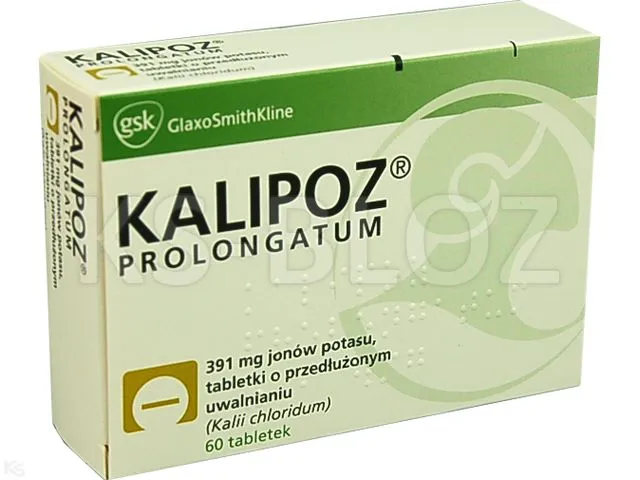
Table of Contents
Patient Information Leaflet
Kalipoz Prolongatum
391 mg potassium ions, prolonged-release tablets
Potassium chloride
Please read all of this leaflet carefully before taking this medicine, because it contains
important information for you.
- Keep this leaflet. You may need to read it again.
- If you have any questions, ask your doctor or pharmacist.
- This medicine has been prescribed for a specific individual. Do not pass it on to others. It may harm someone else even if their symptoms are the same.
- If you experience any adverse effects, including any not listed in this leaflet, tell your doctor or pharmacist. See section 4.
Leaflet Contents:
- What Kalipoz Prolongatum is and what it is used for
- What you need to know before you take Kalipoz Prolongatum
- How to take Kalipoz Prolongatum
- Possible side effects
- How to store Kalipoz Prolongatum
- Contents of the pack and other information
1. What Kalipoz Prolongatum is and what it is used for
Kalipoz Prolongatum is a medicine containing potassium chloride. It comes in the form of prolonged-release tablets. This means that the potassium chloride contained in the tablet is released gradually as it passes through the gastrointestinal tract. The formulation reduces irritation to the gastric and intestinal mucosa. It also prevents a sudden increase in blood potassium levels.
Normal serum potassium concentration ranges from 3.7 to 5.3 mmol/l. A lower potassium concentration is referred to as hypokalaemia.
Indications for use of Kalipoz Prolongatum:
- Prevention and treatment of potassium deficiency (hypokalaemia).
2. Important information before using Kalipoz Prolongatum
When not to use Kalipoz Prolongatum
Do not use Kalipoz Prolongatum if the patient has:
- hypersensitivity (allergy) to potassium chloride or any of the other ingredients of this medicine (listed in section 6),
- hypersensitivity to potassium-containing products,
- increased blood potassium levels (hyperkalaemia),
- renal failure,
- adrenal insufficiency (Addison's disease),
- hyporeninaemic hypoaldosteronism (a deficiency of a hormone involved in electrolyte regulation),
- a congenital disorder – paramyotonia (characterized by increased muscle tension, sometimes with muscle hypertrophy and difficulty performing movements),
- metabolic disorders, including acidosis (accumulation of acidic substances in the blood)
occurring in poorly controlled diabetes, - severe dehydration,
- conditions involving extensive cell destruction (e.g. severe burns),
- gastrointestinal bleeding,
- worsening of peptic ulcer symptoms,
- disorders impairing the movement of the drug through the gastrointestinal tract,
or if the patient is taking certain diuretics (potassium-sparing diuretics, such as
spironolactone, canrenone, amiloride, triamterene, eplerenone. See section: Kalipoz Prolongatum
and other medicines).
Warnings and precautions
Before taking Kalipoz Prolongatum, the patient should inform the doctor:
- if they have impaired kidney function. There is a risk of dangerous increase in blood potassium levels. During treatment, the doctor will order regular blood potassium tests and monitor heart and kidney function;
- if they pass black stools, vomit coffee-ground-like material (coffee-ground vomiting), or experience severe abdominal pain. In such cases, the medicine should be stopped immediately and the patient should contact a doctor as soon as possible;
- if they have heart disease;
- if they have liver disease.
Children and adolescents
Use of Kalipoz Prolongatum is not recommended in children and adolescents.
Elderly patients (over 65 years of age) should use Kalipoz Prolongatum with caution due to the risk of overdose. The doctor will order regular blood potassium tests.
Before and during treatment with Kalipoz Prolongatum, the doctor will order regular blood potassium tests and monitor heart function (ECG).
In some patients, magnesium deficiency caused by diuretic therapy may prevent correction of potassium deficiency; therefore, the doctor will also monitor blood magnesium levels.
Extreme caution is required when administering potassium chloride to patients with impaired liver function.
Kalipoz Prolongatum and other medicines
Inform the doctor about all medicines currently taken or recently used, as well as any medicines the patient plans to take. This includes medicines available without a prescription.
Kalipoz Prolongatum may affect the action of other medicines. Likewise, other medicines may affect the action of Kalipoz Prolongatum.
Blood potassium levels should be monitored periodically when other medicines are used concomitantly.
In particular, inform the doctor if the patient is taking any of the following medicines:
Antihypertensive medicines:
- potassium-sparing diuretics (reducing potassium excretion), e.g. spironolactone, canrenone, amiloride, eplerenone, or triamterene (see section: When not to use Kalipoz Prolongatum),
- angiotensin-converting enzyme (ACE) inhibitors (e.g. captopril, enalapril),
- angiotensin II receptor blockers (ARBs, sartans),
- beta-blockers (e.g. metoprolol, propranolol),
- direct renin inhibitors (e.g. aliskiren).
Used concomitantly with Kalipoz Prolongatum, they may cause a dangerous increase in blood potassium levels. This may be life-threatening, especially in patients with renal failure.
Anti-inflammatory medicines:
- non-steroidal anti-inflammatory drugs (NSAIDs), e.g. indomethacin, ibuprofen, diclofenac.
Used concomitantly with Kalipoz Prolongatum, they may cause a dangerous increase in blood potassium levels.
Cardiac glycosides:
- cardiac glycosides (e.g. digoxin). Excessively high blood potassium levels may cause cardiac arrhythmias.
Anticholinergic medicines:
- anticholinergic medicines (e.g. atropine, ipratropium bromide), used, among others, in ophthalmology, respiratory and gastrointestinal disorders.
Proton pump inhibitors
Proton pump inhibitors (e.g. omeprazole, pantoprazole), used, among others, in peptic ulcer disease.
Used concomitantly with Kalipoz Prolongatum, they may cause a dangerous increase in blood potassium levels.
Other medicines:
- cyclosporine – an immunosuppressive medicine (suppressing the body's immune response), used to prevent transplant rejection and in other disorders.
- heparin (a medicine preventing blood clotting). Administered concomitantly with Kalipoz Prolongatum, it may cause a dangerous increase in blood potassium levels.
- other medicines or products containing potassium (see section: When not to use Kalipoz Prolongatum). This may lead to a dangerous increase in blood potassium levels.
Taking Kalipoz Prolongatum with food and drink
Salt intake should be limited. Salt reduces the effectiveness of Kalipoz Prolongatum.
Pregnancy and breastfeeding
If the patient is pregnant, breastfeeding, suspects she may be pregnant, or is planning to become pregnant, she should consult a doctor or pharmacist before using this medicine.
Kalipoz Prolongatum may be used during pregnancy and breastfeeding only on a doctor's explicit recommendation.
Driving and operating machinery
Kalipoz Prolongatum does not affect the ability to drive or operate machinery.
This medicine contains lactose, carmine lake, and sodium
Lactose
Kalipoz Prolongatum contains a sugar called lactose. If the patient has previously been diagnosed with intolerance to certain sugars, they should consult a doctor before taking this medicine.
Carmine lake
Due to the presence of carmine lake, this medicine may cause allergic reactions.
Sodium
This medicine contains less than 1 mmol (23 mg) of sodium per tablet, meaning it is considered "sodium-free".
3. How to use Kalipoz Prolongatum
Kalipoz Prolongatum should always be used as directed by the physician.
If in doubt, consult your doctor.
The usual dosage is:
- for prevention and mild potassium deficiency: 1 to 2 tablets daily,
- for significant potassium deficiency: 2 to 6 tablets daily.
When determining the dosage, the potassium content in the diet (fruits, vegetables, juices) should be taken into account.
Kalipoz Prolongatum should be taken during or immediately after a meal, with a large amount of water. This helps reduce irritation of the gastrointestinal mucosa caused by the medication.
Tablets should be swallowed whole. Do not chew. They must not be divided, as this would destroy their sustained-release properties. Rapid release of the entire dose may lead to adverse effects.
Remnants of the tablet may be excreted in the stool. This does not reduce the effectiveness of the medication.
Use of a higher than recommended dose of Kalipoz Prolongatum
In case of overdose, contact your doctor or pharmacist immediately.
If any of the following symptoms of overdose occur, discontinue the medication and contact your doctor.
The severity of symptoms depends on the extent to which serum potassium concentration exceeds normal levels. Symptoms include:
- cardiovascular disturbances (marked drop in blood pressure, shock, cardiac arrhythmias potentially leading to cardiac arrest),
- neuromuscular disturbances (sensory disturbances, convulsions, loss of reflexes, respiratory failure due to muscle paralysis),
- excessive increase in serum potassium concentration,
- changes in the ECG.
Rarely, after ingestion of a very large dose, pharmacobezoars (pseudoconcretions in the intestines) have been observed. Formation of pharmacobezoars may result in continuous release of potassium chloride many hours after ingestion.
If symptoms of overdose occur, discontinue the medication and contact your doctor.
Missed dose of Kalipoz Prolongatum
If a dose is missed, take it as soon as possible. If it is almost time for the next dose, skip the missed dose.
Do not take a double dose to make up for a missed dose.
4. Possible adverse reactions
Like all medicines, this medicine can cause adverse reactions, although not everybody will experience them.
The following adverse reactions may occur:
- disturbances in heart function (heart beating too fast, too slow or irregularly),
- nausea, vomiting, burning sensation in the stomach and oesophagus, abdominal discomfort, abdominal pain, bloating, diarrhoea or constipation, intestinal obstruction, bleeding,
- gastric and duodenal ulcer (the risk is higher when higher doses of the medicine are used),
- minor lesions of the mucosa in the small intestine (erosions). If gastrointestinal bleeding occurs, the medicine must be discontinued immediately and a doctor should be consulted,
- rash (red, itchy bumps on the skin), itching, urticaria,
- increased blood potassium levels (hyperkalaemia). During treatment with Kalipoz Prolongatum, blood potassium levels should be monitored regularly to prevent hyperkalaemia.
Reporting of adverse reactions
If any adverse reactions occur, including any adverse reactions not listed in this leaflet, inform a doctor, pharmacist or nurse. Adverse reactions can be reported directly to the Department of Monitoring of Adverse Drug Reactions of the Office for Registration of Medicinal Products, Medical Devices and Biocidal Products, Al. Jerozolimskie 181C, 02-222 Warsaw, Tel.: + 48 22 49 21 301, Fax: + 48 22 49 21 309, website: https://smz.ezdrowie.gov.pl
Adverse reactions can also be reported to the marketing authorisation holder.
Reporting adverse reactions helps to provide more information on the safety of the medicine.
5. How to store Kalipoz Prolongatum
Keep out of the sight and reach of children.
Store below 25°C. Protect from moisture.
Store in the original packaging.
Do not use this medicinal product after the expiry date stated on the packaging. The expiry date refers to the last day of the stated month.
Medicines should not be disposed of via wastewater or household waste. Ask your pharmacist how to dispose of medicines no longer required. This will help protect the environment.
6. Contents of the packaging and other information
What Kalipoz Prolongatum contains
The active substance is potassium chloride.
One tablet contains 391 mg of potassium ions (10 mEq K).
The other ingredients are:
- tablet core: monohydrate lactose, ammonium methacrylate copolymer (type B), talc, colloidal anhydrous silica, magnesium stearate.
- tablet coating: talc, titanium dioxide, ammonium methacrylate copolymer (type B), ammonium methacrylate copolymer (type A), carmine red lake (E 124), macrogol 6000.
What Kalipoz Prolongatum looks like and contents of the pack
The medicine is in the form of prolonged-release tablets. The tablets are pink in colour.
The tablets are biconvex circular discs with a smooth surface, free from chipping.
One box contains 30 or 60 tablets.
Marketing Authorisation Holder
GSK PSC Poland sp. z o.o.
ul. Grunwaldzka 189,
60-322 Poznań
Manufacturer
Delpharm Poznań Spółka Akcyjna
ul. Grunwaldzka 189
60-322 Poznań
For more detailed information, please contact the representative of the Marketing Authorisation Holder.