Kaldyum
Poland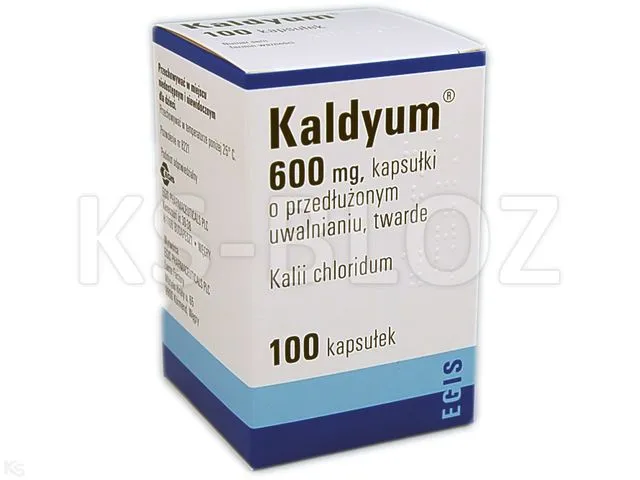
Table of Contents
Package leaflet: Information for the user
Warning! Keep this leaflet. Information on the immediate packaging in a foreign language.
Kaldyum
600 mg, prolonged-release capsules, hard
Potassium chloride
Please read all of this leaflet carefully before taking this medicine because it contains
important information for you.
- Keep this leaflet so that you can read it again if necessary.
- If you have any questions, ask your doctor, pharmacist, or nurse.
- This medicine has been prescribed for a specific individual. Do not pass it on to others. It may harm others, even if their symptoms are the same.
- If you experience any adverse reactions, including any not listed in this leaflet, inform your doctor, pharmacist, or nurse. See section 4.
Contents of the leaflet
- What Kaldyum is and what it is used for
- Important information before taking Kaldyum
- How to take Kaldyum
- Possible side effects
- How to store Kaldyum
- Contents of the pack and other information
1. What Kaldyum is and what it is used for
Kaldyum is used for the prevention and treatment of potassium deficiency in the body. Potassium deficiency
may be caused by taking certain medicines, e.g. diuretics (water tablets), or
certain diseases (e.g. gastrointestinal disorders associated with vomiting or
diarrhoea).
2. Important information before using Kaldyum
When not to use Kaldyum
- if the patient is allergic to potassium or any of the other ingredients of this medicine (listed in section 6);
- if the patient has hyperkalemia (excess potassium in blood serum), caused by certain diseases or medications [hyperkalemia may occur, for example, when taking certain diuretics (potassium-sparing diuretics) or antihypertensive drugs (e.g. so-called ACE inhibitors), in adrenal cortex insufficiency, kidney failure, acidosis (blood acidification, e.g. in diabetic patients), or after tissue injuries (severe burns affecting a large body surface)];
- if the patient has severe kidney disease;
- if the patient has Addison's disease (chronic adrenal insufficiency) and is not being treated for it;
- acute dehydration;
- if the patient has gastrointestinal obstruction or esophageal stricture that makes swallowing difficult.
Warnings and precautions
Before starting treatment with Kaldyum, discuss it with your doctor or pharmacist.
Before prescribing the medicine, the doctor may check blood potassium levels and perform an ECG.
Inform your doctor if you have ulcers or other gastrointestinal disorders.
If you are taking cardiac glycosides (medicines used in heart diseases), inform your treating physician, as abruptly stopping Kaldyum may be harmful.
In certain conditions, your doctor may prescribe a different potassium-containing medicine; in other cases, additional medication may be recommended to be taken together with Kaldyum.
Follow the diet prescribed by your doctor.
Kaldyum and other medicines
Tell your doctor or pharmacist about all medicines you are currently taking, have recently taken, or plan to take.
Exercise caution when using Kaldyum together with the following medicines:
- ACE inhibitors (medicines used to treat hypertension), potassium-sparing diuretics, as concomitant use may lead to very high potassium levels in blood serum;
- potassium-rich food products and herbal remedies (e.g. leaves and roots of dandelion, bananas, tomatoes, orange juice) which increase the risk of elevated serum potassium levels;
- angiotensin II receptor blockers and aliskiren (medicines used to treat high blood pressure and certain heart conditions) which may lead to increased serum potassium levels;
- proton pump inhibitors (medicines that reduce gastric acid secretion) which may lead to increased serum potassium levels;
- nonsteroidal anti-inflammatory drugs, anticholinergic medicines, as they may exacerbate adverse effects in the gastrointestinal tract;
- cardiac glycosides (used in the treatment of heart failure), beta-adrenergic agents (used to treat hypertension and/or cardiac arrhythmias), heparin (a blood anticoagulant), cyclosporine (a cytostatic medicine). Your doctor may perform regular monitoring of serum potassium levels when any of these medicines are used concomitantly with Kaldyum.
If you have any doubts regarding medicines you are taking, consult your doctor.
Pregnancy and breastfeeding
If the patient is pregnant or breastfeeding, suspects she might be pregnant, or is planning to have a child, she should consult her doctor or pharmacist before using this medicine.
Kaldyum may be used during pregnancy and breastfeeding, according to medical indications and recommended dosage.
Driving and operating machinery
There are no restrictions.
3. How to use Kaldyum
This medicine should always be taken exactly as prescribed by your doctor. If you have any doubts, consult your doctor or pharmacist.
The dosage is determined by your doctor according to individual patient needs.
Adults
Prophylaxis: the recommended dose is 2 or 3 capsules per day.
Treatment: the recommended dose is 5 to 12 capsules per day, with regular monitoring of serum potassium concentration.
If the daily dose exceeds 2 capsules, it should be divided into two or more doses.
The capsule should usually be swallowed whole with a glass of water, during or after a meal.
Patients fed via gastric or intestinal tube
If the patient is fed through a gastric or intestinal tube, the capsule may be opened and the pellets mixed with food or liquid administered through the tube.
Use in children
Experience with use in children is limited.
Renal impairment
Kaldyum must not be administered in severe renal impairment (see section "When not to use Kaldyum").
Hepatic impairment
No studies have been conducted in patients with hepatic impairment.
Elderly patients
Due to possible deterioration of kidney function in elderly patients, dose reduction may be necessary.
Use of a higher than recommended dose of Kaldyum
If a higher than recommended dose of Kaldyum is taken, seek immediate medical advice from your doctor or pharmacist.
Symptoms of overdose: muscle weakness, hypotension, cardiac arrhythmias, and even cardiac arrest.
Treatment: gastric lavage, intravenous infusion of sodium chloride solution, glucose and insulin, and forced diuresis may be used. Peritoneal dialysis or hemodialysis may be required.
Missed dose of Kaldyum
Do not take a double dose to make up for a missed dose.
If you have any further questions about the use of this medicine, consult your doctor or pharmacist.
4. Possible adverse reactions
Like all medicines, this medicine can cause adverse reactions, although not everybody will experience them.
You should stop taking the medicine immediately and contact your doctor if any of the following symptoms occur:
- tarry (black) stools (due to bleeding, ulceration, perforation, or gastrointestinal obstruction);
- unusual sensations such as burning, pricking, tingling, itching (paresthesia), muscle weakness, paralysis, irregular heartbeat, low blood pressure (symptoms of high potassium levels in the blood).
Other adverse reactions:
- nausea, vomiting, diarrhoea, abdominal pain.
Reporting of adverse reactions
If any adverse reactions occur, including any adverse reactions not listed in the leaflet, inform your doctor, pharmacist, or nurse. Adverse reactions can also be reported directly to the Department of Monitoring Adverse Drug Reactions of the Office for Registration of Medicinal Products, Medical Devices and Biocidal Products
Al. Jerozolimskie 181C
02-222 Warsaw
Phone: +48 (22) 49 21 301
Fax: +48 (22) 49 21 309
Website: https://smz.ezdrowie.gov.pl
Reporting adverse reactions allows further information on the safety of the medicine to be collected.
5. How to store Kaldyum
Store below 25°C.
Keep out of sight and reach of children.
Do not use this medicine after the expiry date stated on the packaging. The expiry date refers to the last day of the stated month.
Medicines must not be disposed of via wastewater or household waste. Ask your pharmacist how to dispose of medicines no longer in use. This will help protect the environment.
6. Contents of the pack and other information
What Kaldyum contains
The active substance in Kaldyum is potassium chloride.
Each prolonged-release capsule contains 600 mg of potassium chloride, corresponding to 8 mmol
of potassium ions (315 mg of potassium ions).
Other ingredients are:
microcrystalline cellulose, polyacrylate dispersion 30%, dimethicone, talc, colloidal anhydrous silica,
indigotine (E 132).
Capsule shell composition:
cap: gelatin, indigotine (E 132), erythrosine (E 127).
body: gelatin.
What Kaldyum looks like and contents of the pack
Kaldyum is in the form of capsules with a blue cap and a transparent lower part (body).
The capsule contains a mixture of light blue and white or almost white pellets.
The packaging consists of a clear glass bottle with a polyethylene cap, placed in a cardboard box.
Pack contents: 50 or 100 capsules (1 bottle containing 100 capsules or 2 bottles containing 50 capsules each).
For more detailed information, please contact the marketing authorisation holder or the parallel importer.
Marketing Authorisation Holder in Hungary, the country of export:
Egis Gyógyszergyár Zrt.
Keresztúri út 30-38.
H-1106 Budapest
Hungary
Manufacturer:
Egis Gyógyszergyár Zrt.
Mátyás király u. 65.
H-9900 Körmend
Hungary
Parallel Importer:
Delfarma Sp. z o.o.
ul. Św. Teresy od Dzieciątka Jezus 111
91-222 Łódź
Repackaged by:
Delfarma Sp. z o.o.
ul. Św. Teresy od Dzieciątka Jezus 111
91-222 Łódź
Hungarian Marketing Authorisation Numbers in the country of export: OGYI-T-5297/01
OGYI-T-5297/02
Parallel Import Authorisation Number: 23/13