Isoptin sr-e 240
Poland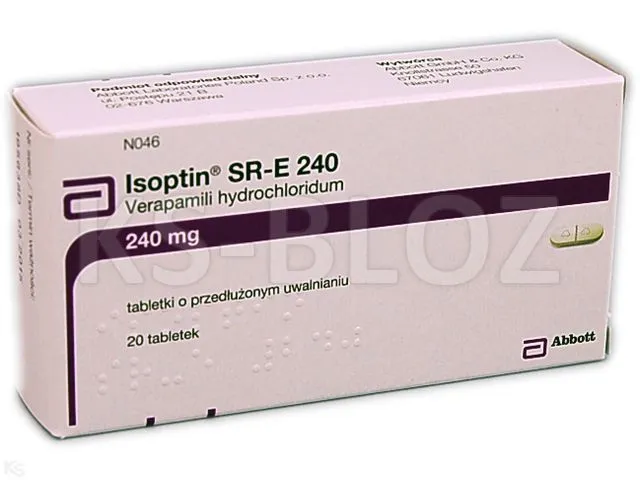
Table of Contents
- Package leaflet: Information for the patient
- 1. What Isoptin SR-E 240 is and what it is used for
- 2. Important information before using Isoptin SR-E 240
- 3. How to use Isoptin SR-E 240
- 4. Possible adverse reactions
- 5. How to store the medicine Isoptin SR-E 240
- 6. Contents of the package and other information
Package leaflet: Information for the patient
Warning! Keep this leaflet. The information on the immediate packaging is in a foreign language.
Isoptin SR-E 240 (Isoptin SR)
240 mg, prolonged-release tablets
Verapamili hydrochloridum
Isoptin SR-E 240 and Isoptin SR are different trade names for the same medicine.
Please read this leaflet carefully before taking this medicine, as it contains
important information for the patient.
- Keep this leaflet so that you can read it again if necessary.
- If you have any questions, please consult your doctor, pharmacist, or nurse.
- This medicine has been prescribed for a specific individual. Do not give it to others. This medicine may harm another person, even if their symptoms are the same.
- If you experience any adverse reactions, including any not listed in this leaflet, inform your doctor, pharmacist, or nurse. See section 4.
Table of contents:
- What Isoptin SR-E 240 is and what it is used for
- Important information before taking Isoptin SR-E 240
- How to take Isoptin SR-E 240
- Possible side effects
- How to store Isoptin SR-E 240
- Contents of the pack and other information
1. What Isoptin SR-E 240 is and what it is used for
Isoptin SR-E 240 is available as prolonged-release tablets containing 240 mg of the active substance – verapamil hydrochloride. Verapamil hydrochloride is a selective calcium antagonist acting directly on cardiac muscle.
The mechanism of action of the drug involves inhibition of calcium ion influx through the cell membrane into cardiac muscle cells and vascular smooth muscle cells.
The drug exerts antihypertensive and antiarrhythmic effects.
The antihypertensive effect results from reduced peripheral resistance without a concomitant increase in heart rate. In individuals with normal blood pressure, the drug does not produce a significant hypotensive effect.
The antiarrhythmic effect, particularly in supraventricular rhythm disorders, is due to slowing of conduction in the atrioventricular node. As a result, depending on the type of arrhythmia, sinus rhythm is restored and/or ventricular rate is normalized. The drug does not alter normal heart rate or only slightly reduces it.
Isoptin SR-E 240 is indicated for use in adults for the treatment of:
- arterial hypertension
- coronary artery disease (conditions characterized by inadequate oxygen supply to the heart muscle), including:
- chronic stable angina pectoris
- unstable angina pectoris (with increasing pain, pain at rest)
- Prinzmetal's angina
Page 1 of 7
- post-myocardial infarction angina without heart failure, when β-adrenolytic agents are not indicated
- cardiac arrhythmias such as:
- paroxysmal supraventricular tachycardia, atrial fibrillation/flutter with rapid atrioventricular conduction (except Wolff-Parkinson-White [WPW] syndrome or Lown-Ganong-Levine [LGL] syndrome)
2. Important information before using Isoptin SR-E 240
When not to use Isoptin SR-E 240
- if the patient is allergic to verapamil hydrochloride or any of the other ingredients of this medicine (listed in section 6)
- in cardiogenic shock
- in second- or third-degree atrioventricular block (except in patients with a fully functioning cardiac pacemaker)
- in sick sinus syndrome (except in patients with a fully functioning cardiac pacemaker)
- in heart failure with reduced ejection fraction below 35% and/or pulmonary capillary wedge pressure above 20 mmHg (unless secondary to supraventricular tachycardia that responds to verapamil treatment)
- in atrial fibrillation/flutter with an accessory conduction pathway (e.g. Wolff-Parkinson-White syndrome [WPW], Lown-Ganong-Levine syndrome [LGL]). In such patients, administration of the drug carries a risk of ventricular tachyarrhythmia, including ventricular fibrillation
- if the patient is taking ivabradine
Warnings and precautions
Before starting treatment with Isoptin SR-E 240, consult your doctor.
Particular caution is required in patients:
- with acute myocardial infarction complicated by bradycardia, significant hypotension or left ventricular dysfunction
- with heart block, first-degree atrioventricular block, bradycardia, or asystole
- taking antiarrhythmic drugs or β-blockers
- taking digoxin
- with heart failure and ejection fraction above 35%
- with arterial hypotension
- taking statins
- with neuromuscular transmission disorders [myasthenia gravis, Lambert-Eaton syndrome, late stages of Duchenne muscular dystrophy]
- with renal function impairment
- with severe hepatic insufficiency
Isoptin SR-E 240 and other medicines
Tell your doctor about all medicines currently or recently taken by the patient, including those the patient plans to take.
Verapamil may interact with the following medicines:
- α-adrenolytic agents (e.g. prazosin, terazosin)
- antiarrhythmic drugs (e.g. flecainide, quinidine)
- bronchodilators (e.g. theophylline)
- anticonvulsants and antiepileptic drugs (e.g. carbamazepine, phenytoin)
- antidepressants (e.g. imipramine)
- antidiabetic drugs (e.g. glyburide)
- drugs for gout (e.g. colchicine)
- drugs used in infections (e.g. clarithromycin, erythromycin, rifampicin, telithromycin)
Page 2 of 7
- anticancer drugs (e.g. doxorubicin)
- barbiturates (e.g. phenobarbital)
- benzodiazepines and other anxiolytics (e.g. buspirone, midazolam)
- β-adrenolytic agents (e.g. metoprolol, propranolol)
- cardiac glycosides (e.g. digitoxin, digoxin)
- H-receptor antagonists (e.g. cimetidine)
- immunomodulatory and immunosuppressive drugs (e.g. cyclosporine, everolimus, sirolimus, tacrolimus)
- lipid-lowering drugs (e.g. atorvastatin, lovastatin, simvastatin)
- serotonin receptor agonists (e.g. almotriptan)
- drugs increasing urinary excretion of uric acid (e.g. sulfinpyrazone)
- dabigatran (an anticoagulant) and direct oral anticoagulants
- ivabradine (used in the treatment of heart diseases), see section "When not to use Isoptin"
- metformin (used in the treatment of diabetes). Verapamil may reduce the glucose-lowering effect of metformin.
Isoptin SR-E 240 with food and drink
Interactions may also occur with grapefruit juice and products containing St. John's wort extract.
Additional information on some interactions is provided below.
Antiviral drugs for human immunodeficiency virus (HIV)
Ritonavir may increase verapamil plasma concentration, thereby enhancing its effect. Caution is required when these drugs are used concomitantly, and if necessary, the verapamil dose should be reduced.
Lithium
Increased sensitivity to lithium (neurotoxicity) has been reported during concomitant treatment with Isoptin SR-E 240 and lithium, with unchanged or increased serum lithium concentrations. However, adding Isoptin SR-E 240 has also led to decreased serum lithium concentrations in patients chronically receiving stable oral doses of lithium. Patients receiving both drugs should be closely monitored.
Neuromuscular blocking agents
The drug may potentiate the effects of neuromuscular blocking agents (curare-like and depolarizing agents). It may be necessary to reduce the dose of Isoptin SR-E 240 and/or the dose of the neuromuscular blocking agent when these drugs are used concomitantly.
Acetylsalicylic acid
Increased tendency to bleeding.
Ethanol
Increased plasma ethanol concentration.
HMG-CoA reductase inhibitors (statins)
In patients receiving Isoptin SR-E 240, treatment with HMG-CoA reductase inhibitors (e.g. simvastatin, atorvastatin, or lovastatin) should be initiated at the lowest possible dose, which is then gradually increased.
If treatment is initiated in patients already taking an HMG-CoA reductase inhibitor (e.g. simvastatin, atorvastatin, or lovastatin), consider reducing the statin dose and subsequently readjusting it based on serum cholesterol levels.
Page 3 of 7
The likelihood of interaction with fluvastatin, pravastatin, or rosuvastatin is lower.
Antihypertensive drugs, diuretics, and vasodilators
Enhancement of the hypotensive effect.
Pregnancy and breastfeeding
If the patient is pregnant or breastfeeding, suspects she may be pregnant, or plans to become pregnant, she should consult her doctor before using this medicine.
There are no data on the use of this medicine in pregnant women, and therefore it should be used during pregnancy only if absolutely necessary.
The drug passes into breast milk in small amounts. Risk to newborns and infants cannot be excluded. However, due to the possibility of serious adverse effects in breastfed infants, the drug should be used during breastfeeding only if essential for the mother's health.
Driving and operating machinery
In some patients, Isoptin SR-E 240 may affect reaction ability to such an extent that it impairs the ability to drive vehicles, operate mechanical equipment, or work under hazardous conditions. This is particularly likely during the initial phase of treatment, during dose escalation, when switching from another medication, and when alcohol is consumed concurrently. The drug may increase blood alcohol concentration and delay its elimination. Therefore, the effects of alcohol may be intensified.
Isoptin SR-E 240 contains Quinoline Yellow Lake (E 104)
Isoptin SR-E 240 contains Quinoline Yellow Lake (E 104), which may cause allergic reactions in some patients.
Isoptin SR-E 240 contains sodium
Isoptin SR-E 240 contains 37.1 mg of sodium (main component of table salt) per tablet. This corresponds to 1.9% of the maximum recommended daily dietary sodium intake for adults.
3. How to use Isoptin SR-E 240
This medicine should always be taken as directed by the physician. In case of doubt, consult your doctor or pharmacist.
The dosage should be individually adjusted according to the severity of the disease. Long-term clinical experience confirms that in all indications, the usual daily dose ranges from 240 mg to 360 mg. During long-term treatment, the daily dose should not exceed 480 mg; however, higher doses may be used in short-term therapy. There is no limitation on the duration of treatment. After prolonged use, the drug must not be discontinued abruptly. Gradual dose reduction is recommended.
Oral administration. The tablet should be swallowed whole (do not suck or chew), with an adequate amount of liquid, preferably during or immediately after a meal.
Adults and adolescents with body weight over 50 kg
- Hypertension: 120 mg to 480 mg per day in one or two divided doses.
- Angina pectoris, paroxysmal supraventricular tachycardia, atrial fibrillation, and atrial flutter: 120 mg to 480 mg per day in one or two divided doses.
If a dose of 120 mg is required, Isoptin SR 120 mg prolonged-release tablets should be administered.
In patients who may exhibit an adequate response to lower doses (e.g., patients with hepatic impairment or elderly patients), use of Isoptin 40 coated tablets 40 mg or Isoptin 80 coated tablets 80 mg is recommended.
Special populations
Children and adolescents
Isoptin SR-E 240 should not be used in children. In children, medicines with immediate (unmodified) release should be used.
Renal impairment
Caution should be exercised when administering the drug to patients with renal function impairment, and the patient's condition should be closely monitored.
Hepatic impairment
In patients with hepatic impairment, drug metabolism is impaired to varying degrees depending on the severity of liver dysfunction, resulting in stronger and prolonged drug effects. Therefore, particular caution is required when determining the dosage in patients with hepatic impairment, and low doses should be used during the initial phase of treatment (see section "Warnings and precautions").
Use of a higher than recommended dose of Isoptin SR-E 240
Symptoms
Hypotension, bradycardia, slowed conduction velocity up to high-degree atrioventricular block and sinus arrest, hyperglycemia, stupor, metabolic acidosis, acute respiratory failure syndrome. Fatal outcomes have occurred following overdose.
Treatment
In case of overdose, primarily supportive and individually tailored treatment should be administered. In cases of intentional oral overdose, effective treatment includes β-adrenergic stimulation and/or parenteral calcium (calcium chloride). In the event of clinically significant reactions such as hypotension or high-degree atrioventricular block, appropriate vasopressor drugs or cardiac pacing should be used, respectively. In case of asystole, standard management should be applied, including β-adrenergic stimulation (e.g., isoproterenol hydrochloride), other vasopressor agents, or cardiopulmonary resuscitation.
In case of overdose with verapamil hydrochloride in a prolonged-release formulation, due to slower absorption of the drug, the patient should be hospitalized and observed for up to 48 hours. Verapamil hydrochloride cannot be removed from the body by hemodialysis.
Missed dose of Isoptin SR-E 240
Do not take a double dose to make up for a missed dose.
Discontinuation of Isoptin SR-E 240
After prolonged use, the drug should not be discontinued abruptly. Gradual dose reduction is recommended.
4. Possible adverse reactions
Like all medicines, this medicine can cause adverse reactions, although not everyone will experience them.
The most commonly observed adverse reactions were: headache, dizziness, gastrointestinal disorders:
nausea, constipation and abdominal pain, as well as bradycardia, palpitations,
Page 5 of 7
hypotension, skin flushing with sensation of warmth, peripheral edema,
and feeling of fatigue.
Adverse reactions are listed below by system organ classification:
Common (in 1 to 10 out of 100 patients):
- central dizziness, headache
- bradycardia
- skin flushing with sensation of warmth, arterial hypotension
- constipation, nausea
- peripheral edema
Uncommon (in 1 to 10 out of 1,000 patients):
- palpitations, tachycardia
- abdominal pain
- feeling of fatigue
Rare (in 1 to 10 out of 10,000 patients):
- paresthesia, muscle tremors
- somnolence
- tinnitus
- vomiting
- excessive sweating
Adverse reactions with unknown frequency (frequency cannot be estimated from the available data):
- hypersensitivity reactions
- extrapyramidal disorders, seizures
- hyperkalemia
- peripheral dizziness
- atrioventricular block (I˚, II˚, III˚), heart failure, sinoatrial arrest, sinus bradycardia, asystole (cardiac arrest)
- bronchospasm, dyspnea
- abdominal discomfort, gingival hyperplasia, intestinal obstruction
- angioedema, Stevens-Johnson syndrome, erythema multiforme, alopecia, pruritus, itching, purpura, maculopapular rash, urticaria
- joint pain, muscle weakness, muscle pain
- renal failure
- erectile dysfunction, galactorrhea, gynecomastia
- increased prolactin blood concentration, increased liver enzyme activity
After marketing authorization, one case of paralysis (quadriparesis) has been reported following concomitant use of verapamil and colchicine.
If any of the adverse reactions worsen or if any adverse reactions not listed in this leaflet occur, inform your doctor or pharmacist.
Reporting of adverse reactions
If you experience any adverse reactions, including any not listed in this leaflet, tell your doctor, pharmacist, or nurse. Adverse reactions can be reported directly to the Department of Monitoring Adverse Drug Reactions of the Office for Registration of Medicinal Products, Medical Devices and Biocidal Products
Al. Jerozolimskie 181C, 02-222 Warsaw, Tel.: + 48 22 49 21 301; Fax: + 48 22 49 21 309; website: https://smz.ezdrowie.gov.pl
Reporting adverse reactions helps to provide more information on the safety of the medicine.
Page 6 of 7
5. How to store the medicine Isoptin SR-E 240
Keep the medicine out of sight and reach of children.
Do not use this medicine after the expiry date stated on the packaging. The expiry date refers to the last day of the stated month.
Store below 25°C.
Medicines must not be disposed of via wastewater or household waste. Ask your pharmacist how to dispose of medicines no longer in use. This will help protect the environment.
6. Contents of the package and other information
What the medicine Isoptin SR-E 240 contains
The active substance is: verapamil hydrochloride 240 mg.
The other ingredients are: microcrystalline cellulose, sodium alginate, povidone K 30, magnesium stearate, purified water, hypromellose, polyethylene glycol 400, polyethylene glycol 6000, talc, titanium dioxide (E 171), quinoline yellow lake (E 104) and indigo carmine lake (E 132), glycol waxes Montana.
What Isoptin SR-E 240 looks like and contents of the pack
Elongated, light green tablets with a bisecting groove on both sides and a triangular logo on one side.
Isoptin SR-E 240 is available in packages containing:
20 tablets or 40 tablets.
Blister packs in a cardboard outer box.
For further information, please contact the marketing authorisation holder or the parallel importer.
Marketing authorisation holder in Bulgaria, the country of export:
Mylan Ltd., Office building Serdika, 48 Sitnyakovo Blvd., 7th floor, 1505 Sofia, Bulgaria
Manufacturer:
FAMAR A.V.E. Anthoussa Plant, Anthoussa Avenue 7, 15349, Anthoussa Attiki, Greece
Mylan Hungary Kft., Mylan utca 1, Komárom 2900, Hungary
Parallel importer:
Delfarma Sp. z o.o., ul. Św. Teresy od Dzieciątka Jezus 111, 91-222 Łódź, Poland
Repackaged in:
Delfarma Sp. z o.o., ul. Św. Teresy od Dzieciątka Jezus 111, 91-222 Łódź, Poland
Marketing authorisation number in Bulgaria, the country of export: 20030014
Parallel import licence number: 27/26
Page 7 of 7