Ipravent inhaler
Poland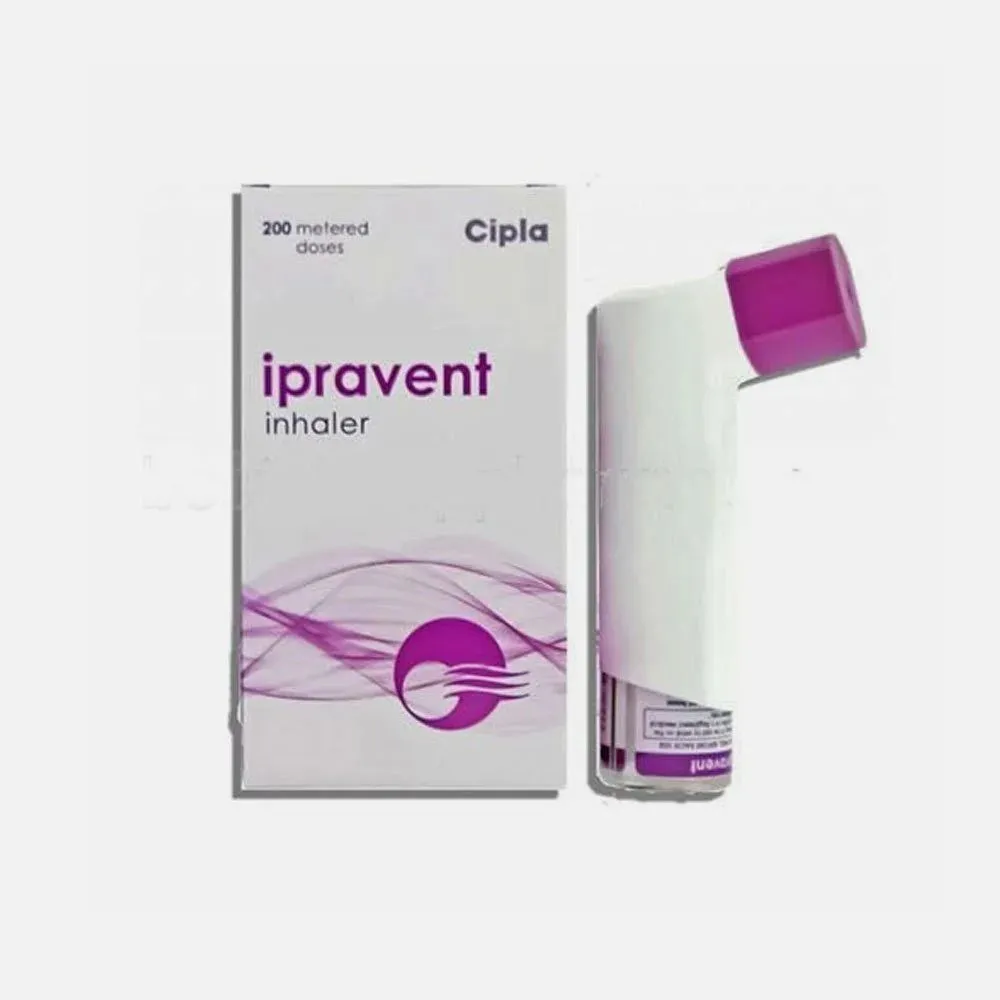
Table of Contents
Package leaflet: Information for the patient
Ipravent Inhaler, 20 micrograms/dose, inhalation aerosol, solution
Ipratropii bromidum
Please read this leaflet carefully before using this medicine because it contains important information for you.
- Keep this leaflet as you may need to read it again.
- If you have any questions, please consult your doctor, pharmacist, or nurse.
- This medicine has been prescribed for a specific individual. Do not share it with others. This medicine may harm someone else, even if their symptoms are the same.
- If you experience any adverse effects, including any not listed in this leaflet, inform your doctor, pharmacist, or nurse. See section 4.
Table of contents of the leaflet
- What Ipravent Inhaler is and what it is used for
- Important information before using Ipravent Inhaler
- How to use Ipravent Inhaler
- Possible side effects
- How to store Ipravent Inhaler
- Contents of the pack and other information
1. What Ipravent Inhaler is and what it is used for
Ipravent Inhaler contains ipratropium bromide. It belongs to a group of medicines called bronchodilators.
It is used to help make breathing easier in adults with chronic asthma or chronic obstructive pulmonary disease (COPD).
Ipravent Inhaler works by opening the airways.
2. Important information before using Ipravent Inhaler
When not to use Ipravent Inhaler:
- if the patient is allergic to ipratropium bromide or any of the other ingredients of this medicine (listed in section 6);
- if the patient is allergic to similar medicines containing atropine or drugs such as atropine, hyoscine, and scopolamine.
This medicine must not be used if any of the above conditions apply to the patient. If in doubt, the patient should consult a doctor or pharmacist before using Ipravent Inhaler.
Warnings and precautions
Before starting treatment with Ipravent Inhaler, discuss with a doctor or pharmacist if the patient:
- has narrow-angle glaucoma (a condition related to increased intraocular pressure) or has been informed of a risk of developing this condition;
- has difficulty passing urine;
- has an enlarged prostate;
- has cystic fibrosis (a genetic disorder affecting the digestive system that alters the way nutrients are metabolized and absorbed);
- experiences sudden or rapidly worsening breathlessness (difficulty breathing).
If in doubt whether any of the above conditions apply, consult a doctor or pharmacist before using Ipravent Inhaler.
Ipravent Inhaler may rarely cause allergic reactions shortly after use. These may include hives or swelling of the upper airways.
If any of the following symptoms of angioedema occur, stop using Ipravent Inhaler and consult a doctor immediately:
- swelling of the face, tongue, or throat,
- difficulty swallowing,
- hives and difficulty breathing.
If breathing difficulties do not improve or worsen despite treatment, always contact a doctor. In case of sudden worsening of lung function, contact a doctor immediately.
Ipravent Inhaler may cause dryness of the mouth, which, during prolonged treatment, may lead to changes affecting teeth and the oral mucosa. Teeth should be brushed thoroughly twice daily with fluoride toothpaste.
Children and adolescents
This medicine is not intended for use in children and adolescents.
Ipravent Inhaler and other medicines
Inform the doctor or pharmacist about all medicines currently or recently taken, as well as any medicines planned for future use, including herbal medicines. This is because Ipravent Inhaler may affect the action of other medicines, and other medicines may affect the action of Ipravent Inhaler.
In particular, inform the doctor or pharmacist if the patient is currently or has previously used:
- any other inhaled medicines that help breathing, such as salbutamol in an inhaler;
- medicines called "xanthines" that help breathing, such as theophylline or aminophylline.
If in doubt whether any of the above apply, consult a doctor or pharmacist before using Ipravent Inhaler.
Pregnancy, breastfeeding, and fertility
If the patient is pregnant, breastfeeding, suspects she may be pregnant, or is planning to have a baby, she should consult a doctor or pharmacist before using this medicine.
As a precautionary measure, use of Ipravent Inhaler during pregnancy is not recommended. There are no data available on the use of this medicine during pregnancy. Consult a doctor before using Ipravent Inhaler during pregnancy.
It is not known whether Ipravent Inhaler passes into breast milk. Consult a doctor before using Ipravent Inhaler while breastfeeding.
Driving and operating machinery
Dizziness, accommodation disorders (difficulty adjusting vision to different distances), visual disturbances, or blurred vision may occur during treatment with Ipravent Inhaler. In such cases, the patient should not drive or operate tools or machinery. The patient should assess whether he or she is able to drive or perform tasks requiring alertness.
Ipravent Inhaler contains ethanol (alcohol)
This medicine contains 8.4 mg of alcohol (ethanol) per dose. The amount of alcohol in one dose of this medicine is equivalent to less than 4.3 ml of beer or 1.72 ml of wine.
The small amount of alcohol in this medicine will not produce noticeable effects.
3. How to use Ipravent Inhaler
Ipravent Inhaler should always be used exactly as directed by your doctor. If you are unsure,
please consult your doctor.
To achieve the best results, follow the instructions below carefully. If you have any doubts after
reading this leaflet, please consult your doctor or pharmacist.
Recommended dose:
Adults (including elderly patients)
- 1-2 inhalations four times daily.
- Maximum of 12 inhalations per day.
This medicine should always be used exactly as described in this patient information leaflet or as
directed by your doctor, pharmacist or nurse. Do not use more inhalations than recommended by
your doctor. If you are unsure, consult your doctor, pharmacist or nurse.
Checking the inhaler
Before first use, check that the inhaler is working properly. You should also check the inhaler if it
has not been used for 3 days or longer.
- Remove the mouthpiece cap by gently squeezing its sides with your thumb and index finger.
- Point the mouthpiece away from you and press the canister twice (once, then a second time) to release two doses into the surrounding air.
How to use the inhaler
It is important to breathe as slowly as possible just before using the inhaler.
- Use the inhaler while standing or sitting upright.
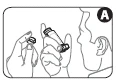
- Remove the mouthpiece cap. Check both the outside and inside of the mouthpiece to ensure it is clean and free from particles (Figure A).
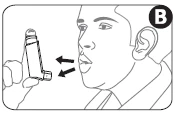
- Hold the inhaler upright, gripping the base below the mouthpiece with your thumb. Breathe out fully until you feel discomfort (Figure B). Do not inhale yet.
- Place the mouthpiece between your teeth. Close your lips around it. Do not bite (Figure C).
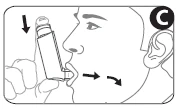
- Inhale slowly and deeply through your mouth. As you begin to inhale, press down on the top of the canister to release a dose of medicine. Do this while continuing a slow and deep inhalation (Figure C).
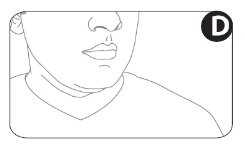
- Hold your breath, remove the inhaler from your mouth and take your finger off the top of the inhaler. Hold your breath for a few seconds or as long as comfortable (Figure D).
- If your doctor has prescribed two doses, wait about one minute before taking the next dose. Repeat steps 3 to 7.
- After using the inhaler, immediately replace the mouthpiece cap to prevent dust from entering. Push the cap on firmly.
The mouthpiece is specially designed for use only with this medicine. Do not use any other mouthpiece
with this medicine, and do not use this mouthpiece with any other medicine.
Practice using the inhaler several times in front of a mirror. If you see a mist escaping from the top of
the inhaler or from the sides of your mouth, try again.
For people with reduced hand strength, it may be easier to hold the inhaler with both hands. In this
case, place both index fingers on the top of the inhaler and both thumbs at the bottom, below the
mouthpiece. Your doctor, nurse or pharmacist can assist you.
The inhaler can be used with an Aerochamber Plus spacer. This may be helpful for people who have
difficulty coordinating breathing and actuating the inhaler.
If you have any difficulty using Ipravent Inhaler, consult your doctor.
When using Ipravent Inhaler, take care to avoid spraying the aerosol into the eyes.
If Ipravent Inhaler accidentally gets into the eyes, rinse them immediately with running water. If the
aerosol accidentally enters the eyes, symptoms such as pain, stinging or redness of the eyes, pupil
dilation, blurred vision, or seeing colors or halos may occur.
In such a case, consult your doctor for advice. If eye problems occur in any other situation, consult your
doctor. Patients may develop glaucoma, which requires immediate treatment.
Cleaning the inhaler
It is important to clean the inhaler regularly. Otherwise, it may not work properly.
- Remove the canister and take off the cap.
- Wash and clean the white mouthpiece with warm soapy water.
- Rinse thoroughly in warm water and allow to air-dry; do not use heating devices.
- Clean the small hole in the mouthpiece carefully.
- After the mouthpiece is completely dry, reinsert the canister and replace the cap.
The metal canister must not be placed in water.
Do not use more than the prescribed dose of medicine
Consult your doctor immediately if:
- you feel the inhaler is not working as well as usual;
- you need to use the inhaler more often than prescribed.
Your doctor may need to check how well the medicine is working. In some cases, your doctor may
change your treatment.
Ensure that Ipravent Inhaler does not run out suddenly
The inhaler contains 200 doses of medicine. However, it is not possible to determine whether the
inhaler is empty or whether 200 doses have already been used. There may still be a small amount of
liquid remaining in the canister. Remember to replace the inhaler after 200 doses have been used
(usually after 3–4 weeks of regular use) to ensure that each inhalation delivers the correct amount of
medicine.
Using more than the recommended dose of Ipravent Inhaler
If you use more than the recommended dose, seek medical advice immediately from your doctor or
go to hospital. Take all your inhalers and other medicines (and, if possible, their packaging) with you.
Taking too high a dose may cause dry mouth, rapid heartbeat, dilated pupils, difficulty urinating,
headache, constipation and dizziness.
Missing a dose of Ipravent Inhaler
- If you forget to take a dose, take it as soon as possible.
- However, if it is nearly time for your next dose, skip the missed dose.
- Do not take a double dose to make up for a forgotten dose.
If you have any further questions, consult your doctor or pharmacist.
Stopping treatment with Ipravent Inhaler
Do not stop using Ipravent Inhaler without consulting your doctor. If you have any further questions
about using this medicine, consult your doctor or pharmacist.
4. Possible adverse reactions
Like all medicines, this medicine can cause adverse reactions, although they do not occur in everyone.
If any of the following serious adverse reactions occur,
seek immediate medical advice – the patient may require urgent medical care:
- If the patient develops wheezing or other breathing difficulties after using Ipravent Inhaler, do not use the medicine again (unless otherwise advised by a doctor) (may occur in fewer than 1 in 100 people).
- Swelling of the mouth and face, sudden breathing difficulties, low blood pressure, or throat tightness. These may be symptoms of an allergic reaction or angioedema (may occur in fewer than 1 in 100 people).
- If eye problems occur. The patient may develop glaucoma, which requires immediate treatment (may occur in fewer than 1 in 100 people). If the aerosol accidentally gets into the eyes, pain, burning, redness, pupil dilation, blurred vision, or seeing colours or halos may occur. If Ipravent Inhaler accidentally gets into the eyes, rinse thoroughly with running water and consult a doctor.
The following adverse reactions have been reported in patients using Ipravent Inhaler.
They are listed according to frequency: common, uncommon, rare, or frequency not known.
Common (may occur in fewer than 1 in 10 people)
- Headache, dizziness.
- Dry mouth, nausea, stomach upset or discomfort, intestinal disturbances.
- Cough and throat irritation after using Ipravent Inhaler.
Uncommon (may occur in fewer than 1 in 100 people)
- Itching, rash.
- Unexpected chest tightness, throat swelling, dry throat.
- Diarrhoea, constipation, or vomiting.
- Herpes labialis (cold sores) and oral mucosal inflammation.
- Difficulty in urination, especially if such problems have occurred previously.
Rare (may occur in fewer than 1 in 1000 people)
- Accommodation disorders (difficulty adjusting vision to different distances)
- Increased heart rate
- Atrial fibrillation
- Urticaria (hives)
Frequency not known (frequency cannot be estimated from available data)
- Taste disturbances
- Dyspnoea (shortness of breath)
- Nasal congestion
- Dryness of the nasal mucosa
Reporting of adverse reactions
If any adverse reactions occur, including any adverse reactions not listed
in this leaflet, inform your doctor, pharmacist, or nurse. Adverse reactions
can be reported directly to the Department of Monitoring Adverse Drug Reactions of the Office for Registration of Medicinal Products, Medical Devices and Biocidal Products:
Al. Jerozolimskie 181C
02-222 Warsaw
Tel.: + 48 22 49 21 301
Fax: + 48 22 49 21 309
Website: https://smz.ezdrowie.gov.pl
Adverse reactions can also be reported to the marketing authorisation holder.
Reporting adverse reactions helps to provide more information on the safety of the medicine.
5. How to store Ipravent Inhaler
Keep the medicine out of the sight and reach of children.
Do not use this medicine after the expiry date stated on the carton and label on the container following: EXP. The expiry date refers to the last day of the stated month.
Protect from direct sunlight, high temperatures, and frost.
If the inhaler has been exposed to low temperatures, the patient should remove the metal container from the plastic housing and warm it in their hands for at least two minutes.
The container holds contents under pressure. Do not expose to temperatures above 50°C. Do not open, pierce, or burn the container, even when empty.
Medicines must not be disposed of via wastewater or household waste. Ask your pharmacist how to dispose of medicines no longer in use. This will help protect the environment.
6. Contents of the pack and other information
What Ipravent Inhaler contains
- The active substance is ipratropium bromide. One dose contains 20 micrograms of ipratropium bromide (as monohydrate). Each container contains 200 doses.
- The other ingredients are: propellant HFC 134a (norflurane), anhydrous citric acid, anhydrous ethanol and purified water.
- This medicine contains fluorinated greenhouse gases.
- Each inhaler contains 12.3 g of HFC-134a (norflurane), equivalent to 0.018 tonnes of CO$_2$ (global warming potential GWP = 1430).
What Ipravent Inhaler looks like and contents of the pack
Ipravent Inhaler is a clear solution in an aluminium container fitted with a suitable metering valve and a plastic actuator.
The inner pack consists of an anodised aluminium container with a capacity of 19 ml, equipped with a metering valve delivering 50 microlitres and a plastic actuator. The valve comprises a two-part thermoplastic core, body, measuring chamber, two elastomeric seats, seal, metal ferrule and spring. The plastic housing and actuator cap are made of polypropylene.
Each container contains 200 metered doses.
Pack sizes
Single pack
Each pack contains one container with 200 doses.
Multi-pack
400 doses (2 x 200). A set containing 2 single packs.
600 doses (3 x 200). A set containing 3 single packs.
Not all pack sizes may be marketed.
Marketing Authorisation Holder
Glenmark Pharmaceuticals s.r.o.
Hvězdova 1716/2b
140 78 Prague 4
Czech Republic
Manufacturer/Importer
Cipla Europe NV, De Keyserlei 60C, Bus 1301, 2018, Antwerp, Belgium
Glenmark Pharmaceuticals s.r.o., Fibíchova 143, 566 17 Vysoké Mýto
Czech Republic
This medicinal product is authorised in the member states of the European Economic Area under the following names:
Sweden Ipravent
Poland Ipravent Inhaler
Germany Ipravent 20 Microgram/ Puff Pressurised Inhalation, Solution
For further information, please contact the local representative of the Marketing Authorisation Holder:
Glenmark Pharmaceuticals Sp. z o.o.
Dziekonińskiego 3 Street
00-728 Warsaw
Email: [email protected]