Inj. magnesium sulfate 20% polpharma
Poland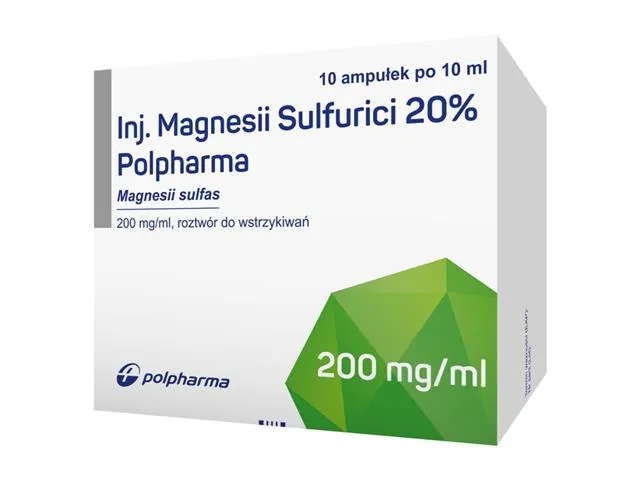
Table of Contents
- Package leaflet: Information for the patient
- 1. What Inj. Magnesii Sulfurici 20% Polpharma is and what it is used for
- 2. Important information before using the medicine Inj. Magnesii Sulfurici 20% Polpharma
- 3. How to use Inj. Magnesii Sulfurici 20% Polpharma
- 4. Possible adverse reactions
- 5. How to store Inj. Magnesii Sulfurici 20% Polpharma
- 6. Contents of the packaging and other information
- Information intended exclusively for medical professionals:
Package leaflet: Information for the patient
Inj. Magnesii Sulfurici 20% Polpharma 200 mg/ml, solution for injection
Magnesii sulfas
Please read this leaflet carefully before using the medicine, as it contains
important information for the patient.
- Keep this leaflet, so that you can read it again if necessary.
- If you have any doubts, please consult your doctor or nurse.
- This medicine has been prescribed for a specific individual. Do not pass it on to others. This medicine may harm another person, even if their symptoms are the same.
- If you experience any adverse reactions, including any not listed in this leaflet, inform your doctor or nurse. See section 4.
Table of contents
- What Inj. Magnesii Sulfurici 20% Polpharma is and what it is used for
- Important information before using Inj. Magnesii Sulfurici 20% Polpharma
- How to use Inj. Magnesii Sulfurici 20% Polpharma
- Possible side effects
- How to store Inj. Magnesii Sulfurici 20% Polpharma
- Contents of the pack and other information
1. What Inj. Magnesii Sulfurici 20% Polpharma is and what it is used for
Magnesium sulfate – the active substance in Inj. Magnesii Sulfurici 20% Polpharma – when administered
parenterally, reduces excitability of the central nervous system and neuromuscular transmission.
After intravenous administration, the effect occurs immediately and lasts about 30 minutes. After
intramuscular administration, the effect begins after approximately 1 hour and lasts 3–4 hours. Magnesium sulfate is excreted by the kidneys proportionally to serum concentration and glomerular filtration status.
Indications
- Hypertensive disorders of pregnancy (EPH gestosis), ranging from mild single-symptom EPH gestosis, through multi-symptom forms, prevention and treatment of impending eclampsia, up to eclampsia itself. The medicine is used for prevention and treatment.
- Acute magnesium deficiency states in malabsorption syndrome, alcoholism, liver cirrhosis, acute pancreatitis, or during prolonged administration of infusion fluids not containing magnesium.
- As a preventive agent against magnesium deficiency in parenterally fed patients.
- Magnesium deficiency-induced convulsive states occurring in epilepsy, glomerulonephritis, or hypothyroidism.
- Paroxysmal atrial tachycardia without signs of myocardial damage, when other treatment methods have proven ineffective.
- Torsade de pointes (a cardiac arrhythmia that may lead to death).
- Treatment of mild to moderate acute asthma attacks.
2. Important information before using the medicine Inj. Magnesii Sulfurici 20% Polpharma
When not to use Inj. Magnesii Sulfurici 20% Polpharma:
-
if the patient is allergic to magnesium and its salts, or to any of the other components
of this medicine (listed in section 6); -
if the patient has heart block or myocardial damage;
-
if the patient has muscle weakness ( myasthenia gravis );
-
if the patient has renal failure.
Warnings and precautions
- To avoid poisoning during parenteral administration of magnesium sulfate, the patient must be closely observed and serum magnesium ion concentration should be monitored.
- Respiratory rate should be monitored during treatment and before administering the next dose (it should not be less than 16 breaths/minute).
- Treatment should not be continued if the patient has excreted less than 100 ml of urine within 4 hours.
- The medicine should be used with caution in patients with impaired kidney function due to the risk of poisoning.
- Magnesium sulfate should not be used in patients with hepatic coma if there is a risk of renal failure.
Inj. Magnesii Sulfurici 20% Polpharma and other medicines
Inform the doctor about all medicines currently used or recently used by the patient,
as well as any medicines the patient plans to use.
- Magnesium salts enhance the effect of muscle relaxants of the tubocurarine type.
- Parenteral administration of magnesium sulfate together with neuromuscular blocking agents may result in neuromuscular blockade.
- Magnesium sulfate enhances the effect of barbiturates, opioids, anesthetic agents, and other drugs acting as central nervous system depressants.
- Magnesium sulfate should be used with particular caution in patients treated with cardiac glycosides, as conduction disturbances in the heart may occur.
- Calcium salts administered intravenously counteract the effects of magnesium.
- Magnesium salts enhance the effect of calcium channel antagonists. Concurrent use with nifedipine may rarely lead to disturbances in calcium balance and cause muscle function disorders.
Pregnancy and breastfeeding
If the patient is pregnant or breastfeeding, suspects she may be pregnant, or is planning to have
a child, she should consult a doctor before using this medicine.
The safety of use during pregnancy and breastfeeding has not been established. Therefore,
the use of this medicine during pregnancy or breastfeeding is not recommended unless the doctor considers it necessary. In such a case, administration must be carried out under strict medical supervision.
The medicine should not be administered intravenously within 12 hours before delivery, as this increases the risk of magnesium poisoning in newborns.
Magnesium ions pass into the breast milk of nursing mothers. After parenteral administration, higher magnesium concentrations in milk persist for approximately 24 hours.
Breastfeeding should be avoided during treatment with this medicine.
Driving and operating machinery
There are no controlled studies on the effect of the medicine on psychomotor performance. Due to the inhibitory effect of magnesium ions on the central nervous system, driving vehicles
and operating machinery during treatment is not recommended.
Sodium content
The medicine contains less than 1 mmol (23 mg) of sodium per dose, meaning the medicine is considered "sodium-free".
The medicine may be diluted, for example, with 0.9% NaCl solution or 5% glucose solution. The sodium content originating from the diluent should be taken into account when calculating the total sodium content in the prepared diluted solution. For precise information on the sodium content in the solution used for dilution, refer to the patient leaflet of the diluent used.
3. How to use Inj. Magnesii Sulfurici 20% Polpharma
The medicinal product must be used strictly according to the doctor's instructions. Dosages may vary for different patients.
Inj. Magnesii Sulfurici 20% Polpharma is intended for intravenous or intramuscular injections in adults and children.
Detailed dosage instructions, method of administration, and preparation of the medicinal product for administration are provided at the end of this leaflet, under the section “Information intended exclusively for healthcare professionals”.
Use of a higher than recommended dose of Inj. Magnesii Sulfurici 20% Polpharma
If the patient suspects that an excessive dose has been administered, the doctor should be informed immediately, as symptomatic treatment may be necessary.
In cases of overdose, adverse reactions listed in the section “Possible side effects” may occur. Treatment of poisoning consists of intravenous administration of calcium salts and application of artificial respiration. In adults, administration of 5–10 mEq of calcium intravenously (e.g., 10–20 ml of 10% Calcium gluconate) should reverse respiratory depression or heart block caused by magnesium toxicity.
If kidney function is normal, appropriate fluid administration should be provided to support the elimination of magnesium ions from the body.
In cases of severe hypermagnesemia, peritoneal dialysis or hemodialysis is recommended.
Missed dose of Inj. Magnesii Sulfurici 20% Polpharma
If the patient suspects that a dose has been missed, the doctor should be informed as soon as possible.
If there are any further doubts regarding the use of this medicinal product, consult a doctor or nurse.
4. Possible adverse reactions
Like any medicine, this medicinal product may cause adverse reactions, although not everybody will experience them.
Adverse symptoms following parenteral administration of magnesium sulfate are most commonly associated with hypermagnesaemia and include:
- muscle weakness, reduced reflexes, paralysis;
- drowsiness, disorientation, coma;
- increased sweating, sensation of thirst;
- respiratory depression;
- cardiac arrhythmias and cardiac arrest, bradycardia, hypotension;
- renal function disturbances;
- facial flushing, hypothermia;
- nausea and vomiting.
To reduce the risk of magnesium salt intoxication, serum magnesium concentration should be monitored.
During treatment of eclampsia, significant hypocalcaemia and hypocalcaemic tetany may occur.
Reporting of adverse reactions
If any adverse reactions occur, including any not listed in this leaflet, patients should inform their doctor or pharmacist. Adverse reactions can be reported directly to the Department of Monitoring of Adverse Drug Reactions, Office for Registration of Medicinal Products, Medical Devices and Biocidal Products
Al. Jerozolimskie 181C
02-222 Warsaw
Phone: +48 22 49 21 301
Fax: +48 22 49 21 309
Website: https://smz.ezdrowie.gov.pl
Adverse reactions can also be reported to the Marketing Authorisation Holder.
Reporting of adverse reactions helps to provide more information on the safety of the medicinal product.
5. How to store Inj. Magnesii Sulfurici 20% Polpharma
Keep this medicine out of sight and reach of children.
Do not store above 25 °C. Protect from light.
Do not use this medicine after the expiry date stated on the container. The expiry date refers to the last day of the stated month.
Medicines must not be disposed of via wastewater or household waste. Ask your pharmacist how to dispose of medicines no longer required. This will help protect the environment.
6. Contents of the packaging and other information
What Inj. Magnesii Sulfurici 20% Polpharma contains
- The active substance is magnesium sulfate. 1 ml of solution contains 200 mg of magnesium sulfate.
- The other components of this medicine are: water for injections, hydrochloric acid 0.1 M (for pH adjustment), and sodium hydroxide 0.1 M (for pH adjustment).
What Inj. Magnesii Sulfurici 20% Polpharma looks like and contents of the pack
The pack contains 10 glass ampoules, each containing 10 ml of solution.
Marketing Authorisation Holder and Manufacturer
Zakłady Farmaceutyczne POLPHARMA S.A.
ul. Pelplińska 19, 83-200 Starogard Gdański
tel. +48 22 364 61 01
Information intended exclusively for medical professionals:
Inj. Magnesii Sulfurici 20% Polpharma 200 mg/ml, solution for injections
Magnesii sulfas
How to use Inj. Magnesii Sulfurici 20% Polpharma
The medicine should be used strictly according to the physician's instructions. Dosages may vary for different patients.
Inj. Magnesii Sulfurici 20% Polpharma is intended for intravenous or intramuscular administration in adults and children.
The injection rate should not exceed 1.5 ml per minute of a 10% solution or its equivalent. Inj. Magnesii Sulfurici 20% Polpharma may be diluted if necessary in 5% glucose solution or 0.9% sodium chloride solution. Dosages should be reduced in renal insufficiency. Serum magnesium levels should be monitored during treatment.
The following dosages are generally recommended:
In conditions threatening with eclampsia and in eclampsia:
- 30 ml of 20% magnesium sulfate solution, intramuscularly;
- After 4 hours, another 30 ml of 20% magnesium sulfate solution, intramuscularly;
- After 4 hours, another 30 ml of 20% magnesium sulfate solution, intramuscularly;
- A 12-hour break in administration. If symptoms of toxicity persist, repeat administration as above;
- For seizure control, 1 to 2 g of drug/hour may be administered via continuous infusion.
Dosage in patients with impaired renal function:
In severe renal failure, the dose of magnesium sulfate is 20 g over 48 hours.
In acute magnesium deficiency:
Intramuscularly, 250 mg/kg body weight at intervals greater than 4 hours.
Alternatively: intravenous infusion of 5 g magnesium sulfate in 1 liter of 5% glucose solution or 0.9% NaCl (normal saline) over 3 hours.
In moderate magnesium deficiency:
Intramuscularly, 1 g magnesium sulfate every 6 hours (in 4 divided doses).
As an additive to parenteral nutrition:
In adults: 0.5–3 g magnesium sulfate (4–24 mEq Mg ) per day.
In infants: 0.25–1.25 g magnesium sulfate (2–10 mEq Mg ) per day.
For control of seizures due to epilepsy, glomerulonephritis, or hypothyroidism:
In adults: 1 g magnesium sulfate intramuscularly or intravenously.
In children with hypertensive disease, encephalopathy, or seizures occurring in acute nephritis, administer the drug intramuscularly at a dose of 100 mg/kg body weight, repeated every 4–6 hours if needed.
For seizure control in children, the drug may also be administered intramuscularly at a dose of 20–40 mg/kg body weight (0.1–0.2 ml/kg body weight of 20% magnesium sulfate solution).
In severe conditions, administer the drug intravenously by slow infusion as a 1–3% solution, at a dose of 100–200 mg/kg body weight, with continuous monitoring of arterial pressure.
The total dose should be administered over 1 hour, with half of the dose given during the first 15–20 minutes.
In treatment of arrhythmias:
Paroxysmal supraventricular tachycardia: 3–4 g magnesium sulfate intravenously over 30 seconds. Extreme caution should be exercised during administration.
Life-threatening arrhythmias (e.g. ventricular tachycardia and torsade de pointes):
without pulse: 1 to 2 g diluted in 10 ml of 5% glucose solution, administered intravenously or intracardially over 5 to 20 minutes.
with pulse: 1 to 2 g diluted in 50 to 100 ml of 5% glucose solution, administered intravenously over 5 to 60 minutes as an initial dose, followed by intravenous infusion of 0.5 to 1 g per hour.
In treatment of acute asthma attack:
1.2 g to 2 g magnesium sulfate intravenously over 20 minutes.