Inovox ultra
Poland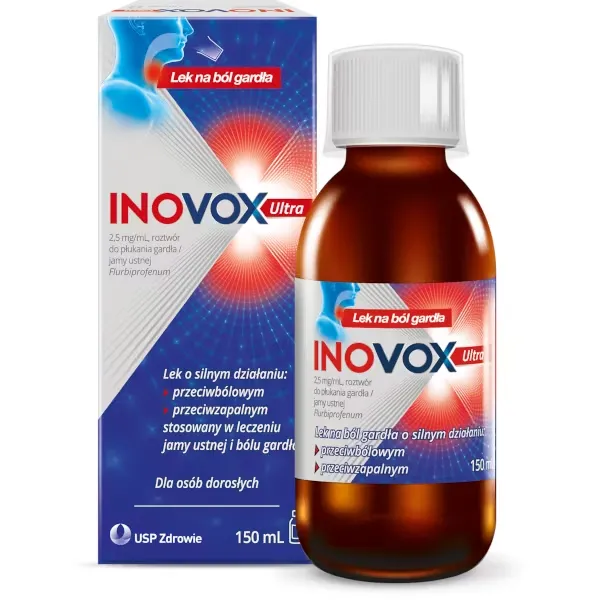
Table of Contents
Package leaflet: Information for the user
Inovox Ultra 2.5 mg/mL, solution for rinsing the mouth / throat
Flurbiprofenum
Please read all of this leaflet carefully before using this medicine, because it contains
important information for the patient.
This medicine should always be used exactly as described in this patient leaflet or as directed by
the doctor or pharmacist.
- Keep this leaflet so that you can read it again if necessary.
- If you need advice or further information, consult your doctor or pharmacist.
- If you experience any adverse reactions, including any possible adverse reactions not listed in this leaflet, inform your doctor or pharmacist. See section 4.
- If there is no improvement after 3 days, or if you feel worse, consult your doctor.
Contents of the leaflet
- What Inovox Ultra is and what it is used for
- Important information before using Inovox Ultra
- How to use Inovox Ultra
- Possible side effects
- How to store Inovox Ultra
- Contents of the pack and other information
1. What Inovox Ultra is and what it is used for
Inovox Ultra contains flurbiprofen, which belongs to a group of medicines called non-steroidal anti-inflammatory drugs (NSAIDs), used to relieve pain and inflammation.
Flurbiprofen is used to treat irritation, pain, and inflammation of the mouth and throat in adults associated with:
- gingivitis;
- stomatitis;
- pharyngitis;
- dental procedures (dental treatment).
If there is no improvement after 3 days, or if you feel worse, consult your doctor.
2. Important information before using Inovox Ultra
When not to use Inovox Ultra
- if the patient is allergic to flurbiprofen or any of the other ingredients of this medicine (listed in section 6);
- if the patient has experienced asthma, urticaria, or other allergic reactions after taking flurbiprofen, acetylsalicylic acid (aspirin), or other non-steroidal anti-inflammatory drugs (NSAIDs);
page 1 of 7
- if the patient is taking acetylsalicylic acid (aspirin) or other NSAIDs;
- if the patient has gastrointestinal ulcer disease (gastric or duodenal ulcer), Crohn's disease, or ulcerative colitis;
- if the patient has had two or more episodes of peptic ulcer disease or gastrointestinal bleeding;
- if the patient has experienced an episode of gastrointestinal bleeding and/or perforation due to NSAID use;
- if the patient has severe impairment of heart, kidney, or liver function;
- during the last three months of pregnancy.
Warnings and precautions
Before starting treatment with Inovox Ultra, consult a doctor or pharmacist if:
- the patient is elderly, as they may be more susceptible to adverse effects;
- the patient is pregnant or planning to become pregnant, or is breastfeeding;
- the patient has impaired liver or kidney function;
- the patient has heart or circulatory system disorders, as use of medicines such as Inovox Ultra may be associated with a moderate increase in the risk of myocardial infarction (heart attack) or stroke. The risk of adverse effects increases with higher doses and prolonged duration of use. Do not exceed the maximum recommended dose or use for extended periods. Inform the doctor if the patient has heart problems, a history of stroke, or is at risk of such conditions (e.g. high blood pressure, diabetes, high cholesterol levels, or if the patient smokes);
- the patient has a history of peptic ulcer (gastric or duodenal ulcer) or other stomach or intestinal disorders;
- the patient has asthma;
- the patient has systemic lupus erythematosus (SLE, commonly known as lupus) or mixed connective tissue disease—conditions affecting connective tissue that cause joint or muscle pain, skin changes, or organ dysfunction;
- the patient is dehydrated, as this increases the risk of kidney problems;
- the patient has an infection—see subsection “Infections” below.
Infections
Non-steroidal anti-inflammatory drugs (NSAIDs) may mask symptoms of infection such as fever and pain. This may delay appropriate treatment of infections, potentially increasing the risk of complications. If the patient is taking this medicine during an ongoing infection and symptoms persist or worsen, immediate consultation with a doctor or pharmacist is necessary.
WARNING: When using any medicine from the NSAID class, the following may occur:
- unusual gastrointestinal symptoms, with or without warning signs, even in patients who have not previously had serious gastrointestinal disorders (such as bleeding, ulceration, or perforation of the stomach or intestines), which may be life-threatening.
- very rarely, severe skin reactions may occur, characterized by redness, blistering, and skin peeling (e.g. exfoliative dermatitis, Stevens-Johnson syndrome, toxic epidermal necrolysis), which may be fatal. Patients appear to be at higher risk of such reactions early in treatment. These reactions most commonly occur within the first month of treatment.
page 2 of 7
Immediately discontinue treatment and contact a doctor if:
- gastrointestinal symptoms occur, especially if there is bleeding;
- a skin rash, mucosal lesions, or any other signs of allergic reaction occur (e.g. redness, itching, swelling) affecting the face or throat, or sudden drop in blood pressure. These conditions have mainly occurred after using flurbiprofen-containing medicines in systemic formulations.
Inovox Ultra and other medicines
Inform your doctor or pharmacist about all medicines currently used, recently taken, or planned for use.
Some medicines may interfere with the action of Inovox Ultra or increase the risk of serious adverse effects.
In particular, consult a doctor if the patient is taking:
- diuretics (medicines that increase urine production, e.g. furosemide and spironolactone);
- cardiac glycosides (medicines used for heart conditions, such as digoxin);
- angiotensin-converting enzyme (ACE) inhibitors (e.g. captopril) or angiotensin II receptor antagonists (e.g. losartan), medicines used to treat high blood pressure (hypertension);
- anticoagulants (e.g. warfarin), used to prevent blood clots;
- antiplatelet agents, used to thin the blood;
- lithium, used to treat depression;
- zidovudine, an antiviral medicine;
- methotrexate, used in the treatment of certain cancers and autoimmune diseases such as rheumatoid arthritis;
- cyclosporine and tacrolimus, immunosuppressive medicines used to reduce immune response;
- medicines known as corticosteroids, used to treat inflammatory conditions (e.g. prednisone, dexamethasone, hydrocortisone);
- antidepressants known as selective serotonin reuptake inhibitors (SSRIs) (e.g. paroxetine, fluoxetine);
- antibiotics known as quinolones (e.g. ciprofloxacin);
- mifepristone, a medicine used to induce abortion (taken currently or within the last 12 days);
- any other anti-inflammatory medicine (NSAID), including acetylsalicylic acid (aspirin) and COX-2 inhibitors (e.g. celecoxib).
The above interactions have been reported particularly with systemic formulations of flurbiprofen.
No interactions with other medicines have been reported when recommended doses are used.
Pregnancy, breastfeeding, and fertility
Oral formulations (e.g. tablets) of flurbiprofen may cause adverse effects in the unborn child. It is not known whether the same risk applies to Inovox Ultra 2.5 mg/mL.
If the patient is pregnant or breastfeeding, suspects she may be pregnant, or plans to become pregnant, she should consult a doctor or pharmacist before using this medicine. Do not use Inovox Ultra 2.5 mg/mL during the last three months of pregnancy. Do not use Inovox Ultra 2.5 mg/mL during the first 6 months of pregnancy unless absolutely necessary and prescribed by a doctor. If treatment is required during this period, the lowest effective dose should be used for the shortest possible duration.
Avoid using this medicine during breastfeeding.
If the patient wishes to become pregnant or experiences fertility problems, she should consult a doctor, as this medicine may affect fertility.
page 3 of 7
Driving and operating machinery
This medicine may cause drowsiness, visual disturbances, dizziness, and fatigue. The patient should ensure these adverse effects do not occur before driving or operating machinery.
Inovox Ultra contains sorbitol (E 420), ethanol, macrogol glycerol hydroxystearate, patent blue (E 131), and sodium.
The medicine contains 70 mg of sorbitol (E 420) per 1 mL. Sorbitol is a source of fructose. If the patient has previously been diagnosed with intolerance to certain sugars or hereditary fructose intolerance—a rare genetic disorder in which the body cannot break down fructose—the patient should consult a doctor before using this medicine.
This medicine contains ethanol (alcohol), up to 1.0 g per dose, equivalent to 24 mL of beer or 10 mL of wine per dose.
The small amount of alcohol in this medicine will not cause noticeable effects.
Do not swallow this product.
This medicine may cause skin reactions.
This medicine may cause allergic reactions.
This medicine contains less than 1 mmol of sodium (23 mg) per 1 mL and is therefore considered "sodium-free".
3. How to use Inovox Ultra
This medicine should always be used exactly as described in this patient leaflet or as directed by a doctor or pharmacist. If in doubt, consult a doctor or pharmacist.
The lowest effective dose for the shortest duration necessary to relieve symptoms should be used.
If the patient has an infection, consult a doctor or pharmacist immediately if symptoms (such as fever and pain) persist or worsen (see section 2).
Adults
Rinse the mouth and throat 2 to 3 times daily with 10 mL of solution. The solution may be diluted with a small amount of water. The solution should not be swallowed.
Use of this medicine is recommended for a maximum of 3 days.
Do not use this medicine for longer than recommended or exceed the recommended dose.
If there is no improvement after 3 days or if the patient feels worse, consult a doctor.
Children and adolescents
Due to lack of data, the use of Inovox Ultra is not recommended in children and adolescents.
page 4 of 7
Method of administration
Inovox Ultra can be used at any time of day.
Use the measuring device provided in the package to measure the dose. The medicine should not be swallowed; however, accidental swallowing of the solution does not pose a particular risk, as the dose of flurbiprofen used is considerably lower than the usual oral dose. After rinsing the throat and/or mouth, the solution should be expelled from the oral cavity.
Accidental overdose of Inovox Ultra
If a larger amount of Inovox Ultra is accidentally swallowed, contact a doctor immediately or go to the nearest hospital. Bring the Inovox Ultra medicine package with you.
4. Possible adverse reactions
Like all medicines, this medicine can cause adverse reactions, although not everyone will experience them.
YOU MUST STOP TAKING THE MEDICINE AND IMMEDIATELY CONTACT YOUR DOCTOR
if any of the following symptoms occur:
- severe burning or abdominal pain due to gastric or duodenal ulcers (not common adverse reactions);
- sudden, severe abdominal pain (perforation, ulcer) (not common adverse reactions);
- bleeding from the stomach or intestines (common adverse reactions);
- excessive fatigue, shortness of breath, swelling, symptoms of heart failure (common adverse reactions);
- reduced urine output (common adverse reactions);
- symptoms of allergic reactions, e.g. asthma, shortness of breath, bronchospasm, unexplained wheezing or shortness of breath, itching, rhinitis, skin rash, and others (not common adverse reactions);
- swelling of the face, tongue or throat causing difficulty breathing, palpitations, drop in blood pressure leading to shock (rare adverse reactions; may occur even after the first dose of the medicine);
- severe skin reactions such as peeling, blistering, severe forms of skin reactions (e.g. erythema multiforme, bullous reactions, including Stevens-Johnson syndrome, toxic epidermal necrolysis) (very rare adverse reactions);
- pancreatitis (very rare adverse reactions);
- cerebrovascular incident (frequency unknown);
- aseptic meningitis (high fever, sudden headache, inability to bend the neck, nausea, vomiting, confusion, drowsiness, photophobia) (frequency unknown).
Adverse reactions that may occur:
Common (may occur in up to 1 in 10 people)
- dizziness, headache;
- fatigue, malaise, oedema;
- abnormal liver function test results, prolonged bleeding time;
- dyspepsia, diarrhoea, nausea, vomiting, abdominal pain, bloating, constipation.
Uncommon (may occur in up to 1 in 100 people)
- anaemia;
- paraesthesia;
- visual disturbances;
- tinnitus, dizziness;
- gastritis, oral ulceration;
- rash, urticaria, pruritus, purpura, photosensitivity reaction;
- hypertension.
Rare (may occur in up to 1 in 1,000 people)
- depression, confusion;
- somnolence, insomnia;
- nephrotoxicity in various forms, including tubulointerstitial nephritis, nephrotic syndrome, renal failure and acute renal failure.
Very rare (may occur in up to 1 in 10,000 people)
- blood and lymphatic system disorders (leukopenia, agranulocytosis, aplastic anaemia, neutropenia, thrombocytopenia, haemolytic anaemia);
- hallucinations;
- jaundice, cholestatic jaundice, liver function disorders.
Frequency not known (frequency cannot be estimated from available data)
-
optic neuritis;
-
colitis, Crohn's disease;
-
hepatitis;
-
glomerulonephritis.
-
Reporting of adverse reactions If any adverse reactions occur, including any adverse reactions not listed in this leaflet, inform your doctor or pharmacist. Adverse reactions can be reported directly to the Department of Monitoring Adverse Drug Reactions, Office for Registration of Medicinal Products, Medical Devices and Biocidal Products, Al. Jerozolimskie 181C, 02-222 Warsaw, Tel: +48 22 49 21 301, Fax: +48 22 49 21 309, Website: https://smz.ezdrowie.gov.pl Adverse reactions can also be reported to the marketing authorisation holder. By reporting adverse reactions, additional information on the safety of the medicine can be collected.
5. How to store Inovox Ultra
Keep this medicine out of the sight and reach of children.
There are no special requirements regarding the storage temperature of the medicinal product.
After first opening the package: do not store above 25°C.
Store in the original packaging to protect from light.
Do not use this medicine after the expiry date stated on the packaging following the abbreviation "EXP". The expiry date refers to the last day of the stated month.
Medicines must not be disposed of via wastewater or household waste. Ask your pharmacist how to dispose of medicines no longer required. Such measures will help protect the environment.
page 6 of 7
6. Contents of the pack and other information
What Inovox Ultra contains
The active substance is flurbiprofen. 1 mL of solution contains 2.5 mg of flurbiprofen.
The other ingredients are: glycerol 85%, ethanol 96%, sorbitol (E 420), macrogol glycerol
hydroxystearate, sodium saccharin (E 954), peppermint essential oil, patent blue (E 131),
potassium hydrogen carbonate, sodium hydroxide (for pH adjustment), concentrated hydrochloric acid (for pH adjustment),
purified water.
What Inovox Ultra looks like and contents of the pack
Clear, bluish solution with a minty odour and taste, and pH 6.5 – 9.5.
Amber glass bottle (type III), with a PP/HDPE child-resistant cap and a polypropylene dosing spoon graduated at 10 mL,
packaged in a cardboard box.
1 bottle - 150 mL of solution.
Marketing Authorisation Holder:
US Pharmacia Sp. z o.o.
Ziębicka 40 Street, 50-507 Wrocław, Poland
Manufacturer:
UAB “Valentis”
Taikos pr. 102, LT-51195 Kaunas, Lithuania
For further information about this medicinal product, please contact:
USP Zdrowie Sp. z o.o.
Poleczki 35 Street, 02-822 Warsaw, Poland
Tel. +48 (22) 543 60 00
page 7 of 7