Indocollyre 0,1%
Poland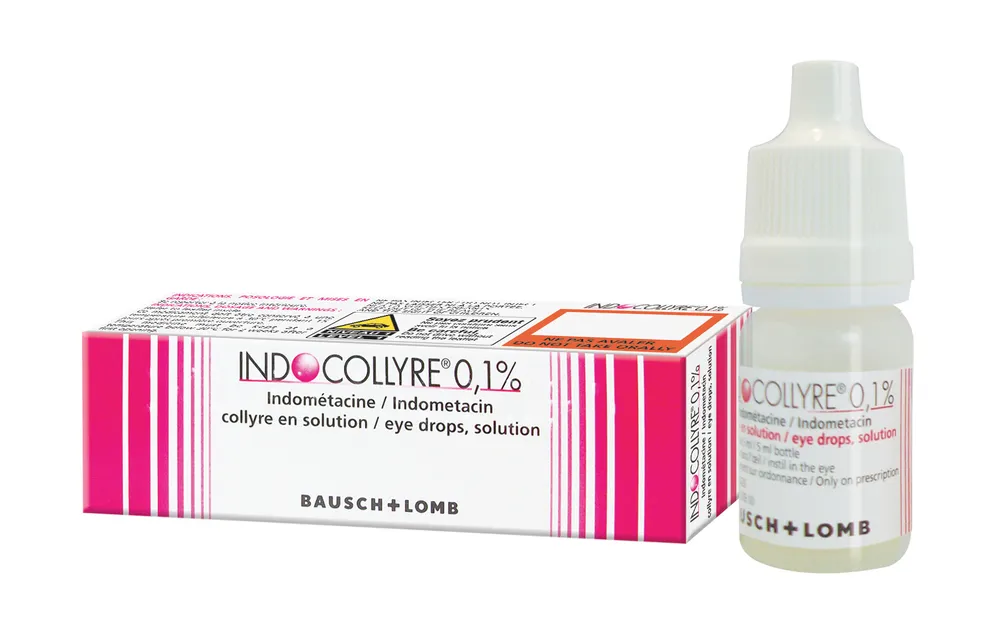
Table of Contents
Patient Information Leaflet
Indocollyre 0.1%
1 mg/ml, eye drops, solution
Indometacinum
Please read all of this leaflet carefully before using this medicine, as it contains important information for you.
Keep this leaflet, as you may need to read it again.
If you have any further questions, please ask your doctor or pharmacist.
This medicine has been prescribed for a specific individual. Do not pass it on to others. It may harm other people, even if their symptoms are the same.
If you experience any adverse reactions, including any not listed in this leaflet, tell your doctor or pharmacist. See section 4.
Contents of the leaflet:
- What Indocollyre 0.1% is and what it is used for
- What you need to know before using Indocollyre 0.1%
- How to use Indocollyre 0.1%
- Possible side effects
- How to store Indocollyre 0.1%
- Contents of the pack and other information
1. What Indocollyre 0.1% is and what it is used for
This medicine is called Indocollyre 0.1% and contains the active substance indometacin, a substance belonging to the group of non-steroidal anti-inflammatory drugs (NSAIDs). The medicine has strong local anti-inflammatory and analgesic effects.
This medicine is intended for use during surgical procedures and postoperatively to:
- prevent miosis (pupil constriction),
- act as an anti-inflammatory agent following cataract removal and anterior segment eye surgeries,
- treat pain in the first few days after photorefractive keratectomy.
2. Important information before using Indocollyre 0,1%
When not to use Indocollyre 0,1%:
If the patient is allergic to indomethacin or to any of the other ingredients of this
medicine (listed in section 6).
If the patient is allergic to non-steroidal anti-inflammatory drugs (NSAIDs) or acetylsalicylic acid (aspirin).
If the patient has previously experienced an asthma attack triggered by taking aspirin or other
non-steroidal anti-inflammatory drugs.
If the patient has active gastric or duodenal ulcer disease.
If the patient has severe liver or kidney function disorders.
Do not use from the sixth month of pregnancy onwards.
Do not use simultaneously with:
- oral anticoagulant medicines
- other non-steroidal anti-inflammatory drugs (including salicylates at doses equal to or greater than 3 g per day)
- diflunisal
- heparin
- lithium
- high-dose methotrexate
- ticlopidine
For additional information, see section: Indocollyre 0,1% and other medicines
Warnings and precautions
Before starting treatment with Indocollyre 0,1%, discuss it with your doctor, pharmacist, or
nurse.
- If the patient is allergic to the medicine. In such a case, treatment with Indocollyre 0,1% should be discontinued. The doctor will then order diagnostic eye examinations; The medicine may cause cross-sensitivity reactions to acetylsalicylic acid or other non-steroidal anti-inflammatory drugs (NSAIDs);
- The medicine may mask typical signs of eye infection. If there is a risk of eye infection, the doctor will initiate appropriate treatment;
- Non-steroidal anti-inflammatory drugs may delay corneal healing;
- If the patient has or has previously had a tendency to bleeding or is taking medicines that reduce blood clotting, NSAIDs may increase the risk of bleeding from ocular tissues during surgical procedures in these patients;
- If the patient is using topical corticosteroids (e.g. hydrocortisone), as they may cause adverse effects;
- If the patient has eye problems (e.g. dry eye syndrome, corneal disorders);
- If the patient has diabetes;
- If the patient suffers from rheumatoid arthritis;
- If the patient has undergone repeated ophthalmic surgeries in a short period;
- If the patient wears contact lenses. The use of contact lenses is not recommended during treatment with this medicine;
- When treating with other eye medicines, a 15-minute interval should be maintained between administration of each medicine.
- The tip of the dropper must not touch the eye.
Consult your doctor, even if the above warnings refer to conditions that occurred
in the past.
Children and adolescents
The use of this medicine in children is not recommended, as its safety and efficacy have not been studied in this
age group.
Indocollyre 0,1% and other medicines
Tell your doctor or pharmacist about all medicines the patient is currently taking or has recently taken, as well as any medicines the patient plans to use.
When the medicine is administered into the eye, the amount of indomethacin entering the systemic circulation is
small, but interactions with systemically administered non-steroidal anti-inflammatory drugs may still occur.
Particular caution is required when using eye drops containing
indomethacin together with corticosteroids.
The use of Indocollyre 0,1% eye drops is not recommended with the following medicines:
- oral anticoagulants (medicines used to reduce blood clotting)
- other non-steroidal anti-inflammatory drugs (including aspirin, starting at doses of 3 g per day in adults)
- diflunisal (a medicine used to treat joint inflammation)
- heparin (a medicine that reduces blood clotting)
- lithium (a medicine used to treat certain types of depression)
- methotrexate (at doses of 15 mg per week or higher) (a medicine used to treat rheumatoid arthritis and psoriasis)
- ticlopidine (a medicine that reduces blood clotting).
Use with caution in patients taking:
- diuretics
- angiotensin-converting enzyme (ACE) inhibitors (medicines used to treat high blood pressure)
- methotrexate (at doses less than 15 mg per week) (a medicine used to treat rheumatoid arthritis and psoriasis)
- pentoxifylline (a medicine used to treat certain circulatory disorders)
- zidovudine (a medicine used to treat HIV infection)
- gastric acid neutralizing agents (salts, oxides, hydroxides of magnesium, aluminium, and calcium)
- cyclosporine (a medicine used to prevent transplant rejection)
- desmopressin (a medicine used to treat nocturnal enuresis)
- beta-adrenergic receptor blocking agents (medicines used to treat hypertension, heart diseases, hyperthyroidism, migraine, or high intraocular pressure).
Non-steroidal anti-inflammatory drugs may reduce the effectiveness of intrauterine contraceptive
devices.
When used concomitantly with thrombolytics (medicines used to dissolve blood clots), there is an increased risk of bleeding.
Pregnancy, breastfeeding and effects on fertility
If the patient is pregnant or breastfeeding, suspects she may be pregnant, or is planning to have a
child, she should consult her doctor or pharmacist before using this medicine.
This medicine may be used in women during the 1st to 5th month of pregnancy only if the doctor considers it absolutely necessary.
Absolutely do not use from the sixth month of pregnancy onwards.
There are no data on the passage of indomethacin into breast milk after ocular administration.
Systemically administered indomethacin passes into breast milk. This medicine should not be used
in breastfeeding women. The doctor will decide whether the patient should discontinue breastfeeding or discontinue use of this product, taking into account the benefits of treatment for the mother and the potential risk to the infant.
NSAIDs may adversely affect fertility in women. This effect is reversible and resolves after discontinuation of treatment. The effect of indomethacin in the form of eye drops on fertility has not been studied.
Driving and operating machinery
There is a risk of transient visual disturbances immediately after administration of the medicine; therefore, wait until vision disturbances have completely subsided before driving or operating machinery.
Indocollyre 0,1% contains thiomersal
The medicine may cause allergic reactions. In case of hypersensitivity reactions, discontinue use of Indocollyre 0,1% immediately.
3. How to use Indocollyre 0.1%
This medicine should always be used exactly as directed by your doctor or pharmacist. If in doubt,
please consult your doctor or pharmacist.
Recommended dose:
-
To prevent constriction of the pupil necessary during surgical procedures: 4 drops on the day
before surgery, and 4 drops within 3 hours before surgery. -
Prevention of inflammation caused by cataract surgery and other surgical procedures on the
anterior segment of the eye: 1 drop 4 to 6 times daily until inflammation symptoms have completely
resolved. Treatment should begin 24 hours before surgery. -
Treatment of eye pain following photorefractive keratectomy in the first few days after surgery:
1 drop 4 times daily in the first few days after surgery.
Instructions for administering the medicine:
- Wash your hands thoroughly.
- Unscrew the protective cap from the bottle.
- Hold the bottle upside down, using your thumb and index finger.
- Tilt your head backward.
- Gently pull down the lower eyelid with your index finger to create a "pocket" between the eyeball and the eyelid, into which the drops will be instilled.
- Bring the dropper tip close to the eye, without touching the dropper tip to the eye, eyelid, surrounding areas, or any other surface.
- To release a single drop, gently squeeze the sides of the bottle.
- Look upward and instill 1 drop into the eye. If unsuccessful, repeat the procedure.
- Close the eye and press with your finger on the inner corner of the eye at the bridge of the nose for 1 minute. This helps minimize the risk of the medicine entering the systemic circulation.
- If drops are to be administered to both eyes, repeat the above steps for the second eye.
- Immediately after use, replace the protective cap and close the bottle securely.
Having assistance from another person or using a mirror may make administration easier.
Indocollyre 0.1% eye drops are sterile. To avoid contamination, do not touch the dropper tip with your fingers or allow it to touch the eye surface or any other surface. Using contaminated drops may lead to serious eye damage, including loss of vision.
If you feel that the effect of Indocollyre 0.1% is too strong or too weak, consult your doctor.
Use of a higher than recommended dose of Indocollyre 0.1%
If more than the recommended dose has been used, seek immediate advice from your doctor or pharmacist.
Missed dose of Indocollyre 0.1%
Do not use a double dose to make up for a missed dose. If you miss a dose, wait until it is time for your next scheduled dose.
Stopping treatment with Indocollyre 0.1%
If you have any further questions about the use of this medicine, consult your doctor or pharmacist.
4. Possible adverse reactions
Like all medicines, this medicine can cause adverse reactions, although not everyone will experience them.
Rare (may occur in less than 1 in 1,000 patients): hypersensitivity reactions.
Unknown (frequency cannot be estimated from the available data):
- inflammation, ulceration or perforation of the surface membrane of the eye (cornea), particularly in patients with pre-existing corneal damage
- transient eye burning, eye stinging
- visual disturbances
- light sensitivity
- corneal epithelial damage (e.g. corneal abrasion, punctate keratitis)
- increased intraocular pressure (pressure inside the eye)
- eye discomfort
- eyelid swelling
- corneal edema (the outer, transparent part of the eye)
- eye swelling
- eye pain
- eye irritation
- eye redness
- conjunctival redness
- conjunctivitis
- increased lacrimation
- thrombocytopenia (decreased number of blood platelets)
- asthma
- skin redness and itching
- swelling.
Other adverse reactions may occur in some patients during treatment with Indocollyre 0.1%.
Reporting of adverse reactions
If any adverse reactions occur, including any not listed in this leaflet, inform your doctor or pharmacist. Adverse reactions can be reported directly to the Department of Monitoring Adverse Drug Reactions, Office for Registration of Medicinal Products, Medical Devices and Biocidal Products
Al. Jerozolimskie 181C
02-222 Warsaw
Phone: +48 22 49 21 301
Fax: +48 22 49 21 309
Website: https://smz.ezdrowie.gov.pl
Adverse reactions can also be reported to the marketing authorization holder.
Reporting adverse reactions helps provide more information on the safety of the medicine.
5. How to store Indocollyre 0.1%
Keep this medicine out of sight and reach of children.
Do not use this medicine after the expiry date stated on the packaging after "Expiry date". The expiry date refers to the last day of the stated month.
After first opening the bottle, the medicine remains stable for 15 days.
Store below 25°C.
Medicines must not be disposed of via wastewater or household waste. Ask your pharmacist how to dispose of medicines no longer in use. This will help protect the environment.
6. Contents of the pack and other information
What Indocollyre 0,1% contains
The active substance is indometacin. 1 ml of solution contains 1 mg of indometacin.
The other ingredients are: thiomersal, arginine, hydroxypropyl-beta-cyclodextrin, hydrochloric acid 1 M,
purified water, nitrogen.
What Indocollyre 0,1% looks like and contents of the pack
A bottle containing 5 ml of drops with a dropper, closed with a screw cap, in a cardboard box.
Marketing Authorisation Holder
BAUSCH + LOMB IRELAND LIMITED
3013 Lake Drive
Citywest Business Campus
Dublin 24, D24PPT3
Ireland
[email protected]
Manufacturer:
Laboratoire Chauvin
Z.I. Ripotier Haut
07200 Aubenas
France
Dr. Gerhard Mann
chem.-pharm. Fabrik GmbH
Brunsbütteler Damm 165/173
13581 Berlin, Germany