Inaldin throat
Poland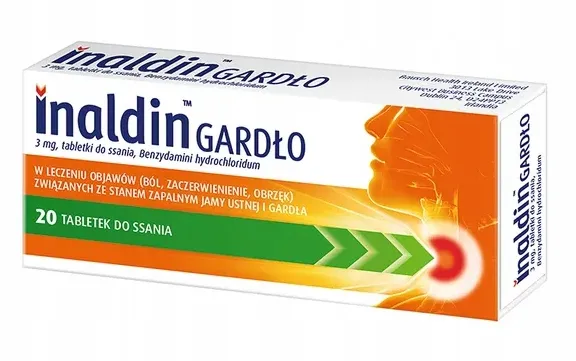
Table of Contents
Package leaflet: information for the user
INALDIN Throat, 3 mg, lozenges
Benzydamini hydrochloridum
Please read carefully all the information in this leaflet before taking the medicine, as it contains
important information for the patient.
This medicine should always be taken exactly as described in this patient leaflet or as directed by
the physician or pharmacist.
- Keep this leaflet, so that you can read it again if necessary.
- If you need advice or further information, please consult your pharmacist.
- If you experience any adverse reactions, including any possible adverse reactions not listed in this leaflet, inform your doctor or pharmacist. See section 4.
- If there is no improvement after 3 days, or if your condition worsens, consult a doctor.
Table of contents
- What INALDIN Throat is and what it is used for
- Important information before using INALDIN Throat
- How to use INALDIN Throat
- Possible side effects
- How to store INALDIN Throat
- Contents of the pack and other information
1. What INALDIN Throat is and what it is used for
INALDIN Throat contains benzydamine, which belongs to the group of non-steroidal anti-inflammatory drugs. It exerts local anti-inflammatory and analgesic action and produces local anaesthetic effect on the oral mucosa. INALDIN Throat lozenges are used in the treatment of symptoms (pain, redness, swelling) associated with inflammatory conditions of the mouth and throat.
INALDIN Throat is indicated for use in adults, adolescents, and children aged 6 years and older.
2. Information before using INALDIN Throat
When not to use INALDIN Throat
- if the patient is allergic to benzidamine hydrochloride or any of the other ingredients of this medicine (listed in section 6),
- if the patient has phenylketonuria (a condition characterized by the inability to metabolize the amino acid phenylalanine, which in excessive amounts may be harmful to the body).
Warnings and precautions
Before starting treatment with INALDIN Throat, consult your doctor or pharmacist:
- if the patient is allergic to acetylsalicylic acid or other non-steroidal anti-inflammatory drugs (NSAIDs), as in such cases there is an increased risk of allergy to benzidamine;
- if the patient has asthma or a history of allergic diseases, as in such cases the risk of bronchospasm or allergic reactions is increased.
If there is no improvement after 3 days, or if the patient feels worse, consult a doctor, because in rare cases, ulceration of the cheeks or throat may be caused by a serious underlying disease.
Do not use INALDIN Throat for longer than 7 days without consulting a doctor, as prolonged use may lead to allergic reactions. If an allergic reaction occurs, contact a doctor or pharmacist immediately and discontinue use of the medicine.
Children and adolescents
INALDIN Throat is not recommended for use in children under 6 years of age.
INALDIN Throat and other medicines
Tell your doctor or pharmacist about all medicines the patient is currently taking or has recently taken, as well as any medicines the patient plans to take.
To date, no interactions have been reported where other medicines affect the action of INALDIN Throat, or where INALDIN Throat alters the effect of other medicines.
INALDIN Throat with food and drink
Shortly after taking the medicine, a sensation of numbness in the mouth or throat may occur. Avoid eating or drinking until the numbness subsides.
Pregnancy, breastfeeding and fertility
If the patient is pregnant, breastfeeding, suspects she may be pregnant, or is planning to have a baby, she should consult a doctor before using this medicine.
INALDIN Throat should not be used during pregnancy or breastfeeding.
Driving and operating machinery
INALDIN Throat has no effect or has negligible effect on the ability to drive or operate machinery.
INALDIN Throat contains aspartame (E 951)
This medicine contains 7 mg of aspartame in each lozenge.
Aspartame is a source of phenylalanine. It may be harmful for patients with phenylketonuria. This is a rare genetic disorder in which phenylalanine accumulates due to improper elimination from the body.
3. How to use INALDIN Throat
This medicine should always be taken exactly as described in the patient leaflet or as directed by a doctor or pharmacist.
If in doubt, consult a doctor or pharmacist.
Recommended dose:
Adults and elderly: 1 lozenge to be sucked 3 times daily.
Children aged 6 years and above: dosage as for adults.
INALDIN Throat lozenges are not recommended for children under 6 years of age.
Do not use INALDIN Throat for longer than 7 days without medical advice.
Instructions for use
The lozenges should be sucked. Do not chew or swallow them.
Overdose of INALDIN Throat
Overdose with INALDIN Throat is unlikely. Toxic symptoms are not expected even if larger than recommended amounts of the medicine are accidentally swallowed. However, if a patient takes more than the recommended dose and experiences symptoms such as agitation, seizures, sweating, disturbances in balance and coordination (e.g. uncoordinated movements), tremor or vomiting, consult a doctor or pharmacist.
Missed dose of INALDIN Throat
If a patient misses a dose, it should be taken as soon as possible. However, if it is almost time for the next dose, the missed dose should not be taken. Do not take a double dose to make up for a missed dose.
If you have any further questions about the use of this medicine, consult your doctor or pharmacist.
4. Possible adverse effects
Like all medicines, this medicine can cause adverse effects, although not everyone will experience them.
In patients using benzydamine, the following adverse effects have been reported with the following frequency:
- Uncommon adverse effects (may occur in fewer than 1 in 100 patients) – photosensitivity;
- Rare adverse effects (may occur in fewer than 1 in 1,000 patients) – burning sensation and dryness in the oral cavity;
- Very rare adverse effects (may occur in fewer than 1 in 10,000 patients) – laryngospasm, swelling of the face, hands and feet, eyes, lips and (or) tongue, which may cause difficulty in breathing or swallowing (angioedema);
- Frequency not known (frequency cannot be estimated from the available data) – allergic reaction (hypersensitivity). Severe allergic reaction (anaphylactic shock) with symptoms such as: difficulty in breathing, pain or tightness in the chest, and (or) dizziness/fainting, intense skin itching or raised skin rash (urticaria), swelling of the face, lips, tongue and (or) throat, which may be potentially life-threatening.
Shortly after taking the medicine, a sensation of numbness or burning in the mouth or throat may occur.
This reaction is related to the normal action of the medicine and subsides after a short time.
In isolated cases, nausea or vomiting may occur, caused by a reflex irritation of the throat associated with taking the medicine. These symptoms resolve spontaneously after discontinuation of the medicine.
Reporting of adverse effects
If any adverse effects occur, including any adverse effects not listed in this leaflet, inform your doctor or pharmacist. Adverse effects can be reported directly to the Department of Monitoring of Adverse Drug Reactions of the Office for Registration of Medicinal Products, Medical Devices and Biocidal Products, Al. Jerozolimskie 181C, 02-222 Warsaw, phone: +48 22 49 21 301, fax: +48 22 49 21 309,
Website: https://smz.ezdrowie.gov.pl
Adverse effects can also be reported to the marketing authorization holder.
Reporting adverse effects helps to provide more information on the safety of the medicine.
5. How to store the medicine INALDIN Gardło
Do not store above 30°C.
Keep the medicine out of sight and reach of children.
Do not use this medicine after the expiry date stated on the blister and cardboard packaging. The expiry date refers to the last day of the stated month.
Medicines must not be disposed of via wastewater or household waste. Ask your pharmacist how to dispose of medicines no longer required. These measures will help protect the environment.
6. Contents of the pack and other information
What INALDIN Throat contains
- The active substance is benzidamine hydrochloride. Each lozenge contains 3 mg of benzidamine hydrochloride.
- Other ingredients are: mannitol (E 421), citric acid, hypromellose, peppermint flavour [containing natural peppermint flavour, corn maltodextrin, modified corn starch E 1450], aspartame (E 951), patent blue V (E 131), quinoline yellow (E 104), magnesium stearate.
What INALDIN Throat looks like and contents of the pack
Round, biconvex lozenges with a marbled green surface, packed in blisters made of PVC/PE/PVDC/Aluminium (10 lozenges per blister).
Pack sizes:
10 or 20 lozenges (1 or 2 blisters containing 10 lozenges each).
Not all pack sizes may be marketed.
Marketing Authorisation Holder
Bausch Health Ireland Limited
3013 Lake Drive
Citywest Business Campus
Dublin 24, D24PPT3
Ireland
Manufacturer
ICN Polfa Rzeszów S.A.
Przemysłowa 2 Street
35-959 Rzeszów
Poland
This medicinal product is authorised in the European Economic Area countries under the following names:
Poland: INALDIN Throat
Slovakia: Garganta 3 mg