Immunine 600 iu
Poland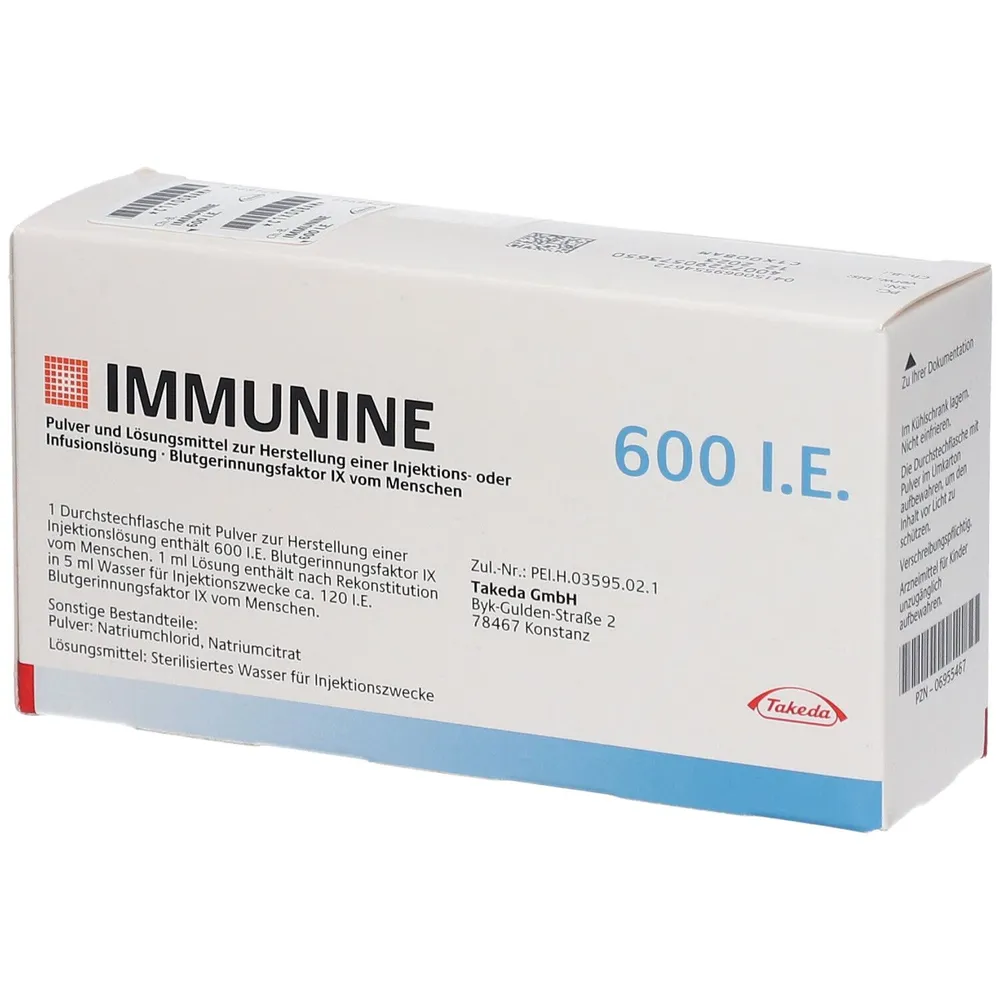
Table of Contents
- Package leaflet: Information for the user
- 1. What IMMUNINE is and what it is used for
- 2. Important information before using IMMUNINE
- 3. How to use IMMUNINE
- 4. Possible adverse reactions
- 5. How to store IMMUNINE
- 6. Contents of the pack and other information
- Information intended exclusively for medical professionals:
Package leaflet: Information for the user
IMMUNINE 600 IU
powder and solvent for solution for injection or infusion
human coagulation factor IX
Please read all of this leaflet carefully before this medicine is administered, because it contains
important information for the patient.
- Keep this leaflet, as you may need to read it again.
- If you have any questions, please consult your doctor or pharmacist.
- This medicine has been prescribed for a specific individual. Do not pass it on to others. The medicine may harm other people, even if their symptoms are the same.
- If any adverse reactions occur in the patient, including any adverse reactions not listed in this leaflet, inform your doctor or pharmacist immediately. See section 4.
Contents of the leaflet
- What IMMUNINE is and what it is used for
- What you need to know before using IMMUNINE
- How to use IMMUNINE
- Possible side effects
- How to store IMMUNINE
- Contents of the pack and other information
1. What IMMUNINE is and what it is used for
IMMUNINE is a concentrate of human coagulation factor IX. It replaces the deficient or malfunctioning factor IX in haemophilia B. Haemophilia B is an X-linked inherited bleeding disorder caused by reduced levels of blood coagulation factor IX. This leads to severe bleeding into joints, muscles, and internal organs, both spontaneously and following accidental or surgical trauma. Administration of IMMUNINE temporarily corrects the factor IX deficiency and reduces the tendency to bleed. IMMUNINE is used for the treatment and prevention of bleeding episodes in patients with congenital haemophilia B. IMMUNINE is indicated for use in all age groups, from children older than 6 years to adults.
There are insufficient data to recommend the use of IMMUNINE in children below 6 years of age.
2. Important information before using IMMUNINE
When not to use IMMUNINE
- if the patient is allergic to human coagulation factor IX or any of the other ingredients of this medicine (listed in section 6).
- if the patient has an allergy to heparin or an abnormal decrease in blood platelets associated with blood clotting caused by heparin administration ( heparin-induced thrombocytopenia ).
After appropriate treatment of these conditions, IMMUNINE should be administered only
in life-threatening bleeding episodes.
Warnings and precautions
Before starting IMMUNINE, discuss this with your doctor or pharmacist.
If allergic reactions occur:
In rare cases, there is a possibility of a sudden severe allergic reaction (anaphylactic reaction) to IMMUNINE.
If any of the following symptoms occur, infusion must be stopped immediately
and medical advice sought without delay. These symptoms may indicate anaphylactic shock
and require immediate treatment as in emergencies:
- skin redness,
- rash,
- skin welts (urticaria),
- itching all over the body,
- swelling of lips and tongue,
- breathing difficulties / apnea,
- difficulty inhaling and/or exhaling due to airway constriction (wheezing),
- feeling of pressure in the chest,
- general malaise,
- dizziness,
- drop in blood pressure,
- loss of consciousness.
If monitoring of treatment is required:
- Your treating physician will regularly perform blood tests to ensure that the current dose is appropriate and that sufficient factor IX is being provided.
- To identify possible complications, your doctor will pay particular attention to:
- if the patient is receiving high doses of IMMUNINE.
- if the patient is predisposed to thrombosis. In such a case, the patient will also receive lower doses of factor IX, the active substance in IMMUNINE.
If bleeding persists:
- If bleeding cannot be controlled with IMMUNINE, the doctor must be informed immediately. The patient may have developed factor IX inhibitors. Factor IX inhibitors are antibodies that appear in the blood and counteract the effects of factor IX. This reduces the effectiveness of factor IX in controlling bleeding. The doctor will carry out necessary tests to confirm this.
- There is a probable association between the development of factor IX inhibitors and allergic reactions. Patients with factor IX inhibitors may be at increased risk of sudden and severe allergic reactions (anaphylaxis). Therefore, patients experiencing allergic reactions should be evaluated for the presence of inhibitors.
Tell your doctor if you have liver or heart disease, or if you have recently undergone major
surgical procedures, as there is an increased risk of complications related to blood coagulation.
Information on safety regarding infectious agents
When medicines are manufactured from human blood or plasma, specific measures are taken to prevent transmission of infections to patients. These include:
- careful selection of blood and plasma donors to ensure that individuals at risk of carrying infections are excluded,
- testing of individual blood samples and pooled plasma for viruses/infections,
- inclusion in the blood or plasma processing procedures of steps that inactivate or remove viruses.
Despite these measures, when administering medicines derived from human blood or plasma, the possibility of transmitting infection cannot be completely ruled out. This also applies to unknown or newly emerging viruses and other types of infections.
The measures taken are considered effective against enveloped viruses, such as human immunodeficiency virus (HIV), hepatitis B virus, hepatitis C virus, and non-enveloped hepatitis A virus.
The measures may have limited effectiveness against non-enveloped viruses, such as
parvovirus B19 [a virus that causes skin redness (erythema infectiosum)].
Infection with parvovirus B19 may be dangerous for pregnant women (fetal infection) and for individuals with weakened immune systems or for individuals with certain types of anemia (e.g., congenital spherocytosis or hemolytic anemia).
For patients receiving products derived from human plasma regularly or repeatedly,
the doctor may recommend considering vaccination against hepatitis A and B.
It is strongly recommended that the name and batch number of the product be recorded each time IMMUNINE is administered, to maintain traceability of the batches used.
Children
There are insufficient data to recommend the use of IMMUNINE in children under 6 years of age.
IMMUNINE and other medicines
Tell your doctor or pharmacist about all medicines the patient is currently taking or has recently taken, as well as any medicines the patient plans to take.
No interactions between IMMUNINE and other medicinal products are known.
Pregnancy and breastfeeding
Hemophilia B is very rare in women. Therefore, data on the use of IMMUNINE during pregnancy and breastfeeding are not available.
If the patient is pregnant or breastfeeding, suspects she may be pregnant, or plans to become pregnant, she should consult her doctor before using this medicine. The doctor will decide whether IMMUNINE can be used during pregnancy or breastfeeding.
Driving and operating machinery
No effects on the ability to drive and operate machinery have been observed.
IMMUNINE contains sodium chloride and sodium citrate.
IMMUNINE 600 IU contains 20 mg of sodium (main component of table salt) per vial.
This corresponds to 1% of the maximum recommended daily dietary sodium intake for adults.
3. How to use IMMUNINE
Treatment should be initiated and supervised by a physician experienced
in the treatment of haemophilia B.
The physician will determine the appropriate dose for the patient, based on individual
requirements. If the patient feels that the effect of IMMUNINE is insufficient or too
strong, they should inform their physician.
Use in children
There are insufficient data to recommend the use of IMMUNINE in children under
6 years of age.
Monitoring of treatment by the physician
The physician will perform appropriate laboratory tests at regular intervals to ensure
that sufficient levels of factor IX are present in the patient's blood. This is particularly important
in the case of major surgical procedures or life-threatening bleeding.
Patients with developed inhibitors
If factor IX does not reach the expected blood level despite administration of the appropriate dose, or
if bleeding does not stop, inhibitors may be present. The physician will check for the presence of inhibitors
using appropriate tests. In case an inhibitor develops, contact with a specialized haemophilia treatment centre should be established.
If the patient has developed inhibitors against factor IX, higher amounts of IMMUNINE may be required to control bleeding. If bleeding cannot be controlled despite this, the physician may consider using an alternative product.
Do not increase the dose of IMMUNINE to control bleeding without consulting a physician.
Frequency of administration
The physician will explain to the patient how often and at what intervals IMMUNINE should be administered. This will be determined individually, depending on the patient's response to IMMUNINE.
Route and/or method of administration
IMMUNINE must be administered slowly intravenously after reconstitution using the provided solvent.
IMMUNINE must not be mixed with other medicinal products prior to administration, as this may adversely
affect the efficacy and safety of the product.
Strictly follow the physician's instructions.
The infusion rate should be adjusted to the patient's comfort level and must not exceed
2 ml per minute.
- Use only the provided administration sets. If other injection sets are used, IMMUNINE may adhere to the internal surfaces of the set, potentially leading to incorrect dosing.
- If other medicinal products are administered via the same venous access, the access line must be flushed before and after IMMUNINE infusion with an appropriate solution, e.g. saline.
- IMMUNINE should be reconstituted immediately before use and the solution used promptly (the product does not contain preservatives). The infusion should be completed within 3 hours after reconstitution.
- The injection solution should be clear or slightly milky (opalescent). Do not use if the solution is more turbid or contains visible particles.
- Any unused reconstituted product should be discarded according to local regulations.
Reconstituting the powder to prepare the injection solution
Ensure that the solution is prepared under conditions as clean and sterile as possible!
- Warm the closed vial with the rubber stopper containing the solvent (water for injections) to room temperature (max. 37°C).
- Remove the protective caps from the vials with rubber stoppers containing the powder and the solvent (fig. A) and clean the surfaces of both rubber stoppers.
- Twist and remove the protective cover from the shorter end of the double-ended needle (fig. B). Insert the exposed needle into the rubber stopper of the solvent vial (fig. C).
- Remove the cover from the other end of the double-ended needle, taking care not to touch the exposed needle end.
- Invert the solvent vial over the powder vial and pierce the rubber stopper of the powder vial with the needle (fig. D). The vacuum will draw the solvent into the powder vial.
- When all the solvent has transferred into the powder vial, disconnect the vials by removing the double-ended needle from the powder vial (fig. E). Gently rotate the powder vial to accelerate dissolution of the powder.
- After complete dissolution of the powder, insert the venting needle (fig. F); the foam formed will settle. Then remove the venting needle.
Administration of the solution by injection / infusion
Ensure that the solution is prepared under conditions as clean and sterile as possible!
- Twist and remove the protective cover from one end of the provided filter needle and attach the needle to a sterile single-use syringe. Draw the solution from the vial into the syringe (fig. G).
- Disconnect the filter needle from the syringe and slowly (maximum infusion rate 2 ml/min) administer the solution intravenously using the provided infusion set (or the provided single-use needle).
When administering by infusion, use a single-use infusion set with an appropriate
filter.
fig.A fig.B fig.C fig.D fig.E fig.F fig.G
Duration of treatment
IMMUNINE is usually required for lifelong use.
Use of a higher than recommended dose of IMMUNINE
Inform the physician. No symptoms of factor IX overdose have been reported.
Missed dose of IMMUNINE
- Do not administer a double dose to make up for a missed dose.
- Take the next dose as soon as possible and continue administration at regular intervals as directed by the physician.
Discontinuation of IMMUNINE
Do not discontinue IMMUNINE without consulting a physician.
If there are any further questions regarding the use of this medicinal product, consult
the physician or pharmacist.
4. Possible adverse reactions
Like all medicines, IMMUNINE may cause adverse reactions, although not
everyone will experience them. If any of the adverse symptoms worsen or if any adverse
reactions not listed in this leaflet occur, inform your doctor or pharmacist.
In the event of the following severe adverse reactions, seek immediate medical advice:
- Severe allergic reactions (anaphylactic reactions). If any of the following symptoms occur, the infusion must be stopped immediately and medical advice sought without delay. Particular caution is required in patients with known presence of inhibitors in the blood.
- Skin redness
- Rash
- Skin hives (urticaria)
- Itching all over the body
- Swelling of lips and tongue
- Breathing difficulties / apnoea
- Difficulty inhaling and/or exhaling due to narrowing of the airways (wheezing)
- Feeling of tightness in the chest
- General malaise
- Dizziness
- Drop in blood pressure
- Loss of consciousness
- Sudden swelling of the skin or mucous membranes, with or without difficulty swallowing or breathing (angioedema)
- Formation of blood clots in small blood vessels throughout the body (disseminated intravascular coagulation, DIC)
- Heart attack (myocardial infarction)
- Rapid heartbeat (tachycardia)
- Drop in arterial blood pressure (hypotension)
- Blood clots (thromboembolic events)
- Vessel blockage by a blood clot (e.g. pulmonary embolism, venous thrombosis, arterial thrombosis, cerebral artery thrombosis)
- Sudden facial flushing
- Difficulty inhaling and/or exhaling due to narrowing of the airways (wheezing)
- Breathing difficulties (dyspnoea)
- Kidney disorder with symptoms such as eyelid, facial and lower limb swelling, accompanied by weight gain and protein loss in urine (nephrotic syndrome)
In patients with inhibitors detected in the blood, there is a particularly high risk of developing a condition known as serum sickness. If any of the following symptoms occur, the infusion must be stopped immediately and medical advice sought without delay:
- Rash
- Itching
- Joint pain (arthralgia), especially in fingers and toes
- Fever
- Swelling of lymph nodes (lymphadenopathy)
- Drop in blood pressure (hypotension)
- Enlargement of the spleen (splenomegalia)
Other adverse reactions
Uncommon adverse reactions (may affect up to 1 in 100 people)
- Throat irritation, sore throat and dry cough
- Rash and itching (urticaria)
- Fever
Adverse reactions with unknown frequency (cannot be estimated from available data)
- Headache
- Restlessness
- Tingling
- Nausea
- Vomiting
- Generalized urticaria
- Chills
- Hypersensitivity reactions
- Burning and stinging at the site of injection
- Drowsiness
- Sudden facial flushing
- Chest tightness
The following adverse reactions have been observed with products of this same class:
Abnormal or reduced sensation (paresthesia).
Reporting of adverse reactions
If any adverse reactions occur, including those not listed in this leaflet, inform your doctor or pharmacist. Adverse reactions can be reported directly to the Department for Monitoring of Adverse Drug Reactions at the Office for Registration of Medicinal Products, Medical Devices and Biocidal Products:
Al. Jerozolimskie 181 C
02-222 Warsaw
Phone: +48 22 49 21 301
Fax: +48 22 49 21 309
Website: https://smz.ezdrowie.gov.pl
Adverse reactions may also be reported to the marketing authorization holder.
Reporting adverse reactions helps to provide more information on the safety of the medicine.
5. How to store IMMUNINE
Keep this medicine out of the reach and sight of children.
Do not use this medicine after the expiry date stated on the label after EXP. The expiry date refers to the last day of the specified month.
Store in a refrigerator (2°C - 8°C). Do not freeze.
Keep the vial in the outer packaging to protect it from light.
During the stated shelf life, IMMUNINE may be stored at temperatures up to and including 25°C. However, this is limited to a maximum of 3 months. The start and end dates of the room temperature storage period (up to 25°C) must be recorded on the outer packaging of the product.
IMMUNINE must be used within these 3 months. After this period ends, IMMUNINE must not be returned to the refrigerator, but must be used immediately or discarded.
Medicines must not be disposed of via wastewater or household waste. Ask your pharmacist how to dispose of medicines no longer required. Such measures help protect the environment.
6. Contents of the pack and other information
What IMMUNINE contains
Powder
- The active substance is human blood coagulation factor IX. One vial of powder for solution for injection contains 600 IU of human coagulation factor IX. After reconstitution with 5 ml of water for injections, 1 ml of solution contains approximately 120 IU of human coagulation factor IX.
- The other ingredients are sodium chloride and sodium citrate.
Solvent
- Water for injections
What IMMUNINE looks like and contents of the pack
IMMUNINE is a white or slightly yellow powder for solution for injection. After reconstitution with the provided solvent (water for injections), the solution is clear or slightly milky (opalescent). Do not use the product if particulate matter, discoloration or cloudiness is observed in the solution.
Pack size: 1 x 600 IU
Each pack contains:
- 1 vial of IMMUNINE 600 IU
- 1 vial of 5 ml water for injections
- 1 double-ended needle
- 1 venting needle
- 1 filter needle
- 1 single-use needle
- 1 single-use syringe (5 ml)
- 1 infusion set
Marketing Authorisation Holder and Manufacturer
Marketing Authorisation Holder
Takeda Pharma Sp. z o.o.
ul. Prosta 68
00-838 Warsaw
Poland
Manufacturer
Takeda Manufacturing Austria AG
Industriestrasse 67
1221 Vienna
Austria
Marketing Authorisation Number: 14541
This medicinal product is authorised for sale in the European Economic Area countries under the following names:
Austria, Bulgaria, Czech Republic, Estonia, Germany, Latvia, Lithuania, Norway, Poland, Portugal, Romania, Slovakia, Slovenia, Spain, Sweden: Immunine
Italy: Fixnove
Information intended exclusively for medical professionals:
Dosage and administration
Treatment should be initiated under the supervision of a physician experienced in the management of hemophilia.
Dosage
The dosage and duration of replacement therapy depend on the severity of factor IX deficiency, the location and extent of bleeding, and the patient's clinical condition.
The number of factor IX units administered is expressed in international units (IU), corresponding to the current WHO standard for factor IX products. Factor IX activity in plasma is expressed either as a percentage (relative to normal plasma) or in international units (relative to the international standard for factor IX concentrates in plasma).
One international unit (IU) of factor IX is equivalent to the factor IX content in one ml of normal human plasma.
Acute treatment
The required dose of factor IX is calculated based on empirical data showing that 1 international unit (IU) of factor IX per kg of body weight raises plasma factor IX activity by 1.1% of normal activity in patients aged 12 years and older.
The required dose should be calculated using the following formula:
Required number of units
= body weight (kg) × desired increase in factor IX (%) (IU/dl) × 0.9
The dose and frequency of administration should always be adjusted according to individual clinical response. Factor IX preparations rarely require administration more than once daily.
In the event of the following bleeding episodes, factor IX activity should not fall below the indicated plasma activity level (% of normal or IU/dl) during the corresponding time period.
The table below may be used as a guide for determining dosage in cases of bleeding or surgical procedures:
| Bleeding severity/ Type of surgical procedure | Required factor IX level (% of normal) (IU/dl) | Dosing frequency (hours)/ Duration of treatment (days) |
| Bleeding | ||
| Early haemarthrosis, muscle bleeding or oral bleeding | 20–40 | Repeat infusion every 24 hours. For at least 1 day, until bleeding resolves as indicated by relief of pain or wound healing. |
| More severe haemarthrosis, muscle bleeding or haematoma | 30–60 | Repeat infusions every 24 hours for 3–4 days or longer, until resolution of pain or disability. |
| Life-threatening haemorrhage | 60–100 | Repeat infusions every 8–24 hours until the threat is resolved. |
| Bleeding severity/ Type of surgical procedure | Required factor IX level (% of normal) (IU/dl) | Dosing frequency (hours)/ Duration of treatment (days) |
| Surgical treatment | ||
| Minor surgical procedure, including tooth extraction | 30–60 | Every 24 hours, for at least 1 day until wound healing. |
| Major surgical procedure | 80–100 (before and after surgery) | Repeat infusions every 8–24 hours until adequate wound healing is achieved, followed by continuation of therapy for at least 7 additional days to maintain factor IX activity between 30% and 60%. |
Prophylactic treatment
For long-term prevention of bleeding in patients with severe haemophilia B, the usual dose is 20 to 40 IU of factor IX/kg body weight administered every 3 to 4 days.
In some cases, especially in younger patients, it may be necessary to shorten the interval between doses or to administer higher doses.
During treatment, appropriate monitoring of factor IX levels is recommended to determine the dose and frequency of repeated infusions. Particularly during major surgical procedures, precise monitoring of replacement therapy is required through coagulation analysis (factor IX activity). Individual patients may vary in their response to factor IX, achieving different levels of in vivo recovery and exhibiting different half-lives.
Children and adolescents
Based on available clinical data, recommendations for use in paediatric patients may apply to individuals aged 12 to 18 years. In the age group from 6 to 12 years, available clinical data are insufficient to provide dosing recommendations.
Adverse reactions
Specific patient groups
The use of IMMUNINE has been evaluated in children and adolescents with haemophilia B. The safety profile was similar to that observed in adults receiving IMMUNINE.
The safety of IMMUNINE was assessed in two observational studies involving children up to 6 years of age and individuals aged 0–64 years with haemophilia B. The safety profile in children up to 6 years of age was similar to that in children above 6 years of age and in adults receiving IMMUNINE.