Immunate 250 iu fviii/190 iu vwf
Poland
Table of Contents
Package leaflet: Information for the user
Immunate 250 IU FVIII/ 190 IU VWF powder and solvent for solution for injection
human coagulation factor VIII / human von Willebrand factor
Please read all of this leaflet carefully before using this medicine, because it contains important information for the patient.
- Keep this leaflet, as you may need to read it again.
- If you have any further questions, please ask your doctor or pharmacist.
- This medicine has been prescribed for a specific individual. Do not pass it on to others. It may harm other people, even if their symptoms are the same.
- If the patient experiences any adverse reactions, including any not listed in this leaflet, please inform your doctor or pharmacist. See section 4.
Contents of the leaflet
- What Immunate 250 IU FVIII/ 190 IU VWF is and what it is used for
- Important information before using Immunate 250 IU FVIII/ 190 IU VWF
- How to use Immunate 250 IU FVIII/ 190 IU VWF
- Possible side effects
- How to store Immunate 250 IU FVIII/ 190 IU VWF
- Contents of the pack and other information
1. What Immunate 250 IU FVIII/ 190 IU VWF is and what it is used for
What Immunate 250 IU FVIII/ 190 IU VWF is
Immunate is a coagulation factor VIII / von Willebrand factor complex, produced from human plasma. The coagulation factor VIII contained in Immunate replaces the missing or malfunctioning factor VIII in haemophilia A. Haemophilia A is a sex-linked inherited bleeding disorder caused by reduced levels of factor VIII. This leads to severe bleeding into joints, muscles, and internal organs, occurring spontaneously or following trauma or surgical procedures. Administration of Immunate temporarily corrects the deficiency of factor VIII and reduces the tendency to bleed. In addition to its role as a protective protein for factor VIII, von Willebrand factor (VWF) mediates platelet adhesion at the site of vessel injury and plays a role in platelet aggregation.
What Immunate 250 IU FVIII/ 190 IU VWF is used for
Immunate is used for the treatment and prevention of bleeding in congenital (haemophilia A) or acquired factor VIII deficiency.
Immunate is also used to treat bleeding in patients with von Willebrand disease associated with factor VIII deficiency, when no specific von Willebrand disease-effective product is available and when treatment with desmopressin (DDAVP) alone is ineffective or contraindicated.
2. Information before using Immunate 250 IU FVIII/190 IU VWF
When not to use Immunate 250 IU FVIII/190 IU VWF
- if the patient is allergic to human coagulation factor VIII or to any of the other ingredients of this medicine (listed in section 6).
If in doubt about whether the medicine can be used, consult a doctor.
Warnings and precautions
In case of allergic reactions:
- There is a small risk of an anaphylactic reaction (a sudden, severe allergic reaction) to Immunate. The patient should be informed about early signs of allergic reactions, such as sudden flushing, rash, urticaria, hives, generalized itching, swelling of lips, eyelids and tongue, shortness of breath, wheezing, chest pain, feeling of pressure in the chest, general malaise, dizziness, rapid heartbeat and low blood pressure. These symptoms may be early signs of anaphylactic shock, in which additional symptoms may include extreme dizziness, loss of consciousness and severe breathing difficulties.
- If any of these symptoms occur, the injection/infusion must be stopped immediately and a doctor should be contacted. Severe symptoms, including difficulty breathing and (near) fainting, require immediate emergency treatment.
When treatment monitoring is required:
- The doctor may order tests to ensure that the current dose is sufficient to achieve and maintain appropriate levels of factor VIII and von Willebrand factor.
If bleeding continues:
- The development of inhibitors (antibodies) is a known complication that may occur during treatment with any factor VIII-containing medicines. These inhibitors, especially at high concentrations, interfere with effective treatment, and the patient will be closely monitored for their development. If bleeding in the patient is not properly controlled with Immunate, this must be reported to the doctor immediately.
Patients with von Willebrand disease, particularly type 3 patients, may develop neutralizing antibodies (inhibitors) against von Willebrand factor. The doctor may order tests to confirm their presence. Inhibitors against von Willebrand factor are antibodies in the blood that block the administered von Willebrand factor. For this reason, von Willebrand factor becomes less effective in controlling bleeding.
With medicines derived from human blood or plasma, appropriate precautions are taken to prevent transmission of infection to patients. These include careful selection of blood and plasma donors to ensure exclusion of individuals at risk of carrying infections, testing each blood donation and plasma pool for viruses/infections, and incorporating into the manufacturing process procedures that inactivate or remove viruses. Despite these measures, it cannot be completely excluded that administration of medicines derived from human blood or plasma may transmit infection. This also applies to unknown or newly emerging viruses and other types of infections.
The measures used are considered effective against enveloped viruses, such as human immunodeficiency virus (HIV), hepatitis B virus and hepatitis C virus, as well as the non-enveloped hepatitis A virus. The measures may have limited effectiveness against non-enveloped viruses such as parvovirus B19. Parvovirus B19 infection may have serious consequences for pregnant women (fetal infection) and for patients with immune deficiencies or certain types of anemia (e.g. hereditary spherocytosis or hemolytic anemia).
In case of regular or repeated administration of factor VIII products derived from human plasma, the doctor may recommend vaccination against hepatitis A and B.
It is especially recommended that the name and batch number of the medicinal product be recorded each time a dose of Immunate is administered, to maintain a record of the batch used.
Immunate contains blood group isoagglutinins (anti-A and anti-B). Hemolysis may occur in patients with blood group A, B or AB following repeated administration in a short time or administration of very high doses.
Children
This product should be used with caution in children under 6 years of age who have had limited prior exposure to factor VIII-containing products, as clinical data in this patient group are limited.
Immunate 250 IU FVIII/190 IU VWF with other medicines
Tell your doctor or pharmacist about all medicines the patient is currently taking, has recently taken or plans to take.
No interactions between Immunate and other medicines have been reported.
Immunate must not be mixed with other medicines or solvents prior to administration, except with the water for injection supplied, as they may negatively affect the efficacy and safety of the product. It is recommended to flush the intravenous access line with an appropriate solution, e.g. physiological saline, before and after administration of Immunate.
Immunate 250 IU FVIII/190 IU VWF with food and drink
There are no special instructions regarding administration of Immunate in relation to meals.
Pregnancy, breastfeeding and fertility
As hemophilia A is rare in women, there is limited experience with the use of Immunate during pregnancy, breastfeeding and its effect on fertility. Immunate should be used during pregnancy and breastfeeding only if clearly indicated. If the patient is pregnant or breastfeeding, suspects she may be pregnant, or is planning to have a child, she should consult her doctor or pharmacist before using this medicine.
Driving and operating machinery
There is no information available on the effect of Immunate on the ability to drive and operate machinery.
Immunate 250 IU FVIII/190 IU VWF contains sodium
The medicine contains 9.8 mg of sodium (main component of table salt) per vial. This corresponds to 0.5% of the maximum recommended daily intake of sodium in adults' diets.
3. How to use Immunate 250 IU FVIII/190 IU VWF
Treatment must be supervised by a physician experienced in the management of hemostatic disorders.
This medicine should always be used exactly as prescribed by the doctor. If in doubt, consult your doctor.
Dosage for prophylaxis of bleeding
If Immunate is used to prevent bleeding, the doctor will calculate the dose based on the individual needs of the patient. The usual dose is generally between 20 and 40 IU of factor VIII per kilogram of body weight, administered every 2–3 days. However, in some cases, particularly in younger patients, shorter intervals between doses or higher doses may be necessary.
If the patient feels that the effect of Immunate is too weak, they should consult their doctor.
Dosage for treatment of bleeding
If Immunate is used to treat bleeding, the doctor will calculate the dose based on the individual needs of the patient.
If the patient feels that the effect of Immunate is too weak, they should consult their doctor.
Monitoring of treatment by the physician
To ensure that factor VIII levels are adequate, the doctor will perform appropriate laboratory tests. This is particularly important during major surgical procedures.
Dosage in von Willebrand disease
The physician will manage bleeding episodes according to guidelines for hemophilia A.
Route and (or) method of administration
Immunate is administered intravenously after reconstitution with the solvent provided.
Strictly follow the doctor's instructions.
Only use the infusion set supplied in the package for reconstitution, as adsorption of human coagulation factor VIII onto the internal surfaces of certain infusion sets may lead to therapeutic failure.
Immunate should be reconstituted immediately before use. The solution should be used immediately, as it contains no preservatives.
Reconstitution of the powder to prepare an injectable solution
Use aseptic technique!
- Warm the unopened vial containing the solvent (water for injection) to room temperature (up to a maximum of 37 °C).
- Remove the protective caps from the vials containing the powder and the solvent (Fig. A) and clean the rubber stoppers of both vials.
- Place the corrugated end of the transfer set onto the solvent vial and press firmly (Fig. B).
- Remove the protective cover from the other end of the transfer set, taking care not to touch the exposed end.
- Invert the transfer set with the attached solvent vial over the vial containing the powder and insert the free needle through the rubber stopper of the powder vial (Fig. C). The solvent will be drawn into the powder vial by vacuum.
- After approximately one minute, disconnect the vials by removing the transfer set with the attached solvent vial from the powder vial (Fig. D). Since dissolution occurs easily, gently swirl the concentrate vial or do not agitate at all. DO NOT SHAKE THE CONTENTS OF THE VIAL. DO NOT INVERT THE POWDER VIAL UNTIL READY TO TRANSFER THE CONTENTS.
- After reconstitution, before administration, inspect the prepared solution for the presence of insoluble particles or discoloration. The solution should be clear or slightly opalescent. However, even when the reconstitution procedure is strictly followed, a small amount of fine particles may occasionally be observed. The provided filter set will remove these particles, and the labeled potency of the medicine will not be reduced. Discard any solution that is cloudy or contains a precipitate. Do not refrigerate the reconstituted solution prior to use.
Administration
Use aseptic technique!
Use the provided filter set to prevent administration of rubber particles from the stopper (risk of microembolism). To withdraw the reconstituted product, attach the filter set to the provided single-use syringe and insert it through the rubber stopper (Fig. E).
Briefly disconnect the syringe from the filter set. Air will enter the powder vial, allowing any foam inside to settle. Then, draw the solution into the syringe through the filter set (Fig. F).
Disconnect the syringe from the filter set and slowly administer the solution intravenously (maximum infusion rate: 2 ml per minute) using the provided infusion set – butterfly needle (or the provided single-use needle).
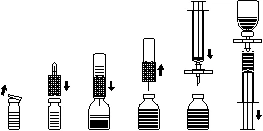
Fig. A Fig. B Fig. C Fig. D Fig. E Fig. F
Any unused portions of the medicinal product or waste materials should be disposed of in accordance with local regulations.
Administration of Immunate should be documented, and the batch number recorded. A detachable label is attached to each vial for inclusion in the patient's records.
Frequency of administration
The doctor will inform the patient how often and at what intervals Immunate should be administered, based on the treatment response in each individual patient.
Duration of treatment
Replacement therapy with Immunate is usually required for life.
Use of a higher than recommended dose of Immunate 250 IU FVIII/190 IU VWF
- No symptoms of factor VIII overdose have been reported. In case of doubt, consult your doctor.
- Thromboembolic events may occur.
- Hemolysis may occur in patients with blood group A, B, or AB.
Missed dose of Immunate 250 IU FVIII/190 IU VWF
- Do not administer a double dose to make up for a missed dose.
- Take the next regular dose as soon as possible and continue treatment at the intervals prescribed by the doctor.
Discontinuation of Immunate 250 IU FVIII/190 IU VWF
Do not discontinue Immunate without consulting your doctor.
If you have any further questions about the use of this medicine, consult your doctor.
4. Possible adverse reactions
Like all medicines, this medicine can cause adverse reactions, although not everyone experiences them.
Serious adverse reactions that may occur after administration of factor VIII products derived from human plasma
Allergic reactions have been rarely observed, which in some cases have led to severe and life-threatening reactions (anaphylaxis). Therefore, it is important to be aware of the early signs of allergic reactions, such as: sudden redness of the face, rash, urticaria, urticarial blisters, generalized itching, swelling of lips and tongue, dyspnoea (breathing difficulties), wheezing (difficulty inhaling/exhaling air due to narrowing of the airways), chest tightness, low blood pressure, drop in blood pressure, general malaise, and dizziness. These symptoms may be early signs of anaphylactic shock. If any allergic or anaphylactic reaction occurs, infusion/injection must be stopped immediately and the physician must be notified. Severe symptoms require immediate treatment as in emergencies.
In children who have not previously been treated with factor VIII-containing medicines, blocking antibodies (see section 2) may develop very frequently (more than 1 in 10 patients). However, in patients who have previously been treated with factor VIII (more than 150 days of treatment), the risk is uncommon (less than 1 in 100 patients). If this occurs, the patient's medicines may stop working properly and persistent bleeding may occur. In such cases, contact the physician immediately.
The development of neutralizing antibodies against von Willebrand factor is a known complication of treatment in patients with von Willebrand disease. If neutralizing antibodies (inhibitors) develop, this may manifest as an inadequate clinical response (bleeding not controlled despite appropriate dosing) or as an allergic reaction. In such cases, contact with a specialized hemophilia treatment center is recommended.
Hemolysis may occur in patients with blood group A, B, or AB after administration of high doses.
Adverse reactions reported after use of Immunate
Very common (may affect more than 1 in 10 patients)
- factor VIII inhibition (in children who have not previously been treated with factor VIII-containing medicines).
Uncommon (may affect not more than 1 in 100 patients)
- hypersensitivity;
- factor VIII inhibition [in patients who have previously been treated with factor VIII (treatment lasting longer than 150 days)].
Frequency not known (cannot be estimated from available data)
- coagulation disorders (inability to form clots);
- anxiety;
- paresthesia (tingling or pricking sensation);
- dizziness;
- headache;
- conjunctivitis;
- tachycardia (rapid heartbeat);
- palpitations;
- hypotension (low blood pressure);
- sudden redness of the face;
- pallor (pale appearance);
- dyspnoea (breathing difficulties);
- cough;
- vomiting;
- nausea;
- urticaria (urticarial rash over the body);
- rash;
- pruritus (itching sensation);
- erythema (redness of the skin);
- excessive sweating;
- neurodermitis (itchy or rough skin);
- muscle pain;
- chest pain;
- discomfort in the chest;
- edema (fluid retention);
- fever;
- chills;
- burning and stinging at the site of administration (local reactions);
- pain.
Reporting of adverse reactions
If any adverse reactions occur, including any not listed in this leaflet, inform your doctor or pharmacist. Adverse reactions can be reported directly to the Department of Monitoring Adverse Drug Reactions of the Office for Registration of Medicinal Products, Medical Devices and Biocidal Products
Al. Jerozolimskie 181 C
02-222 Warsaw
Tel.: + 48 22 49 21 301
Fax: + 48 22 49 21 309
Website: https://smz.ezdrowie.gov.pl
Adverse reactions can also be reported to the marketing authorization holder.
Reporting adverse reactions helps to provide more information on the safety of the medicine.
5. How to store Immunate 250 IU FVIII/190 IU VWF
Keep the medicine out of the sight and reach of children.
Store and transport under refrigerated conditions (2 °C – 8 °C). Do not freeze.
Keep in the original packaging to protect from light.
Do not use this medicine after the expiry date stated on the label and carton after EXP.
The expiry date refers to the last day of the stated month.
Within the shelf life, the product may be stored at room temperature (up to 25 °C) for one period not exceeding 6 months. The date and time of starting room temperature storage must be recorded on the product packaging. After storage at room temperature, Immunate must not be returned to the refrigerator but used immediately or discarded.
Do not use this medicine if, after reconstitution, the solution is cloudy or contains particulate matter.
Medicines must not be disposed of via the sewage system or household waste. Ask your pharmacist how to dispose of medicines no longer required. Such measures will help protect the environment.
6. Contents of the package and other information
What Immunate 250 IU FVIII/190 IU VWF contains
Powder:
- The active substances are human coagulation factor VIII and human von Willebrand factor. Each vial contains nominally 250 IU of factor VIII and 190 IU of von Willebrand factor derived from human plasma. After reconstitution with the provided solvent, the product contains approximately 50 IU/mL of factor VIII from human plasma and 38 IU/mL of von Willebrand factor from human plasma.
- Other ingredients: human albumin, glycine, sodium chloride, sodium citrate, lysine hydrochloride, and calcium chloride.
Solvent:
- Water for injections
What Immunate 250 IU FVIII/190 IU VWF looks like and contents of the pack
Powder and solvent for solution for injection.
White or slightly yellowish powder or brittle, solid mass.
The powder and solvent are available in single-dose glass vials, Ph. Eur. (powder: type II glass; solvent: type I glass), closed with butyl rubber stoppers, Ph. Eur.
Each pack contains:
1 vial of Immunate 250 IU FVIII/190 IU VWF
1 vial of water for injections (5 ml)
1 transfer or filtration set
1 single-use syringe (5 ml)
1 single-use needle
1 infusion set (butterfly needle)
Pack size: 1 x 250 IU FVIII/190 IU VWF
Marketing Authorisation Holder and Manufacturer
Marketing Authorisation Holder
Takeda Pharma Sp. z o.o.
ul. Prosta 68
00-838 Warsaw
Poland
Manufacturer
Takeda Manufacturing Austria AG
Industriestrasse 67
1221 Vienna
Austria
This medicinal product is authorised in the Member States of the European Economic Area under the following names:
Austria, Cyprus, Malta, Poland, Portugal, Romania, Slovakia, Slovenia: Immunate
Hungary: Immunate S/D
Italy: Talate
Other sources of information
Information intended exclusively for healthcare professionals:
Dosing in haemophilia A
The dose and duration of replacement therapy depend on the severity of factor VIII deficiency, the location and extent of bleeding, and the patient's clinical condition.
The administered factor VIII dose is expressed in International Units (IU), referring to the current WHO standard for factor VIII-containing products. Factor VIII activity in plasma is expressed as a percentage (relative to normal human plasma) or in IU (relative to the International Standard for plasma factor VIII).
One International Unit (IU) of factor VIII activity corresponds to the amount of factor VIII present in one millilitre of normal human plasma.
The required factor VIII dose has been calculated based on empirical observations that 1 International Unit (IU) of factor VIII per kg body weight raises plasma factor VIII activity by approximately 2% of normal activity.
The required dose can be calculated using the following formula:
Required number of units = body weight (kg) × desired increase in factor VIII (%) × 0.5
The administered amount and frequency should always be adjusted according to clinical efficacy in the individual case.
Bleeding episodes and surgical procedures
In the following types of bleeding, factor VIII activity should not fall below the indicated plasma activity levels (expressed as % of normal or IU/dL) at any time during treatment.
The following table may be used to guide dosing according to the type of bleeding or surgical procedure:
| Severity of bleeding / type of surgical procedure | Required factor VIII level (as % of normal) (IU/dL) | Dosing frequency (hours) / duration of treatment (days) |
|---|---|---|
| Bleeding Early bleeding into joints, muscles or oral cavity More severe bleeding into joints, muscles or hematoma Life-threatening bleeding | 20–40 30–60 60–100 | Repeat every 12–24 hours. For at least 1 day until bleeding stops, as assessed by resolution of pain or wound healing. Repeat infusions every 12–24 hours for 3–4 days or more, until resolution of pain and acute functional impairment. Repeat infusions every 8–24 hours until the life-threatening condition has resolved. |
| Surgical procedures Minor, including tooth extraction Major | 30–60 80–100 (pre- and postoperative) | Every 24 hours, for at least 1 day until wound healing occurs. Repeat infusions every 8–24 hours until adequate wound healing is achieved, then continue treatment for at least 7 additional days to maintain factor VIII activity at 30–60% (IU/dL). |
In certain circumstances (e.g., in the presence of low inhibitor titer), doses higher than those calculated according to the formula may be required.
Long-term prophylaxis
For long-term prophylaxis of bleeding in patients with severe hemophilia A, the usual factor VIII dose is 20–40 IU per kg body weight administered every 2–3 days.
In some cases, especially in younger patients, shorter intervals between doses or higher doses may be necessary.
Dosing in von Willebrand disease
Substitution therapy using Immunate to control bleeding is based on the guidelines for hemophilia A.
Immunate contains a relatively high amount of factor VIII in relation to von Willebrand factor content; therefore, the treating physician should be aware that continued treatment may lead to excessive increase in FVIII:C, which may result in an increased risk of thrombotic events.
Children and adolescents
The product should be used with caution in children under 6 years of age who have limited exposure to factor VIII-containing products, as data in this patient group are limited.
Dosing of factor VIII in children and adolescents under 18 years of age is based on body weight and therefore generally follows the same guidelines as in adult patients.
The dose and frequency of administration should always be adjusted according to clinical efficacy in the individual case (see section 4.4). In some cases, especially in younger patients, shorter intervals between doses or higher doses may be necessary.