Imipenem/cilastatin kabi
Poland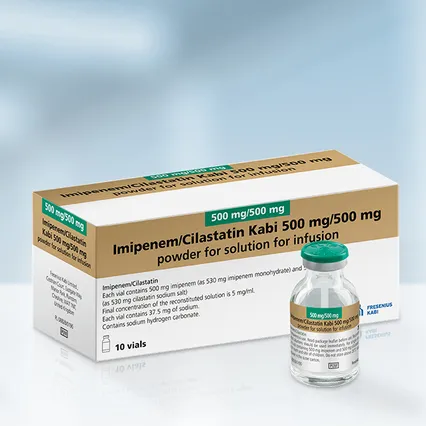
Table of Contents
- Package leaflet: Information for the user
- 1. What Imipenem/Cilastatin Kabi is and what it is used for
- 2. Important information before using Imipenem/Cilastatin Kabi
- 3. How to use Imipenem/Cilastatin Kabi
- 4. Possible adverse reactions
- 5. How to store Imipenem/Cilastatin Kabi
- 6. Contents of the pack and other information
- Information intended exclusively for medical professionals:
Package leaflet: Information for the user
Imipenem/Cilastatin Kabi, 500 mg + 500 mg, powder for solution for infusion
Imipenemum + Cilastatinum
Please read all of this leaflet carefully before use, as it contains important information for the patient.
- Keep this leaflet, as you may need to read it again.
- If you have any further questions, please consult your doctor or nurse.
- If you experience any adverse reactions, including any not listed in this leaflet, inform your doctor or nurse immediately. See section 4.
Table of contents
- What Imipenem/Cilastatin Kabi is and what it is used for
- Important information before using Imipenem/Cilastatin Kabi
- How to use Imipenem/Cilastatin Kabi
- Possible side effects
- How to store Imipenem/Cilastatin Kabi
- Contents of the pack and other information
1. What Imipenem/Cilastatin Kabi is and what it is used for
Imipenem/Cilastatin Kabi belongs to a group of medicines called carbapenem antibiotics. This medicine destroys a wide range of bacteria (microorganisms) causing infections in various parts of the body in adults and children aged 1 year and older.
Treatment
Your doctor has prescribed Imipenem/Cilastatin Kabi because you have been diagnosed with at least one of the following infections:
- complicated intra-abdominal infections;
- lung infection (pneumonia);
- infections acquired during or after childbirth;
- complicated urinary tract infections;
- complicated skin and soft tissue infections.
Imipenem/Cilastatin Kabi may be used to treat patients with low white blood cell counts and fever, which is likely caused by a bacterial infection.
Imipenem/Cilastatin Kabi may also be used to treat bacterial blood infections that may be associated with one of the types of infections listed above.
2. Important information before using Imipenem/Cilastatin Kabi
When not to use Imipenem/Cilastatin Kabi
- if the patient is allergic to imipenem, cilastatin, or any of the other ingredients of this medicine (listed in section 6);
- if the patient is allergic to other antibiotics, such as penicillins, cephalosporins, or carbapenems.
Warnings and precautions
Before starting treatment with Imipenem/Cilastatin Kabi, discuss with your doctor or
nurse if:
- the patient is allergic to any medicines, including antibiotics (sudden, life-threatening allergic reactions requiring immediate medical attention);
- the patient has colitis or any other gastrointestinal disorder;
- the patient has kidney or urinary tract disorders, including impaired renal function (in patients with impaired renal function, increased blood levels of Imipenem/Cilastatin Kabi have been observed; if the dose is not adjusted according to renal function, adverse effects on the central nervous system may occur);
- the patient has disorders of the central nervous system, such as focal tremor or seizures (convulsions);
- the patient has liver disease.
The result of a blood test detecting antibodies that can destroy red blood cells (Coombs test)
may be positive. Your doctor will discuss this with you.
Children
Imipenem/Cilastatin Kabi is not recommended for use in children under 1 year of age
and in children with kidney disease.
Imipenem/Cilastatin Kabi and other medicines
Tell your doctor or pharmacist about all medicines the patient is currently taking or
has recently taken, as well as any medicines the patient plans to take.
Inform your doctor if the patient is taking ganciclovir, which is used to treat
certain viral infections.
Also inform your doctor if the patient is taking valproic acid or sodium valproate
(medicines used for epilepsy, bipolar affective disorder, migraine, or schizophrenia),
or any medicines that "thin the blood", such as warfarin.
Your doctor will decide whether the patient can receive Imipenem/Cilastatin Kabi together with these
medicines.
Pregnancy and breastfeeding
If the patient is pregnant or breastfeeding, suspects she may be pregnant, or is planning to have
a baby, she should consult her doctor or pharmacist before using this medicine.
If the patient is pregnant or planning to become pregnant, she should inform her doctor before
starting treatment with Imipenem/Cilastatin Kabi. The use of imipenem with cilastatin in pregnant women has not been studied. Imipenem/Cilastatin Kabi should not be used during pregnancy unless the doctor decides that the potential benefits of treatment outweigh the risks to the developing child.
If the patient is breastfeeding or intends to breastfeed, she should inform her doctor before
starting treatment with Imipenem/Cilastatin Kabi. The medicine may pass into human milk in small amounts and may affect the breastfed child. Therefore, the doctor will decide
whether Imipenem/Cilastatin Kabi can be used during breastfeeding.
Driving and operating machinery
Some adverse effects associated with this medicine (such as hallucinations, i.e. seeing,
hearing, or feeling things that are not there, dizziness, drowsiness, and sensation of spinning) may
affect some patients' ability to drive or operate machinery (see section 4).
Imipenem/Cilastatin Kabi contains sodium
This medicine contains 37.5 mg of sodium (the main component of table salt) per vial. This corresponds to
1.9% of the maximum recommended daily dietary intake of sodium for adults.
3. How to use Imipenem/Cilastatin Kabi
Imipenem/Cilastatin Kabi is prepared and administered by a doctor or other qualified
medical personnel. The doctor will decide how much Imipenem/Cilastatin Kabi should be given
to the patient.
Use in adult patients and adolescents
The recommended dose for adult patients and adolescents is 500 mg + 500 mg every 6 hours or
1000 mg + 1000 mg every 6 or 8 hours. In patients with kidney disease, the doctor may reduce
the dose.
Use in children
The recommended dose for children aged 1 year or older is (15 mg + 15 mg)/kg body weight or (25 mg +
25 mg)/kg body weight every 6 hours. Imipenem/Cilastatin Kabi is not recommended for children under
1 year of age, or for children with kidney disease.
Method of administration
Imipenem/Cilastatin Kabi is administered intravenously; doses ≤(500 mg + 500 mg) should be given over
20–30 minutes, and doses >(500 mg + 500 mg) over 40–60 minutes. If the patient experiences nausea,
the infusion rate may be reduced.
Use of a higher than recommended dose of Imipenem/Cilastatin Kabi
Symptoms of overdose may include: seizures, confusion, tremor, nausea, vomiting,
low blood pressure, and slow heart rate. If the patient suspects having received too high
a dose of Imipenem/Cilastatin Kabi, they should contact a doctor or other qualified
medical personnel immediately.
Missed dose of Imipenem/Cilastatin Kabi
If the patient suspects that a dose of Imipenem/Cilastatin Kabi has been missed, they should contact
a doctor or other qualified medical personnel immediately.
Do not use a double dose to make up for a missed dose.
Stopping treatment with Imipenem/Cilastatin Kabi
Do not stop using Imipenem/Cilastatin Kabi without the doctor's instruction.
If you have any further questions about the use of this medicine, consult your doctor or nurse.
4. Possible adverse reactions
Like all medicines, this medicine can cause adverse reactions, although not everyone will experience them.
During or after administration of Imipenem/Cilastatin Kabi, the following adverse reactions have occurred rarely; however, if they do occur, treatment must be discontinued immediately and medical advice should be sought without delay.
- Allergic reactions, including rash, swelling of the face, lips, tongue and (or) throat (causing difficulty in breathing or swallowing) and (or) low blood pressure.
- Skin peeling (toxic epidermal necrolysis).
- Severe skin reactions (Stevens-Johnson syndrome and erythema multiforme).
- Severe rash with skin peeling and hair loss (exfoliative dermatitis).
Other possible adverse reactions:
Common (may affect less than 1 in 10 patients):
- nausea, vomiting, diarrhoea; nausea and vomiting appear to occur more frequently in patients with low white blood cell counts;
- swelling and redness along the vein, which may be exceptionally tender to touch;
- rash;
- abnormal liver function detected by blood tests;
- increased number of certain types of white blood cells.
Uncommon (may affect less than 1 in 100 patients):
- local skin redness;
- pain and formation of a hard lump at the injection site;
- skin itching;
- urticaria;
- fever;
- blood disorders affecting blood cells, usually detected during blood analysis (symptoms may include fatigue, pale skin, and prolonged bruising after injury);
- abnormal kidney, liver and blood function detected by blood tests;
- tremor and uncontrolled muscle twitching;
- seizures;
- psychiatric disturbances (such as mood swings and impaired judgment);
- seeing, hearing or feeling things that are not real (hallucinations);
- disorientation;
- dizziness, drowsiness;
- low blood pressure.
Rare (may affect less than 1 in 1,000 patients):
- fungal infection (candidiasis);
- discoloration of teeth and (or) tongue;
- inflammation of the colon (large intestine) with severe diarrhoea;
- taste disturbances;
- liver function disorders;
- hepatitis;
- kidney function disorders;
- changes in the amount of urine passed and changes in urine colour;
- brain function disturbances, tingling sensation, local tremor;
- hearing loss.
Very rare (may affect less than 1 in 10,000 patients):
- severe liver dysfunction due to hepatitis (fulminant hepatitis);
- inflammation of the stomach or intestines;
- intestinal inflammation with bloody diarrhoea (haemorrhagic colitis);
- redness and swelling of the tongue, tongue papillae overgrowth giving a "hairy" appearance, heartburn, sore throat, increased salivation;
- stomach pain;
- sensation of spinning (dizziness), headache;
- ringing in the ears (tinnitus);
- joint pain, weakness;
- irregular heartbeat, rapid heartbeat or strong heartbeats (palpitations);
- chest discomfort, difficulty breathing, excessive rapid or shallow breathing, pain in the upper part of the spine;
- hot flushes with facial redness, bluish discolouration of the face and lips, skin texture changes, excessive sweating;
- genital itching in women;
- changes in blood cell counts;
- worsening of symptoms of a rare condition causing muscle weakness (exacerbation of myasthenia gravis symptoms).
Frequency not known (cannot be estimated from the available data):
- abnormal movements;
- restlessness.
Reporting of adverse reactions
If any adverse reactions occur, including any adverse reactions not listed in this leaflet, inform a doctor or pharmacist. Adverse reactions can be reported directly to the Department of Monitoring Adverse Drug Reactions of the Office for Registration of Medicinal Products, Medical Devices and Biocidal Products
Al. Jerozolimskie 181C
02-222 Warszawa
Tel: +48 22 49-21-301
Fax: +48 22 49-21-309
Website: https://smz.ezdrowie.gov.pl
Adverse reactions can also be reported to the marketing authorization holder.
Reporting adverse reactions helps provide more information on the safety of this medicine.
5. How to store Imipenem/Cilastatin Kabi
Keep the medicine out of the sight and reach of children.
Do not use this medicine after the expiry date stated on the cardboard box and vial (bottle) after EXP. The expiry date refers to the last day of the stated month.
Before opening:
Do not store above 25°C.
After first opening/reconstitution:
The reconstituted/diluted solution should be used immediately. The time from the start of dissolution to the end of intravenous infusion should not exceed two hours.
Do not freeze the prepared solution.
Medicines must not be disposed of via wastewater or household waste. Ask your pharmacist how to dispose of medicines no longer required. These measures will help protect the environment.
6. Contents of the pack and other information
What Imipenem/Cilastatin Kabi contains
- The active substances are: 500 mg of imipenem (as 530 mg of imipenem monohydrate) and 500 mg of cilastatin (as 530 mg of cilastatin sodium).
- Other ingredient: sodium hydrogen carbonate.
What Imipenem/Cilastatin Kabi looks like and contents of the pack
Imipenem/Cilastatin Kabi is a white to almost white or light yellow powder supplied in 20 ml glass vials or 100 ml glass bottles.
Imipenem/Cilastatin Kabi is available in packs containing 10 glass vials or 10 glass bottles of powder, each closed with a rubber stopper and an aluminium flip-off cap, packed in a cardboard box.
Not all pack sizes may be marketed.
Marketing Authorisation Holder and Manufacturer
Marketing Authorisation Holder
Fresenius Kabi Polska Sp. z o.o.
Al. Jerozolimskie 134
02-305 Warsaw
Poland
Manufacturer
ACS Dobfar S.p.A.
Nucleo Industriale S. Atto
S. Nicolò a Tordino, 64100 Teramo
Italy
For further information about this medicinal product, please contact the Marketing Authorisation Holder:
Fresenius Kabi Polska Sp. z o.o.
Al. Jerozolimskie 134
02-305 Warsaw
Poland
Tel: +48 22 345 67 89
This medicinal product is authorised in the European Economic Area countries under the following names:
Austria Imipenem/Cilastatin Kabi 500 mg/500 mg Pulver zur Herstellung einer Infusionslösung
Belgium Imipenem/Cilastatine Fresenius Kabi 500 mg/500 mg poeder voor oplossing voor infusie
Czech Republic Imipenem/Cilastatin Kabi 500 mg/500 mg, prášek pro přípravu inf. roztoku
France Imipenem/Cilastatine Kabi 500 mg/500 mg, poudre pour solution pour perfusion
Greece Imipenem/Cliastatin 500 mg/500 mg κόνις για διάλυμα προς έγχυση
Spain Imipenem/Cilastatina Kabi 500 mg/500 mg, polvo para solución para perfusión
Netherlands Imipenem/Cilastatine Fresenius Kabi 500 mg/500 mg poeder voor oplossing voor infusie
Luxembourg Imipenem/Cilastatin Kabi 500 mg/500 mg, Pulver zur Herstellung einer Infusionslösung
Germany Imipenem/Cilastatin Kabi 500 mg/500 mg Pulver zur Herstellung einer Infusionslösung
Poland Imipenem/Cilastatin Kabi
Portugal Imipenem/Cilastatina Kabi
Romania Imipenem/Cilastatină Kabi 500 mg/500 mg pulbere pentru soluţie perfuzabilă
Slovakia Imipenem/Cilastatin Kabi 500 mg/500 mg, prášok na infúzny roztok
Sweden Imipenem/Cilastatin Fresenius Kabi 500 mg/500 mg pulver till infusionsvätska, lösning
Hungary Imipenem/Cilastatin Kabi 500 mg/500 mg por oldatos infúzióhoz
United Kingdom Imipenem/Cilastatin 500 mg/500 mg Powder for Solution for Infusion
Italy Imipenem/Cilastatina Kabi 500 mg/500 mg, polvere per soluzione per infusione
Information intended exclusively for medical professionals:
Each container is for single use only.
Preparation of the solution
The contents of each container should be transferred to 100 ml of an appropriate infusion solution
(see section Incompatibility and Reconstituted solution): 0.9% sodium chloride solution.
In exceptional circumstances, if 0.9% sodium chloride solution cannot be used for clinical reasons,
5% glucose solution may be used instead.
According to the recommended procedure, add approximately 10 ml of the appropriate infusion
solution to the container. Shake the container vigorously, then transfer the resulting mixture to
an infusion container.
WARNING: THE MIXTURE IS NOT INTENDED FOR DIRECT INFUSION.
Repeat the procedure by adding another 10 ml of infusion solution to ensure that the entire
contents of the container have been transferred into the infusion solution. Shake the mixture until
it becomes clear.
The concentration of imipenem and cilastatin in the solution prepared according to the above
procedure is approximately 5 mg/ml.
Variations in color (from colorless to yellow) do not affect the potency of the medicinal product.
Incompatibility
This medicinal product exhibits chemical incompatibility with lactates and therefore must not be
dissolved or diluted in solvents containing lactates. However, the medicinal product may be
administered through an infusion set used for lactate-containing solutions.
Do not mix this medicinal product with other medicinal products, except those mentioned in
section Preparation of the solution.
Reconstituted solution
The reconstituted/diluted solution should be used immediately. The time from the start of
reconstitution to the end of intravenous infusion should not exceed two hours.
Any unused portions of the medicinal product or waste materials should be disposed of in
accordance with local regulations.