Imikeraderm
Poland
Table of Contents
Imikeraderm, 50 mg/g, cream
Imiquimod
Please read the entire leaflet carefully before using the medicine, as it contains
important information for the patient.
- Keep this leaflet, so that you can read it again if necessary.
- If you have any doubts, please consult your doctor or pharmacist.
- This medicine has been prescribed for a specific individual. Do not pass it on to others. This medicine may harm someone else, even if their symptoms are the same.
- If the patient experiences any adverse reactions, including any not listed in this leaflet, inform your doctor or pharmacist. See section 4.
Table of contents
- What Imikeraderm is and what it is used for
- Important information before using Imikeraderm
- How to use Imikeraderm
- Possible side effects
- How to store Imikeraderm
- Contents of the pack and other information
1. What Imikeraderm is and what it is used for
Imikeraderm is used in the treatment of actinic keratosis.
Actinic keratosis is a condition characterized by rough skin patches in individuals who have been exposed to prolonged sunlight over their lifetime. Some of the skin lesions may be skin-colored, while others may appear grey, pink, red, or brown. These lesions may be flat and scaly, or raised, rough, hard, and wart-like. Imikeraderm may only be used for flat actinic keratosis located on the face and scalp (hairy skin of the head) in patients with normally functioning immune systems, when the doctor considers treatment with Imikeraderm cream to be the most appropriate option.
Imikeraderm helps the body's immune system produce natural substances that assist in fighting actinic keratosis.
2. Important information before using Imikeraderm
When not to use Imikeraderm:
- if the patient is allergic to imiquimod or any of the other ingredients of this medicine (listed in section 6).
Warnings and precautions
Before starting treatment with Imikeraderm, discuss this with your doctor or pharmacist.
- If Imikeraderm or other similar medicines have been used previously, inform your doctor before starting treatment.
- If the patient has autoimmune disorders.
- If the patient has undergone organ transplantation.
- Do not use Imikeraderm until the treated area has healed after previous treatment with medicines or surgical procedures.
- Avoid contact with eyes, mouth, and nostrils. In case of accidental contact, remove the cream by rinsing with water.
- Do not use the cream internally.
- Do not use more cream than prescribed by the doctor.
- Do not cover the treated area with bandages or other dressings after application of Imikeraderm.
- If symptoms at the treated site become too bothersome, wash the cream off with water and mild soap. After symptoms subside, treatment with the cream may be resumed.
- If blood cell counts are outside normal ranges, inform your doctor.
Due to its mechanism of action, Imikeraderm may cause worsening of pre-existing inflammatory conditions
at the treated site.
During treatment with Imikeraderm, do not use solariums and, as much as possible, avoid exposure to sunlight. When outdoors, wear protective clothing and wide-brimmed hats.
During treatment with Imikeraderm, until lesions have healed, the treated area may significantly differ from normal skin.
Children and adolescents
Use of this medicine is not recommended in children and adolescents.
Imikeraderm and other medicines
Inform your doctor or pharmacist about all medicines the patient is currently taking or has recently taken, as well as any medicines planned for future use.
No medicines are known to interact with Imikeraderm.
Pregnancy and breastfeeding
If the patient is pregnant or breastfeeding, suspects she might be pregnant, or is planning to become pregnant, she should consult her doctor or pharmacist before using this medicine.
The patient must inform her doctor if she is pregnant or intends to become pregnant. The doctor will discuss the risks and benefits of using Imikeraderm during pregnancy. Animal studies have not shown direct or indirect harmful effects on pregnancy.
Breastfeeding should be avoided during treatment with Imikeraderm, as it is unknown whether imiquimod is excreted in human milk.
Driving and operating machinery
This medicine has no effect or has negligible effect on the ability to drive and operate machinery.
Imikeraderm contains methyl parahydroxybenzoate, propyl parahydroxybenzoate (E 218 and E 216)
Methyl hydroxybenzoate (E 218) and propyl hydroxybenzoate (E 216) may cause allergic reactions (including delayed-type reactions).
Imikeraderm contains cetyl alcohol and stearyl alcohol
Cetyl alcohol and stearyl alcohol may cause local skin reactions (e.g. contact dermatitis).
Imikeraderm contains benzyl alcohol
The medicine contains 5 mg of benzyl alcohol in each sachet. Benzyl alcohol may cause allergic reactions and mild local irritation.
Imikeraderm contains butylated hydroxytoluene (E 321)
Butylated hydroxytoluene (E 321) may cause local skin reactions (e.g. contact dermatitis) or irritation of eyes and mucous membranes.
3. How to use Imikeraderm
Children and adolescents:
The use of this medicine is not recommended in children and adolescents.
Adults:
This medicine should always be used as directed by a physician. In case of doubt, consult your
doctor or pharmacist.
Hands should be thoroughly washed before and after applying the cream. The treated area should not be covered with bandages or
other dressings after application of Imikeraderm.
Each time the cream is used, a new sachet should be used. After squeezing out the cream from the sachet, the remaining cream and the empty sachet should be discarded. Do not leave an opened sachet for later use.
Imikeraderm – instructions for use
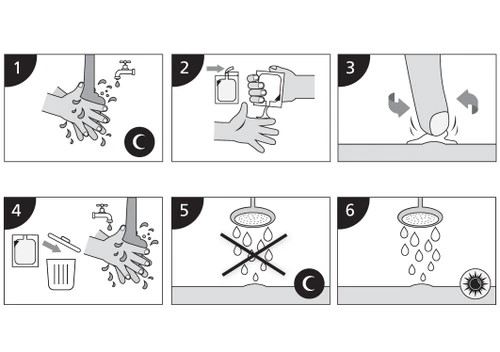
Instructions for use (Monday, Wednesday, and Friday)
- Before going to sleep, wash your hands and the affected area with water and a mild soap. Dry carefully.
- Open a new sachet and squeeze a small amount of cream onto the fingertip.
- Apply a thin layer of cream to the affected area. Gently rub in until the cream is completely absorbed into the skin.
- After applying the cream, discard the opened sachet. Wash your hands with water and soap.
- Leave Imikeraderm on the skin for approximately 8 hours. During this time, do not take a shower or bath.
- After approximately 8 hours, wash the treated area with water and mild soap.
Imikeraderm should be applied three times a week, for example on Monday, Wednesday, and Friday. One
sachet contains enough cream to cover an area of approximately 25 cm². Continue treatment for four weeks. After the first four weeks of treatment, your doctor will assess your skin condition. If the lesions have not resolved, treatment may be extended for an additional four weeks.
If more Imikeraderm is used than recommended
Wash off the excess cream with water and mild soap. Once skin reactions have subsided, treatment may be resumed as directed.
In case of accidental ingestion of Imikeraderm, contact your doctor immediately.
If you forget to use Imikeraderm
If a dose is missed, apply the cream as soon as you remember, then continue treatment according to the prescribed schedule.
Do not apply the cream more than once a day.
If you have any doubts about how to use this medicine, consult your doctor or pharmacist.
4. Possible adverse reactions
Like all medicines, this medicine can cause adverse reactions, although not everyone experiences them.
If you feel unwell during treatment with Imikeraderm, inform your doctor or pharmacist as soon as possible.
Some patients have experienced skin discoloration at the site of application of Imikeraderm. Although these changes usually resolve over time, in some patients they may be permanent. If the skin reacts badly during treatment with Imikeraderm, discontinue use of the cream, wash the treated area with water and mild soap, and contact your doctor or pharmacist.
In some patients, a decrease in blood cell counts has been observed. A reduced number of blood cells may increase the risk of infections, lead to more frequent bruising, or cause fatigue. If any of these symptoms occur, inform your doctor.
In patients with autoimmune disorders, their condition may worsen. If any changes occur during treatment with Imikeraderm, patients should inform their doctor.
Serious skin reactions have been rarely reported. If skin lesions or skin spots appear, initially as small red spots followed by tiny spots, possibly accompanied by symptoms such as itching, fever, general malaise, joint pain, vision problems, burning, pain or itching of the eyes, and oral ulcers, discontinue use of Imikeraderm and inform your doctor immediately.
In a small number of patients, hair loss at the application site or surrounding area has been observed.
Many of the adverse reactions associated with Imikeraderm are local skin reactions. Local skin reactions may indicate that the medicine is working as intended.
Very common (may affect more than 1 in 10 people)
Very commonly, mild itching at the treated skin area may occur.
Common (may affect up to 1 in 10 people)
Common adverse reactions include pain, burning sensation, irritation, or redness.
If skin discomfort becomes too bothersome during treatment, inform your treating doctor. The doctor may recommend temporarily discontinuing Imikeraderm for several days (e.g. a short treatment break). If pus (discharge) or symptoms suggesting infection occur, inform your treating doctor. In addition to skin reactions, other common adverse reactions include headache, loss of appetite, nausea, muscle and joint pain, and fatigue.
Uncommon (may affect up to 1 in 100 people)
Uncommonly, some patients experienced changes at the site of cream application (bleeding, inflammatory reaction, discharge, hypersensitivity, swelling, localized swelling, tingling sensation, scaling, scarring, ulceration, or sensation of warmth or discomfort), or inflammatory changes of the nasal mucosa, nasal congestion, flu-like symptoms, depression, eye irritation, eyelid swelling, sore throat, diarrhea, solar keratosis, redness, facial swelling, ulceration, limb pain, fever, weakness, or chills.
Reporting of adverse reactions
If any adverse reactions occur, including any not listed in this leaflet, inform your doctor or pharmacist. Adverse reactions can be reported directly to the Department of Monitoring Adverse Drug Reactions of the Office for Registration of Medicinal Products, Medical Devices and Biocidal Products:
Al. Jerozolimskie 181C
02-222 Warsaw
Phone: +48 22 49 21 301
Fax: +48 22 49 21 309
Website: https://smz.ezdrowie.gov.pl
Adverse reactions can also be reported to the responsible entity.
Reporting adverse reactions helps to provide more information on the safety of the medicine.
5. How to store Imikeraderm medicine
Keep the medicine out of sight and reach of children.
Do not store above 25°C.
Do not use this medicine after the expiry date stated on the packaging and sachet following "EXP".
The expiry date refers to the last day of the stated month.
Do not reuse cream from an opened sachet.
Medicines must not be disposed of via wastewater or household waste. Ask your pharmacist how to dispose of medicines no longer in use. This will help protect the environment.
6. Contents of the package and other information
What Imikeraderm contains
The active substance is:
imiquimod.
Each sachet contains 250 mg of cream (100 mg of cream contains 5 mg of imiquimod).
Other components are:
isostearic acid, benzyl alcohol, white soft paraffin (stabilized with butylhydroxytoluene E 321),
cetyl alcohol, stearyl alcohol, polysorbate 60, sorbitan stearate (type I), glycerol, methyl
parahydroxybenzoate (E 218), propyl parahydroxybenzoate (E 216), xanthan gum, purified water
(see also section 2).
What Imikeraderm looks like and contents of the pack
Each sachet of Imikeraderm contains 250 mg of cream, white to pale yellow in colour. Each pack contains
12 single-use sachets made of PET/LDPE/Aluminium/Surlyn laminate.
Not all pack sizes may be marketed.
Marketing Authorisation Holder and Manufacturer
Marketing Authorisation Holder
SUN-FARM Sp. z o.o.
ul. Dolna 21
05-092 Łomianki
tel. +48 22 350 66 69
Manufacturer
mibe GmbH Arzneimittel
Münchener Straße 15
06796 Brehna
Germany
SUN-FARM Sp. z o.o.
ul. Dolna 21
05-092 Łomianki
This medicinal product is authorised in the following names in the European Economic Area countries:
Germany: Imikeraderm 50 mg/g Creme
Austria: Imikeraderm 50 mg/g Creme
Poland: Imikeraderm
Spain: Imikeraderm 50 mg/g crema