Ibuprom effect gel
Poland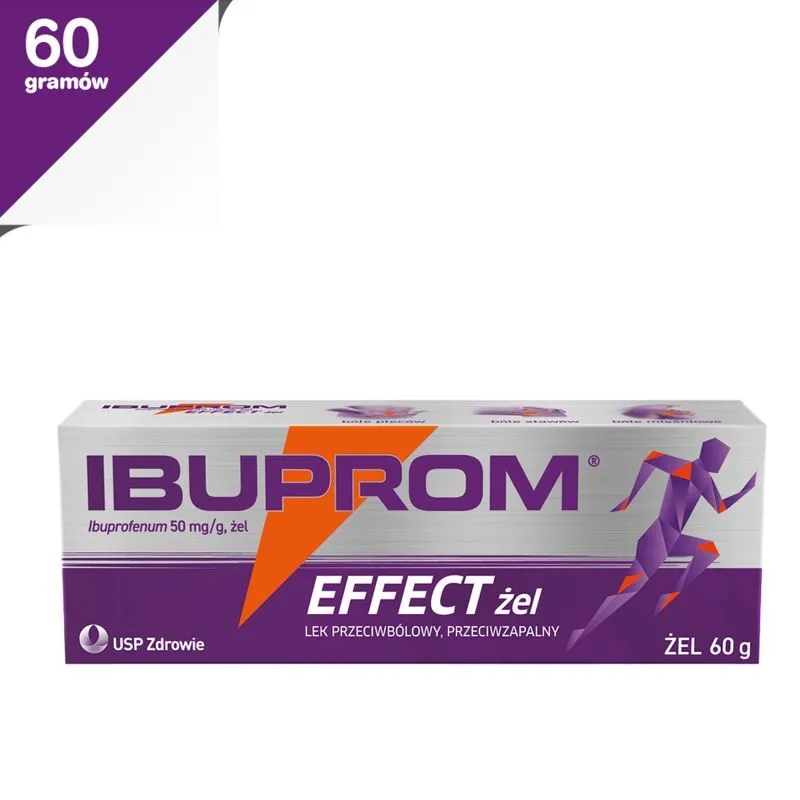
Table of Contents
Package leaflet: Information for the patient
IBUPROM EFFECT GEL
50 mg/g, gel
Ibuprofen
Please read all of this leaflet carefully before using this medicine, as it contains
important information for you.
This medicine should always be used exactly as described in this patient leaflet or as directed by
your doctor or pharmacist.
- Keep this leaflet, so that you can read it again if necessary.
- If you need advice or further information, please consult your pharmacist.
- If you experience any side effects, including any possible side effects not listed in this leaflet, tell your doctor or pharmacist. See section 4.
- If there is no improvement after 10 days, or if you feel worse, you should contact your doctor.
Contents of the leaflet
- What Ibuprom Effect Gel is and what it is used for
- Important information before using Ibuprom Effect Gel
- How to use Ibuprom Effect Gel
- Possible side effects
- How to store Ibuprom Effect Gel
- Contents of the pack and other information
1. What Ibuprom Effect Gel is and what it is used for
Ibuprofen belongs to a group of medicines called non-steroidal anti-inflammatory drugs (NSAIDs).
Ibuprofen has analgesic and anti-inflammatory effects. Its action is based on inhibition of prostaglandin synthesis in inflamed tissues.
Indications for Ibuprom Effect Gel:
- Local treatment of muscle pain,
- Treatment of pain associated with degenerative joint diseases, rheumatic disorders of peripheral joints and spine,
- Treatment of inflammatory changes in periarticular tissues (e.g. bursae, tendons, tendon sheaths, ligaments and joint capsules),
- Treatment of painful shoulder stiffness, lumbar back pain, and traumatic injuries related to sports or accidents (e.g. contusions, sprains).
Ibuprom Effect Gel is indicated for use in adults and adolescents aged
over 14 years.
2. Important information before using Ibuprom Effect Gel
When not to use Ibuprom Effect Gel
- If you are allergic to the active substance or to any of the other ingredients of this medicine (listed in section 6).
- If you have hypersensitivity (allergy) to acetylsalicylic acid or other non-steroidal anti-inflammatory drugs (NSAIDs).
- If in the past, after taking acetylsalicylic acid or other NSAIDs, you experienced: urticaria, allergic rhinitis, or asthma.
If you are in the last three months of pregnancy.
Warnings and precautions
Before starting to use Ibuprom Effect Gel, discuss it with your doctor or
pharmacist.
Do not apply Ibuprom Effect Gel to open wounds, mucous membranes, or near the eyes.
Use Ibuprom Effect Gel with caution in patients with gastric or duodenal ulcer disease, renal insufficiency, bronchial asthma, or intolerance to acetylsalicylic acid, ibuprofen, or other orally administered NSAIDs.
Serious skin reactions have been reported with the use of ibuprofen, including exfoliative dermatitis, erythema multiforme, Stevens-Johnson syndrome, toxic epidermal necrolysis, drug reaction with eosinophilia and systemic symptoms (DRESS), and acute generalized exanthematous pustulosis (AGEP). If you experience any symptoms related to these serious skin reactions described in section 4, stop using Ibuprom Effect Gel immediately and seek medical help.
During treatment with Ibuprom Effect Gel, avoid exposing the treated areas of skin to sunlight, as this may cause photosensitivity reactions (photoallergy).
If a rash develops, discontinue use of the medicine.
If there is no need to treat the hands therapeutically, wash your hands after each application of the gel.
Children and adolescents
Ibuprom Effect Gel is not recommended for use in children under 14 years of age.
Ibuprom Effect Gel and other medicines
Tell your doctor or pharmacist about all medicines you are currently taking, have recently taken, or plan to take.
There are currently no known interactions between topically applied ibuprofen and other medicines. However, concomitant use of acetylsalicylic acid and other non-steroidal anti-inflammatory drugs may increase the frequency of adverse effects.
Pregnancy, breastfeeding and fertility
If you are pregnant or breastfeeding, think you may be pregnant, or are planning to have a baby, you should consult your doctor or pharmacist before using Ibuprom Effect Gel.
Pregnancy
Do not use Ibuprom Effect Gel during the last three months of pregnancy. Do not use
Ibuprom Effect Gel during the first six months of pregnancy unless absolutely
necessary and recommended by a doctor. If treatment is required during this period, the lowest effective dose should be used for the shortest possible duration.
Oral forms of ibuprofen (e.g. tablets) may cause adverse effects in the unborn child. It is not known whether the same risk applies when ibuprofen is applied to the skin.
Breastfeeding
Do not use Ibuprom Effect Gel during breastfeeding.
Driving and using machines
There are no data on the effect of this medicine on the ability to drive or operate machinery.
Ibuprom Effect Gel contains alcohol (ethanol)
This medicine contains 200 mg of alcohol (ethanol) in each 1 g of gel, equivalent to 400 mg to 1000 g per dosing unit. It may cause stinging on damaged skin.
3. How to use Ibuprom Effect gel
This medicine should always be used exactly as described in this patient leaflet or as directed by your doctor or pharmacist. If in doubt, consult your doctor or pharmacist.
Ibuprom Effect gel is for topical use on the skin only.
Unless otherwise advised by your doctor, apply a strip of gel 4 to 10 cm long (2 g to 5 g of gel, corresponding to 100 mg to 250 mg of ibuprofen) to the affected area and rub in gently 3 to 4 times daily.
If necessary, the medicine may be used more frequently, but not more often than every 4 hours.
Do not exceed a total daily dose of 12 g of gel (600 mg of ibuprofen).
The duration of treatment should be determined by your doctor. If symptoms persist or worsen after 10 days of treatment, consult your doctor.
This medicine is not intended for use under occlusive dressings.
Absorption of the active substance through the skin is increased during iontophoresis (a special form of electrotherapy). When using iontophoresis, apply Ibuprom Effect gel under the cathode (negative pole). The usual current intensity is 0.1 to 0.5 mA per 5 cm² of electrode surface area, and the treatment duration should not exceed 15 minutes.
Ibuprom Effect gel is not recommended for use in children under 14 years of age.
Overdose of Ibuprom Effect gel
Due to low systemic absorption through the skin (compared to oral administration), cases of poisoning following topical application of Ibuprom Effect gel have not been observed.
Oral ingestion of 8 g to 12 g of ibuprofen in adults may cause dizziness, loss of consciousness, and hypotension.
In children aged 1.5 to 2 years, ingestion of 3 g to 4 g of ibuprofen may result in respiratory arrest and cyanosis. With controlled ventilation and intensive supportive care, respiration normalizes within 12 hours.
In cases of poisoning due to misuse of Ibuprom Effect gel, treatment should be based on the symptoms presented. There is no known antidote for ibuprofen poisoning. If a potentially toxic amount of Ibuprom Effect gel has been ingested within the past hour, seek immediate medical attention.
Missed dose of Ibuprom Effect gel
Do not use a double dose to make up for a missed dose.
If you have any doubts about how to use this medicine, consult your doctor or pharmacist.
4. Possible adverse effects
Like all medicines, this medicine can cause adverse effects, although they do not occur in everyone.
If any of the following symptoms occur, stop taking the medicine and contact your doctor immediately.
- non-specific allergic and anaphylactic reactions, shock,
- asthma, worsening of asthmatic condition, bronchospasm or shortness of breath,
- red, flat, disc-shaped or circular skin lesions on the trunk, often with blisters in the center, peeling skin, oral, throat, nasal, genital or ocular ulcers. These severe skin reactions may be preceded by fever and flu-like symptoms (exfoliative dermatitis, erythema multiforme, Stevens-Johnson syndrome, toxic epidermal necrolysis),
- widespread rash, high body temperature and enlarged lymph nodes (DRESS syndrome),
- red, scaly rash with subcutaneous nodules and blisters, accompanied by fever. Symptoms usually appear at the beginning of treatment (acute generalised exanthematous pustulosis).
Very rare adverse effects (may affect up to 1 in 10,000 people):
- skin disorders (e.g. redness, tingling at the site of application),
- various types of rashes, itching, urticaria, angioedema, purpura,
- renal failure in patients with kidney disease,
- abdominal pain, dyspepsia.
Adverse effects with unknown frequency (frequency cannot be estimated from available data):
- skin becomes sensitive to light.
Additional adverse effects may occur during long-term treatment.
If any adverse effect worsens or if any adverse effects not listed in this leaflet occur, inform your doctor or pharmacist.
Reporting of adverse effects
If any adverse effects occur, including any possible adverse effects not listed in this leaflet, consult your doctor or pharmacist.
Adverse effects can be reported directly to the Department of Monitoring of Adverse Drug Reactions at the Office for Registration of Medicinal Products, Medical Devices and Biocidal Products
Al. Jerozolimskie 181C
02–222 Warsaw
Tel.: +48 22 49 21 301
Fax: +48 22 49 21 309
Website: https://smz.ezdrowie.gov.pl
Adverse effects can also be reported to the marketing authorisation holder.
Reporting adverse effects helps to provide more information on the safety of this medicine.
5. How to store the medicine I E
Keep this medicine out of sight and reach of children.
There are no special storage temperature requirements for this medicine. Store in the original
packaging to protect from light.
Storage conditions after first opening: Store below 25 °C.
Store in the original packaging to protect from light.
Do not use medicine I E after the expiry date stated on the label.
The expiry date refers to the last day of the specified month.
After first opening, the medicine should be used within a maximum of 3 months.
Medicines must not be disposed of via wastewater or household waste. Ask your
pharmacist how to dispose of medicines no longer required. Such measures will help
protect the environment.
6. Contents of the packaging and other information
What I E contains
The active substance is ibuprofen. The content of ibuprofen is 50 mg per 1 g of gel.
The other ingredients are: ethanol 96%, isopropyl alcohol, hydroxyethylcellulose, levomenthol,
aroma Reflex 12122 (methyl salicylate), diethylene glycol monoethyl ether,
caprylic-capric macrogol glycerides (Macrogol 400), glycerol, sodium hydroxide (10% aqueous solution), purified water.
What I E looks like and contents of the pack
A transparent, slightly yellowish gel with a characteristic odour.
Aluminium tube, internally coated with epoxyphenolic resin, protected with an aluminium foil, closed with a cap made of HDPE polyethylene, containing 20 g, 60 g or 100 g of gel, placed in a cardboard box.
Marketing Authorisation Holder and Manufacturer
Marketing Authorisation Holder
US Pharmacia Sp. z o.o.
Ziębicka Street 40
50-507 Wrocław, Poland
Manufacturer
Farmasierra Manufacturing, S.L.
Ctra. Irún, Km. 26,200
San Sebastián de los Reyes, 28709 Madrid, Spain
For further information about this medicine, please contact the representative of the Marketing Authorisation Holder:
USP Zdrowie Sp. z o.o.
Poleczki Street 35, 02-822 Warsaw, Poland
Tel. +48 (22) 543 60 00