Hydroxyzine vp
Poland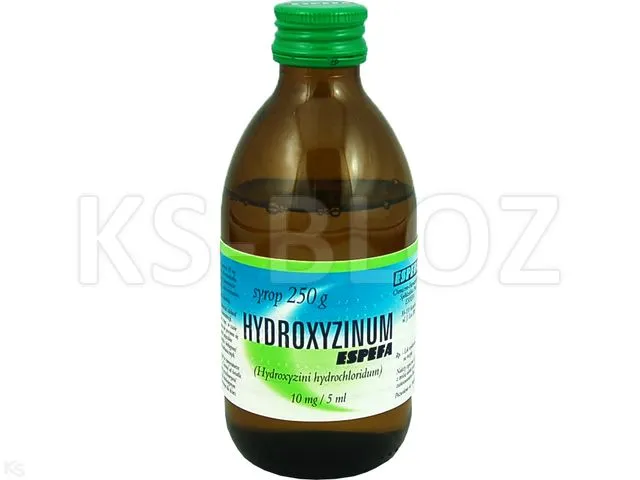
Table of Contents
Package leaflet: Information for the patient
Hydroxyzinum VP, 2 mg/ml, syrup
Hydroxyzini hydrochloridum
Please read the entire leaflet carefully before using this medicine, as it contains important information for the patient.
- Keep this leaflet for future reference.
- If you have any questions, please consult your doctor or pharmacist. This medicine has been prescribed for a specific individual. Do not share it with others. This medicine may harm others, even if their symptoms are similar.
- If any adverse reactions occur, including any not listed in this leaflet, inform your doctor or pharmacist. See section 4.
Table of contents:
- What is Hydroxyzinum VP and what is it used for
- Important information before taking Hydroxyzinum VP
- How to take Hydroxyzinum VP
- Possible side effects
- How to store Hydroxyzinum VP
- Contents of the pack and other information
1. What is Hydroxyzinum VP and what is it used for
Hydroxyzinum VP is a medicine with anxiolytic, sedative, and antipruritic effects.
Hydroxyzinum VP is indicated:
- for symptomatic treatment of anxiety in adults,
- for symptomatic relief of pruritus,
- for premedication prior to surgical procedures.
2. Important information before using Hydroxyzinum VP
When not to use Hydroxyzinum VP:
- if the patient is allergic to hydroxyzine hydrochloride or any of the other ingredients of this medicine (listed in section 6);
- if the patient is allergic to cetirizine or other medicines belonging to the so-called piperazine derivatives, theophylline or ethylenediamine;
- if the patient has porphyria;
- if the patient's ECG (electrocardiogram) shows heart rhythm disturbances known as QT prolongation;
- if the patient has or has had heart disease or if the heart rate is very low;
- if the patient has low levels of electrolytes (e.g. low potassium or magnesium levels);
- if the patient is taking certain medicines used to treat heart rhythm disorders or medicines that may affect heart rhythm (see "Hydroxyzinum VP and other medicines");
- if someone in the patient’s family has died suddenly due to heart disease;
- if the patient is pregnant or breastfeeding;
- if the patient has a hereditary intolerance to certain sugars.
Warnings and precautions
Before starting treatment with Hydroxyzinum VP, discuss with your doctor:
- if the patient has an increased tendency to seizures or heart rhythm disturbances (arrhythmias);
- if the patient is taking other medicines (see section "Hydroxyzinum VP and other medicines");
- if the patient has glaucoma, myasthenia (muscle fatigue and weakness) or dementia;
- if the patient has difficulty urinating or reduced gastrointestinal peristalsis.
Treatment with Hydroxyzinum VP may be associated with an increased risk of heart rhythm disturbances that could be life-threatening. Therefore, inform your doctor about any heart conditions and about any other medicines you are taking, including those available without a prescription.
If, during treatment with Hydroxyzinum VP, symptoms affecting the heart occur, such as rapid heartbeat (palpitations), difficulty breathing, or loss of consciousness, seek immediate medical advice. Treatment with hydroxyzine should also be discontinued.
Hydroxyzinum VP may affect the results of allergy tests and bronchial provocation tests with methacholine – it should not be used at least 5 days before such tests are performed.
Alcohol should be avoided during treatment with Hydroxyzinum VP.
Children and adolescents
Young children are more susceptible to adverse effects affecting the central nervous system (see section 4 "Possible side effects").
Hydroxyzinum VP and other medicines
Inform your doctor about all medicines currently or recently taken, as well as any medicines the patient plans to take. This includes medicines available without a prescription. Hydroxyzinum VP may affect the action of other medicines, and other medicines may affect the action of Hydroxyzinum VP.
This is particularly important when the patient is taking the following medicines:
- anticholinergic medicines – a group of medicines used, among others, in gastrointestinal disorders and respiratory diseases;
- medicines with a depressant effect on the central nervous system – such as sedatives, anxiolytics, antidepressants, anticonvulsants, and hypnotics;
- betahistine – a medicine used in Ménière’s disease;
- cholinesterase inhibitors – a group of medicines used, among others, in the treatment of myasthenia, Alzheimer’s disease, and glaucoma;
- adrenaline – a medicine used, among others, in severe allergic reactions;
- phenytoin – a medicine used in the treatment of epilepsy;
- cimetidine – a medicine used in gastrointestinal disorders, including treatment of heartburn;
- monoamine oxidase inhibitors (MAOIs) – a group of medicines mainly used in the treatment of depression;
- medicines metabolized by one of the liver enzymes (called CYP2D6) – including beta-blockers used, for example, in hypertension, and medicines known as selective serotonin reuptake inhibitors, used, for example, in the treatment of depression, anxiety, and obsessive-compulsive disorder;
- medicines inhibiting the activity of certain enzymes (alcohol dehydrogenase and CYP3A4/5) – including disulfiram, used in the treatment of alcoholism, and fluconazole and ketoconazole, used in the treatment of fungal infections.
Do not take Hydroxyzinum VP if the patient is taking medicines used to treat:
- bacterial infections (e.g. antibiotics such as erythromycin, moxifloxacin, levofloxacin);
- fungal infections (e.g. pentamidine);
- heart diseases or high blood pressure (e.g. amiodarone, quinidine, disopyramide, sotalol);
- psychosis (e.g. haloperidol);
- depression (e.g. citalopram, escitalopram);
- gastrointestinal disorders (e.g. prucalopride);
- allergies;
- malaria (e.g. mefloquine);
- cancer (e.g. toremifene, vandetanib);
- drug addiction or severe pain (methadone).
Hydroxyzinum VP with food, drink and alcohol
Food and beverages do not affect treatment with Hydroxyzinum VP.
Alcohol intensifies the effect of Hydroxyzinum VP (see section "Warnings and precautions").
Pregnancy and breastfeeding
If the patient is pregnant or breastfeeding, suspects she may be pregnant, or is planning to have a child, she should consult a doctor or pharmacist before using this medicine.
Hydroxyzinum VP must not be used during pregnancy or while breastfeeding. Breastfeeding must be discontinued if treatment with Hydroxyzinum VP is necessary.
Driving and operating machinery
Hydroxyzinum VP may impair reactions and the ability to concentrate – if this occurs, do not drive or operate machinery.
Hydroxyzinum VP contains liquid maltitol
The medicine may have a mild laxative effect. Calorific value: 2.3 kcal/g of liquid maltitol.
If the patient has previously been diagnosed with intolerance to certain sugars, the patient should consult a doctor before taking the medicine.
Hydroxyzinum VP contains sodium
The medicine contains less than 1 mmol (23 mg) of sodium per 50 ml (corresponding to the maximum daily dose), meaning the medicine is considered "sodium-free".
Hydroxyzinum VP contains propylene glycol
The medicine contains 5.16 mg of propylene glycol in 1 ml of solution, equivalent to 258 mg/50 ml. Before administering the medicine to a child under 4 weeks of age, consult a doctor or pharmacist, especially if the child is taking other medicines containing propylene glycol or alcohol.
Hydroxyzinum VP contains sodium benzoate
The medicine contains 2 mg of benzoic acid salt in each 1 ml, equivalent to 100 mg/50 ml.
Benzoic acid salt may increase the risk of jaundice (yellowing of the skin and whites of the eyes) in newborns (up to 4 weeks of age).
3. How to use Hydroxyzinum VP
This medicine should always be used as prescribed by the doctor. In case of doubt, consult a doctor or pharmacist.
Hydroxyzinum VP should be used at the lowest effective dose. The duration of treatment should be as short as possible.
In adults and children with body weight above 40 kg, the maximum daily dose in all indications is 100 mg.
Recommended dose
Adults
Symptomatic treatment of anxiety:
50 mg/day in 2 to 3 divided doses.
In severe cases, oral doses up to 100 mg/day may be used.
Symptomatic treatment of pruritus (itching):
Begin treatment with 25 mg before bedtime. Later, if necessary, the doctor may increase the dose to 25 mg 3 to 4 times daily.
Premedication before surgical procedures:
50 mg in two doses or 100 mg as a single oral dose.
Children and adolescents
In children with body weight up to 40 kg, the maximum daily dose is 2 mg/kg body weight/day.
In children with body weight above 40 kg, the maximum daily dose in all indications is 100 mg.
Children from 12 months of age
Symptomatic treatment of pruritus:
1 mg/kg to 2 mg/kg body weight per day, in divided doses.
Premedication before surgical procedures:
0.6 mg/kg body weight orally, as a single dose.
The total daily dose should not exceed 2 mg/kg body weight per day.
The exact dosage should be determined by the doctor.
Elderly patients
Treatment usually starts at half the dose recommended for younger adults.
In elderly patients, the maximum daily dose is 50 mg.
Patients with liver impairment
Treatment usually involves lower doses of Hydroxyzinum VP (approximately one-third lower).
Patients with renal impairment
The doctor may consider it necessary to use lower doses of Hydroxyzinum VP.
Method of administration
Hydroxyzinum VP is administered orally.
Taking more than the recommended dose of Hydroxyzinum VP
Never take more than the recommended dose.
If the patient has taken or used too much Hydroxyzinum VP, contact a doctor or hospital emergency department immediately, especially if this concerns a child. Bring the medicine packaging with you, as this will help with identification.
In case of overdose, symptomatic treatment may be applied. ECG monitoring is recommended due to the risk of heart rhythm disturbances such as QT prolongation or torsade de pointes.
Symptoms of Hydroxyzinum VP overdose include: nausea, vomiting, tachycardia (increased heart rate), fever, drowsiness, pupillary reflex disturbances, tremor, confusion or hallucinations, followed by decreased level of consciousness, respiratory depression, seizures, hypotension or heart rhythm disturbances, and progressively deepening coma and circulatory-respiratory collapse.
If excessive amounts of Hydroxyzinum VP have been taken together with other medicines or substances (e.g. alcohol), inform the doctor or pharmacist.
Missing a dose of Hydroxyzinum VP
If a dose is missed at the scheduled time, take it as soon as possible. However, if it is almost time for the next dose, skip the missed dose. Do not take a double dose to make up for a missed dose.
Stopping treatment with Hydroxyzinum VP
Hydroxyzinum VP should always be taken exactly as prescribed by the doctor.
Discontinuing treatment without consulting the doctor may lead to recurrence or worsening of symptoms for which the medicine was prescribed (anxiety or pruritus).
If you have any further questions about the use of this medicine, consult your doctor or pharmacist.
4. Possible adverse effects
Like any medicine, this medicine may cause adverse effects, although not everyone will experience them.
In clinical trials, the most commonly observed adverse effects in patients taking hydroxyzine were
drowsiness (in nearly 14%) and headache, fatigue, and dry mouth (in less than 2%
of patients).
After the medicine was placed on the market, the following adverse effects have been observed:
Very common (in more than 1 in 10 patients):
- drowsiness
Common (in more than 1 in 100 but less than 1 in 10 patients):
- dry mouth
- fatigue
- headache
- pronounced sedation
Uncommon (in more than 1 in 1,000 but less than 1 in 100 patients):
- nausea
- malaise
- fever
- dizziness
- insomnia
- tremor
- restlessness
- confusion
Rare (in more than 1 in 10,000 but less than 1 in 1,000 patients):
- rapid heartbeat
- accommodation disorders (eye's difficulty adjusting to viewing objects at varying distances)
- blurred vision
- constipation
- vomiting
- hypersensitivity reactions
- abnormal liver function test results
- seizures
- uncoordinated and involuntary movements
- disorientation
- hallucinations
- urinary retention
- itching
- skin rash
- urticaria
- dermatitis
- hypotension
Very rare (in less than 1 in 10,000 patients):
- anaphylactic shock (a type of severe, life-threatening allergic reaction)
- bronchospasm
- angioedema (painless swelling affecting most commonly the face, limbs, and joint areas, and sometimes the mucous membranes of the respiratory and gastrointestinal tracts)
- increased sweating
- fixed drug eruption, acute generalized exanthematous pustulosis, erythema multiforme, Stevens-Johnson syndrome
Frequency not known (frequency cannot be estimated from available data):
- hepatitis
- QT interval prolongation in electrocardiogram
- torsade de pointes-type cardiac arrhythmias
Treatment should be discontinued and medical advice sought immediately if the patient develops
cardiac arrhythmias such as rapid heartbeat (palpitations), breathing difficulties, or loss of consciousness.
Additionally, the following adverse effects associated with cetirizine, the main metabolite of hydroxyzine, have been observed and may also occur following administration of hydroxyzine: thrombocytopenia (reduced platelet count), aggression, depression, tics, involuntary movements, paresthesia, compulsive staring with eye rolling, diarrhea, urinary hesitation, urinary incontinence, asthenia (weakness, fatigue), edema, weight gain.
Reporting of adverse effects
If any adverse effects occur, including any not listed in this leaflet, patients should inform their doctor or pharmacist. Adverse effects can be reported directly to the Department of Monitoring Adverse Drug Reactions at the Office for Registration of Medicinal Products, Medical Devices and Biocidal Products, Al. Jerozolimskie 181C, 02-222 Warsaw, Tel: +48 22 49 21 301, Fax: +48 22 49 21 309, Website: https://smz.ezdrowie.gov.pl
Adverse effects can also be reported to the marketing authorization holder.
Reporting adverse effects helps to provide more information on the safety of the medicine.
5. How to store Hydroxyzinum VP
Store below 25°C.
Keep in the original packaging.
Shelf life after first opening of the 120 ml bottle: 48 days
Shelf life after first opening of the 200 ml bottle: 80 days
Keep the medicine out of the sight and reach of children.
Do not use this medicine after the expiry date stated on the bottle after EXP. The expiry date refers to the last day of the stated month.
Medicines must not be disposed of via wastewater or household waste. Ask your pharmacist how to dispose of medicines no longer required. These measures will help protect the environment.
6. Contents of the pack and other information
What Hydroxyzinum VP contains
- The active substance is hydroxyzine hydrochloride.
- The other ingredients are: liquid maltitol, sodium benzoate (E 211), propylene glycol, Tutti-Frutti flavour, purified water, hydrochloric acid concentrated.
What Hydroxyzinum VP looks like and contents of the pack
A bottle made of amber glass (type III) with a capacity of 125 ml or 200 ml, closed with a polypropylene cap with child-resistant closure of the "child-proof" type and with tamper-evident seal. A polypropylene measuring cup with a capacity of 15 ml is supplied with the bottle. The outer packaging is a cardboard box.
Pack sizes: 120 ml or 200 ml.
Marketing Authorisation Holder
Bausch Health Ireland Limited
3013 Lake Drive
Citywest Business Campus
Dublin 24, D24PPT3
Ireland
Manufacturer
ICN Polfa Rzeszów S.A.
Przemysłowa 2 Street
35-959 Rzeszów, Poland