Hydroxyzine aflofarm
Poland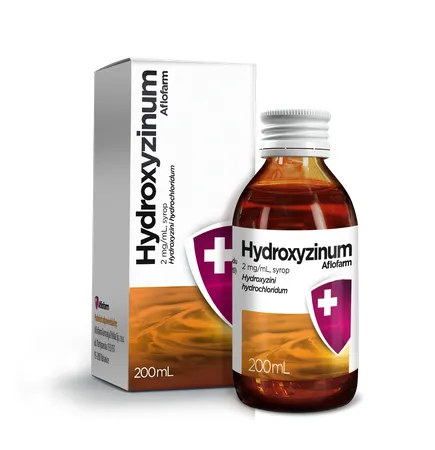
Table of Contents
Patient Information Leaflet
Hydroxyzinum Aflofarm, 2 mg/mL, syrup
Hydroxyzini hydrochloridum
Please read this leaflet carefully before taking the medicine, as it contains
important information for the patient.
- Keep this leaflet, as you may need to read it again.
- If you have any further questions, please consult your doctor or pharmacist.
- This medicine has been prescribed for a specific individual. Do not share it with others. The medicine may harm another person, even if their symptoms are the same.
- If the patient experiences any adverse effects, including those not listed in this leaflet, inform a doctor or pharmacist immediately. See section 4.
Table of Contents
- What Hydroxyzinum Aflofarm is and what it is used for
- Important information before taking Hydroxyzinum Aflofarm
- How to take Hydroxyzinum Aflofarm
- Possible side effects
- How to store Hydroxyzinum Aflofarm
- Contents of the pack and other information
1. What Hydroxyzinum Aflofarm is and what it is used for
Hydroxyzinum Aflofarm is a medicine with anxiolytic, sedative, and antipruritic properties. It also has antihistaminic (antiallergic), antiemetic, spasmolytic (reduces smooth muscle tension in the gastrointestinal tract), and analgesic properties.
Indications:
- Symptomatic treatment of anxiety in adults;
- Symptomatic treatment of pruritus (itching);
- Premedication prior to surgical procedures (pharmacological preparation of the patient for surgery).
2. Important information before taking Hydroxyzinum Aflofarm
When not to take Hydroxyzinum Aflofarm
- if the patient is allergic to hydroxyzine or any of the other ingredients of this medicine (listed in section 6);
- if the patient is allergic to cetirizine, any other piperazine derivative, aminophylline or ethylenediamine;
- if the patient has porphyria (a disorder characterized by abnormal heme production – a component of hemoglobin);
- if the patient is pregnant or breastfeeding;
- if the patient's ECG (electrocardiogram) shows heart rhythm disturbances known as "QT prolongation";
- if the patient has or has had cardiovascular disease or if heart rate is very low;
- if the patient has low electrolyte levels (e.g. low potassium or magnesium levels);
- if the patient is taking certain medicines used to treat heart rhythm disorders or medicines that may affect heart rhythm (see "Hydroxyzinum Aflofarm with other medicines");
- if someone in the patient's family has died suddenly due to heart disease.
Warnings and precautions
Before starting treatment with Hydroxyzinum Aflofarm, discuss with a doctor:
- if the patient has impaired kidney function;
- if the patient has impaired liver function;
- if the patient has a lowered seizure threshold (a tendency to seizures);
- if the patient has a predisposition to heart rhythm disorders (arrhythmias) or is taking antiarrhythmic medicines (used to normalize irregular heart function);
- if the patient has narrow-angle glaucoma (a type of glaucoma – an eye disease);
- if the patient has urinary retention (impaired urine outflow from the bladder);
- if the patient has paralytic ileus (lack of intestinal activity);
- if the patient has myasthenia (a disease characterized by excessive muscle weakness).
In elderly patients (over 65 years of age), cognitive function may deteriorate (e.g. disturbances in memory, thinking, attention).
This medicine may affect the results of allergy tests or bronchial provocation tests with methacholine; therefore, the medicine should not be taken at least 5 days before such tests.
Use of Hydroxyzinum Aflofarm may be associated with an increased risk of life-threatening heart rhythm disturbances. Therefore, inform the doctor about any heart-related disorders and about all other medicines being taken, including those available without a prescription.
If heart-related symptoms such as rapid heartbeat (palpitations), difficulty breathing, or loss of consciousness occur during treatment with Hydroxyzinum Aflofarm, consult a doctor immediately. Treatment with hydroxyzine should also be discontinued.
Children
This medicine must not be given to children under 3 years of age.
Hydroxyzinum Aflofarm with other medicines
Tell your doctor or pharmacist about all medicines the patient is currently taking or has recently taken, as well as any medicines the patient plans to take.
This includes medicines available without a prescription. Hydroxyzinum Aflofarm may affect the action of other medicines. Other medicines may affect the action of Hydroxyzinum Aflofarm.
Do not take Hydroxyzinum Aflofarm if the patient is taking medicines used to treat:
- bacterial infections (e.g. antibiotics such as erythromycin, moxifloxacin, levofloxacin);
- fungal infections (e.g. pentamidine);
- heart diseases or high blood pressure (e.g. amiodarone, quinidine, disopyramide, sotalol);
- psychoses (e.g. haloperidol);
- depression (e.g. citalopram, escitalopram);
- gastrointestinal disorders (e.g. prucalopride);
- allergies;
- malaria (e.g. mefloquine);
- cancer (e.g. toremifene, vandetanib);
- drug addiction or severe pain (methadone).
If the patient is taking any of the medicines listed above, a dose adjustment or discontinuation of treatment may be necessary. In particular, consult a doctor if the patient is taking:
- coumarin-derived anticoagulants (medicines used to reduce blood clotting);
- barbiturates (medicines used to treat insomnia and epilepsy);
- sedatives;
- sleeping medicines;
- meperidine (a medicine used to treat chronic pain);
- tricyclic antidepressants, monoamine oxidase inhibitors (medicines used to treat depression);
- phenytoin (a medicine used to treat epilepsy);
- betahistine (a medicine used to treat vertigo, especially of labyrinthine origin).
If the patient is unsure whether they are taking any of the medicines listed above, they should consult a doctor or pharmacist.
Alcohol consumption
Do not drink alcohol while taking this medicine.
Pregnancy, breastfeeding and fertility
If the patient is pregnant or breastfeeding, suspects she may be pregnant, or is planning to have a child, she should consult a doctor or pharmacist before using this medicine.
This medicine must not be used during pregnancy and breastfeeding.
Hydroxyzine must not be administered during childbirth.
Driving and operating machinery
This medicine may affect the ability to drive and operate machinery. Patients should not drive or operate machinery while taking Hydroxyzinum Aflofarm.
This medicine contains sucrose, sodium benzoate (E211), propylene glycol (E1520), sodium, citral, geraniol, farnesol, linalool, citronellol, limonene
Sucrose
The medicine contains 2711 mg of sucrose in 5 mL of syrup. This should be taken into account in patients with diabetes.
If the patient has previously been diagnosed with intolerance to certain sugars, they should consult a doctor before taking this medicine.
Sodium benzoate (E211)
The medicine contains 4.519 mg of sodium benzoate in 5 mL of syrup.
Propylene glycol (E1520)
The medicine contains 4.446 mg of propylene glycol in 5 mL of syrup.
Sodium
The medicine contains 3.01 mg of sodium in 5 mL of syrup.
The medicine contains 30.1 mg of sodium (the main component of table salt) in 50 mL of syrup. This corresponds to 1.5% of the maximum recommended daily sodium intake in the diet of adults.
3. How to take Hydroxyzinum Aflofarm
This medicine should always be taken according to the doctor's instructions. In case of any doubts, consult your doctor or pharmacist.
Hydroxyzinum Aflofarm should be used at the lowest effective dose. The duration of treatment should be as short as possible.
This medicine is taken orally.
The dosage is determined individually by the doctor, depending on the patient's response to treatment.
To measure the dose accurately, use the dosing device provided with the package.
Recommended dosage
Adults
- For symptomatic treatment of anxiety: 50 mg per day divided into 2 or 3 single doses.
- For symptomatic treatment of pruritus (itching): treatment should start with a dose of 25 mg at bedtime. If necessary, the doctor may increase the dose up to 25 mg 3 or 4 times daily.
- For premedication before surgical procedures: 50 to 100 mg as a single dose.
In adults and children with body weight above 40 kg, the maximum daily dose for all indications is 100 mg.
Children
-
For symptomatic treatment of pruritus (itching):
in children aged 3 to 6 years: 5 to 15 mg per day, maximum 50 mg per day in divided doses.
in children over 6 years of age:
15 to 25 mg per day, maximum 50 to 100 mg per day in divided doses. -
For premedication before surgical procedures: 0.6 mg per kg of body weight as a single dose.
In children with body weight up to 40 kg, the maximum daily dose is 2 mg/kg body weight/day.
In elderly patients (over 65 years of age), treatment should be initiated at half the recommended dose.
In patients with impaired liver and/or kidney function, treatment should be initiated at half the recommended dose, and continued with lower than usual doses.
In elderly patients, the maximum daily dose is 50 mg.
Use in children
Do not use in children under 3 years of age.
Taking more than the recommended dose of Hydroxyzinum Aflofarm
If a dose higher than recommended is taken, contact your doctor.
Excessive sedation may occur.
If a patient has taken or used too much Hydroxyzinum Aflofarm, contact a doctor immediately, especially if it involves a child. In case of overdose, symptomatic treatment may be applied. ECG monitoring is recommended due to the possibility of cardiac arrhythmias, such as QT interval prolongation or torsade de pointes.
Missed dose of Hydroxyzinum Aflofarm
Continue taking the medicine as prescribed, without increasing the next dose.
Do not take a double dose to make up for a missed dose.
If you have any further doubts regarding the use of this medicine, consult your doctor or pharmacist.
4. Possible adverse reactions
Like any medicine, this medicine may cause adverse reactions, although not everyone will experience them.
You should stop taking the medicine and contact your doctor immediately if the following occur:
- anaphylactic shock – initial symptoms may include: skin rash, swelling of the face, lips or throat, breathing difficulties, wheezing, shortness of breath, undetectable pulse, significantly lowered blood pressure, sweating, loss of consciousness;
- heart rhythm disturbances, such as rapid heartbeat (palpitations), breathing difficulties, loss of consciousness.
The following adverse reactions may occur
Very common (in more than 1 in 10 patients):
- drowsiness.
Common (in more than 1 in 100 but less than 1 in 10 patients):
- dry mouth;
- headache;
- sedation, feeling of fatigue and exhaustion.
Uncommon (in more than 1 in 1,000 but less than 1 in 100 patients):
- nausea;
- dizziness;
- insomnia;
- tremor, restlessness;
- confusion (disturbance of consciousness, disorientation in time, place, situation or self);
- malaise;
- fever.
Rare (in more than 1 in 10,000 but less than 1 in 1,000 patients):
- tachycardia (rapid heartbeat);
- eye accommodation disorders (vision disturbances);
- blurred vision;
- constipation, vomiting;
- hypersensitivity;
- seizures;
- dyskinesia (involuntary, uncoordinated movements of limbs or whole body);
- disorientation (disturbance of orientation in time, place, situation or self);
- hallucinations (perceiving non-existent objects or people);
- urinary retention (inability to urinate causing strong urge to urinate);
- skin inflammation, itching;
- erythematous rash (red spots on the skin);
- maculopapular rash;
- urticaria (pinkish, itchy wheals on the skin);
- hypotension (significant drop in blood pressure).
Very rare (in less than 1 in 10,000 patients):
- anaphylactic shock;
- bronchospasm (wheezing, shortness of breath);
- angioedema (sudden swelling of face, limbs or joints without itching or pain);
- increased sweating.
Frequency not known
- impaired motor coordination (difficulty maintaining balance, unsteady gait);
- bone marrow suppression with thrombocytopenia (markedly reduced platelet count);
- coagulation disorders (increased tendency to bleeding and bruising);
- worsening of cognitive function in elderly patients (see section: Warnings and precautions);
- feeling of emptiness in the head;
- irritability;
- weight gain.
Reporting of adverse reactions
If any adverse reactions occur, including any not listed in this leaflet, inform your doctor or pharmacist.
Adverse reactions can be reported directly to the Department of Monitoring Adverse Drug Reactions at the Office for Registration of Medicinal Products, Medical Devices and Biocidal Products
Al. Jerozolimskie 181C, 02-222 Warsaw
Tel.: +48 22 49 21 301
Fax: +48 22 49 21 309
Website: https://smz.ezdrowie.gov.pl
Adverse reactions can also be reported to the marketing authorization holder.
Reporting adverse reactions helps to provide more information on the safety of the medicine.
5. How to store Hydroxyzinum Aflofarm
Keep this medicine out of sight and reach of children.
Do not store above 25°C.
Do not use this medicine after the expiry date stated on the label and on the carton.
The expiry date refers to the last day of the stated month.
Medicines must not be disposed of via wastewater or household waste. Ask your pharmacist how to dispose of medicines no longer in use. This will help protect the environment.
6. Contents of the package and other information
What Hydroxyzinum Aflofarm contains
- The active substance is hydroxyzine hydrochloride. 1 mL of syrup contains 2 mg of hydroxyzine hydrochloride.
Other ingredients: sodium benzoate (E211), sucrose, citric acid (E330), sodium citrate (E331), vanilla flavour AR 0345 (containing propylene glycol (E1520)), orange flavour AR1430 (containing, among others, citral, geraniol, farnesol, linalool, citronellol, limonene), purified water.
What Hydroxyzinum Aflofarm looks like and contents of the pack
Hydroxyzinum Aflofarm is a light yellow syrup.
The pack consists of a brown glass bottle containing 200 mL or 250 g of syrup, closed with an aluminium cap, placed in a cardboard box with a measuring device.
Marketing Authorisation Holder and Manufacturer
Aflofarm Farmacja Polska Sp. z o.o.
ul. Partyzancka 133/151
95-200 Pabianice
tel. (42) 22-53-100