Chronada
Poland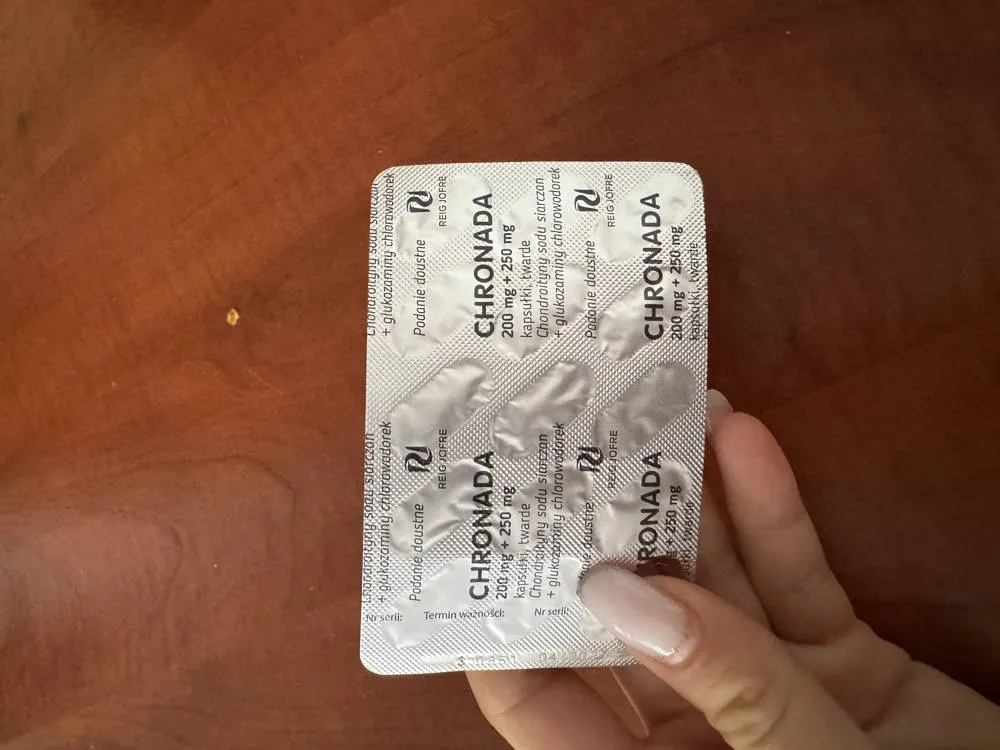
Table of Contents
Package leaflet: Information for the patient
Chronada, 200 mg + 250 mg, hard capsules
Chondroitin sodium sulfate + Glucosamine hydrochloride
Please read carefully the entire leaflet before taking this medicine, as it contains
important information for the patient.
- Keep this leaflet, as you may need to read it again.
- If you have any further questions, please consult your doctor or pharmacist.
- This medicine has been prescribed for a specific individual. Do not pass it on to others. This medicine may harm other people, even if their symptoms are the same. If you experience any adverse effects, inform your doctor or pharmacist. Please report any adverse effects not listed in this leaflet. See section 4.
Table of contents:
- What Chronada is and what it is used for
- Important information before taking Chronada
- How to take Chronada
- Possible side effects
- How to store Chronada
- Contents of the pack and other information
1. What Chronada is and what it is used for
Chronada is a hard capsule containing two active substances. The first active substance is sodium chondroitin sulfate, and the second is glucosamine hydrochloride. Both active substances belong to the group of non-steroidal anti-inflammatory and anti-rheumatic drugs.
Chronada is used for the symptomatic treatment of osteoarthritis of the knee joint in adults with moderate to severe pain, for whom combined treatment with chondroitin sulfate and glucosamine hydrochloride is appropriate.
2. Important information before taking Chronada
When not to take Chronada:
- If you are allergic to chondroitin sulfate, glucosamine hydrochloride, or any of the other ingredients of this medicine (listed in section 6).
- If you are allergic to shellfish, because glucosamine is derived from shellfish.
Warnings and precautions
Before starting treatment with Chronada, discuss with your doctor or pharmacist:
- If you have impaired glucose tolerance, more frequent monitoring of blood glucose levels may be necessary before starting glucosamine.
- If you have or have had kidney or liver function disorders, as no studies have been conducted in such patients, therefore specific dosage recommendations cannot be provided.
- If you have any serious heart conditions, please consult your doctor.
Children and adolescents
The use of this medicine is not recommended in children or adolescents under 18 years of age.
Chronada with other medicines
Inform your doctor or pharmacist about all medicines you are currently taking or have recently taken, as well as any medicines you plan to take.
Exercise caution when taking Chronada together with other medicines, especially:
- Certain types of anticoagulant medicines (e.g. warfarin, dicoumarol, phenprocoumon, acenocoumarol, and fluindione). The effect of these medicines may be enhanced during concomitant use with glucosamine. Patients receiving such combinations should be monitored particularly carefully when starting and stopping glucosamine therapy.
- Or medicines used for infections (antibiotics such as tetracycline, chloramphenicol, or penicillin).
For additional information, please consult your doctor or pharmacist.
Chronada with food and drink
Capsules may be taken before, during, or after meals. If you are prone to gastrointestinal discomfort, it is recommended to take the medicine after a meal.
Pregnancy and breastfeeding
If you are pregnant or breastfeeding, think you may be pregnant, or are planning to have a baby, consult your doctor or pharmacist before using this medicine.
It is not known whether the active substances of Chronada pass into breast milk. Do not take this medicine if you are breastfeeding, as there is insufficient data on its effects on infant health.
Before starting any medication, consult your doctor or pharmacist.
Driving and operating machinery
If dizziness or drowsiness occurs, do not drive or operate machinery.
3. How to take Chronada
This medicine should always be taken exactly as directed by the physician. In case of doubts, consult
your doctor or pharmacist.
The recommended dose is 2 capsules taken 3 times daily.
The capsules should be swallowed whole, without chewing, with an adequate amount of fluid.
Taking more Chronada than recommended
If more capsules than recommended are taken, symptoms such as headache, dizziness,
disorientation, joint pain, nausea, vomiting, or diarrhoea may occur; however, it is likely that
none of these symptoms will appear. If any of these symptoms occur, contact your doctor.
Missed dose of Chronada
A missed dose can be taken at any time, but do not take more than 6 capsules in a 24-hour period.
Stopping Chronada
Symptoms may recur. If you have any doubts about using this medicine, consult your doctor or pharmacist.
4. Possible adverse reactions
Like any medicine, this medicine can cause adverse reactions, although not everyone will
experience them.
You should inform your doctor immediately if any of the following adverse reactions occur:
Upper respiratory tract infection, urinary tract infection, or chest pain.
The most common adverse reactions during treatment with Chronada are:
Common (may affect up to 1 in 10 people):
- headache
- diarrhoea, nausea, dyspepsia, bloating (gas)
Rare (may affect up to 1 in 1,000 people):
- taste disturbances
- abdominal pain
- gastroesophageal reflux (a condition in which food or liquid flows back from the stomach into the oesophagus)
- constipation, heartburn, abdominal bloating
- muscle spasms, limb pain
- fatigue
- upper respiratory tract infection, urinary tract infection
- increased liver enzyme activity
- abnormal urine test results
Adverse reactions observed in patients treated exclusively with chondroitin sulfate (other than those described above) are listed below:
Very rare (may affect up to 1 in 10,000 people):
- swelling, fluid retention
- allergic reaction
Adverse reactions observed in patients treated exclusively with glucosamine hydrochloride (other than those described above) are listed below:
Rare (may affect up to 1 in 100 people):
- skin redness or rash and itching
Frequency not known (cannot be estimated from available data):
- facial, tongue or throat swelling
- urticaria, ankle, leg and foot swelling
- dizziness, vomiting
- worsening of blood test results in patients with diabetes
In general, adverse reactions that may occur during treatment with this medicine are mild
and transient, resolving after discontinuation of the medicine.
If any of the adverse reactions experienced by the patient may be serious, or if adverse reactions not listed in this leaflet occur, the doctor or pharmacist should be informed.
Reporting of adverse reactions
If any adverse reactions occur, including any adverse reactions not listed in this leaflet, please inform your doctor, pharmacist, or nurse.
Adverse reactions can be reported directly to the Department of Monitoring Adverse Drug Reactions, Office for Registration of Medicinal Products, Medical Devices and Biocidal Products
Al. Jerozolimskie 181C
02-222 Warsaw
Tel.: + 48 22 49 21 301
Fax: + 48 22 49 21 309
Website: https://smz.ezdrowie.gov.pl
Adverse reactions can also be reported to the marketing authorization holder.
Reporting adverse reactions helps to provide more information on the safety of the medicine.
5. How to store Chronada
Do not store this medicine above 30°C. Keep the medicine in its original packaging to protect it from moisture.
Keep the medicine out of sight and reach of children.
Do not use this medicine after the expiry date stated on the carton. The expiry date refers to the last day of the stated month.
Medicines must not be disposed of via wastewater or household waste. Ask your pharmacist how to dispose of medicines no longer required. This will help protect the environment.
6. Contents of the pack and other information
What Chronada contains
- The active substances are chondroitin sodium sulfate, derived from bovine cartilage, and glucosamine hydrochloride. Each capsule contains 200 mg of chondroitin sodium sulfate and 250 mg of glucosamine hydrochloride.
- The other ingredient is magnesium stearate.
What Chronada looks like and contents of the pack
Chronada is a turquoise-colored hard gelatin capsule.
Chronada is available in a cardboard box containing 90 capsules in blisters. Each
pack contains 6 blisters with 15 capsules each. The blister is made of PVC/PVDC-
aluminum.
Marketing Authorisation Holder and Manufacturer
LABORATORIO REIG JOFRE, S.A.
Gran Capitán 10
08970 Sant Joan Despí (Barcelona)
Spain
Manufacturer
NOUCOR HEALTH, S.A.
Avda. Camí Reial 51-57
Palau-Solità i Plegamans, 08184 Barcelona
Spain
or
SINCROFARM, S.L.
c/ Mercuri, 10. Pol. Ind. Almeda
08940 Cornellà de Llobregat (Barcelona), Spain
or
Adamed Pharma S.A.
ul. Marszałka Józefa Piłsudskiego 5,
95-200 Pabianice, Poland
Representative of the Marketing Authorisation Holder
Adamed Pharma S.A.
Pieńków, ul. M. Adamkiewicza 6A
05-152 Czosnów, Poland
This medicinal product is authorised for sale in the European Economic Area under the following names:
Finland: Droglican
Austria, France: Cartifit
Hungary: Droglycan
Poland: Chronada