Choligrip menthol active
Poland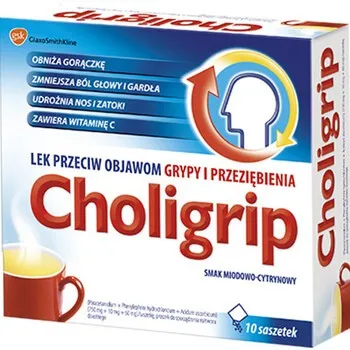
Table of Contents
- Package leaflet: Information for the user
- 1. What Choligrip Menthol Active is and what it is used for
- 2. Important information before using Choligrip Menthol Active
- 3. How to use Choligrip Menthol Active
- 4. Possible adverse reactions
- 5. How to store Choligrip Menthol Active
- 6. Contents of the packaging and other information
Package leaflet: Information for the user
Choligrip Menthol Active
Menthol, honey and lemon flavour
600 mg + 40 mg + 10 mg, effervescent powder for oral solution
Paracetamolum + Acidum ascorbicum + Phenylephrini hydrochloridum
Please read all of this leaflet carefully before taking this medicine, because it contains
important information for you.
This medicine should always be used exactly as described in this patient leaflet or as directed by
your doctor, pharmacist or nurse.
- Keep this leaflet as you may need to read it again.
- If you need advice or further information, please contact your pharmacist.
- If you experience any side effects, including any not listed in this leaflet, tell your doctor, pharmacist or nurse. See section 4.
- If there is no improvement after 3 days, or if you feel worse, you should contact your doctor.
Leaflet contents:
- What Choligrip Menthol Active is and what it is used for
- What you need to know before taking Choligrip Menthol Active
- How to take Choligrip Menthol Active
- Possible side effects
- How to store Choligrip Menthol Active
- Contents of the pack and other information
1. What Choligrip Menthol Active is and what it is used for
Choligrip Menthol Active is indicated for short-term, symptomatic treatment of influenza
or colds associated with fever, chills, headache, sore throat, and inflammation of the nasal mucosa (catarrh).
Choligrip Menthol Active contains three active ingredients:
- Paracetamol – provides analgesic and antipyretic effects
- Phenylephrine – constricts blood vessels, clears nasal passages and sinuses, facilitating breathing
- Vitamin C – a vitamin whose deficiency may occur during the early days of colds and influenza.
2. Important information before using Choligrip Menthol Active
When not to use Choligrip Menthol Active:
- if the patient is allergic to paracetamol, phenylephrine, ascorbic acid, or any of the other ingredients of this medicine (listed in section 6).
- if the patient has liver failure or severe kidney failure.
- if the patient has alcoholic liver disease.
- if the patient is taking zidovudine (used in the treatment of HIV infections).
- if the patient is taking medicines from the group of monoamine oxidase inhibitors (used in the treatment of depression), or within 2 weeks after stopping such treatment.
Warnings and precautions
The medicine contains paracetamol.
Paracetamol overdose may lead to severe liver damage.
Do not take this medicine simultaneously with other medicines containing paracetamol, such as painkillers, antipyretics, or medicines used to treat flu and cold symptoms.
Do not take other medicines that reduce nasal mucosal congestion, appetite suppressants, or psychostimulants with amphetamine-like effects, together with cold and flu remedies.
Before starting treatment, consult a doctor, pharmacist, or nurse if the patient:
- has hypertension.
- has heart or vascular diseases.
- has diabetes.
- has hyperthyroidism.
- has angle-closure glaucoma (a serious eye disease usually caused by increased intraocular pressure).
- has pheochromocytoma (a tumour near the kidneys).
- has benign prostatic hyperplasia.
- has vascular diseases involving vessel lumen occlusion (e.g. Raynaud’s phenomenon, characterized by episodic finger pain triggered by cold or emotional stress).
- is taking beta-adrenergic receptor blockers or other blood pressure-lowering medicines (e.g. debrisoquine, guanethidine, reserpine, methyldopa).
- is taking tricyclic antidepressants (e.g. imipramine or amitriptyline).
- is taking other sympathomimetics (such as nasal decongestants, appetite suppressants, or psychostimulants with amphetamine-like action).
- has glucose-6-phosphate dehydrogenase deficiency or methemoglobin reductase deficiency.
- has liver or kidney failure. General liver disorders increase the risk of liver damage from paracetamol.
- is underweight or malnourished, or suffers from anorexia.
- regularly consumes alcohol. Consult a doctor in case of severe infection, which may increase the risk of metabolic acidosis. Symptoms of metabolic acidosis include:
- deep, rapid, and laboured breathing,
- nausea, vomiting, and loss of appetite,
- general malaise. Seek immediate medical advice if the patient experiences these symptoms simultaneously.
Patients with liver disorders have an increased risk of overdose.
Do not drink alcohol while taking this medicine, due to increased risk of liver damage.
Liver damage is possible in individuals who have ingested 10 g or more of paracetamol in a single dose.
Ingestion of 5 g of paracetamol may lead to liver damage in patients with the following risk factors:
- patients taking long-term carbamazepine, phenobarbital, phenytoin, primidone, rifampicin, St. John’s wort, or other medicines that induce liver enzymes.
- patients who regularly abuse alcohol.
- patients who may have glutathione deficiency, e.g. those with eating disorders, cystic fibrosis, HIV infection, malnutrition, or cachexia.
In case of paracetamol overdose, immediate treatment is required, even in the absence of early symptoms.
If symptoms persist, consult a doctor.
Keep the medicine out of sight and reach of children.
Use of Choligrip Menthol Active in children
Do not give this medicine to children under 12 years of age.
Choligrip Menthol Active and other medicines
Inform your doctor or pharmacist about all medicines currently or recently taken, as well as any medicines you plan to take.
Consult your doctor if you are taking the following medicines:
- metoclopramide, domperidone (used to treat nausea and vomiting).
- cholestyramine (used to reduce high blood cholesterol levels).
- anticoagulants (e.g. warfarin), especially if long-term pain relief is needed.
- sedatives, antiepileptics, rifampicin (an anti-tuberculosis medicine).
- salicylamide (an anti-inflammatory, antipyretic, and analgesic medicine).
- MAO inhibitors (used, among others, in depression), or if less than 2 weeks have passed since stopping such treatment.
- other antidepressants (tricyclic antidepressants, e.g. amitriptyline).
- non-steroidal anti-inflammatory drugs (including acetylsalicylic acid).
- ergot alkaloids (used, among others, in migraine).
- certain medicines used for heart diseases or hypertension (e.g. digoxin, beta-blockers, methyldopa).
- appetite suppressants, nasal decongestants, and psychostimulant amphetamine derivatives (e.g. those used in attention deficit hyperactivity disorder).
Paracetamol may cause false results in certain laboratory tests (e.g. blood glucose measurement).
Phenylephrine may enhance the blood pressure-raising effect of drugs used to accelerate labour.
Caffeine enhances the analgesic effect of paracetamol.
Ascorbic acid increases iron absorption and enhances aluminium absorption from aluminium-containing antacid preparations.
Pregnancy, breastfeeding and fertility
If the patient is pregnant or breastfeeding, suspects she may be pregnant, or plans to become pregnant, she should consult a doctor or pharmacist before using this medicine.
Driving and operating machinery
This medicine may cause dizziness. If such symptoms occur, do not drive or operate machinery.
Choligrip Menthol Active contains 3755 mg of sucrose per sachet.
This should be considered in patients with diabetes. If a patient has previously been diagnosed with intolerance to certain sugars, they should consult a doctor before taking this medicine.
Choligrip Menthol Active contains 50 mg of aspartame (E 951) per sachet. Aspartame is a source of phenylalanine. It may be harmful to patients with phenylketonuria. This is a rare genetic disorder in which phenylalanine accumulates in the body due to improper excretion.
Choligrip Menthol Active contains 118 mg of sodium (the main component of table salt) per sachet, equivalent to 6% of the recommended daily sodium intake in adults. Patients with impaired kidney function or those on a low-sodium diet should consider this amount in their daily dietary intake.
Choligrip Menthol Active contains glucose (a component of maltodextrin). If a patient has previously been diagnosed with intolerance to certain sugars, they should consult a doctor before taking this medicine.
The medicine contains sulphites. Rarely, it may cause severe hypersensitivity reactions and bronchospasm.
Choligrip Menthol Active contains 3.5 mg of benzoic acid per sachet, equivalent to 0.7 mg/g.
Choligrip Menthol Active contains sulphites. Rarely, it may cause severe hypersensitivity reactions and bronchospasm.
3. How to use Choligrip Menthol Active
This medicine should always be taken exactly as described in this patient leaflet or as directed by your doctor, pharmacist, or nurse. If in doubt, consult your doctor, pharmacist, or nurse.
Use in adults and adolescents over 12 years of age
The recommended dose is one sachet (600 mg paracetamol, 40 mg ascorbic acid, and 10 mg phenylephrine hydrochloride) as needed every 4 to 6 hours. For oral use only.
Before administration, dissolve the powder in hot water. Empty the contents of one sachet into a glass, add half a glass of hot water, stir well, and drink. If necessary, add cold water or sweeten.
- Do not take more frequently than every 4 hours.
- Do not exceed 4 sachets (2400 mg paracetamol, 160 mg ascorbic acid, and 40 mg phenylephrine hydrochloride) per day.
- Do not take a higher dose than recommended.
- Always use the lowest effective dose.
- Without a doctor's advice, do not use the medicine for longer than 3 days.
- If symptoms worsen or do not improve, consult a doctor or pharmacist.
Use in children
Do not give this medicine to children under 12 years of age.
Overdose of Choligrip Menthol Active
Paracetamol overdose can cause severe liver damage, which may lead to liver transplantation or death, with symptoms appearing after a delay. Paracetamol overdose may cause nausea, vomiting, excessive sweating, drowsiness, and general weakness within a few to several hours. Ingestion of 5 g or more of paracetamol at once may provoke vomiting if less than one hour has passed since ingestion; seek immediate medical attention. Administer 60–100 g of activated charcoal orally, preferably mixed with water. The amount of drug that would cause severe symptoms of overdose from phenylephrine or ascorbic acid would already cause severe liver damage due to paracetamol.
Phenylephrine overdose may cause nervousness, headache, dizziness, insomnia, increased blood pressure, nausea, vomiting, irritability, restlessness, hypertension, and reduced heart rate. In severe cases, confusion, hallucinations, and arrhythmia may occur. High doses of ascorbic acid (above 3 g) may cause transient diarrhoea and gastrointestinal symptoms such as nausea and abdominal discomfort.
In case of overdose, seek immediate medical advice even if the patient feels well. Bring the medicine package leaflet with you to show to the doctor.
Missed dose of Choligrip Menthol Active
Do not take a double dose to make up for a missed dose.
4. Possible adverse reactions
Like all medicines, this medicine can cause adverse reactions, although not everyone will experience them.
You must stop using the medicine immediately and consult a doctor if any of the following occur:
- an allergic reaction (hypersensitivity) such as: skin rash or skin itching, sometimes associated with breathing difficulties or swelling of the lips, tongue, throat or face.
- skin rash or severe skin reaction manifesting as acute generalized pustular rash or blisters and erosions on the skin, in the mouth, eyes and genital organs, fever and joint pain, or ruptured subcutaneous giant blisters, extensive skin erosions, peeling of large sheets of epidermis, and fever.
- breathing problems, especially if similar problems occurred previously during use of acetylsalicylic acid or other non-steroidal anti-inflammatory drugs.
- bruises or unexplained bleeding.
- nausea, sudden weight loss, loss of appetite, and yellowing of the eyes and skin.
- eye pain and redness, visual disturbances, headache and nausea, which may be symptoms of acute angle-closure glaucoma caused by markedly increased intraocular pressure. This is very rare, but the likelihood is higher in individuals with closed-angle glaucoma.
- unusual rapid heartbeat or sensation of irregular heart rhythm.
- difficulty in passing urine. The likelihood is higher in men with benign prostatic hyperplasia.
The above symptoms occur very rarely (less frequently than in 1 out of 10,000 patients).
The following adverse reactions may also occur. Inform your doctor if any of these occur:
- increased blood pressure, headache, dizziness, sleep disturbances, nervousness, restlessness, pupil dilation.
- diarrhoea or vomiting.
Reporting of adverse reactions
If any adverse symptoms occur, including any adverse symptoms not listed in this leaflet, inform your doctor, pharmacist or nurse. Adverse reactions can be reported directly to the Department of Monitoring of Adverse Drug Reactions, Office for Registration of Medicinal Products, Medical Devices and Biocidal Products, Al. Jerozolimskie 181C, 02-222 Warsaw, phone: +48 22 49 21 301, fax: +48 22 49 21 309, website: https://smz.ezdrowie.gov.pl
Adverse reactions can also be reported to the marketing authorization holder.
Reporting adverse reactions helps to provide more information on the safety of the medicine.
5. How to store Choligrip Menthol Active
Keep this medicine out of sight and reach of children.
Do not store above 30°C.
Do not use this medicine after the expiry date stated on the packaging after EXP.
The expiry date refers to the last day of the stated month.
Medicines must not be disposed of via wastewater or household waste. Ask your pharmacist how to dispose of medicines no longer required. This will help protect the environment.
6. Contents of the packaging and other information
What Choligrip Menthol Active contains
- The active substances are paracetamol, ascorbic acid (vitamin C), and phenylephrine hydrochloride. Each sachet contains 600 mg of paracetamol, 40 mg of ascorbic acid, and 10 mg of phenylephrine hydrochloride.
- Other ingredients are: sodium saccharin (E 954), aspartame (E 951), sucrose, sodium citrate, citric acid (anhydrous), maize starch, menthol flavour E41580, lemon flavour PHS-163671 (containing linalool, geraniol, d-limonene, citronellol, citral, maltodextrin – glucose source, butylated hydroxyanisole (E 320), sulphites), honey flavour PHS-050860 (containing maltodextrin – glucose source, propylene glycol, sulphites, benzoic acid (E 210)), honey flavour F7624/P, caramel colouring.
What Choligrip Menthol Active looks like and contents of the pack
Choligrip Menthol Active is a clear powder with honey, lemon, and menthol flavour.
Pack sizes contain 5, 6, 8, 10, 12, 15, 20 or 24 sachets.
Marketing Authorisation Holder:
Haleon Poland Sp. z o.o.
ul. Rzymowskiego 53
02-697 Warsaw
tel. 800 702 849
Manufacturer:
SmithKline Beecham S.A.
Carretera De Ajalvir, km 2.500, 28806 Alcala de Henares
Madrid
Spain
Further information
Detailed information on this medicinal product is available on the website of the Office for Registration of Medicinal Products, Medical Devices and Biocidal Products.