Histigen
Poland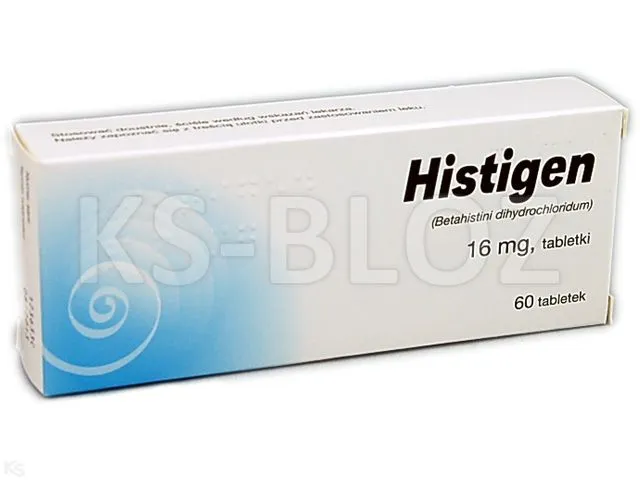
Table of Contents
Package leaflet: Information for the patient
Warning! Keep this leaflet! Information on the immediate packaging in a foreign language.
Histigen (Betahistine Viatris)
24 mg, tablets
Betahistini dihydrochloridum
Histigen and Betahistine Viatris are different brand names of the same medicine.
Please read this leaflet carefully before taking the medicine, as it contains
important information for the patient.
- Keep this leaflet, so that you can read it again if necessary.
- If you have any questions, consult your doctor or pharmacist.
- This medicine has been prescribed for a specific individual. Do not pass it on to others. It may harm someone else, even if their symptoms are the same.
- If you experience any adverse effects, including any not listed in this leaflet, inform your doctor or pharmacist. See section 4.
Table of contents of the leaflet:
- What Histigen is and what it is used for
- Important information before taking Histigen
- How to take Histigen
- Possible side effects
- How to store Histigen
- Contents of the pack and other information
1. What Histigen is and what it is used for
Histigen contains betahistine. Histigen is a type of medicine known as a “histamine analogue”.
It is used in the treatment of Ménière’s syndrome, which is characterized by:
- dizziness, nausea, or vomiting
- tinnitus (ringing in the ears)
- hearing loss or impaired hearing.
Histigen works by improving blood flow in the inner ear. This leads to a reduction in elevated pressure.
2. Important information before using Histigen
When not to use Histigen:
- if the patient is allergic to betahistine or any of the other ingredients of this medicine (listed in section 6)
- if the patient has high blood pressure caused by a tumour of the adrenal gland (‘phaeochromocytoma’).
If any of the above apply to the patient, use of this medicine should be discontinued. In case of
doubt, consult a doctor or pharmacist.
Warnings and precautions
Before starting to take Histigen, consult a doctor or pharmacist if:
- the patient has or has previously had stomach ulcers
- the patient has bronchial asthma
If any of the above apply to the patient, speak to a doctor before taking this medicine.
The doctor will decide whether it is safe to use this medicine.
The doctor may recommend monitoring patients with bronchial asthma who are taking Histigen.
Histigen and other medicines
Tell the doctor about all medicines currently used or recently taken by the patient, as well as any
medicines the patient plans to use.
In particular, inform the doctor or pharmacist if the patient is taking any of the
following medicines:
- antihistamines, which may reduce the effect of betahistine. Betahistine may also reduce the effect of antihistamines
- monoamine oxidase inhibitors (such as selegiline), used in the treatment of depression or Parkinson's disease. These may enhance the effect of Histigen.
Histigen and food
Histigen may be taken with or without food. However, Histigen may cause mild gastrointestinal discomfort (see section 4). Taking Histigen with food may help reduce gastrointestinal symptoms.
Pregnancy and breastfeeding
If the patient is pregnant or breastfeeding, suspects she may be pregnant, or is planning to have a
child, she should consult a doctor or pharmacist before using this medicine.
It is not known whether Histigen affects the unborn child.
- Discontinue taking Histigen and inform the doctor if the patient is pregnant or suspects she may be pregnant.
- Do not take Histigen during pregnancy unless the doctor decides it is necessary.
- It is not known whether Histigen passes into breast milk. Do not take Histigen while breastfeeding unless authorized by a doctor.
Driving and operating machinery
It is unlikely that Histigen affects the ability to drive or operate machinery. However, bear in mind that the condition for which Histigen is used (dizziness, tinnitus, and hearing loss associated with Ménière's disease) may cause dizziness or nausea and may thus affect the ability to drive or operate machinery.
3. How to use Histigen
This medicine should always be used as directed by the physician. If in doubt, consult a doctor or pharmacist. The physician may adjust the dose according to the patient's condition.
Adults
The recommended initial dose is 24 mg (one tablet) twice daily (48 mg per day).
The physician may reduce the dose to 12 mg (half a tablet) twice daily (24 mg per day).
If more than one tablet per day is taken, the doses should be evenly spaced throughout the day; for example, take one tablet in the morning and one in the evening.
Try to take the tablets at the same times each day. This will ensure a constant level of medicine in the body.
Continue taking the medicine as directed. It may take some time for the medicine to start working.
How to take the medicine
Swallow the tablet with water. Histigen may be taken with or without food. However, Histigen may cause mild gastrointestinal discomfort (see section 4). Taking Histigen with food may help reduce gastrointestinal discomfort.
The score line on the tablet is provided only to facilitate breaking the tablet if the patient has difficulty swallowing it whole.
Use in children and adolescents
Histigen is not recommended for use in children and adolescents under 18 years of age.
Taking more Histigen than recommended
If more Histigen is taken than recommended, symptoms such as nausea, drowsiness, or abdominal pain may occur. If in doubt, contact a doctor.
Missed dose of Histigen
If a dose of Histigen is missed, take the next dose at the scheduled time. Do not take a double dose to make up for the missed dose.
Stopping treatment with Histigen
Do not stop taking Histigen without consulting your doctor.
Even if the patient feels better, the doctor may recommend continuing treatment to ensure consistent therapeutic effect.
If you have any further questions about the use of this medicine, consult your doctor or pharmacist.
4. Possible adverse reactions
Like all medicines, this medicine can cause adverse reactions, although not everyone experiences them.
The following adverse reactions may occur after taking this medicine:
Allergic reactions:
If an allergic reaction occurs, discontinue taking Histigen and contact a doctor immediately or go to the nearest hospital.
Symptoms of an allergic reaction may include:
- red, bumpy skin rash or inflamed, itchy skin
- swelling of the face, lips, tongue, neck
- low blood pressure
- loss of consciousness
- breathing difficulties
Discontinue taking Histigen and seek immediate medical attention or go to the nearest hospital if any of the above symptoms occur.
Other adverse reactions:
Common (may affect up to 1 in 10 people)
- nausea
- indigestion
- headache
Frequency not known (frequency cannot be estimated from available data)
- mild gastrointestinal disorders such as vomiting, abdominal pain, and bloating. Taking Histigen with food may reduce gastrointestinal discomfort.
Reporting of adverse reactions
If any adverse reactions occur, including any not listed in this leaflet, inform your doctor, pharmacist, or nurse. Adverse reactions can also be reported directly to the Department of Monitoring of Adverse Drug Reactions, Office for Registration of Medicinal Products, Medical Devices and Biocidal Products, Al. Jerozolimskie 181C, 02-222 Warsaw, phone: +48 22 49 21 301, fax: +48 22 49 21 309, website: https://smz.ezdrowie.gov.pl.
Reporting adverse reactions helps provide more information on the safety of this medicine.
5. How to store Histigen.
Keep this medicine out of sight and reach of children.
No special storage instructions are required.
Do not use Betaserc after the expiry date stated on the packaging. The expiry date refers to the last day of the stated month.
Medicines should not be disposed of via wastewater or household waste. Ask your pharmacist how to dispose of medicines you no longer use. This will help protect the environment.
6. Contents of the pack and other information
What Histigen contains
The active substance is betahistine dihydrochloride. Each tablet contains 24 mg of betahistine dihydrochloride.
The other ingredients are: microcrystalline cellulose, mannitol, colloidal anhydrous silica, talc, citric acid monohydrate.
What Histigen looks like and contents of the pack
White or almost white, round, biconvex tablets with bevelled edges and a division line, marked with "289" on both sides of the division line on one side of the tablet.
The medicine is available in blister packs of 20, 60, and 100 tablets, packed in cardboard boxes.
For more detailed information, please contact the responsible entity or the parallel importer.
Marketing Authorisation Holder in Belgium, the country of export:
Viatris GX
Terhulpsesteenweg 6A
B-1560 Hoeilaart
Belgium
Manufacturer:
Mylan Laboratories SAS
Route de Belleville, Lieu-dit Maillard
01400 Châtillon-sur-Chalaronne
France
Madaus GmbH
Lütticher Straße 5
53842 Troisdorf
Germany
Parallel Importer:
InPharm Sp. z o.o.
ul. Strumykowa 28/11
03-138 Warsaw
Poland
Repackaged by:
InPharm Sp. z o.o. Services sp. k.
ul. Chełmżyńska 249
04-458 Warsaw
Poland
Marketing Authorisation Number in Belgium, the country of export: BE353245
Parallel Import Licence Number: 61/26