Histigen
Poland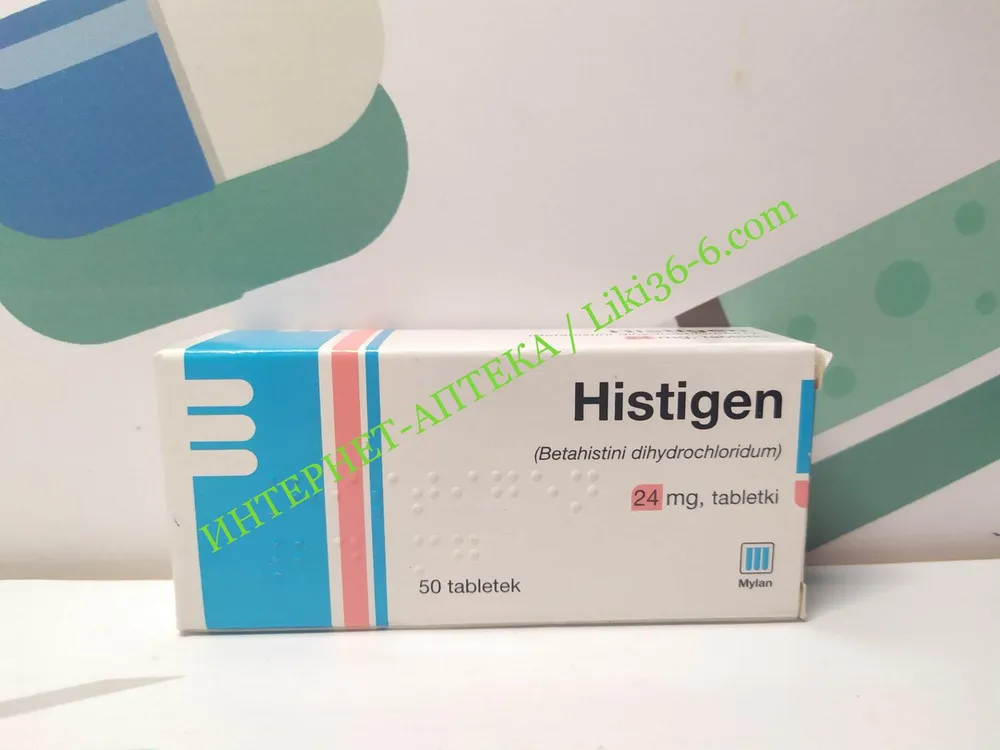
Table of Contents
Patient Information Leaflet
Warning! Keep this leaflet! Information on the immediate packaging is in a foreign language.
Histigen (Betahistine diHCl Viatris)
16 mg , tablets
Betahistini dihydrochloridum
Histigen and Betahistine diHCl Viatris are different trade names for the same medicine.
Please read this leaflet carefully before taking the medicine, because
it contains important information for the patient.
- Keep this leaflet so that you can read it again if necessary.
- If you have any questions, please consult your doctor or pharmacist.
- This medicine has been prescribed for a specific individual. Do not pass it on to others. The medicine may harm someone else, even if their symptoms are the same.
- If you experience any adverse effects, including any not listed in this leaflet, inform your doctor or pharmacist. See section 4.
Table of contents:
- What Histigen is and what it is used for
- Important information before taking Histigen
- How to take Histigen
- Possible side effects
- How to store Histigen
- Contents of the pack and other information
1. What Histigen is and what it is used for
Histigen contains betahistine, which belongs to a group of medicines used against vertigo.
This medicine is indicated for the treatment of certain types of vertigo.
2. Important information before using Histigen
When not to use Histigen
- if the patient is allergic to the active substance or to any of the other ingredients of this medicine (listed in section 6);
- if the doctor has diagnosed the patient with a tumour of the adrenal gland which may cause high blood pressure ("phaeochromocytoma").
Warnings and precautions
Special warnings
If the patient has asthma, this should be discussed with a doctor or pharmacist before starting treatment with Histigen. In such cases, the patient receiving Histigen must be monitored additionally due to the risk of bronchospasm.
Patients receiving betahistine who have peptic ulcer disease (peptic ulcers) or who have previously suffered from peptic ulcer disease should be monitored more closely during treatment.
Histigen should not be used in the treatment of the following types of dizziness:
- mild positional dizziness,
- dizziness associated with disorders of the central nervous system.
Taking the medicine with food may help reduce gastrointestinal discomfort.
Talk to your doctor or pharmacist before using this medicine.
Histigen and other medicines
Tell your doctor or pharmacist if the patient is currently taking, has recently taken or might take any other medicines.
In particular, inform your doctor or pharmacist if the patient is taking any of the following medicines:
- antihistamines, which may reduce the effect of betahistine. Betahistine may also reduce the effect of antihistamines.
- monoamine oxidase inhibitors, used in the treatment of Parkinson's disease. These may enhance the effect of Histigen.
Pregnancy, breastfeeding and fertility
Do not take Histigen during pregnancy unless your doctor has decided it is necessary.
If the patient becomes pregnant while being treated, she should consult her doctor, as he or she is the person who can assess whether continuing treatment is necessary.
If the patient is pregnant or breastfeeding, suspects she may be pregnant, or is planning to become pregnant, she should consult her doctor or pharmacist before using this medicine.
Driving and operating machinery
Histigen has no effect or is unlikely to have any effect on the ability to drive and operate machinery.
3. How to take Histigen
This medicine should always be taken according to the doctor's instructions. In case of doubt, consult
your doctor or pharmacist.
Histigen is available in the following strengths: 8 mg, 16 mg.
Dosage
The usual dose is 1 to 2 tablets three times daily. Do not take more than 6
tablets per day.
When administering this medicine to elderly patients, caution should be exercised.
Use in children and adolescents
Betahistine is not recommended for use in children and adolescents under 18 years of age.
Method of administration
Oral administration.
This medicine should be taken orally during meals to avoid stomach discomfort.
The tablet should be swallowed whole with a glass of water. Do not chew.
If you feel that the effect of Histigen is too strong or too weak, consult your doctor.
Taking more Histigen than recommended
If you have taken too much Histigen (overdose), contact your doctor immediately or go to hospital.
Missing a dose of Histigen
If you have missed a dose of Histigen, take the next dose at the scheduled time. Do not take a double
dose to make up for the missed dose.
If you have any further questions regarding the use of this medicine, consult your doctor or pharmacist.
4. Possible adverse reactions
Like all medicines, this medicine can cause adverse reactions, although they do not occur in everyone.
Common adverse reactions (occurring in 1 in 100 patients but less than 1 in 10 patients):
- nausea
- digestive disturbances
- headache.
Frequency unknown (frequency cannot be determined from available data):
- significant decrease in platelet count
- allergic reactions, the symptoms of which may include swelling of the face, lips, tongue or throat, causing difficulty in breathing (angioedema)
- mild gastrointestinal discomfort, such as vomiting, dry mouth, diarrhoea, abdominal pain, bloating and gas. These adverse reactions can be avoided by taking the tablet with food or by reducing the dose of the medicine.
- skin allergic reactions, particularly angioedam, rash, redness, itching.
Reporting of adverse reactions
If any adverse effects occur, including any adverse effects not listed in the leaflet, inform your doctor or pharmacist. Adverse reactions can be reported directly to the Department of Monitoring Adverse Drug Reactions, Office for Registration of Medicinal Products, Medical Devices and Biocidal Products, Al. Jerozolimskie 181C, 02-222 Warsaw, tel.: + 48 22 49 21 301, fax: + 48 22 49 21 309, website: https://smz.ezdrowie.gov.pl.
By reporting adverse reactions, more information on the safety of the medicine can be collected.
5. How to store Histigen
Keep this medicine out of sight and reach of children.
Do not use this medicine after the expiry date stated on the packaging.
The expiry date refers to the last day of the stated month.
No special storage conditions are required.
Medicines must not be disposed of via wastewater or household waste. Ask your pharmacist how to dispose of medicines no longer required. This will help protect the environment.
6. Contents of the pack and other information
What Histigen contains
- The active substance is betahistine dihydrochloride (Betahistini dihydrochloridum). Each tablet contains 16 mg of betahistine dihydrochloride.
- Other components (excipients): microcrystalline cellulose, mannitol (E 421), citric acid monohydrate (E 330), colloidal anhydrous silica, talc (E 553b).
What Histigen looks like and contents of the pack
Histigen 16 mg is a white or almost white, round, biconvex tablet with bevelled edges and a break line, marked "267" on both sides of the break line on one side of the tablet. The tablet diameter is approximately 8.5 mm.
Available pack sizes
Blister packs made of PVC/PVDC/Aluminium in a cardboard carton containing 30, 60 or 90 tablets.
For further information, please contact the responsible party or parallel importer.
Marketing Authorisation Holder in the Netherlands, country of export:
Viatris Ltd
Damastown Industrial Park
Mulhuddart
Dublin 15
Dublin
Ireland
Manufacturer:
Mylan Laboratories SAS
Route de Belleville
Lieu-dit Maillard
01400 Châtillon-sur-Chalaronne
France
Parallel Importer:
InPharm Sp. z o.o.
ul. Strumykowa 28/11
03-138 Warsaw
Poland
Relabelled and repackaged by:
InPharm Sp. z o.o. Services sp. k.
ul. Chełmżyńska 249
04-458 Warsaw
Poland
Marketing Authorisation Number in the Netherlands, country of export: RVG 24682
Parallel Import Licence Number: 288/23