Chibroxin
Poland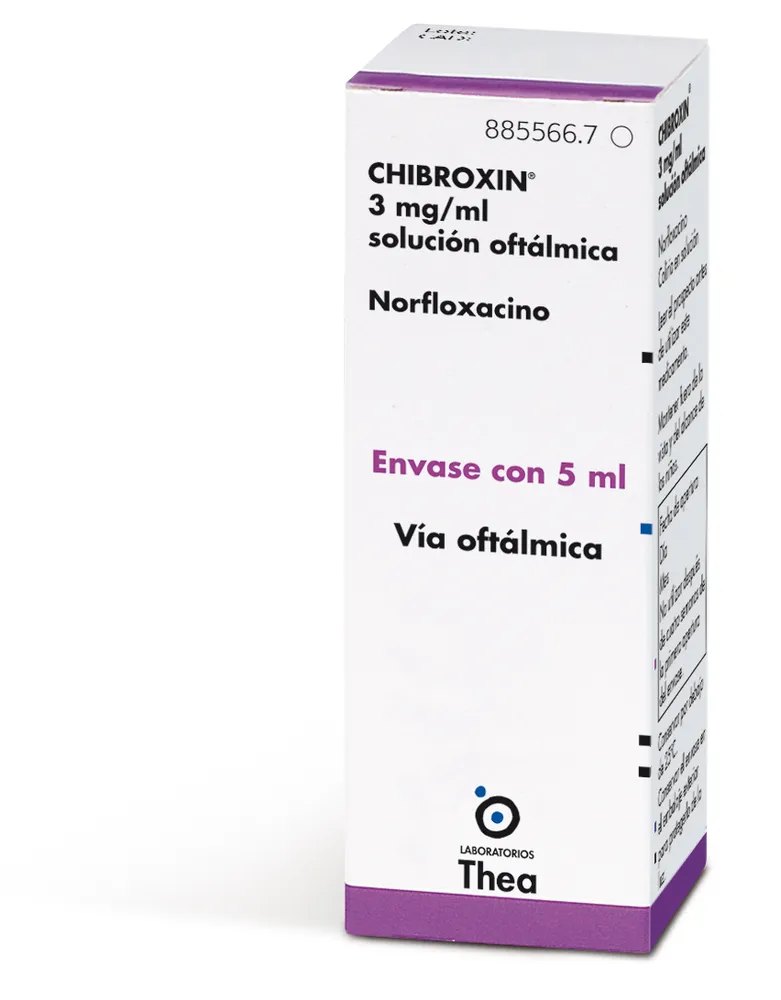
Table of Contents
Package leaflet: Information for the patient
Warning! Keep this leaflet! Information on the immediate packaging is in a foreign language.
Chibroxin (Chibroxine 0.3%), 3 mg/ml, eye drops, solution
Norfloxacinum
Chibroxin and Chibroxine 0.3% are different trade names for the same medicinal product.
Please read the following information carefully before using the medicine, as it contains
important information for the patient.
- Keep this leaflet, as you may need to read it again.
- If you have any further questions, please consult your doctor or pharmacist.
- This medicine has been prescribed for a specific individual. Do not pass it on to others. The medicine may harm other people, even if their symptoms are similar.
- If you experience any adverse effects, including any not listed in this leaflet, inform your doctor or pharmacist. See section 4.
Table of contents
- What Chibroxin is and what it is used for
- Important information before using Chibroxin
- How to use Chibroxin
- Possible side effects
- How to store Chibroxin
- Contents of the pack and other information
1. What Chibroxin is and what it is used for
Chibroxin is a broad-spectrum antibacterial medicine in the form of eye drops.
It is indicated for the treatment of eye infections (of the eye[s]) caused by specific types of bacteria.
Chibroxin is indicated for the local treatment of ocular infections.
2. Important information before using Chibroxin
When not to use Chibroxin
- if the patient is allergic to the active substance, to other quinolone compounds, or to any of the other ingredients of this medicine (listed in section 6).
Warnings and precautions
Before starting to use Chibroxin, consult your doctor or pharmacist.
Inform your doctor about any past or current medical conditions and about any allergies to medicines.
If eye irritation occurs or new symptoms develop, such as eye redness or eyelid swelling, consult your doctor immediately.
If an allergic (hypersensitivity) reaction is suspected after using Chibroxin (e.g. rash, eye redness, or itching), discontinue use of the medicine immediately and consult your doctor.
Inform your doctor if there is worsening of infection, eye injury, or eye surgery has been performed, as well as if new symptoms appear or existing symptoms worsen.
Do not wear contact lenses while using Chibroxin:
- due to the risk of absorption of some components of the eye drop solution onto the surface of the lens,
- due to the presence of benzalkonium chloride.
Chibroxin and other medicines
Tell your doctor about all medicines you are currently using, have recently used, or plan to use.
When different types of eye drops are used simultaneously, at least a 15-minute interval should be maintained between the administration of different medicines. Ophthalmic ointments should always be applied last.
Pregnancy and breastfeeding
If you are pregnant, breastfeeding, suspect you may be pregnant, or are planning to become pregnant, consult your doctor or pharmacist before using this medicine.
Use of this medicine during pregnancy and breastfeeding is not recommended.
Driving and operating machinery
Some adverse reactions reported after using Chibroxin may affect the ability to drive or operate machinery (see section 4. Possible side effects).
If such reactions occur, do not drive or operate machinery during this period.
Chibroxin contains benzalkonium chloride as a preservative.
The medicine contains 0.025 ml of benzalkonium chloride per 1 ml of solution.
Benzalkonium chloride may be absorbed by soft contact lenses and may alter their colour. If you wear contact lenses, inform your doctor before starting treatment with Chibroxin.
Do not wear contact lenses during treatment.
If you do wear contact lenses, remove them before instilling the drops and wait at least 15 minutes before reinserting them.
Benzalkonium chloride may cause punctate keratitis and/or toxic ulcerative keratitis.
Benzalkonium chloride may also cause eye irritation, particularly in individuals with dry eye syndrome or corneal disorders (the transparent layer at the front of the eye). If abnormal sensations, stinging, or eye pain occur after using the medicine, contact your doctor.
3. How to use Chibroxin
This medicine should always be used exactly as recommended by the doctor or pharmacist. If in doubt,
consult your doctor or pharmacist.
The doctor will determine the dose and duration of treatment.
Typically, one or two drops of Chibroxin are administered into the affected eye(s) four times daily.
Depending on the severity of the infection, during the first day of treatment one or two drops may be instilled every two hours while awake during the day. The effectiveness of the antibacterial action of the medicine should be assessed by the doctor during a visit.
Do not change the dosage without consulting your doctor. If it becomes necessary to discontinue the use of this medicine, consult your doctor immediately.
Contact lenses must be removed before instilling Chibroxin.
Instructions for use
- Before first use, check that the seal on the cap is intact. Then unscrew the cap.
- Tilt the head backwards and gently pull down the lower eyelid to create a pocket between the eyelid and the eyeball. Invert the dropper bottle, holding it between the thumb and index finger. Squeeze the bottle with the fingers to release one drop into the eye.
- DO NOT TOUCH THE EYE, THE AREA AROUND THE EYE, OR ANY OTHER SURFACE WITH THE TIP OF THE DROPPER. This may contaminate the solution with bacteria, which could lead to eye infection, potentially causing serious damage or even loss of vision.
- Repeat steps 2 and 3 to instill the medicine into the other eye, if required.
- After instillation, replace the cap on the bottle.
Missed dose of Chibroxin
Chibroxin should be used as recommended by your doctor.
If a dose is missed, administer it as soon as possible. However, if it is almost time for the next dose, skip the missed dose and return to the regular dosing schedule.
Do not use a double dose to make up for a missed dose.
Accidental overdose of Chibroxin
If too many drops are instilled or if the contents of the bottle are swallowed, contact a doctor immediately.
If you have any further questions about the use of this medicine, consult your doctor or pharmacist.
4. Possible adverse reactions
Like any medicine, this medicine can cause adverse reactions, although not everyone experiences them.
If symptoms of hypersensitivity to Chibroxin or other serious adverse reactions occur, do not administer the next dose of the medicine. Contact your doctor or the nearest hospital Emergency Department immediately.
If an allergic (hypersensitivity) reaction (e.g. rash, redness and itching of the eyes) or a serious adverse reaction is suspected after using Chibroxin, discontinue use of the medicine and contact your doctor or the nearest hospital Emergency Department immediately.
The following may occur during treatment with Chibroxin:
Eye disorders
Very common (affects more than 1 in 10 people): local burning or stinging sensation.
Uncommon (affects 1 to 10 in 1,000 people): eye redness (conjunctival hyperemia), swelling of the conjunctiva, bitter taste in the mouth after instillation of the medicine.
Very rare (affects less than 1 in 10,000 people): corneal deposits (white spots) in the cornea, i.e. the transparent membrane covering the front part of the eye.
Frequency not known (cannot be estimated from available data): photophobia (light sensitivity).
Other adverse reactions occur less frequently, but some of them may be severe.
Due to the presence of benzalkonium chloride, there is a risk of contact dermatitis and irritation.
If any adverse reactions occur, including any possible adverse reactions not listed in this leaflet, consult your doctor.
Reporting of adverse reactions
If any adverse reactions occur, including any not listed in this leaflet, inform your doctor or pharmacist. Adverse reactions can also be reported directly to the Department of Monitoring of Adverse Drug Reactions at the Office for Registration of Medicinal Products, Medical Devices and Biocidal Products, Al. Jerozolimskie 181 C, 02-222 Warsaw, tel.: +48 22 49 21 301, fax: +48 22 49 21 309, website: https://smz.ezdrowie.gov.pl.
Reporting adverse reactions helps to provide more information on the safety of this medicine.
5. How to store Chibroxin
Keep the medicine out of sight and reach of children.
Do not store above 25°C. Keep the bottle in the outer packaging.
Do not use this medicine after the expiry date stated on the packaging.
Shelf-life after first opening the bottle: 15 days.
Medicines must not be disposed of via wastewater or household waste. Ask your pharmacist how to dispose of medicines no longer required. This will help protect the environment.
6. Contents of the pack and other information
What Chibroxin contains
- The active substance is norfloxacin. 1 ml of solution contains 3 mg of norfloxacin.
- Other ingredients: disodium edetate, sodium acetate trihydrate, sodium chloride, hydrochloric acid (to adjust pH to 5.2), water for injections.
- Preservative: benzalkonium chloride.
What Chibroxin looks like and contents of the pack
Chibroxin is a solution for ocular administration (eye drops) supplied in a plastic bottle with a dropper, safety ring, and cap, packed in a cardboard box.
The polyethylene bottle with dropper contains 5 ml of 0.3% solution.
For more detailed information, please contact the Marketing Authorisation Holder or Parallel Importer.
Marketing Authorisation Holder in France, the country of export:
Laboratoires Thea
12 Rue Louis Bleriot
63017 Clermont-Ferrand Cedex 2
France
Manufacturer:
Excelvision
Rue de la Lombardière
07100 Annonay
France
Laboratoires Thea
12, rue Louis Blériot
63017 Clermont-Ferrand Cedex 2
France
Parallel Importer:
InPharm Sp. z o.o.
ul. Strumykowa 28/11
03-138 Warsaw
Poland
Repackaged by:
InPharm Sp. z o.o. Services sp. k.
ul. Chełmżyńska 249
04-458 Warsaw
Poland
Marketing Authorisation Number in France, the country of export: 3400933132255
Parallel Import Licence Number: 409/24