Hexvix
Poland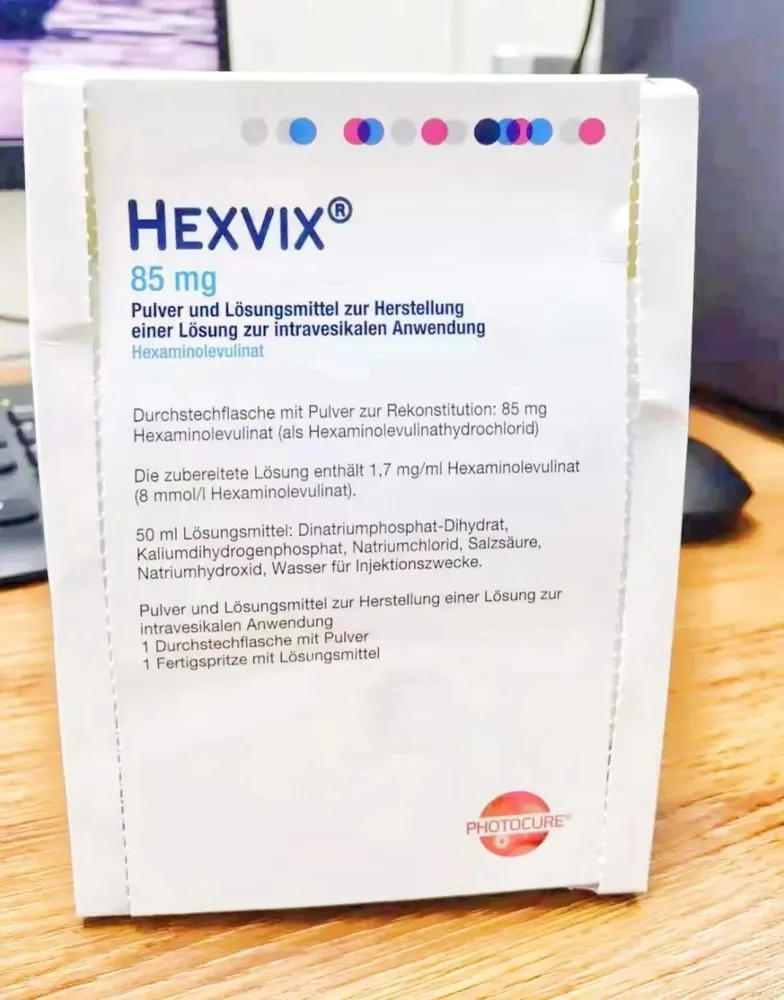
Table of Contents
Hexvix, 85 mg, powder and solvent for solution for bladder instillation
Hexyl aminolevulinate hydrochloride
Read the entire leaflet carefully before use, as it contains important information for the patient.
- Keep this leaflet for future reference.
- Consult your doctor or pharmacist if you need advice or further information.
- If any adverse reactions worsen or if any adverse effects occur, including those not listed in this leaflet, inform your doctor or nurse. See section 4.
Contents of the leaflet:
- What Hexvix is and what it is used for
- Important information before using Hexvix
- How to use Hexvix
- Possible side effects
- How to store Hexvix
- Contents of the pack and other information
1. What Hexvix is and what it is used for
This medicinal product is intended for diagnostic use only.
Hexvix is used to detect bladder tumours. The medicine is administered prior to an examination using a device called a cystoscope to visualize the inside of the bladder. The cystoscope allows visualisation of potential tumours, enabling removal of abnormal cells that fluoresce under blue light after administration of Hexvix.
2. Important information before using Hexvix
When not to use Hexvix
- if the patient has a known allergy (hypersensitivity) to the active substance or to any of the other ingredients of the medicine, including components contained in the solution used to dissolve Hexvix powder (see section 6 of the leaflet: Other information);
- if the patient has been diagnosed with porphyria (a rare, inherited blood disorder).
Warnings and precautions
Before starting treatment with Hexvix, discuss with your doctor or nurse:
- if the patient has a urinary tract infection or experiences a burning sensation during urination;
- if the patient has recently undergone BCG treatment (BCG immunotherapy with BCG vaccine for treatment of superficial bladder tumours);
- if the patient has recently had bladder surgery.
These conditions may cause local reactions in the urinary bladder, which could interfere with interpretation of results during examination.
Hexvix and other medicines
Tell your doctor about all medicines you have recently taken, including those obtained without a prescription.
Pregnancy, breastfeeding and fertility
During pregnancy, while breastfeeding, if pregnancy is suspected, or if planning to become pregnant, consult your doctor or pharmacist before using this medicine.
Driving and operating machinery
Ask your doctor whether it is safe to drive or operate machinery after undergoing an examination with Hexvix.
3. How to use Hexvix
Hexvix will be prepared and administered by qualified medical personnel.
- Hexvix is usually administered in a hospital setting.
Your doctor will administer Hexvix as described below:
- A catheter (thin tube) will be inserted into the bladder.
- The bladder will be emptied through the catheter.
- Hexvix will be instilled into the bladder through the catheter.
- Hexvix will remain in the bladder for approximately 60 minutes.
- The bladder will then be emptied again through the catheter.
- Your doctor will use a device called a cystoscope to examine the inside of the bladder.
Use of a higher than recommended dose of Hexvix
If the duration of contact of the product with the bladder exceeds 60 minutes or if the amount of Hexvix is increased, no adverse effects are expected. In case of doubt, consult your treating physician.
4. Possible adverse reactions
Like all medicines, Hexvix can cause adverse reactions, although not everyone experiences them.
There is a risk of adverse reactions related to the technique used for bladder examination (cystoscopy).
The use of Hexvix as an adjunct in standard cystoscopy to achieve more accurate diagnostic results is generally well tolerated. If adverse reactions occur, they are usually related to standard examination techniques and are mild and transient in nature. The following adverse reactions may occur after examination with Hexvix:
Common (may occur in up to 1 in 10 patients):
- nausea, vomiting,
- diarrhoea,
- constipation,
- abdominal cramps or pain,
- painful and difficult urination,
- urinary retention (inability to empty the bladder),
- blood in urine,
- pain following the procedure,
- fever (high temperature).
Uncommon (may occur in up to 1 in 100 patients):
- headache,
- burning sensation during urination (due to inflammation or infection of the urinary bladder),
- frequent urination (frequency),
- septicaemia (blood infection),
- insomnia (lack of sleep or difficulty falling asleep),
- urethral pain (part of the urinary tract through which urine is passed out of the body),
- sensation of sudden need to urinate,
- increased white blood cell count, elevated bilirubin levels (yellow pigment in bile), or increased liver enzyme activity – confirmed by blood test results,
- anaemia (reduced number of red blood cells in the blood),
- balanitis (inflammation of the glans penis),
- back pain,
- gout,
- rash,
- itching (pruritus).
Unknown (frequency cannot be estimated from available data):
- anaphylactoid shock (decrease in blood pressure, increased heart rate, skin rash).
Reporting of adverse reactions
If any adverse reactions occur, including any adverse reactions not listed in this leaflet, inform your doctor or pharmacist. Adverse reactions can be reported directly to the Department of Monitoring Adverse Drug Reactions of the Office for Registration of Medicinal Products, Medical Devices and Biocidal Products:
Al. Jerozolimskie 181C
02-222 Warsaw
Tel.: +48 22 49 21 301
Fax: +48 22 49 21 309
Website: https://smz.ezdrowie.gov.pl
Adverse reactions can also be reported to the marketing authorisation holder.
Reporting adverse reactions helps provide more information on the safety of the medicine.
5. How to store Hexvix
Keep this medicine out of the sight and reach of children.
Do not use this medicine after the expiry date stated on the outer carton.
The expiry date refers to the last day of the specified month.
Powder and solvent: No special storage precautions.
Solution (after reconstitution): Store in a refrigerator (2 °C – 8 °C) for no longer than 2 hours.
Healthcare personnel should ensure that the product is stored appropriately and not used
beyond the expiry date stated on the outer carton.
6. Contents of the packaging and other information
What Hexvix contains
- The active substance in the product is hexaminolevulinate
- The solvent used to dissolve the Hexvix powder contains disodium phosphate dihydrate, potassium dihydrogen phosphate, sodium chloride, hydrochloric acid 1N, sodium hydroxide 1N, and water for injections
What Hexvix looks like and contents of the pack
-
Each pack consists of one vial containing a white to off-white or light yellow powder, which contains 85 mg of the active substance, hexaminolevulinate, and one pre-filled syringe containing 50 ml of a clear, colourless solution for dissolving the powder.
-
The Hexvix powder is dissolved in 50 ml of the solution provided in the pack. After mixing, a solution containing 1.7 mg/ml of hexaminolevulinate is obtained, corresponding to an 8 mmol/l solution of hexaminolevulinate.
Marketing Authorisation Holder and Manufacturer
Photocure ASA, Hoffsveien 4, NO-0275 Oslo, Norway
This medicinal product is authorised for marketing under the name Hexvix in the following
European Economic Area Member States and in the United Kingdom (Northern Ireland):
Austria, Belgium, Czech Republic, Denmark, Estonia, Finland, France, Germany, Greece, Hungary, Ireland, Iceland, Italy, Latvia, Lithuania, Netherlands, Norway, Poland, Portugal, Slovenia, Spain, Sweden, United Kingdom (Northern Ireland).
The following information is intended for medical or healthcare personnel only:
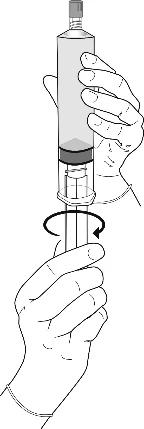
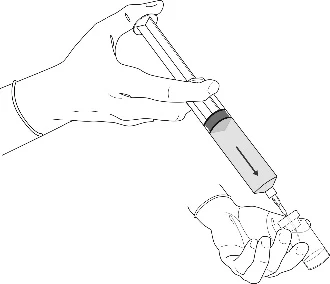
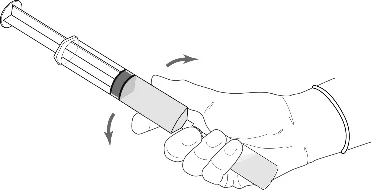
Instructions for product preparation prior to administration
Hexaminolevulinate may cause skin sensitisation upon contact.
All procedures must be carried out using sterile equipment and under aseptic conditions.
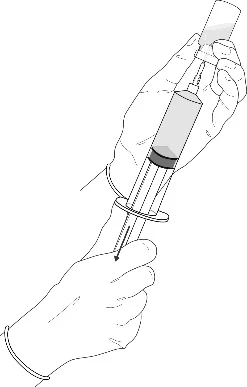
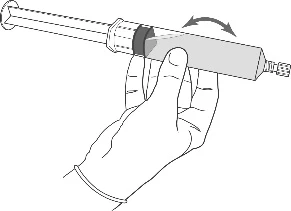
Procedure for preparation: Hexvix powder and diluent for preparation of Hexvix solution in
pre-filled syringe
 |
|
 |
|
 |
|
 |
|
 |
|
Hexvix is dissolved and ready for use. The resulting solution is clear to slightly opalescent, colourless or pale yellow.
Add two hours to the current time, and then record the resulting time and date as the expiry date on the syringe label.
The product is intended for single use. Any unused portions should be discarded. No special requirements for disposal.
The product has been shown to be chemically and physically stable for 2 hours at a temperature of 2 °C – 8 °C. From a microbiological standpoint, the product should be used immediately. If the product is not used immediately, the user is responsible for the duration and conditions of storage prior to use. The product should be stored at 2 °C – 8 °C for no longer than two hours.