Herpex
Poland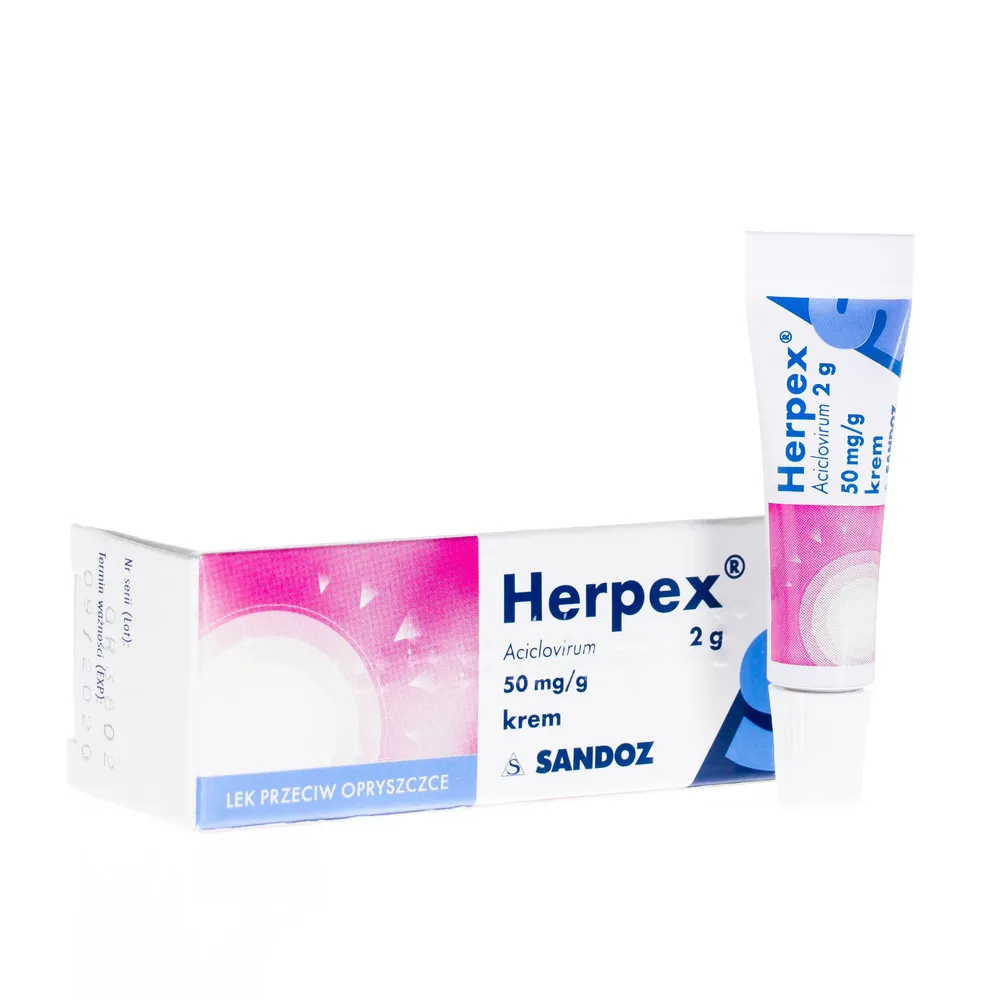
Table of Contents
Package leaflet: Information for the patient
Warning! Keep this leaflet! The information on the immediate packaging is in a foreign language.
Herpex (Acic Creme), 50 mg/g, cream
Aciclovirum
Herpex and Acic Creme are different trade names of the same medicinal product.
Please read this leaflet carefully before using the medicine, as it contains
important information for the patient.
This medicine should always be used according to the instructions provided in this patient leaflet or as directed by a doctor or pharmacist. Keep this leaflet, as you may need to read it again.
- Consult your pharmacist if you need advice or further information.
- If any adverse reactions occur, including any possible adverse reactions not listed in this leaflet, inform your doctor or pharmacist. If there is no improvement after 10 days, or if your condition worsens, consult your doctor.
Table of contents of the leaflet:
- What Herpex is and what it is used for
- Important information before using Herpex
- How to use Herpex
- Possible side effects
- How to store Herpex
- Contents of the pack and other information
1. What Herpex is and what it is used for
Herpex is a topical cream. It contains the active substance aciclovir, an antiviral agent. Aciclovir is highly effective against Herpes simplex virus (HSV) types 1 and 2, as well as against the varicella-zoster virus (VZV) causing chickenpox and shingles.
When applied topically over a small skin area, Herpex does not produce systemic effects.
Indications:
Herpex is used topically in the treatment of skin infections (cold sores and genital herpes) caused by the herpes simplex virus types 1 and 2.
2. Important information before using Herpex
When not to use Herpex
- If the patient is allergic (hypersensitive) to aciclovir, valaciclovir, propylene glycol, or to any of the other ingredients of Herpex.
Warnings and precautions
- This medicine must not be applied to mucous membranes (e.g. mouth, eyes, or vagina) due to the risk of irritation.
- Avoid contact of the medicine with the eyes.
- Use of Herpex on genital organs and in the anal area may reduce the strength of latex condoms and increase the risk of breakage. Paraffin and vaseline contained in Herpex may reduce the safety of condom use.
- Patients with severe immune disorders (e.g. patients infected with HIV or after bone marrow transplantation) should consult a doctor before starting treatment with Herpex. The doctor may recommend taking aciclovir orally.
- Consult a doctor even if the above warnings apply to conditions that occurred in the past.
Other medicines and Herpex
- If in doubt, inform your doctor or pharmacist about all medicines currently taken or recently taken, as well as any medicines the patient intends to use, even those available without a prescription.
- Significant interactions with other medicines are not known.
Pregnancy and breastfeeding
- During pregnancy, while breastfeeding, if pregnancy is suspected, or when planning a pregnancy, consult a doctor or pharmacist before using this medicine.
- Herpex may be used during pregnancy only if, in the opinion of the doctor, the benefit to the mother outweighs the potential risk to the fetus.
- Aciclovir may pass into breast milk, but the dose received by the infant through breastfeeding from a mother using aciclovir cream is negligible.
Driving and operating machinery
- Use of Herpex does not affect the ability to drive or operate machinery.
Herpex contains propylene glycol and cetyl alcohol
- The medicine contains 150 mg of propylene glycol in 1 g of cream. Propylene glycol may cause skin irritation. This medicine should not be used in children under 4 weeks of age on open wounds or large areas of injured or damaged skin (e.g. burned skin) without consulting a doctor or pharmacist.
- Cetyl alcohol may cause local skin reactions (e.g. contact dermatitis).
3. How to use Herpex
Apply Herpex as a thin layer to the affected skin area 5 times daily every 4 hours (with a nighttime break).
Method of application and duration of treatment
Apply the medicine to the affected skin area using a cosmetic swab. The medicine should be applied not only to visible lesions caused by herpes (blisters, swollen papules, redness) but also to the adjacent skin surface. If the medicine is applied directly with fingers, hands must be thoroughly washed before and after application to avoid infecting the affected skin area (e.g. with bacteria) or spreading the herpes virus to uninfected mucous membranes or skin.
The medicine is usually used for 5 days.
If skin lesions have not healed, treatment should be continued until healing occurs or scabs form. However, treatment should not last longer than 10 days.
If symptoms of the disease do not resolve after 10 days of treatment, consult a doctor.
For optimal effectiveness, the medicine should be applied immediately upon the first signs of herpes infection: such as burning, itching, tingling, and redness.
Herpex is not effective when applied at the stage when scabs have already formed.
If you feel that the medicine's effect is too strong or too weak, consult your doctor.
Use of more than the recommended dose of Herpex
Symptoms of overdose with topically applied acyclovir have not been reported.
4. Possible adverse effects
Like any medicine, this medicine can cause adverse effects, although not everybody experiences them.
Uncommonly (more than 1 in 1,000 but less than 1 in 100 patients): transient sensation of
burning or pricking, slight drying or peeling of the skin, itching.
Rarely (more than 1 in 10,000 but less than 1 in 1,000 patients): erythema (reddening
of the skin) and contact dermatitis.
Very rarely (less than 1 in 10,000 patients): immediate hypersensitivity reactions, including
angioedema and urticaria.
Reporting of adverse effects
If any adverse effects occur, including any adverse effects not listed in this leaflet, inform your doctor or pharmacist. Adverse effects can be reported
directly to the Department of Monitoring Adverse Drug Reactions of the Office for Registration of Medicinal Products, Medical Devices and Biocidal Products,
Al. Jerozolimskie 181C, 02-222 Warsaw, tel.: + 48 22 49 21 301, fax: + 48 22 49 21 309,
website: https://smz.ezdrowie.gov.pl.
Reporting adverse effects allows more information on the safety of the medicine to be collected.
5. How to store Herpex medicine
- Keep the medicine out of the sight and reach of children.
- Do not store below 8°C.
- Do not use after the expiry date stated on the packaging. The expiry date refers to the last day of the stated month.
Translation of some information on the immediate packaging:
Ch.-B.:/verwendbar bis – Batch number:/Expiry date
- Medicines must not be disposed of via wastewater or household waste. Ask your pharmacist how to dispose of medicines no longer required. This will help protect the environment.
6. Contents of the packaging and other information
What Herpex contains
The active substance is aciclovir. 1 g of cream contains 50 mg of aciclovir.
The other ingredients are: macrogol stearates of glyceryl, dimethicone 350, cetyl alcohol, white soft paraffin, liquid paraffin, propylene glycol, purified water.
What Herpex looks like and contents of the pack
The tube in a cardboard box contains 2 g or 5 g of cream.
For more detailed information, please contact the Marketing Authorisation Holder or the Parallel Importer.
Marketing Authorisation Holder in Germany, the country of export:
Hexal AG
Industriestraße 25
83607 Holzkirchen, Germany
Manufacturer:
Salutas Pharma GmbH
Otto-von-Guericke-Allee 1
39179 Barleben, Germany
Parallel Importer:
InPharm Sp. z o.o.
ul. Strumykowa 28/11
03-138 Warsaw, Poland
Repackaged in:
InPharm Sp. z o.o. Services sp. k.
ul. Chełmżyńska 249
04-458 Warsaw, Poland
German Marketing Authorisation Number (country of export): 30775.00.01
Parallel Import Authorisation Number: 211/18