Heparin gsk
Poland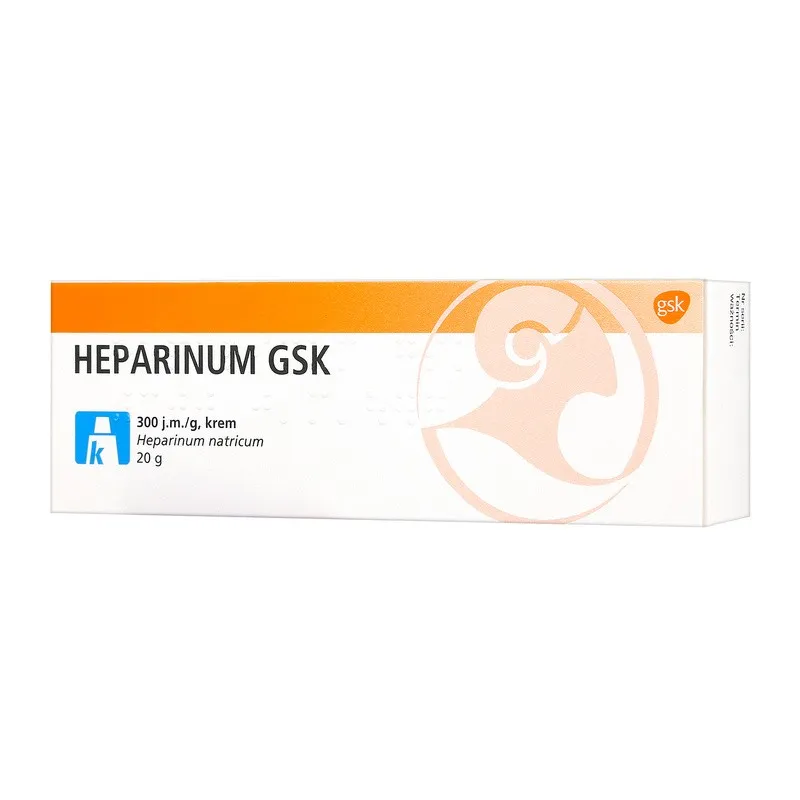
Table of Contents
Patient Information Leaflet
HEPARINUM GSK, 300 IU/g, cream
Heparinum natricum
Please read all of this leaflet carefully before using the medicine, because it contains
important information for the patient.
This medicine should always be used exactly as described in this patient leaflet or as
directed by the physician or pharmacist.
- Keep this leaflet so that you can read it again if necessary.
- If you need advice or further information, please consult your pharmacist.
- If you experience any adverse reactions, including any possible adverse reactions not listed in this leaflet, inform your doctor or pharmacist. See section 4.
- If there is no improvement or if the patient feels worse, consult a doctor.
Contents of the leaflet:
- What Heparinum GSK is and what it is used for
- Important information before using Heparinum GSK
- How to use Heparinum GSK
- Possible side effects
- How to store Heparinum GSK
- Contents of the pack and other information
1. What Heparinum GSK is and what it is used for
Heparinum GSK is a topical cream intended for external use only. The medicine contains heparin, which has anticoagulant and anti-inflammatory properties. It accelerates the absorption of subcutaneous hematomas and edema. It plays an important role in resolving local inflammatory conditions. It relieves pain and contributes to faster resolution of inflammatory swelling.
Indications:
adjunctive treatment in superficial venous disorders such as:
- phlebitis, thrombophlebitis, varicose veins of the lower limbs,
- edema, contusions, subcutaneous hematomas.
2. Important information before using Heparinum GSK
When not to use Heparinum GSK
Do not use the medicine:
- if the patient is allergic to the active substance (heparin), heparinoids, or any of the other ingredients of this medicine (listed in section 6),
- on open wounds, mucous membranes, or around the eyes, because the medicine contains alcohol,
- if the patient has skin lesions of unknown cause,
- on infected wounds,
- orally.
Warnings and precautions
Before starting to use Heparinum GSK, discuss this with a doctor or pharmacist:
- if the patient has a bleeding tendency (predisposition to bleeding) or bleeding wounds,
- if the patient has polycythaemia vera (increased number of red blood cells, white blood cells, and platelets, leading to thrombosis and embolism),
- in some patients, prolonged use of the medicine may cause skin hypersensitivity reactions (see section 4: Possible side effects).
Children
Do not use in children under 12 years of age.
Heparinum GSK and other medicines
Tell your doctor or pharmacist about all medicines the patient is currently using or has recently used, as well as any medicines the patient plans to take.
Do not use the following medicines simultaneously with Heparinum GSK due to the risk of bleeding:
- anticoagulants (medicines used to reduce blood clotting, e.g. warfarin),
- acetylsalicylic acid (used to relieve pain and reduce fever, e.g. aspirin).
Using Heparinum GSK on large skin surfaces may increase the risk of bleeding.
Pregnancy and breastfeeding
If the patient is pregnant, breastfeeding, suspects she may be pregnant, or is planning to have a child, she should consult a doctor or pharmacist before using this medicine.
Avoid using Heparinum GSK during pregnancy unless the benefit to the mother outweighs the potential risk to the fetus.
Avoid using Heparinum GSK during breastfeeding unless the benefit to the mother outweighs the potential risk to the infant.
Pregnant and breastfeeding women may use Heparinum GSK only on the advice of a doctor.
Driving and operating machinery
The medicine has no effect or has a negligible effect on the ability to drive or operate machinery and on psycho-physical performance.
Heparinum GSK contains benzyl alcohol and cetostearyl alcohol
Heparinum GSK contains 1 mg of benzyl alcohol in 100 mg of cream. Benzyl alcohol may cause allergic reactions and mild local irritation.
Due to the presence of benzyl alcohol, the medicine should not be used in premature infants or newborns. The medicine may cause poisoning and allergic reactions in infants and children up to 3 years of age.
Heparinum GSK contains 5 mg of cetostearyl alcohol in 100 mg of cream. Cetostearyl alcohol may cause local skin reactions (e.g. contact dermatitis).
3. How to use Heparinum GSK
This medicine should always be used exactly as described in this patient leaflet or as directed by a doctor or pharmacist. If in doubt, consult a doctor or pharmacist.
Heparinum GSK is intended for topical use only.
Recommended dosage
Apply a thin layer of cream (a strip 3 to 10 cm long) evenly to the affected area. Use 1 to 3 times daily.
Duration of treatment
For the treatment of phlebitis, thrombophlebitis, varicose veins, edema, bruises, and subcutaneous hematomas – use the medicine for 1 to 2 weeks.
For the treatment of acute edema following blunt injuries – use of the medicine is recommended for up to 10 days.
If there is no improvement or if the patient feels worse, consult a doctor.
Use in children
Do not use in children under 12 years of age.
Use of more than the recommended dose of Heparinum GSK
If more medicine is used than recommended, consult a doctor or pharmacist immediately.
There is no data on overdose with topical heparin.
If the patient accidentally ingests the medicine orally, they should contact a doctor immediately.
Missed dose of Heparinum GSK
Apply the cream as soon as possible, then apply the next dose at the usual time.
If there are any further doubts regarding the use of this medicine, consult a doctor or pharmacist.
4. Possible adverse reactions
Like all medicines, this medicine can cause adverse reactions, although not everybody will experience them.
If any of the adverse reactions listed below occur, treatment must be stopped immediately and a doctor should be contacted.
Rare adverse reactions
May occur in up to 1 in 1,000 patients:
- Hypersensitivity (allergic) reactions manifesting as rash, redness, swelling, flushing, itching, dry skin, or burning sensation. These symptoms are rare, especially after long-term use of the medicine.
Other adverse reactions
Other adverse reactions have occurred in a small number of patients, but their frequency is unknown:
-
Palpable purpuric skin lesions with bleeding, skin eruption associated with vasculitis caused by white blood cell breakdown (called leukocytoclastic vasculitis). These symptoms occur in some patients with polycythemia vera (increased number of red blood cells, white blood cells, and platelets, leading to thrombosis and blood clots),
-
Raised and itchy rash (urticaria), erythema, pruritus.
Reporting of adverse reactions
Reporting of adverse reactions
If any adverse reactions occur, including any possible adverse reactions not listed in this leaflet, inform a doctor or pharmacist. Adverse reactions can be reported directly to the Department of Monitoring Adverse Drug Reactions of the Office for Registration of Medicinal Products, Medical Devices and Biocidal Products: Al. Jerozolimskie 181C, 02-222 Warsaw
Tel.: +48 22 49 21 301, Fax: +48 22 49 21 309, Website: https://smz.ezdrowie.gov.pl
Adverse reactions can also be reported to the marketing authorization holder.
Reporting adverse reactions helps to provide more information on the safety of the medicine.
5. How to store Heparinum GSK
Keep the medicine out of the sight and reach of children.
Store below 25°C. Do not freeze.
Do not use this medicine after the expiry date stated on the packaging. The expiry date refers to the last day of the stated month.
Medicines must not be disposed of via wastewater or household waste. Ask your pharmacist how to dispose of medicines no longer required. This will help protect the environment.
6. Contents of the pack and other information
What Heparinum GSK contains
- The active substance is sodium heparin (Heparinum natricum). Each 1 g of cream contains 300 IU of sodium heparin.
- The other ingredients are: glycerol monostearate, polysorbate 60, sorbitan stearate, cetyl stearyl alcohol, benzyl alcohol, liquid paraffin, anhydrous citric acid, purified water.
What Heparinum GSK looks like and contents of the pack
The medicine is a white cream, odourless or with a faint almond-like odour.
Packaging: aluminium tube (internally lacquered, with a membrane and a cap made of polypropylene or polyethylene), containing 20 g of cream, placed in a cardboard carton.
Marketing Authorisation Holder
GSK PSC Poland sp. z o.o.
ul. Grunwaldzka 189,
60-322 Poznań
Manufacturer
Delpharm Poznań Spółka Akcyjna
ul. Grunwaldzka 189
60-322 Poznań
For further information, please contact the Marketing Authorisation Holder.