Hepa-merz
Poland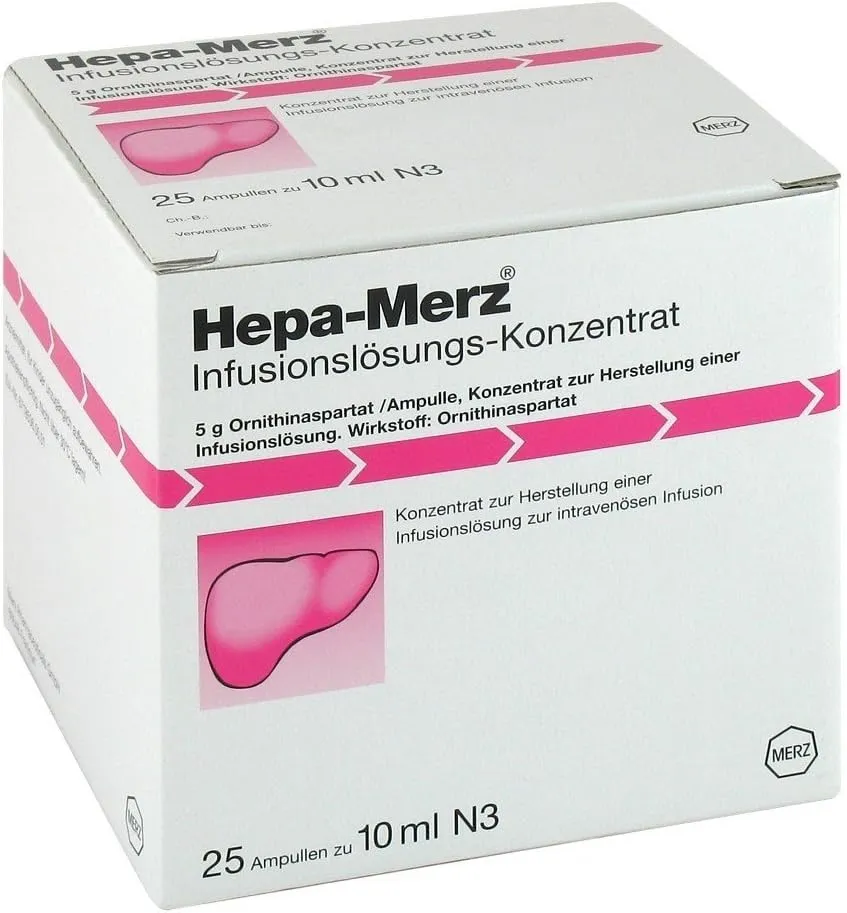
Table of Contents
Package leaflet: Information for the patient
Warning! Please keep the leaflet. Information on the immediate packaging in a foreign language.
Hepa-Merz, 5 g/10 ml (0.5 g/ml), concentrate for solution for infusion
Ornithini aspartas
Please read the entire leaflet carefully before using this medicine, as it contains
important information for the patient.
- Keep this leaflet, as you may need to read it again.
- If you have any questions, please consult your doctor or pharmacist.
- This medicine has been prescribed for a specific individual. Do not pass it on to others. It may harm other people, even if their symptoms are the same.
- If you experience any adverse reactions, including any not listed in this leaflet, inform your doctor, pharmacist, or nurse. See section 4.
Table of contents of the leaflet
- What Hepa-Merz is and what it is used for
- Important information before using Hepa-Merz
- How to use Hepa-Merz
- Possible side effects
- How to store Hepa-Merz
- Contents of the pack and other information
1. What Hepa-Merz is and what it is used for
Hepa-Merz is a medicinal product that promotes the removal of ammonia from the body by enhancing urea synthesis in the liver. Hepa-Merz also supports the elimination of ammonia from tissues other than the liver.
Hepa-Merz is used in the treatment of hepatic encephalopathy associated with acute and chronic liver diseases, such as fatty liver, cirrhosis, and in hyperammonemia.
2. Information before using Hepa-Merz
When not to use Hepa-Merz
Do not use Hepa-Merz in patients with the following conditions:
- hypersensitivity to L-ornithine L-aspartate;
- severe renal insufficiency (serum creatinine concentration above 3 mg/100 ml);
- disorders of amino acid metabolism involved in the urea cycle, e.g. due to enzymatic defects.
Warnings and precautions
Serum and urinary urea concentrations should be monitored during administration of high doses of the medicinal product.
In patients with severe hepatic impairment, the infusion rate should be individually adjusted to avoid gastrointestinal disturbances such as nausea and vomiting.
Children
There is a lack of data on the use of Hepa-Merz in children.
Hepa-Merz with other medicines
Tell your doctor about all medicines you are currently taking or have recently taken, as well as any medicines you plan to take.
No interactions between Hepa-Merz and other medicines are known.
Pregnancy and breastfeeding
If you are pregnant or breastfeeding, suspect you may be pregnant, or are planning to have a baby, you should consult your doctor before using this medicinal product.
Pregnancy
There are insufficient data on the safety of Hepa-Merz during pregnancy; therefore, the use of this medicinal product during pregnancy should be avoided. However, if treatment with Hepa-Merz is necessary during pregnancy, the physician should weigh the potential benefit against the potential risk before deciding to administer the medicinal product.
Breastfeeding
It is not known whether L-ornithine L-aspartate (the active substance of Hepa-Merz) passes into human milk. The use of Hepa-Merz should be avoided during breastfeeding. However, if treatment with Hepa-Merz is necessary during breastfeeding, the physician should weigh the potential benefit against the potential risk before deciding to administer the medicinal product.
Driving and operating machinery
The ability to drive and operate machinery may be impaired due to the disease being treated with Hepa-Merz.
3. How to use Hepa-Merz
Dosage:
This medicine should always be used as prescribed by the physician. In case of doubts, consult your
physician or pharmacist.
The usual dose is up to 20 g (4 vials) per day.
In pre-comatose and comatose states, up to 40 g (8 vials) per day, depending on the patient's condition.
If the patient feels that the effect of the medicine is too strong or too weak, they should contact the physician
or pharmacist.
Route of administration
Intravenous administration.
Before administration, the content of the vial should be dissolved in an infusion fluid. Hepa-Merz may be administered with all commonly used infusion solutions. To date, no incompatibilities related to dissolution have been observed.
It is recommended to prepare the infusion solution immediately before use.
Due to the risk of vein damage, no more than 6 vials should be administered in 500 ml of fluid. Infusion rate: maximum 5 g (1 vial) per hour.
Do not administer intra-arterially.
Overdose of Hepa-Merz
No symptoms of poisoning have been observed following overdose of Hepa-Merz.
In case of overdose, symptomatic treatment should be applied.
4. Possible adverse reactions
Like all medicines, this medicine can cause adverse reactions, although not everybody will experience them.
Uncommon adverse reactions (occurring in less than 1 in 100 people):
nausea
Rare adverse reactions (occurring in less than 1 in 1,000 people):
vomiting
Frequency not known (cannot be estimated from available data):
hypersensitivity, allergic reactions (anaphylactic reactions)
Nausea and vomiting are usually transient and do not require discontinuation of the medicine. Symptoms subside after reducing the dose or infusion rate of the medicine.
Reporting of adverse reactions
If any adverse reactions occur, including any adverse reactions not listed in this leaflet, patients should inform their doctor, pharmacist or nurse. Adverse reactions can also be reported directly to the Department of Monitoring Adverse Drug Reactions at the Office for Registration of Medicinal Products, Medical Devices and Biocidal Products:
Al. Jerozolimskie 181C
02-222 Warsaw
Phone: 22 49-21-301
Fax: 22 49-21-309
Website: https://smz.ezdrowie.gov.pl
Reporting adverse reactions helps to provide more information on the safety of the medicine.
5. How to store Hepa-Merz
Keep this medicine out of sight and reach of children.
Do not use this medicine after the expiry date stated on the packaging.
The expiry date refers to the last day of the stated month.
Do not store above 30°C.
Medicines should not be disposed of via wastewater or household waste. Ask your pharmacist how to dispose of medicines no longer in use. This will help protect the environment.
6. Contents of the packaging and other information
What Hepa-Merz contains
The active substance in Hepa-Merz is L-ornithine L-aspartate.
Each ampoule (10 ml) of concentrate for solution for infusion contains 5 g of L-ornithine L-aspartate.
The excipient is water for injections.
What Hepa-Merz looks like and contents of the pack
Hepa-Merz concentrate for solution for infusion is a clear solution.
The pack contains 10 ampoules of 10 ml each.
For further information, please contact the Marketing Authorisation Holder or the Parallel Importer.
Marketing Authorisation Holder in Romania, the country of export:
Merz Pharmaceuticals GmbH
Eckenheimer Landstr. 100, 60318 Frankfurt am Main
Germany
Manufacturer:
Merz Pharma GmbH & Co. KGaA
Ludwigstraße 22, 64354 Reinheim, Germany
Parallel Importer:
Delfarma Sp. z o.o.
ul. Św. Teresy od Dzieciątka Jezus 111
91-222 Łódź
Poland
Relabeled in:
Delfarma Sp. z o.o.
ul. Św. Teresy od Dzieciątka Jezus 111
91-222 Łódź
Poland
Marketing Authorisation number in Romania, the country of export: 7377/2006/01
Parallel Import Licence number: 151/22