Hepa-merz 3000
Poland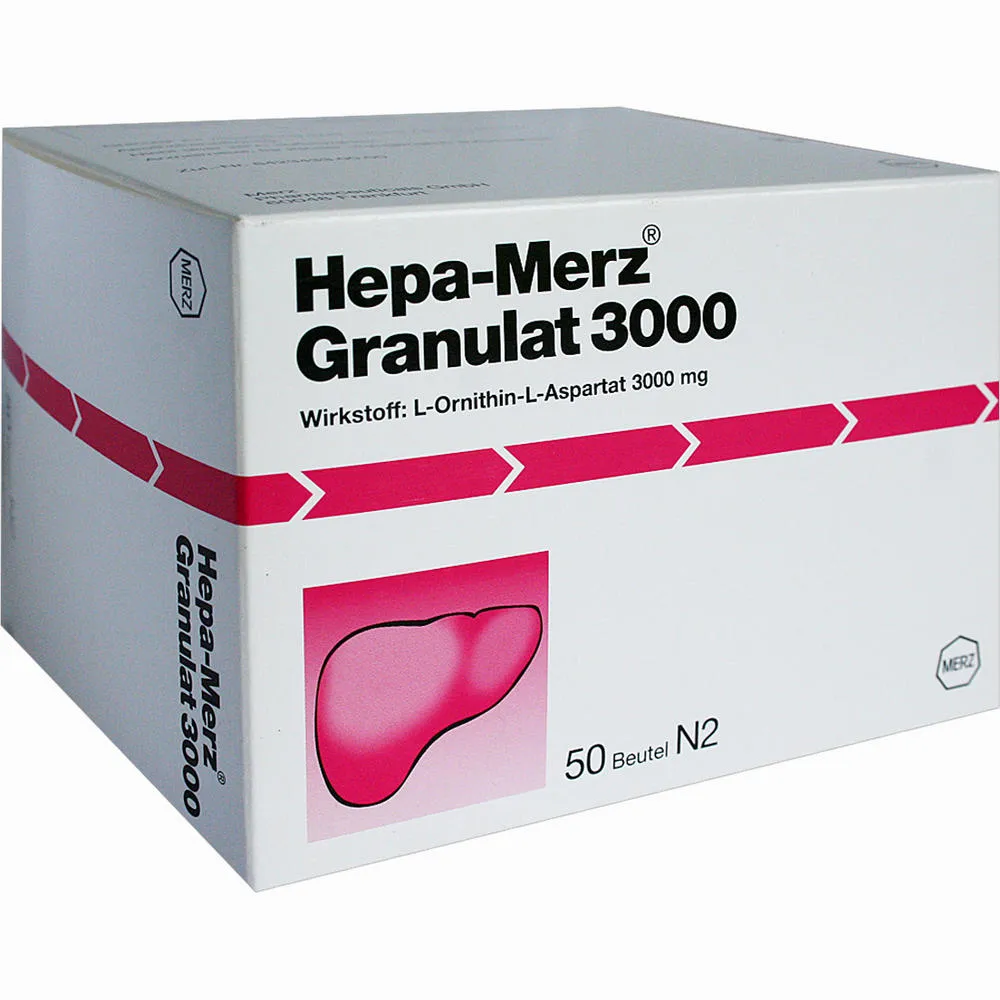
Table of Contents
Package leaflet: Information for the patient
Warning! Keep this leaflet! Information on the immediate packaging in a foreign language.
Hepa-Merz 3000 (Hepa-Merz 3000 mg)
3 g/5 g, granules for oral solution
Ornithini aspartas
Hepa-Merz 3000 and Hepa-Merz 3000 mg are different trade names for the same medicine.
Please read this leaflet carefully before using the medicine, as it contains important information for the patient.
This medicine should always be used exactly as described in this patient leaflet or as directed by a doctor or pharmacist.
- Keep this leaflet, so that you can read it again if necessary.
- If you need advice or further information, please consult your pharmacist.
- If you experience any adverse reactions, including any possible adverse reactions not listed in this leaflet, inform your doctor or pharmacist. See section 4.
- If there is no improvement or if you feel worse, you should contact your doctor.
Leaflet contents:
- What Hepa-Merz 3000 is and what it is used for
- Important information before taking Hepa-Merz 3000
- How to take Hepa-Merz 3000
- Possible side effects
- How to store Hepa-Merz 3000
- Contents of the pack and other information
1. What Hepa-Merz 3000 is and what it is used for
Hepa-Merz 3000 is used in the treatment of latent and manifest hepatic encephalopathy occurring in chronic liver diseases, such as chronic hepatitis, liver cirrhosis.
2. Important information before taking Hepa-Merz 3000
When not to take Hepa-Merz 3000
Do not use Hepa-Merz 3000 in patients with the following conditions:
- Hypersensitivity to L-ornithine L-aspartate, tartrazine (E 110), or any of the other ingredients of the medicine;
- Severe renal insufficiency (serum creatinine concentration above 3 mg/100 ml);
- Disorders of amino acid metabolism involved in the urea cycle, e.g. due to enzymatic defects;
- Fructose intolerance.
Warnings and precautions
Before starting treatment with Hepa-Merz 3000, discuss this with your doctor or pharmacist.
Hepa-Merz 3000 contains a colouring agent – tartrazine (E 110), which may cause allergic reactions (including asthma symptoms). This type of allergy is particularly common in individuals sensitive to acetylsalicylic acid.
Hepa-Merz 3000 contains fructose (1.13 g per sachet, equivalent to 0.11 carbohydrate exchange unit). This should be taken into account in patients with diabetes.
Long-term use of Hepa-Merz 3000 may cause dental caries.
Children:
There is no data available on the use of the medicine in children.
Before administering the medicine to infants or children, consult a doctor, as the child may have previously undiagnosed fructose intolerance.
Hepa-Merz 3000 and other medicines
Inform your doctor about all medicines you are currently taking or have recently taken, as well as any medicines you plan to take.
No interactions between Hepa-Merz 3000 and other medicines are known.
Pregnancy and breastfeeding
If you are pregnant or breastfeeding, suspect you may be pregnant, or are planning to have a child, consult your doctor before using this medicine.
Pregnancy:
There are insufficient data on the safety of Hepa-Merz 3000 during pregnancy; therefore, the use of the medicine should be avoided during pregnancy. Hepa-Merz 3000 may be taken by pregnant women only if recommended by a doctor.
Breastfeeding:
It is not known whether L-ornithine L-aspartate (the active substance of Hepa-Merz 3000) passes into breast milk. The use of the medicine should be avoided during breastfeeding. Hepa-Merz 3000 may be taken by breastfeeding women only if recommended by a doctor.
Driving and operating machinery
The ability to drive vehicles and operate machinery may be impaired due to the disease for which Hepa-Merz 3000 is used in treatment.
Hepa-Merz 3000 contains tartrazine (E 110) and fructose.
See section "Warnings and precautions".
The medicine contains less than 1 mmol (23 mg) of sodium per sachet, meaning the medicine is considered "sodium-free".
3. How to take Hepa-Merz 3000
This medicine should always be taken as directed by your doctor. If in doubt, consult your doctor or pharmacist.
The usual dose is 1 or 2 sachets 1 to 3 times daily.
The contents of the sachet should be dissolved in a glass of water. Take during or after a meal.
If you feel that the effect of the medicine is too strong or too weak, contact your doctor or pharmacist.
Route of administration
Oral use.
Taking more Hepa-Merz 3000 than recommended
Symptoms of poisoning after overdose of Hepa-Merz 3000 have not been observed so far.
In case of overdose, symptomatic treatment should be applied.
If you forget to take Hepa-Merz 3000
Take the next dose at the correct time, according to the dosing instructions.
Do not take a double dose to make up for a missed dose.
If you have any doubts regarding the use of this medicine, consult your doctor or pharmacist.
4. Possible side effects
Like all medicines, this medicine can cause side effects, although not everybody gets them.
Uncommon side effects (less than 1 in 100 people):
nausea; vomiting; stomach pain; bloating; diarrhoea.
Very rare side effects (less than 1 in 10,000 people):
limb pain.
The listed side effects are usually transient and do not require discontinuation of the medicine.
The excipient – tartrazine (E 110) – may cause allergic reactions.
Reporting of side effects
If you experience any adverse reactions, including any adverse reactions not listed in this leaflet, inform your doctor or pharmacist. Adverse reactions can be reported directly to the Department of Monitoring Adverse Drug Reactions, Office for Registration of Medicinal Products, Medical Devices and Biocidal Products, Al. Jerozolimskie 181C, 02-222 Warsaw, tel.: +48 22 49 21 301, fax: +48 22 49 21 309, website: https://smz.ezdrowie.gov.pl.
Reporting adverse reactions helps provide more information on the safety of the medicine.
5. How to store Hepa-Merz 3000
Keep the medicine out of the sight and reach of children.
Do not use this medicine after the expiry date stated on the packaging. The expiry date refers to the last day of the stated month.
Do not store above 25°C.
Medicines must not be disposed of via wastewater or household waste. Ask your pharmacist how to dispose of medicines no longer in use. Such measures help protect the environment.
6. Contents of the packaging and other information
What Hepa-Merz 3000 contains
The active substance is L-ornithine-L-aspartate.
One sachet (5 g of granules) contains 3 g of L-ornithine-L-aspartate.
The other ingredients (excipients) are:
citric acid, lemon flavour, orange flavour, sodium saccharin, sodium cyclamate,
orange yellow (E 110), povidone K 25, fructose.
What Hepa-Merz 3000 looks like and contents of the pack
Hepa-Merz 3000 is an orange-coloured granulate.
The pack contains 10, 30, 50 or 100 sachets.
For more detailed information, please contact the responsible party or the parallel importer.
Marketing Authorisation Holder in Latvia, country of export:
Merz Pharmaceuticals GmbH
Eckenheimer Landstr. 100
60318 Frankfurt, Germany
Manufacturer:
Merz Pharma GmbH & Co. KGaA
Ludwigstraße 22
64354 Reinheim, Germany
Parallel Importer:
InPharm Sp. z o.o.
ul. Strumykowa 28/11
03-138 Warsaw, Poland
Repackaged in:
InPharm Sp. z o.o. Services sp. k.
ul. Chełmżyńska 249
04-458 Warsaw, Poland
Marketing Authorisation Number in Latvia, country of export: 94-0187
Parallel Import Authorisation Number: 334/25