Hascovir
Poland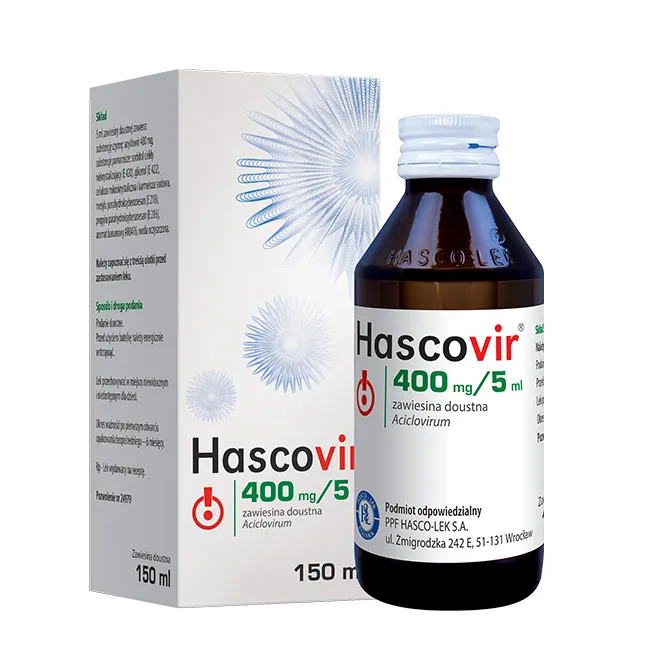
Table of Contents
Package leaflet: Information for the patient
HASCOVIR
400 mg/5 ml, oral suspension
Aciclovirum
Please read all of this leaflet carefully before taking this medicine, because it contains
important information for you.
- Keep this leaflet, as you may need to read it again.
- If you have any further questions, please ask your doctor, pharmacist, or nurse.
- This medicine has been prescribed for a specific individual. Do not pass it on to others. It may harm other people, even if their symptoms are the same.
- If you experience any adverse reactions, including any not listed in this leaflet, inform your doctor, pharmacist, or nurse. See section 4.
Contents of the leaflet
- What Hascovir is and what it is used for
- Important information before taking Hascovir
- How to take Hascovir
- Possible side effects
- How to store Hascovir
- Contents of the pack and other information
1. What Hascovir is and what it is used for
The active substance in Hascovir is aciclovir, which inhibits the replication of human pathogenic
viruses from the Herpes group.
Indications
Hascovir oral suspension 400 mg/5 ml is indicated for:
- Treatment of skin and mucous membrane infections caused by herpes simplex virus, including primary and recurrent genital herpes (excluding herpes simplex virus infections in newborns and severe herpes simplex virus infections in children with significantly impaired immunity);
- Prevention of recurrences of herpes simplex in patients with normal immunity;
- Prevention of herpes simplex virus infections in immunocompromised patients;
- Treatment of infections caused by varicella-zoster virus (chickenpox and shingles).
2. Important information before using Hascovir
When not to use Hascovir
- if the patient is allergic to acyclovir or valacyclovir or any of the other ingredients of this medicine (listed in section 6).
Warnings and precautions
Before starting treatment with Hascovir, discuss this with your doctor, especially if the patient:
- has kidney problems,
- is taking other medicines that may damage the kidneys,
- has significantly weakened immunity,
- is 65 years of age or older.
1/7
Hydration status
Patients receiving high doses of acyclovir (e.g. for shingles treatment and a dose of 4 g acyclovir per day) should drink plenty of fluids to maintain adequate hydration.
Hascovir and other medicines
Tell your doctor or pharmacist about all medicines the patient is currently taking or has recently taken, as well as any medicines the patient plans to take.
In particular, inform your doctor if the patient is taking any of the following medicines:
- probenecid (used in the treatment of gout),
- cimetidine (used for peptic ulcer disease),
- tacrolimus, cyclosporine or mycophenolate mofetil (used in transplant patients),
- theophylline (used in the treatment of asthma and other respiratory disorders).
Pregnancy and breastfeeding
If the patient is pregnant, breastfeeding, suspects she might be pregnant, or is planning to have a baby, she should consult her doctor or pharmacist before using this medicine.
Pregnancy
Hascovir should be avoided during pregnancy unless the doctor considers that the benefits to the mother outweigh the potential risks to the fetus.
Breastfeeding
Caution should be exercised when administering this medicine to breastfeeding women due to the passage of the drug into human milk.
Driving and operating machinery
The effect of acyclovir on the ability to drive or operate machinery has not been studied. However, the possibility of adverse effects such as dizziness, confusion, or seizures should be taken into account.
Hascovir contains methyl parahydroxybenzoate (E 218) and propyl parahydroxybenzoate
Due to the presence of methyl parahydroxybenzoate and propyl parahydroxybenzoate, this medicine may cause allergic reactions (including delayed-type reactions).
Hascovir contains sorbitol (E 420)
The medicine contains 450 mg of sorbitol in 1 ml. Sorbitol is a source of fructose. If the patient (or their child) has previously been diagnosed with intolerance to certain sugars or hereditary fructose intolerance—a rare genetic disorder in which the body cannot break down fructose—the patient should consult a doctor before taking the medicine or giving it to a child.
Hascovir contains propylene glycol (E 1520) – banana flavour component
The medicine contains 2.7 mg of propylene glycol in 5 ml. Before administering this medicine to a child under 4 weeks of age, consult a doctor or pharmacist, especially if the child is taking other medicines containing propylene glycol or alcohol.
Hascovir contains ethanol – banana flavour component
The medicine contains 1.4 mg of alcohol (ethanol) in 5 ml. The amount of alcohol in 5 ml of this medicine is equivalent to less than 1 ml of beer or 1 ml of wine. The small amount of alcohol in this medicine will not cause noticeable effects.
Hascovir contains sodium
The medicine contains less than 1 mmol (23 mg) of sodium per 5 ml, meaning the medicine is considered "sodium-free".
2/7
3. How to use Hascovir
This medicine should always be taken exactly as prescribed by the doctor. In case of doubt, consult
your doctor or pharmacist.
Method of administration
The medicine is taken orally.
Before use, the bottle should be shaken vigorously.
The prescribed dose should be measured using the oral syringe supplied with the package. The syringe
has a capacity of 5 millilitres, and its scale allows measuring the dose volume with an accuracy of ¼ (one quarter)
millilitre (i.e. 20 mg of acyclovir).
Hascovir oral suspension contains 400 mg of acyclovir in 5 ml, thus 1 ml of suspension corresponds to
80 mg of acyclovir.
Recommended dose for adults
Treatment of infections caused by herpes simplex virus
The recommended dose is 200 mg of acyclovir (corresponding to 2.5 ml of suspension at a concentration of 400 mg/5 ml)
five times daily, approximately every 4 hours, with a nighttime break.
Treatment lasts for 5 consecutive days, but in severe primary infections, the doctor may recommend
prolonging the duration of treatment.
In patients with significantly reduced immunity (e.g. after bone marrow transplantation) or with impaired
gastrointestinal absorption, the doctor may decide to double the acyclovir dose to 400 mg (i.e. to 5 ml of suspension at a concentration of 400 mg/5 ml) or to administer acyclovir intravenously.
Treatment should be started as early as possible after diagnosis of infection. In recurrent infections,
starting treatment during the prodromal phase or immediately after the first symptoms appear is particularly important.
Prevention of recurrent herpes simplex in patients with normal immunity
In patients with normal immunity, the recommended dose is 200 mg of acyclovir (corresponding to 2.5 ml of suspension at a concentration of 400 mg/5 ml) four times daily, approximately every 6 hours.
For many patients, administration of a twice-daily dose of 400 mg acyclovir (i.e. 5 ml of suspension at a concentration of 400 mg/5 ml) every 12 hours may be more effective and convenient.
Prophylactic effect may also be achieved with a gradually reduced dose of acyclovir to 200 mg (i.e. to
2.5 ml of suspension at a concentration of 400 mg/5 ml) administered three times daily, approximately every 8 hours, or even twice daily approximately every 12 hours.
In some patients, response to prophylactic treatment occurs with a total daily dose of 800 mg of acyclovir (i.e. 10 ml of suspension at a concentration of 400 mg/5 ml).
The doctor will decide whether to interrupt treatment every 6 to 12 months to monitor any changes in the course of the disease.
Prevention of herpes simplex virus infections in patients with reduced immunity
To prevent herpes simplex virus infection in patients with reduced immunity, administration of 200 mg of acyclovir (corresponding to 2.5 ml of suspension at a concentration of 400 mg/5 ml) four times daily, approximately every 6 hours, is recommended.
In patients with significantly reduced immunity (e.g. after bone marrow transplantation) or with impaired
gastrointestinal absorption, the doctor may decide to double the dose to 400 mg of acyclovir (i.e. to 5 ml of suspension at a concentration of 400 mg/5 ml) or to administer acyclovir intravenously.
The duration of prophylactic treatment will be determined by the doctor, taking into account the period of infection risk.
3/7
Treatment of infections caused by varicella-zoster virus
The recommended dose is 800 mg of acyclovir (i.e. 10 ml of suspension at a concentration of 400 mg/5 ml) five times daily, approximately every 4 hours, with a nighttime break.
The medicine should be taken for 7 days.
The doctor may decide to administer the medicine intravenously in patients with significantly reduced immunity (e.g. after bone marrow transplantation) or with impaired gastrointestinal absorption.
Treatment should be started immediately after diagnosis of infection. The best treatment outcomes for both
chickenpox and shingles are achieved when the medicine is administered within 24 hours of the onset of the first skin lesions – rash.
Recommended dose for children
Treatment of herpes simplex virus infections and prevention of herpes simplex virus infections in patients with reduced immunity
Children aged 2 years and above: dosing is the same as recommended for adults.
Children under 2 years of age: half the adult dose should be administered.
Treatment of varicella-zoster virus infections
Children aged 6 years: administration of 800 mg of acyclovir (corresponding to 10 ml of suspension at a concentration of 400 mg/5 ml) four times daily is recommended.
Children aged 2 to 5 years: administration of 400 mg of acyclovir (corresponding to 5 ml of suspension at a concentration of 400 mg/5 ml) four times daily is recommended.
Children under 2 years of age: administration of 200 mg of acyclovir (corresponding to 2.5 ml of suspension at a concentration of 400 mg/5 ml) four times daily is recommended.
The medicine should be taken for 5 days.
The doctor may also determine the dose more precisely and recommend administration of 20 mg of acyclovir/kg body weight (up to a maximum dose of 800 mg of acyclovir – i.e. up to 10 ml of suspension at a concentration of 400 mg/5 ml) four times daily.
There are no detailed data available on the recommended dosing of acyclovir for prevention of recurrent herpes simplex virus infections and treatment of shingles in children with normal immunity.
Use in elderly patients
In elderly patients, the doctor will consider the possibility of impaired renal function and adjust the dose accordingly (see: Use in patients with renal impairment).
During treatment, patients should drink plenty of fluids.
Use in patients with renal impairment
Caution should be exercised when administering acyclovir to patients with renal impairment.
During treatment, patients should drink plenty of fluids.
During treatment of herpes simplex virus infections or prophylaxis in patients with severe renal failure (creatinine clearance less than 10 ml/min), the doctor may recommend reducing the dose to 200 mg of acyclovir (i.e. to 2.5 ml of suspension at a concentration of 400 mg/5 ml) twice daily, approximately every 12 hours.
During treatment of varicella-zoster virus infections in patients with moderate renal impairment (creatinine clearance 10–25 ml/min), the doctor may recommend reducing the dose to 800 mg of acyclovir (correspondingly 10 ml of suspension at a concentration of 400 mg/5 ml) three times daily, approximately every 8 hours, and in patients with severe renal impairment (creatinine clearance less than 10 ml/min), reducing the dose to 800 mg of acyclovir (i.e. to 10 ml of suspension at a concentration of 400 mg/5 ml) twice daily, approximately every 12 hours.
Administration of a higher than recommended dose of Hascovir
It is unlikely that accidental intake of an excessive dose of acyclovir would cause serious problems.
Single intake of even up to 20 g of acyclovir usually does not cause symptoms of poisoning. Unintentional, repeated oral overdose of acyclovir over several days has been associated with gastrointestinal symptoms (nausea, vomiting) and neurological symptoms (headache, confusion).
If an excessive dose is taken, inform your doctor or pharmacist or contact the nearest hospital emergency department for further advice.
Missed dose of Hascovir
If a dose is missed, take it as soon as possible and continue treatment according to previous instructions. However, if it is almost time for the next dose, skip the missed dose.
Do not take a double dose to make up for a missed dose.
If you have any further doubts regarding the use of this medicine, consult your doctor or pharmacist.
4. Possible adverse reactions
Like all medicines, this medicine can cause adverse reactions, although not everyone experiences them.
In most cases, there are no available data enabling an accurate estimation of the frequency of adverse reactions, which may also vary depending on the indication for treatment. Known adverse reactions observed during acyclovir use include:
Common adverse reactions (may occur in up to 1 in 10 patients):
- headache, dizziness,
- nausea, vomiting, diarrhoea, abdominal pain,
- fatigue, fever,
- itching, skin rash (including photosensitivity).
Uncommon adverse reactions (may occur in up to 1 in 100 patients):
- urticaria, cases of accelerated, diffuse hair loss. Since accelerated, diffuse hair loss may be associated with multiple diseases and the use of various drugs, its relationship to acyclovir is uncertain.
Rare adverse reactions (may occur in up to 1 in 1000 patients):
- angioedema (most commonly occurs in the face, mainly around the lips and eyelids, may also affect the tongue, glottis or larynx, thus potentially posing a life-threatening risk),
- dyspnoea,
- transient increase in bilirubin concentration and liver enzyme activity in blood,
- anaphylactic reaction (immediate allergic reaction, may be life-threatening),
- increased blood urea and creatinine concentrations.
Very rare adverse reactions (may occur in less than 1 in 10,000 patients):
- decreased blood levels of various types of blood cells (anaemia, thrombocytopenia, leukopenia),
- agitation, disorientation, tremors, ataxia, speech disorders, hallucinations, psychotic symptoms, seizures, somnolence, brain damage (so-called encephalopathy), coma.
5/7
The above events are usually transient and generally observed in patients with impaired renal function or other predisposing factors (see section 2). Additionally, the following may occur:
- jaundice, hepatitis,
- acute renal failure, kidney pain. Kidney pain may be associated with renal (kidney) impairment. Adequate fluid intake should be ensured for the patient. Renal dysfunction usually resolves quickly after fluid supplementation and/or dose reduction or discontinuation of the medicine. However, in exceptional cases, acute renal failure may occur.
Reporting of adverse reactions
If any adverse reactions occur, including any adverse reactions not listed in this leaflet, inform your doctor or pharmacist. Adverse reactions can be reported directly to the Department of Monitoring Adverse Drug Reactions of the Office for Registration of Medicinal Products, Medical Devices and Biocidal Products:
Aleje Jerozolimskie 181C, 02-222 Warsaw,
tel.: 22 49 21 301, fax: 22 49 21 309,
website: https://smz.ezdrowie.gov.pl
Adverse reactions can also be reported to the marketing authorisation holder.
Reporting adverse reactions helps to provide more information on the safety of the medicine.
5. How to store Hascovir
Keep this medicine out of sight and reach of children.
Do not use this medicine after the expiry date stated on the packaging. The expiry date refers to the last day of the stated month.
There are no special storage instructions for this medicine.
Shelf-life after first opening the immediate packaging – 6 months.
Medicines must not be disposed of via wastewater or household waste. Ask your pharmacist how to dispose of medicines no longer required. Such measures will help protect the environment.
6. Contents of the packaging and other information
What Hascovir contains
- The active substance is acyclovir. The medicine contains 400 mg of acyclovir in 5 ml, so 1 ml contains 80 mg of acyclovir.
- The other ingredients are: sorbitol liquid, non-crystallising (E 420), glycerol (E 422), microcrystalline cellulose and sodium carmellose, methyl parahydroxybenzoate (E 218), propyl parahydroxybenzoate, banana flavour AR0476 [containing, among others, eugenol, propylene glycol (E 1520) and ethanol], purified water.
What Hascovir looks like and contents of the pack
Hascovir is a white suspension with a banana flavour and odour.
The pack consists of a brown type III glass bottle containing 150 ml of oral suspension, closed with a polyethylene screw cap with a plug and a tamper-evident ring, placed in a cardboard box.
An oral syringe with a capacity of 5 ml is supplied with the pack.
Marketing Authorisation Holder and Manufacturer
"PRZEDSIEBIORSTWO PRODUKCJI FARMACEUTYCZNEJ HASCO-LEK" S.A.
51-131 Wrocław, ul. Żmigrodzka 242 E
6/7
Medicinal Product Information
Tel.: 22 742 00 22
E-mail: [email protected]
7/7