Hascosept
Poland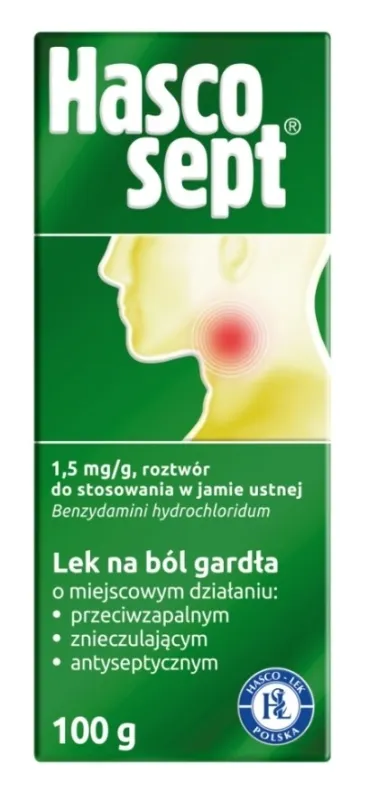
Table of Contents
- Package leaflet: information for the patient
- 1. What Hascosept is and what it is used for
- 2. Important information before using Hascosept
- 3. How to use Hascosept
- 4. Possible adverse reactions
- 5. How to store Hascosept
- 6. Package contents and other information
- Package leaflet: information for the patient
- 1. What Hascosept is and what it is used for
- 2. Important information before using Hascosept
- 3. How to use Hascosept
- 4. Possible side effects
- 5. How to store Hascosept
- 6. Package contents and other information
Package leaflet: information for the patient
HASCOSEPT
1.5 mg/g, oral solution
Benzydamini hydrochloridum
Please read all of this leaflet carefully before using this medicine, because it contains
important information for you.
This medicine should always be used exactly as described in this patient leaflet or as directed by
your doctor, pharmacist, or nurse.
- Keep this leaflet, as you may need to read it again.
- If you need advice or further information, please contact your pharmacist.
- If you experience any side effects, including any not listed in this leaflet, tell your doctor, pharmacist, or nurse. See section 4.
- If your symptoms do not improve or if you feel worse, contact your doctor.
Table of contents
- What Hascosept is and what it is used for
- Important information before using Hascosept
- How to use Hascosept
- Possible side effects
- How to store Hascosept
- Contents of the pack and other information
1. What Hascosept is and what it is used for
Hascosept contains the active substance benzydamine hydrochloride. It is a substance with
anti-inflammatory and analgesic properties. When applied locally, it exerts local anaesthetic and
antiseptic effects.
Hascosept is used in the treatment of symptoms (pain, redness, swelling, aphthae) associated with
inflammatory conditions of the mouth and throat in bacterial and viral infections, as well as after
surgical procedures in otorhinolaryngology and dentistry.
If symptoms do not improve or if you feel worse, consult your doctor.
2. Important information before using Hascosept
When not to use Hascosept
- if the patient is allergic to the active substance or to any of the other ingredients of this medicine (listed in section 6).
Warnings and precautions
Before starting treatment with Hascosept, discuss this with your doctor, pharmacist, or nurse.
Prolonged, especially long-term, use of locally acting medicines may cause allergic reactions. If this occurs, Hascosept should be discontinued and medical advice sought.
Hascosept with other medicines
Inform your doctor or pharmacist about all medicines you are currently taking or have recently taken, as well as any medicines you plan to take.
No interactions between Hascosept and other medicines are known.
Pregnancy and breastfeeding
If the patient is pregnant or breastfeeding, suspects she may be pregnant, or is planning to have a child, she should consult her doctor or pharmacist before using this medicine.
Hascosept should not be used during pregnancy unless absolutely necessary and recommended by a doctor. If use is necessary, the smallest possible dose should be used for the shortest possible time.
Hascosept should not be used during breastfeeding unless otherwise advised by a doctor.
Driving and operating machinery
There are no studies on the effect of the medicine on the ability to drive vehicles or operate machinery.
Hascosept contains methyl parahydroxybenzoate
This medicine may cause allergic reactions (including delayed-type reactions).
Hascosept contains 96% ethanol
The medicine contains small amounts of ethanol (alcohol) – less than 100 mg per dose.
3. How to use Hascosept
This medicine should always be used exactly as described in this patient information leaflet or as advised by your doctor, pharmacist, or nurse. If in doubt, consult your doctor, pharmacist, or nurse.
For application to the oral mucosa.
Rotate the applicator tip to the horizontal position. Then place the applicator into the oral cavity, direct its outlet towards the inflamed area, and firmly press the button.
Dosage
Children under 6 years: 1 dose of medicine per 4 kg body weight (each dose contains 0.14 ml of solution), 2 to 6 times daily.
Regardless of body weight, do not exceed 4 doses at one time.
Children from 6 to 12 years: 4 doses of medicine, 2 to 6 times daily.
Children and adolescents over 12 years and adults: 4 to 8 doses of medicine, 2 to 6 times daily.
Do not use more than the recommended dose.
Before first use, press the pump button several times to ensure proper spray function.
Use of a higher than recommended dose of Hascosept
After topical application, the medicine has practically no systemic effect; therefore, the risk of overdose is minimal. If a larger than recommended dose is ingested or the medicine is accidentally swallowed, contact your doctor or pharmacist immediately.
Missed dose of Hascosept
Do not use a double dose to make up for a missed dose.
If you have any further doubts regarding the use of this medicine, consult your doctor or pharmacist.
4. Possible adverse reactions
Like all medicines, this medicine can cause adverse reactions, although not everybody will experience them.
Local adverse reactions are usually transient, resolve spontaneously, and rarely require additional treatment.
Benzydamine, when applied locally, is absorbed into the systemic circulation in minimal amounts; therefore, general adverse reactions are very rare.
Diluting the medicine usually eliminates these symptoms.
Adverse reactions occurring very rarely (in less than 1 in 10,000 patients using the medicine) or with unknown frequency (frequency cannot be estimated from the available data):
- General disorders and administration site conditions: burning sensation of the oral mucosa,
- Gastrointestinal disorders: dryness of the mouth, nausea, and vomiting,
- Immune system disorders: allergic reaction (hypersensitivity), hypersensitivity reactions,
- Nervous system disorders: sensory disturbances, numbness, dizziness, headache,
- Skin and subcutaneous tissue disorders: rash.
Severe allergic reaction (anaphylactic shock) with symptoms such as: difficulty breathing,
chest pain or tightness, and (or) dizziness/fainting, intense itching of the skin or raised skin rash (hives), swelling of the face, lips, tongue, and (or) throat, which may be potentially life-threatening.
Reporting of adverse reactions
If any adverse reactions occur, including any adverse reactions not listed in this leaflet, inform your doctor or pharmacist. Adverse reactions can be reported directly to the Department of Monitoring Adverse Drug Reactions at the Office for Registration of Medicinal Products, Medical Devices and Biocidal Products:
Al. Jerozolimskie 181C, 02–222 Warsaw
Phone: +48 22 4921301, Fax: +48 22 4921309
Website: https://smz.ezdrowie.gov.pl
Adverse reactions can also be reported to the Marketing Authorisation Holder.
Reporting adverse reactions helps to provide more information on the safety of the medicine.
5. How to store Hascosept
Store below 25°C.
Store in the tightly closed original packaging.
Storage period after first opening: 12 months.
Keep this medicine out of the sight and reach of children.
Do not use this medicine after the expiry date stated on the container. The expiry date refers to the last day of the stated month.
Medicines must not be disposed of via wastewater or household waste. Ask your pharmacist how to properly dispose of medicines no longer in use. This will help protect the environment.
6. Package contents and other information
What Hascosept contains
- The active substance is benzidamine hydrochloride. 1 g of solution contains 1.5 mg of benzidamine hydrochloride.
- The other ingredients (excipients) are: patent blue (E 131), quinoline yellow (E 104), mint flavour, glycerol, 96% ethanol, saccharin, sodium hydrogen carbonate, methyl parahydroxybenzoate, polysorbate 20, purified water.
What Hascosept looks like and contents of the pack
Hascosept is an intensely green-coloured solution.
One package of the medicine (a polyethylene bottle with an atomizer and an oral applicator, placed in a cardboard box) contains 30 g of solution.
Marketing Authorisation Holder and Manufacturer
„PRZEDSIĘBIORSTWO PRODUKCJI FARMACEUTYCZNEJ HASCO-LEK” S.A.
51-131 Wrocław, ul. Żmigrodzka 242 E
Medicine Information
tel.: (22) 742 00 22
e-mail: [email protected]
Package leaflet: information for the patient
HASCOSEPT
1.5 mg/g, solution for oral use
Benzydamini hydrochloridum
Please read carefully all the information in this leaflet before using the medicine, as it contains
important information for the patient.
This medicine should always be used exactly as described in this patient leaflet or as directed by a doctor, pharmacist, or nurse.
- Keep this leaflet, as you may need to read it again.
- If you need advice or further information, please contact your pharmacist.
- If you experience any adverse reactions, including any not listed in this leaflet, inform your doctor, pharmacist, or nurse. See section 4.
- If there is no improvement or if you feel worse, contact your doctor.
Leaflet contents:
- What Hascosept is and what it is used for
- Important information before using Hascosept
- How to use Hascosept
- Possible side effects
- How to store Hascosept
- Package contents and other information
1. What Hascosept is and what it is used for
Hascosept contains the active substance benzidamine hydrochloride. It is a substance with anti-inflammatory and analgesic properties. When applied locally, it has a local anaesthetic and antiseptic effect.
Hascosept is used to treat symptoms (pain, redness, swelling, aphthae) associated with inflammatory conditions of the oral cavity and throat in bacterial and viral infections, and following surgical procedures in otorhinolaryngology and dentistry.
If there is no improvement or if you feel worse, consult your doctor.
2. Important information before using Hascosept
When not to use Hascosept
- if you are allergic to the active substance or to any of the other ingredients of this medicine (listed in section 6).
Warnings and precautions
Before starting to use Hascosept, discuss it with your doctor, pharmacist, or nurse.
The use, especially prolonged use, of locally acting medicines may cause an allergic reaction. In such a case, Hascosept should be discontinued and medical advice sought.
Hascosept and other medicines
Inform your doctor or pharmacist about all medicines you are currently taking or have recently taken, as well as any medicines you plan to take.
No interactions between Hascosept and other medicines are known.
Pregnancy and breastfeeding
If you are pregnant or breastfeeding, think you may be pregnant, or are planning to have a baby, you should consult your doctor or pharmacist before using this medicine.
Do not use Hascosept during pregnancy unless absolutely necessary and recommended by a doctor. If use is necessary, the lowest possible dose should be used for the shortest possible duration.
Hascosept should not be used during breastfeeding unless otherwise advised by a doctor.
Driving and operating machinery
There are no studies on the effect of the medicine on the ability to drive vehicles or operate machinery.
Hascosept contains methyl parahydroxybenzoate
This medicine may cause allergic reactions (including delayed-type reactions).
Hascosept contains 96% ethanol
This medicine contains small amounts of ethanol (alcohol) – less than 100 mg per dose.
3. How to use Hascosept
This medicine should always be used exactly as described in this patient leaflet or as directed by your doctor, pharmacist, or nurse. If in doubt, consult your doctor, pharmacist, or nurse.
For application to the oral mucosa.
Rinse the mouth and throat 2 to 3 times daily using 15 ml (1 tablespoon) of undiluted solution or diluted with a small amount of water.
Use of a higher than recommended dose of Hascosept
When applied locally, the medicine is practically devoid of systemic effects, so the risk of overdose is minimal. Accidental swallowing of a small volume of Hascosept mouthwash solution does not pose a health risk. However, if a very large amount of Hascosept is swallowed (e.g., by children), symptoms such as vomiting, abdominal pain, restlessness, anxiety, seizures, ataxia, fever, tachycardia, and potentially respiratory depression may occur.
In case of overdose symptoms, symptomatic treatment is recommended (e.g., respiratory support, gastric lavage for detoxification, etc.).
If a dose higher than recommended is taken or if the medicine is accidentally swallowed, contact your doctor or pharmacist immediately.
Missed dose of Hascosept
Do not use a double dose to make up for a missed dose.
If you have any further doubts regarding the use of this medicine, consult your doctor or pharmacist.
4. Possible side effects
Like all medicines, this medicine can cause side effects, although not everybody will experience them.
Local side effects are usually transient, resolve spontaneously, and rarely require additional treatment.
Benzidamine, when used locally, is absorbed into the systemic circulation to a small extent; therefore, systemic side effects are very rare.
Diluting the solution usually alleviates these symptoms.
Side effects occurring very rarely (in less than 1 in 10,000 patients using the medicine) or with unknown frequency (frequency cannot be estimated from available data):
- General disorders and administration site conditions: burning sensation of the oral mucosa,
- Gastrointestinal disorders: dry mouth, nausea, vomiting,
- Immune system disorders: allergic reaction (hypersensitivity), hypersensitivity reactions,
- Nervous system disorders: sensory disturbances, numbness, dizziness, headache,
- Skin and subcutaneous tissue disorders: rash.
Severe allergic reaction (anaphylactic shock) with symptoms such as: difficulty breathing, chest pain or tightness, and/or dizziness/fainting, intense itching of the skin or skin hives, swelling of the face, lips, tongue, and/or throat, which may be potentially life-threatening.
Reporting of side effects
If you experience any adverse reactions, including any not listed in this leaflet, inform your doctor or pharmacist. Adverse reactions can be reported directly to the Department of Monitoring of Adverse Drug Reactions, Office for Registration of Medicinal Products, Medical Devices and Biocidal Products:
Al. Jerozolimskie 181C, 02-222 Warsaw
tel.: +48 22 49 21 301, fax: +48 22 49 21 309
Website: https://smz.ezdrowie.gov.pl
Adverse reactions can also be reported to the Marketing Authorisation Holder.
Reporting adverse reactions helps to provide more information on the safety of the medicine.
5. How to store Hascosept
Store below 25°C.
Keep in the original closed container.
Shelf life after first opening: 12 months.
Keep the medicine out of sight and reach of children.
Do not use this medicine after the expiry date stated on the packaging. The expiry date refers to the last day of the stated month.
Medicines should not be disposed of via wastewater or household waste. Ask your pharmacist how to dispose of medicines no longer required. These measures will help protect the environment.
6. Package contents and other information
What Hascosept contains
- The active substance is benzidamine hydrochloride. 1 g of solution contains 1.5 mg of benzidamine hydrochloride.
- The other ingredients (excipients) are: patent blue (E 131), quinoline yellow (E 104), mint flavour, glycerol, 96% ethanol, saccharin, sodium hydrogen carbonate, methyl parahydroxybenzoate, polysorbate 20, purified water.
What Hascosept looks like and contents of the pack
Hascosept is an intensely green-coloured solution.
One package of the medicine (a bottle made of colourless glass placed in a cardboard box) contains 100 g of solution.
Marketing Authorisation Holder and Manufacturer
„PRZEDSIĘBIORSTWO PRODUKCJI FARMACEUTYCZNEJ HASCO-LEK” S.A.
51-131 Wrocław, ul. Żmigrodzka 242 E
Medicine Information
tel.: (22) 742 00 22
e-mail: [email protected]