Gutron
Poland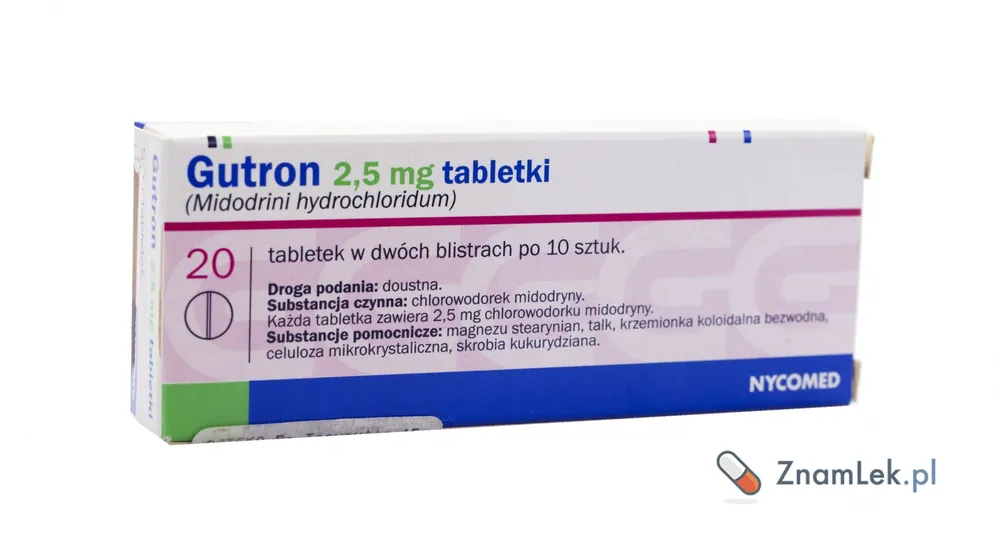
Table of Contents
Package leaflet: Information for the patient
Warning! Keep this leaflet! Information on the immediate packaging in a foreign language.
Gutron, 2.5 mg, tablets
Midodrini hydrochloridum
Please read carefully all the information in this leaflet before taking the medicine, as it contains
important information for the patient.
- Keep this leaflet so that you can read it again if necessary.
- If you have any doubts, consult your doctor or pharmacist.
- This medicine has been prescribed for a specific individual. Do not pass it on to others. The medicine may harm another person, even if their symptoms are the same.
- If you experience any adverse effects, including any adverse effects not listed in this leaflet, inform your doctor or pharmacist. See section 4.
Table of contents of the leaflet
- What is Gutron and what is it used for
- Important information before taking Gutron
- How to take Gutron
- Possible side effects
- How to store Gutron
- Contents of the package and other information
1. What is Gutron and what is it used for
Gutron raises low blood pressure by constricting small veins and arteries and prevents
accumulation of a larger volume of blood in the lower limbs. Low blood pressure and pooling
of blood in the lower limbs may cause dizziness and cerebral hypoperfusion.
Indicated for the treatment of severe orthostatic hypotension (a drop in blood pressure
upon standing, leading to dizziness or fainting) caused by dysfunction of the autonomic
nervous system, when causal treatment is not possible.
2. Important information before taking Gutron
When not to take Gutron:
- if the patient is allergic to midodrine hydrochloride or any of the other ingredients of this medicine (listed in section 6);
- if the patient has:
- severe organic heart and circulatory disorders, hypertension, cardiac arrhythmias;
- severe obstructive or spastic vascular diseases (e.g. cerebral vessel occlusion and spasms);
- acute nephritis, severe renal insufficiency, enlarged prostate gland with prolonged urinary retention, mechanical impairment of urination, urinary retention;
- proliferative diabetic retinopathy (retinal disorders in diabetes);
- adrenal gland chromaffin tumor ( phaeochromocytoma );
- hyperthyroidism;
- narrow-angle glaucoma;
- during pregnancy or breastfeeding.
Warnings and precautions
Before starting treatment with Gutron, consult your doctor or pharmacist.
Exercise particular caution when using Gutron:
- if the patient suffers from other diseases [especially right ventricular enlargement due to lung disease, intraocular hypertension (increased pressure inside the eye), impaired liver or kidney function];
- in case of allergies;
- when taking other medicines simultaneously, especially those containing vasoconstrictive substances (see section "Gutron and other medicines");
- during pregnancy and breastfeeding.
Inform your doctor about all the conditions listed above. The doctor may recommend additional tests to avoid adverse effects.
During treatment, regularly monitor arterial blood pressure in the lying, sitting, and standing positions. At the beginning of treatment, the doctor will assess the risk of developing hypertension in the lying or sitting position.
Be alert for symptoms indicating hypertension (palpitations, headache, dizziness, visual disturbances) or bradycardia (e.g. slow pulse, intensified dizziness, loss of consciousness). In such cases, discontinue treatment immediately and contact your doctor.
Continuation of midodrine treatment is recommended only if initial therapy has proven effective.
If significant changes/fluctuations in blood pressure occur, treatment should be discontinued.
Gutron and other medicines
Inform your doctor about all medicines currently or recently taken, as well as any medicines the patient intends to take.
Concurrent use of Gutron with certain medicines, e.g. perphenazine (an antipsychotic also used in anxiety disorders), amiodarone (used in cardiac arrhythmias), metoclopramide (an antiemetic), may enhance their effects.
Interactions may occur with sympathomimetics (e.g. ingredients of eye or nasal drops – phenylephrine, oxymetazoline, pseudoephedrine) and other agents containing vasoconstrictive substances (e.g. reserpine, guanethidine, antidepressants, antiallergic drugs, thyroid hormones), other medicines used for heart and circulatory diseases (alpha-adrenergic receptor blockers – e.g. phentolamine, prazosin, dihydroergotamine; beta-adrenergic receptor blockers – e.g. propranolol, metoprolol, atenolol, timolol), digoxin, MAO inhibitors, medicines containing atropine, cortisone-containing products (tablets, injections).
Pregnancy and breastfeeding
If the patient is pregnant or breastfeeding, suspects she may be pregnant, or is planning to become pregnant, she should consult her doctor before using this medicine.
Do not take Gutron during pregnancy or breastfeeding.
If the patient becomes pregnant during treatment, she should inform her doctor immediately.
Driving and operating machinery
Caution: this medicine may affect reaction speed and the ability to drive or operate machinery.
No studies have been conducted on the effect of midodrine on reaction speed and driving ability. When driving vehicles or operating machinery, bear in mind that anxiety, restlessness, and irritability may occasionally occur.
3. How to take Gutron
This medicine should always be taken as directed by the physician. In case of doubt, consult your doctor or pharmacist.
Adults and adolescents (over 12 years of age):
Initially, 1 to 2 times half a tablet per day. If the effect is insufficient, the dose may be increased to 2–3 times one tablet per day.
Dosage in patients with hypotension during therapy with psychotropic agents: twice one tablet per day. If the effect is insufficient, the dose may be increased to 2–3 times two tablets per day.
The maximum daily dose is 30 mg.
The medicine should be taken during the day, when the patient is in an upright position and engaged in daily activities.
The medicine should be taken at intervals of at least 3 to 4 hours.
The first dose should be taken shortly after waking up in the morning, the second at lunchtime, and, if necessary, the third in the late afternoon.
To minimize the risk of excessive increase in supine hypertension, Gutron should not be taken after dinner or less than 4 hours before going to bed.
Children under 12 years of age:
No available data.
Elderly patients:
No available data.
Patients with impaired liver or kidney function:
No available data.
Gutron must not be used in patients with acute nephritis and/or severe renal failure (see section "When not to take Gutron").
The duration of treatment is determined by the physician.
Tablets should be taken orally with liquid. Gutron may be taken with food.
Taking more Gutron than recommended
In case of overdose, the adverse reactions listed in section 4 may occur in an intensified manner, particularly: hypertension, goosebumps, chills, bradycardia, and urinary retention. Medical advice should be sought immediately.
If you forget to take Gutron
Do not take a double dose to make up for a missed tablet.
If you have any further questions about the use of this medicine, consult your doctor or pharmacist.
4. Possible adverse reactions
Like all medicines, this medicine can cause adverse reactions, although not everyone experiences them.
The following adverse reactions may occur during treatment with Gutron:
Very common (affects more than 1 in 10 people):
- goosebumps;
- painful urination.
Common (affects more than 1 in 100 people):
- hypertension in the supine position (with doses above 30 mg per day);
- itching, chills, hot flushes, rash;
- nausea, heartburn, inflammation of the oral mucosa;
- sensory disturbances (tingling);
- urinary retention.
Uncommon (affects more than 1 in 1,000 people):
- sleep disturbances, insomnia;
- slowed heart rate (bradycardia), palpitations;
- sudden urge to urinate;
- headache, anxiety, restlessness, irritability.
Rare (affects more than 1 in 10,000 people):
- increased heart rate (tachycardia), cardiac arrhythmias;
- liver function disorders, increased liver enzyme activity.
Frequency not known (cannot be estimated from available data):
- anxiety, confusion;
- abdominal pain, vomiting, diarrhoea.
Reporting of adverse reactions
If any adverse reactions occur, including any adverse reactions not listed in this leaflet, inform your doctor or pharmacist. Adverse reactions can be reported directly to the Department of Monitoring of Adverse Drug Reactions of the Office for Registration of Medicinal Products, Medical Devices and Biocidal Products
Al. Jerozolimskie 181 C
02-222 Warsaw
Phone: +48 22 49 21 301
Fax: +48 22 49 21 309
Website: https://smz.ezdrowie.gov.pl
Reporting adverse reactions helps to provide more information on the safety of the medicine.
5. How to store Gutron
Store below 25°C in the original packaging.
Keep the medicine out of sight and reach of children.
Do not use this medicine after the expiry date stated on the packaging. The expiry date refers to the last day of the stated month.
Medicines must not be disposed of via wastewater or household waste. Ask your pharmacist how to dispose of medicines no longer required. This will help protect the environment.
6. Contents of the packaging and other information
What Gutron contains
- The active substance is midodrine hydrochloride.
- The other ingredients are: magnesium stearate, talc, colloidal anhydrous silica, microcrystalline cellulose PH 101, corn starch.
What Gutron looks like and contents of the pack
Gutron is a white, round tablet with the letters "GU" imprinted above and the dose strength "2.5" below the break line.
The pack contains 20 tablets in two PVC/PVDC/Al blisters.
For further information, please contact the responsible party or the parallel importer.
Marketing Authorisation Holder in Romania, country of export:
Cheplapharm Arzneimittel GmbH
Ziegelhof 24
17489 Greifswald
Germany
Manufacturer:
Takeda GmbH
Plant Oranienburg, Lehnitzstrasse 70-98
DE-16515 Oranienburg, Germany
Parallel Importer:
Aga Kommerz spol. s r.o.
Frydecka 2006
737 01 Český Těšín
Czech Republic
Repackaged in:
Pharma Innovations Sp. z o.o.
ul. Jagiellońska 76
03-301 Warsaw
CEFEA Sp. z o.o. Sp. komandytowa
ul. Działkowa 56
02-234 Warsaw
Wytwórnia Euceryny Laboratorium Farmaceutyczne COEL S.J. E.Z.M. KONSTANTY
ul. Wł. Żeleńskiego 45
31-353 Kraków
Medezin Sp. z o.o.
ul. Zbąszyńska 3
91-342 Łódź
Marketing Authorisation Number in Romania, country of export: 7023/2014/02
Parallel Import Licence Number: 218/22