Groprinosin
Poland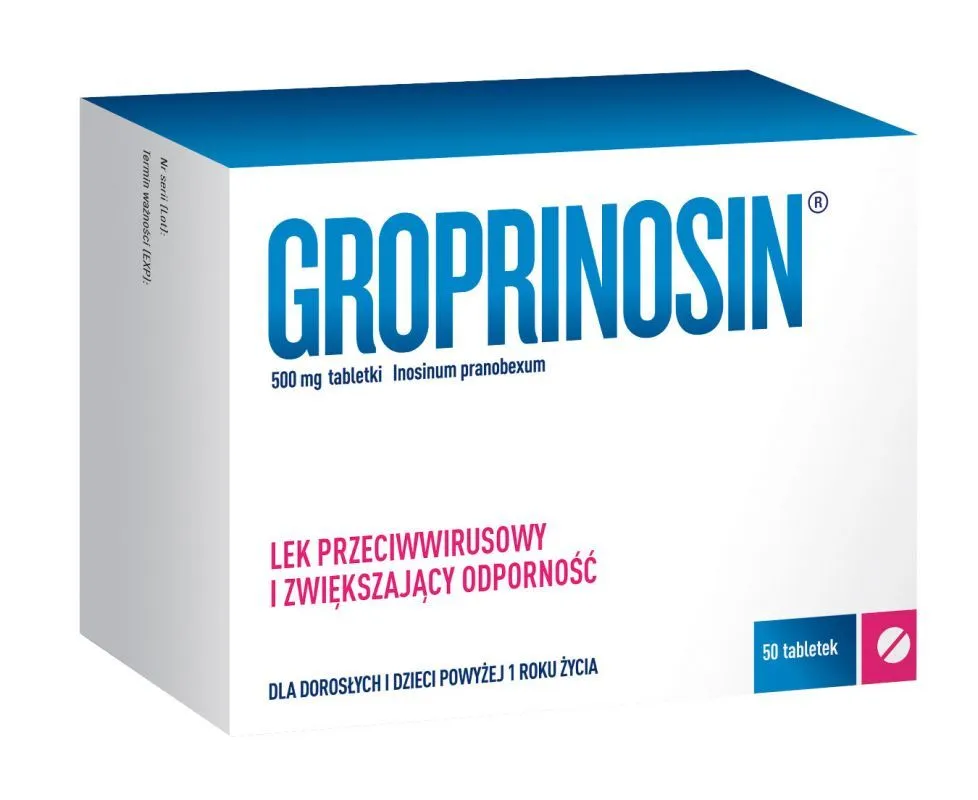
Table of Contents
Package leaflet: Information for the user
GROPRINOSIN, 500 mg, tablets
Inosinum pranobexum
Please read all of this leaflet carefully before taking this medicine, because it contains
important information for you.
You must always take this medicine exactly as described in this patient leaflet or as your
doctor or pharmacist has recommended.
- Keep this leaflet so that you can read it again if necessary.
- If you need advice or further information, please consult your pharmacist.
- If you experience any side effects, including any not listed in this leaflet, you should inform your doctor or pharmacist. See section 4.
- If there is no improvement or if you feel worse after 5 to 14 days, you should consult your doctor.
Contents of the leaflet
- What Groprinosin is and what it is used for
- Important information before taking Groprinosin
- How to take Groprinosin
- Possible side effects
- How to store Groprinosin
- Contents of the pack and other information
1. What Groprinosin is and what it is used for
Groprinosin is an antiviral and immunostimulatory medicine (it enhances the activity of the immune system).
Groprinosin contains the active substance inosine pranobex, which inhibits in vitro replication of human pathogenic viruses of the Herpes group.
Indications for Groprinosin
As an adjunctive treatment in individuals with reduced immunity, in cases of recurrent upper respiratory tract infections.
For the treatment of herpes labialis and facial skin herpes caused by herpes simplex virus (Herpes simplex). Groprinosin may only be used in patients previously diagnosed with herpes simplex virus infection.
If there is no improvement or if you feel worse after 5 to 14 days, you should consult your doctor.
2. Important information before using Groprinosin
When not to use Groprinosin
- If the patient is allergic to inosine pranobex or to any of the other ingredients of this medicine (listed in section 6). Symptoms of an allergic reaction may include: rash, itching, difficulty breathing, swelling of the face, lips, throat or tongue.
- If the patient currently has an acute attack of gout (severe joint pain with swelling and redness of the skin, or effusion in large joints), or tests have shown increased levels of uric acid in the blood.
Warnings and precautions
If any of the following situations apply to the patient, discuss them with a doctor or pharmacist before starting treatment with Groprinosin.
- If the patient has previously experienced gout attacks or has had increased levels of uric acid in the blood or urine. Groprinosin may cause transient increases in uric acid levels in the blood and urine.
- If the patient has previously had kidney stones.
- If the patient has impaired kidney function. In such cases, the doctor will monitor the patient closely.
- If treatment is long-term (3 months or longer). The doctor will recommend regular blood tests and will monitor kidney and liver function. Kidney stones may form during prolonged treatment.
- If symptoms of an allergic reaction occur, such as rash, itching, difficulty breathing, or swelling of the face, lips, throat or tongue. In such cases, treatment must be stopped immediately and the patient should contact a doctor.
Children
Groprinosin should not be used in children under 1 year of age.
Groprinosin and other medicines
Inform the doctor or pharmacist about all medicines the patient is currently taking or has recently taken, as well as any medicines the patient plans to take.
- Medicines used to treat gout (allopurinol or other drugs);
- Medicines that increase uric acid excretion, including diuretics (which increase urine production), e.g. furosemide, torasemide, ethacrynic acid, hydrochlorothiazide, chlorthalidone, indapamide;
- Medicines that suppress the immune system (so-called immunosuppressants, used in organ transplant patients or in atopic dermatitis);
- Zidovudine (a medicine used in the treatment of HIV-infected patients).
Pregnancy and breastfeeding
If the patient is pregnant or breastfeeding, suspects she may be pregnant, or is planning to become pregnant, she should consult a doctor or pharmacist before using this medicine.
Groprinosin should not be taken during pregnancy or breastfeeding unless specifically recommended by a doctor. The doctor will assess whether the benefits of treatment outweigh the potential risks.
Driving and operating machinery
It is unlikely that Groprinosin will affect the ability to drive or operate machinery.
3. How to use Groprinosin
This medicine should always be taken exactly as described in this patient leaflet or as directed by your doctor or pharmacist. If in doubt, consult your doctor or pharmacist.
The medicine should be taken orally.
The tablet should be taken with an adequate amount of liquid, preferably water. If you have difficulty swallowing the whole tablet, to facilitate administration, the tablets may be crushed and dissolved in a small amount of liquid.
Recommended dose
Adults, including elderly patients (over 65 years of age)
The recommended dose is 50 mg/kg body weight per day.
The usual daily dose is 6 tablets (3 g) per day (i.e. 2 tablets three times a day).
The maximum daily dose is 8 tablets (4 g) per day (i.e. 2 tablets four times a day).
Children over 1 year of age
The recommended dose is 50 mg/kg body weight per day, administered in several divided doses.
For children who cannot swallow tablets, administration of Groprinosin syrup is recommended.
Duration of treatment
The usual duration of treatment is from 5 to 14 days.
After symptoms have resolved, treatment should be continued for another 1 to 2 days.
Use of a higher than recommended dose of Groprinosin
Cases of overdose have not been reported so far. If in doubt, contact your doctor immediately.
Missed dose of Groprinosin
If you miss a dose, take it as soon as you remember, unless it is almost time for your next dose. Do not take a double dose to make up for a missed dose.
Stopping Groprinosin treatment
If treatment is discontinued prematurely, the expected therapeutic effect may not be achieved or symptoms of the disease may worsen.
If you have any further questions about the use of this medicine, consult your doctor or pharmacist.
4. Possible adverse effects
Like all medicines, this medicine can cause adverse effects, although not everyone will experience them.
Any medicine may cause an allergic reaction; however, severe allergic reactions after taking the medicine
Groprinosin are very rare.
You should consult a doctor immediately if any of the following symptoms occur:
- sudden onset of wheezing,
- difficulty in breathing,
- swelling of the eyelids, face, lips,
- rash or itching (especially if affecting the whole body).
The following adverse effects have been reported:
Very common (occurring in more than 1 in 10 patients):
- increased blood uric acid concentration, increased urinary uric acid concentration.
Common (occurring in up to 1 in 10 patients):
- increased liver enzyme activity in blood, increased blood urea nitrogen concentration,
- nausea, vomiting,
- discomfort in the epigastrium,
- skin itching,
- skin rash (as the only symptom),
- headache,
- dizziness,
- fatigue, malaise,
- joint pain.
Uncommon (occurring in up to 1 in 100 patients):
- diarrhoea,
- constipation,
- nervousness,
- somnolence or difficulty in falling asleep (insomnia),
- increased urine volume (polyuria).
Frequency not known (cannot be estimated from the available data):
- epigastric pain, swelling of the face, lips, eyelids or throat (angioedema), urticaria, allergic reaction, systemic allergic reaction (anaphylactic reaction), anaphylactic shock, skin redness (erythema).
Reporting of adverse effects
If any adverse effects occur, including any not listed in this leaflet, inform your doctor or pharmacist. Adverse effects can be reported directly to the Department of Monitoring of Adverse Drug Reactions of the Office for Registration of Medicinal Products, Medical Devices and Biocidal Products
Al. Jerozolimskie 181C
02-222 Warsaw
Tel.: + 48 22 49 21 301
Fax: + 48 22 49 21 309
Website: https://smz.ezdrowie.gov.pl
Adverse effects can also be reported to the marketing authorisation holder.
Reporting adverse effects helps to provide more information on the safety of the medicine.
5. How to store Groprinosin
Keep this medicine out of sight and reach of children.
Do not use this medicine after the expiry date stated on the packaging after "EXP".
The expiry date refers to the last day of the stated month.
Do not store above 25°C.
Medicines should not be disposed of via wastewater or household waste. Ask your pharmacist how to dispose of medicines no longer required. Such practices help protect the environment.
6. Contents of the pack and other information
What Groprinosin contains
- The active substance is inosine pranobex (a complex containing inosine and 4-acetamidobenzoate of 2-hydroxypropyldimethylammonium in a molar ratio of 1:3). Each tablet contains 500 mg of inosine pranobex.
- Other components: potato starch, povidone K-25, magnesium stearate.
What Groprinosin looks like and contents of the pack
Oval, white or almost white, biconvex tablets, with a score line on one side.
The score line on the tablet is intended only to facilitate breaking the tablet for easier swallowing and does not indicate division into equal doses.
Groprinosin is packed in blisters made of Aluminium/PVC/PE/PVDC foil, placed in a cardboard box.
Marketing Authorisation Holder and Manufacturer
GEDEON RICHTER POLSKA Sp. z o.o.
ul. Ks. J. Poniatowskiego 5
05-825 Grodzisk Mazowiecki
tel.: (22) 755 50 81
For further information about this medicinal product, please contact:
GEDEON RICHTER POLSKA Sp. z o.o.
Medical Department
ul. Ks. J. Poniatowskiego 5
05-825 Grodzisk Mazowiecki
Tel. +48 (22) 755 96 48
[email protected]
((logo of the Marketing Authorisation Holder))
((pharmacode))