Grafalon
Poland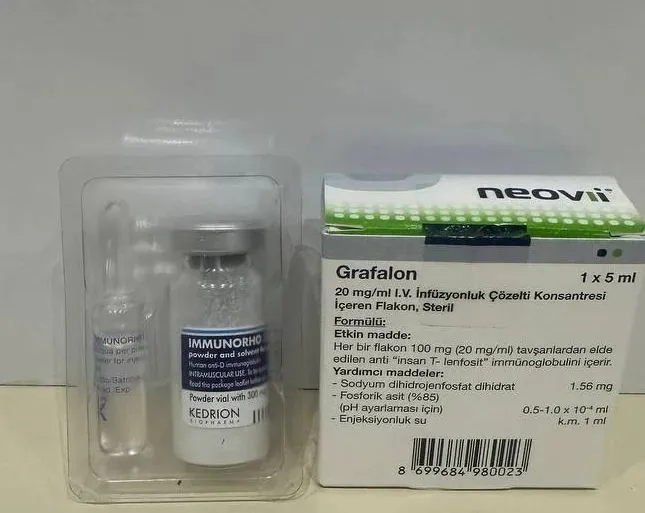
Table of Contents
Grafalon 20 mg/ml concentrate for solution for infusion
Rabbit immunoglobulin against human T lymphocytes
Read the entire leaflet carefully before using this medicine
- Keep this leaflet, as you may need to read it again.
- Consult your doctor if you have any further questions.
- This medicine has been prescribed for a specific individual. Do not pass it on to others.
- This medicine may harm another person, even if their symptoms are the same.
- If any of the side effects worsens, or if any side effects not listed in this leaflet occur, inform your doctor immediately.
Leaflet contents:
- What Grafalon is and what it is used for
- Important information before receiving Grafalon
- How to use Grafalon
- Possible side effects
- How to store Grafalon
- Contents of the package and other information
1. WHAT GRAFALON IS AND WHAT IT IS USED FOR
Grafalon belongs to a group of medicines called immunosuppressive agents. Immunosuppressive medicines are used to prevent the body from rejecting a transplanted organ or transplanted cells.
Grafalon may be given to patients who have undergone or are about to undergo an organ transplant. Its purpose is to prevent the patient's immune system from rejecting the new organ.
Grafalon helps prevent or halt such rejection reactions by blocking the development of specific cells that normally attack the transplanted organ.
Grafalon is used as part of immunosuppressive therapy, in combination with other immunosuppressive medicines.
Grafalon may also be administered before a stem cell transplant (e.g. bone marrow transplant) to prevent a condition known as "graft-versus-host disease". This is a common but serious complication that may occur after stem cell transplantation, in which donor cells react against the recipient's tissues.
2. IMPORTANT INFORMATION BEFORE USING GRAFALON
When not to use Grafalon
- if the patient is allergic (hypersensitive) to the active substance of Grafalon (rabbit immunoglobulin against human T lymphocytes) or to any of the other components of this medicine (listed in section 6),
- if the patient has an infection that does not respond to treatment,
- if the patient has difficulties in stopping bleeding,
- if the patient has cancer, unless they are to receive a stem cell transplant.
Warnings and precautions
It is important to inform the doctor if any of the following conditions are present. The patient may
still be able to receive Grafalon, but must consult with the doctor first.
- if the patient has previously experienced allergic reactions to immunosuppressive medicines or rabbit proteins,
- if the patient has liver disease,
- if the patient has heart problems.
Infections and Grafalon
Grafalon weakens the patient's immune system. As a result, the body will not fight infections as
effectively as usual. The doctor will appropriately treat such infections.
Other medicines and Grafalon
Tell the doctor about all medicines the patient has recently taken, including those available without
a prescription. These medicines may affect the action of Grafalon.
- Grafalon is used together with other immunosuppressive medicines, such as corticosteroids. Taking Grafalon at the same time as other immunosuppressive medicines may increase the risk of infection, prolonged bleeding, and anaemia (a blood disorder).
- Due to immunosuppressive treatment, live vaccines must not be given to the patient. Tell the doctor if the patient is due to receive an inactivated vaccine. Such vaccines may also be less effective if administered at the same time as Grafalon.
Pregnancy and breastfeeding
Tell the doctor if the patient is pregnant or suspects she may be pregnant. If treatment with Grafalon
is necessary, the doctor will discuss the risks and benefits of using the medicine during pregnancy.
Tell the doctor if the patient is breastfeeding. Grafalon may pass into human breast milk.
Important information regarding the manufacture of Grafalon
Components of human origin (e.g. red blood cells) are used in the production of Grafalon.
Therefore, specific measures are taken to prevent the transmission of infectious agents to patients.
These include careful selection of donors to ensure exclusion of those who may be carriers of infections, as well as testing all collected samples for the presence of viruses/infections. The manufacturing process also includes steps for processing components of human origin designed to inactivate or remove viruses. Despite these measures, when administering medicines produced using materials of human origin, it is not possible to completely exclude the risk of transmitting infections. This may also include unknown or newly emerging viruses or other types of infections.
The measures taken are considered effective against enveloped viruses, such as human immunodeficiency virus (HIV), hepatitis B virus, and hepatitis C virus, as well as non-enveloped viruses such as hepatitis A virus and parvovirus B19.
3. HOW TO USE GRAFALON
Treatment with Grafalon has been prescribed by a qualified doctor experienced in immunosuppressive therapy.
Grafalon will be administered to the patient in a hospital. Grafalon will be given as an intravenous infusion.
Prior to administration, the infusion will be diluted in a sodium chloride solution.
The following doses may be administered to adults and children, based on body weight and patient condition:
If the patient is to undergo organ transplantation
The daily dose is 2–5 mg/kg body weight. Treatment lasts from 5 to 14 days.
If the patient has undergone organ transplantation
The usual daily dose is 3–5 mg/kg body weight. The treatment cycle will last from 5 to 14 days.
Adults scheduled for hematopoietic stem cell transplantation
The usual daily dose is 20 mg/kg body weight, administered from day -3 to day -1 before stem cell transplantation.
Use in children and adolescents
Available data indicate that children and adolescents do not require different dosing compared to adult patients.
Administration of a higher than recommended dose of Grafalon
Administration of Grafalon will be discontinued, and immunosuppressive treatment will be modified with another medicinal product. The patient's immune system may be weakened following administration of an excessive dose of Grafalon; therefore, medications aimed at preventing the development of infections may be administered.
If you have any doubts regarding the use of this medicinal product, consult your doctor.
4. POSSIBLE ADVERSE REACTIONS
Like all medicines, Grafalon may cause adverse reactions, although not everyone will experience them.
You should contact your doctor immediately if you notice any of the following adverse reactions related to allergic reactions and anaphylactic shock.
Allergic reactions are common adverse reactions following treatment with Grafalon.
In less than 1 in 10 patients, the following may occur:
- chest pain
- wheezing
- muscle pain
- skin redness
In 3 out of more than 240 patients, allergic reactions progressed to anaphylactic shock. This is a serious and potentially life-threatening condition, during which the following symptoms may occur:
- high fever
- skin rash
- swelling
- breathing difficulties
- low blood pressure
You should inform your doctor if you notice any of the following adverse reactions:
Very common adverse reactions, occurring in more than 1 in 10 patients:
- fever
- chills
- headache
- tremor
- vomiting
- nausea
- diarrhoea
- abdominal pain
- breathing difficulties
- sudden facial flushing
- increased frequency of infections
- low number of red blood cells (anaemia)
Common adverse reactions, occurring in less than 1 in 10 patients:
- thrombocytopenia, leukopenia, pancytopenia (blood disorders)
- mucositis
- oedema
- feeling of fatigue
- chest pain
- joint and muscle pain
- back pain
- muscle stiffness
- low or high blood pressure
- sensation of tingling, pricking, or numbness of the skin
- rapid heartbeat
- light sensitivity
- elevated laboratory parameters
- increased bilirubin levels in blood
- blood in urine
- cough
- nosebleeds
- skin redness
- itching
- skin rash
- renal tubular necrosis (impaired kidney function)
- lymphoproliferative disorder (a type of tumour originating from a specific type of white blood cells)
- veno-occlusive disease (blockage of small veins in the liver)
Uncommon adverse reactions, occurring in less than 1 in 100 patients:
- indigestion
- mucosal inflammation caused by gastric acid reflux into the oesophagus
- elevated liver laboratory parameters
- increased cholesterol levels
- shock
- increased number of red blood cells
- abnormal accumulation of lymph
- fluid retention in the body
Rare but medically significant adverse reactions, occurring in less than 1 in 1,000 patients:
- haemolysis (abnormal breakdown of red blood cells)
In rare cases, especially if the medicine is administered for a prolonged period, serum sickness may develop. This is a type of allergic reaction to foreign protein, and its symptoms include fever, muscle and joint pain, and itchy skin rash.
If any of the adverse symptoms worsen or if any adverse symptoms not listed in this leaflet occur, contact your doctor immediately.
Additional adverse reactions in children and adolescents
Available data indicate that adverse reactions of Grafalon in children and adolescents do not essentially differ from those observed in adult patients.
Reporting of adverse reactions
If any adverse reactions occur, including those not listed in this leaflet, inform your doctor. Adverse reactions can be reported directly to the Department of Monitoring Adverse Drug Reactions at the Office for Registration of Medicinal Products, Medical Devices and Biocidal Products
Al. Jerozolimskie 181C
PL-02 222 Warsaw
Tel.: +48 22 49 21 301
Fax: +48 22 49 21 309
Website: https://smz.ezdrowie.gov.pl
Adverse reactions can also be reported to the marketing authorisation holder.
Reporting adverse reactions helps to improve the safety information available for this medicine.
5. HOW TO STORE GRAFALON
- Keep out of the reach and sight of children.
- Do not use Grafalon after the expiry date stated on the label after EXP. The expiry date refers to the last day of the specified month.
Explanation of abbreviations:
- Expiry date (EXP)
- Batch number (Lot)
- Grafalon should be stored in a refrigerator (2 °C - 8 °C), in the unopened vial placed in the outer packaging, to protect from light.
- Do not use Grafalon if the solution is cloudy.
- Any unused medicinal product or waste material should be disposed of in accordance with local regulations.
- Do not use siliconized syringes for drawing Grafalon from vials or for preparing the infusion solution.
- The medicine is not intended for multiple withdrawals.
6. PACK CONTENTS AND OTHER INFORMATION
WHAT Grafalon CONTAINS
The active substance is 20 mg/ml rabbit immunoglobulin against human T-lymphocytes.
Other components of the medicine are disodium hydrogen phosphate dihydrate, phosphoric acid (85%), and water for injections.
WHAT Grafalon LOOKS LIKE AND CONTENTS OF THE CONTAINER
Grafalon is a clear to slightly opalescent, colourless to light yellow solution in glass vials.
The 5 ml vial contains 100 mg of Grafalon, while the 10 ml vial contains 200 mg of Grafalon.
Grafalon is supplied in a carton containing 1 vial or 10 vials.
MARKETING AUTHORISATION HOLDER AND MANUFACTURER
Neovii Biotech GmbH
Am Haag 6+7
Gräfelfing
Germany
For further information, please contact the marketing authorisation holder.
Fresenius Medical Care Polska S.A.
ul. Krzywa 13
60-118 Poznań
0-61 83 92 600
09/2024