Glycophos
Poland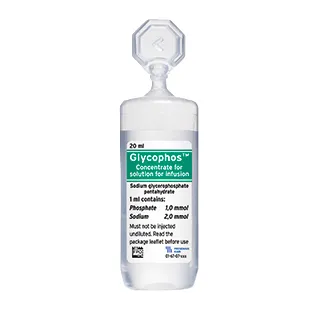
Table of Contents
- Package leaflet: Information for the user
- 1. What GLYCOPHOS is and what it is used for
- 2. Important information before using GLYCOPHOS
- 3. How to use GLYCOPHOS
- 4. Possible adverse reactions
- 5. How to store GLYCOPHOS
- 6. Contents of the pack and other information
- Information intended exclusively for medical professionals:
Package leaflet: Information for the user
Warning! Keep this leaflet. The information on the immediate packaging is in a foreign language.
GLYCOPHOS, 216 mg/ml, concentrate for solution for infusion
Natrii glycerophosphas
Please read the entire leaflet carefully before using this medicine, as it contains
important information for the patient.
- Keep this leaflet, so that you can read it again if necessary.
- If you have any questions, please consult your doctor, pharmacist, or nurse.
- This medicine has been prescribed for a specific individual. Do not pass it on to others. The medicine may harm another person, even if their symptoms are the same.
- If you experience any adverse reactions, including any adverse reactions not listed in this leaflet, inform your doctor, pharmacist, or nurse. See section 4.
Table of contents of the leaflet:
- What GLYCOPHOS is and what it is used for
- Important information before using GLYCOPHOS
- How to use GLYCOPHOS
- Possible side effects
- How to store GLYCOPHOS
- Contents of the pack and other information
1. What GLYCOPHOS is and what it is used for
GLYCOPHOS is a medicine containing glycerophosphate, which plays an important role in fat metabolism in the body.
GLYCOPHOS is administered by intravenous infusion.
Indications:
GLYCOPHOS is indicated for use in adult patients and infants as a supplement to meet phosphate requirements in parenteral nutrition.
2. Important information before using GLYCOPHOS
When not to use GLYCOPHOS
Do not use this medicine:
- if the patient is allergic to the active substance or to any of the other ingredients of this medicine (listed in section 6);
- if the patient is dehydrated (has lost a large amount of fluids or blood);
- if the patient has hypernatraemia (increased sodium level in the blood);
- if the patient has hyperphosphataemia (increased level of phosphates in the blood);
- if the patient has severe renal insufficiency;
- if the patient is in shock (a life-threatening condition caused by sudden lack of oxygen in the body).
Warnings and precautions
Before starting treatment with GLYCOPHOS, discuss this with your doctor or nurse.
- This medicine should be administered with caution in patients with impaired kidney function.
- In patients receiving GLYCOPHOS, the doctor will order regular monitoring of phosphate levels in the blood. Page 1 of 5
GLYCOPHOS and other medicines
Tell your doctor or pharmacist about all medicines the patient is currently taking or has recently taken, as well as any medicines the patient plans to use.
No interactions between GLYCOPHOS and other medicines have been reported. However, when administered simultaneously with carbohydrates (sugars), a decrease in blood phosphate levels may be observed.
Pregnancy and breastfeeding
If the patient is pregnant or breastfeeding, suspects she might be pregnant, or is planning to have a baby, she should consult her doctor or pharmacist before using this medicine.
The doctor will decide whether to use GLYCOPHOS in women during pregnancy and while breastfeeding.
Driving and operating machinery
GLYCOPHOS has no effect on the ability to drive or operate machinery.
GLYCOPHOS contains sodium
1 ml of this medicine contains 2 mmol of sodium. This should be taken into account in patients with impaired kidney function and in patients who are controlling sodium intake in their diet.
3. How to use GLYCOPHOS
This medicine is administered exclusively by medical personnel.
You must not self-administer this medicine.
If in doubt, consult your doctor.
The dosage is determined individually by the doctor for each patient, depending on age, body weight,
and phosphate requirements.
The duration of intravenous infusion should not be shorter than 8 hours.
Administration of a higher than recommended dose of GLYCOPHOS
If a higher than recommended dose of GLYCOPHOS is administered, inform the doctor or nurse immediately.
Symptoms of overdose have not been observed.
If you have any further doubts regarding the use of this medicine, consult your doctor or nurse.
4. Possible adverse reactions
Like any medicinal product, this medicine can cause adverse reactions, although not everyone experiences them.
No adverse reactions related to the use of glycerophosphate have been reported.
Reporting of adverse reactions
If any adverse reactions occur, including any adverse reactions not listed
in this leaflet, inform a doctor, pharmacist, or nurse. Adverse reactions
can be reported directly to the Department of Monitoring of Adverse Drug Reactions of the Office for Registration of Medicinal Products, Medical Devices and Biocidal Products, Al. Jerozolimskie 181C, 02-222 Warsaw, tel.: + 48 (22) 49 21 301,
fax: + 48 (22) 49 21 309, website: https://smz.ezdrowie.gov.pl
Page 2 of 5
Reporting adverse reactions enables continuous monitoring of the safety of the medicine and allows collection of additional safety information.
5. How to store GLYCOPHOS
Keep the medicine out of sight and reach of children.
Do not store above 25°C. Do not freeze.
Any unused portion of an opened vial or ampoule must be discarded; do not store for later use.
Do not use this medicine after the expiry date stated on the packaging. The expiry date refers to the last day of the stated month.
Medicines must not be disposed of via the sewage system or household waste. Ask your pharmacist how to dispose of medicines no longer required. This will help protect the environment.
6. Contents of the pack and other information
What Glycophos contains
- The active substance is glycerophosphoric acid sodium salt.
1 ml of the medicinal product contains:
216 mg of glycerophosphoric acid sodium salt in the form of 306.1 mg of hydrated glycerophosphoric acid sodium salt, which corresponds to
1 mmol of phosphate and 2 mmol of sodium.
- Other excipients: hydrochloric acid, water for injections.
The osmolality of the medicinal product is 2760 mOsm/kg water, pH 7.4.
What Glycophos looks like and contents of the pack
The medicinal product is a concentrate for solution for infusion.
Pack sizes:
- Polypropylene vials containing 20 ml of concentrate for solution for infusion, packed in packs of 10, in a cardboard box,
- Polypropylene ampoules containing 20 ml of concentrate for solution for infusion, packed in packs of 10 or 20, in a cardboard box.
For further information, please contact the Marketing Authorisation Holder or the Parallel Importer.
Marketing Authorisation Holder in the Netherlands, the country of export:
Fresenius Kabi Nederland B.V., Amersfoortseweg 10 E, 3712BC Huis ter Heide, the Netherlands
Manufacturer:
Fresenius Kabi Norge AS, P.O. Box 430, N-1753 Halden, Norway
Parallel Importer:
Delfarma Sp. z o.o., ul. Św. Teresy od Dzieciątka Jezus 111, 91-222 Łódź, Poland
Repackaged in:
Delfarma Sp. z o.o., ul. Św. Teresy od Dzieciątka Jezus 111, 91-222 Łódź, Poland
Marketing Authorisation number in the Netherlands, the country of export: RVG 16431
Page 3 of 5
Parallel Import Licence number: 237/22
Information intended exclusively for medical professionals:
Dosage and administration
GLYCOPHOS must not be administered in undiluted form.
Dosage
Adult patients:
Individualized dosing is recommended.
The usual daily dose of phosphates during parenteral nutrition generally ranges from 10 to 20 mmol.
This can be achieved by adding 10 to 20 ml of GLYCOPHOS to an infusion solution or to a nutrition mixture whose compatibility has been confirmed.
Infants:
Individualized dosing is recommended.
The recommended dose for infants and neonates is 1.0 to 1.5 mmol/kg body weight/day.
Administration method
Intravenous infusion.
The duration of infusion should not be less than 8 hours.
Overdose
No adverse effects related to overdose have been reported. Most patients requiring parenteral nutrition demonstrate increased capacity to utilize glycerophosphate. See also section 4.3 of the Summary of Product Characteristics.
Preparation of the medicinal product for administration
Other medicinal products should be added under aseptic conditions.
Pharmaceutical incompatibilities
GLYCOPHOS may only be added to or mixed with medicinal products whose compatibility has been established.
Medicinal products to be added
No more than 120 ml of GLYCOPHOS and 48 mmol calcium (as CaCl) may be added to 1000 ml of Vamin 14 Electrolyte-Free, Vamin 18 Electrolyte-Free, or Vaminolact.
No more than 10 ml of GLYCOPHOS and 10 mmol calcium (as CaCl) may be added to 1000 ml of glucose 50 mg/ml.
No more than 20 ml of GLYCOPHOS and 20 mmol calcium (as CaCl) may be added to 1000 ml of glucose 200 mg/ml.
No more than 60 ml of GLYCOPHOS and 24 mmol calcium (as CaCl) may be added to 1000 ml of glucose 500 mg/ml.
Stability
When additional medicinal products are added to the infusion solution, the infusion should be completed within 24 hours after preparation of the solution to avoid microbiological contamination.
Any unused content of an opened vial or ampoule must be discarded and must not be stored for later use.
Page 4 of 5
Storage conditions
Do not store above 25°C. Do not freeze.
Disposal of unused medicinal product or waste
Any unused remnants of the medicinal product or waste materials must be disposed of in accordance with local regulations.
Page 5 of 5