Glucobay 50
Poland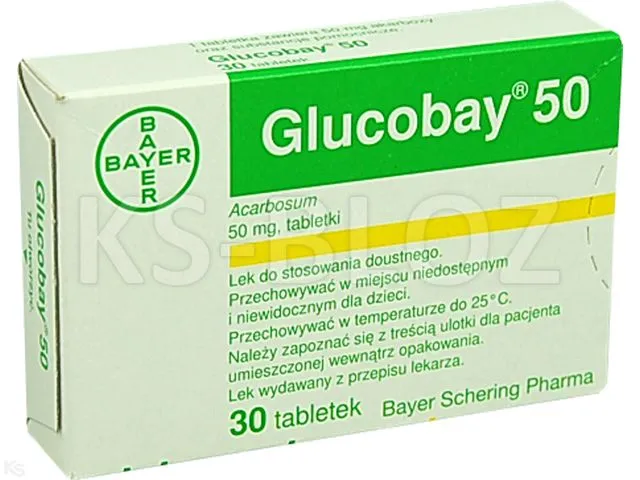
Table of Contents
Glucobay 50, 50 mg, tablets
Glucobay 100, 100 mg, tablets
Acarbose
Please read the entire leaflet carefully before using the medicine.
- Keep this leaflet for future reference.
- If you have any questions, please consult your doctor or pharmacist.
- This medicine has been prescribed for a specific individual. Do not pass it on to others. The medicine may harm someone else, even if their symptoms are the same.
- If the patient experiences any adverse reactions, including those not listed in this leaflet, inform a doctor or pharmacist. See section 4.
Contents of the leaflet:
- What Glucobay is and what it is used for
- Important information before taking Glucobay
- How to take Glucobay
- Possible side effects
- How to store Glucobay
- Other information
1. What Glucobay is and what it is used for
Acarbose, the active substance in Glucobay, acts by delaying the digestion of carbohydrates in the intestines. As glucose is released slowly, its absorption is also slowed, resulting in reduced blood glucose levels after meals and consequently decreased fluctuations in glucose concentration and lower average blood glucose values. During treatment with acarbose, there is a significant reduction in fasting glucose levels and in glycated hemoglobin (HbA1c).
Glucobay is practically not absorbed and its action is confined to the gastrointestinal tract.
Treatment with acarbose does not lead to weight gain.
Indications:
Glucobay is used in the treatment of type 2 (non-insulin-dependent) diabetes mellitus, especially in obese patients in whom diet and physical exercise alone have proven ineffective.
2. Important information before taking Glucobay
When not to take Glucobay
- if the patient is allergic (hypersensitive) to acarbose or any of the other ingredients of Glucobay
- if the patient is under 18 years of age, as there is insufficient data on the safety of acarbose in children and adolescents
- if the patient has chronic gastrointestinal diseases associated with digestive and absorptive disorders
- if the patient has medical conditions that may worsen due to increased accumulation of gas in the intestines (e.g. Roemheld syndrome, large hernias, intestinal obstruction, intestinal ulceration)
- if the patient has inflammatory bowel disease, ulcerative colitis, partial intestinal obstruction, or is predisposed to intestinal obstruction
- if the patient has severe renal impairment (creatinine clearance < 25 ml/min)
- if the patient has severe hepatic impairment
- if the patient is pregnant or breastfeeding
When to exercise special caution with Glucobay
- During treatment with Glucobay, a diabetic diet must be strictly followed.
- Do not discontinue regular use of Glucobay without consulting a doctor, as this may lead to increased blood glucose levels.
- In isolated cases—particularly after high doses of acarbose—fulminant hepatitis may occur. Therefore, during the first 6–12 months of treatment with Glucobay, liver enzymes should be monitored regularly.
- Glucobay used as monotherapy does not cause hypoglycemia. However, in patients receiving combination therapy with insulin, a sulfonylurea derivative, or metformin, if hypoglycemia (low blood glucose) occurs, glucose—not other sugars (e.g. sucrose)—should be administered.
- The use of Glucobay should be recorded in the patient’s diabetes record.
Taking other medicines
Inform your doctor about all medicines currently taken or recently taken, as well as any medicines you plan to use, including those available without a prescription.
Exercise caution if:
- the patient is taking other medications that lower blood sugar levels. In isolated cases, acute hypoglycemia may occur. Therefore, when Glucobay is used concomitantly with sulfonylureas, metformin, or insulin, dose adjustments of these medications may be necessary. In the event of a sudden drop in blood glucose, remember that during treatment with Glucobay, sucrose is digested more slowly into glucose and fructose. Therefore, to rapidly increase blood glucose, glucose should be administered.
- the patient is taking digoxin, a medicine used for heart conditions. The patient should consult a doctor, who may recommend adjusting the digoxin dosage.
- the patient is taking other medicines or food products containing sucrose, as sucrose intake may frequently cause gastrointestinal discomfort, including diarrhea, due to increased fermentation of carbohydrates in the large intestine.
- the patient is taking cholestyramine or other adsorbent agents, which may reduce the effectiveness of Glucobay. Concomitant use should be avoided.
- the patient is taking oral neomycin, as this may lead to greater postprandial reduction in blood glucose levels and more frequent and severe abdominal symptoms. If acute symptoms occur, contact a doctor, who may consider temporarily reducing the dose of Glucobay.
Taking Glucobay with food and drink
During treatment with Glucobay, a diabetic diet must be strictly followed. Avoid consuming food products containing sucrose due to the risk of gastrointestinal symptoms (including diarrhea). Glucobay should be taken immediately before meals or with the first bites of food.
Pregnancy and breastfeeding
If the patient is pregnant or breastfeeding, suspects she may be pregnant, or is planning to become pregnant, she should consult a doctor or pharmacist before using this medicine.
Glucobay should not be used during pregnancy or breastfeeding.
Driving and operating machinery
Glucobay does not affect the ability to drive or operate machinery.
3. How to use Glucobay
Glucobay should always be taken as directed by the physician. If in doubt, consult the doctor or pharmacist again.
Recommended dosage for the treatment of type 2 diabetes, in conjunction with diet and physical activity
Taking Glucobay according to the following scheme helps reduce the risk of adverse effects, particularly flatulence:
| Breakfast | Lunch | Dinner | Number of days |
| 1 time Glucobay 50 | 3 days | ||
| 1 time Glucobay 50 | 1 time Glucobay 50 | 3 days | |
| 1 time Glucobay 50 | 1 time Glucobay 50 | 1 time Glucobay 50 | 7 days |
| 1 time Glucobay 50 | 1 time Glucobay 50 | 2 times Glucobay 50 | 3 days |
| 1 time Glucobay 50 | 2 times Glucobay 50 | 2 times Glucobay 50 | 3 days |
| 1 time Glucobay 100 | 1 time Glucobay 100 | 1 time Glucobay 100 | from week 4 to 8 |
Tablets should be swallowed whole with a small amount of liquid immediately before a meal or with the first bites of the meal to ensure effectiveness.
The efficacy and safety of acarbose have not been studied in patients under 18 years of age.
Use of a higher than recommended dose of Glucobay
If a patient has taken more medicine than recommended, they should not consume any drinks or meals containing carbohydrates for the next 4–6 hours – this usually helps avoid gastrointestinal symptoms.
If a higher than recommended dose of Glucobay was taken together with drinks or (and) meals containing carbohydrates, bloating, flatulence, and diarrhea may occur.
Missed dose of Glucobay
Do not take a double dose to make up for a missed dose.
If you have any doubts concerning the use of the medicine, consult your doctor or pharmacist.
Discontinuation of Glucobay
If you have any further doubts regarding the use of the medicine, consult your doctor or pharmacist. Do not discontinue regular use of the medicine without consulting your doctor, due to the risk of increased blood glucose levels.
4. Possible adverse reactions
Like all medicines, Glucobay can cause adverse reactions, although not everyone will experience them.
Very common adverse reactions:
(may occur in more than 1 in 10 people)
- flatulence
Common adverse reactions:
(may occur in more than 1 in 100 people)
- diarrhoea, gastrointestinal and abdominal pain
Uncommon adverse reactions:
(may occur in less than 1 in 100 people)
- nausea, vomiting, dyspepsia, increased liver enzyme activity (detected in laboratory tests)
Rare adverse reactions:
(may occur in less than 1 in 1000 people)
- oedema, jaundice
Adverse reactions with unknown frequency:
(frequency cannot be determined from available data)
- allergic reactions (e.g. rash, erythema, exanthema, urticaria), intestinal obstruction, partial intestinal obstruction, intestinal pneumatosis, hepatitis, thrombocytopenia (reduced number of blood platelets), acute generalized exanthematous pustulosis
After marketing authorization of the medicinal product, cases of liver disorders, abnormal liver function and liver damage have been reported. Isolated cases of fulminant hepatitis resulting in death, particularly in Japan, have also been reported.
Reporting of adverse reactions
If any adverse reactions occur, including any adverse reactions not listed in this leaflet, inform your doctor or pharmacist.
Adverse reactions can be reported directly to the Department of Monitoring Adverse Drug Reactions of the Office for Registration of Medicinal Products, Medical Devices and Biocidal Products:
Al. Jerozolimskie 181C, 02-222 Warsaw
tel.: +48 22 49 21 301
fax: +48 22 49 21 309
e-mail: [email protected].
Adverse reactions can also be reported to the marketing authorization holder.
Reporting adverse reactions helps provide more information on the safety of this medicine.
5. How to store Glucobay
Keep the medicine out of sight and reach of children.
Store at a temperature not exceeding 25°C.
Tablets should be removed from the packaging immediately before use. Tablets removed from the packaging
and stored according to the recommendations may be used within 2 weeks. Tablets left
outside the packaging and exposed to higher temperatures may change colour.
Do not use Glucobay after the expiry date stated on the carton. The expiry date refers to the last day of the stated month.
Medicines must not be disposed of via wastewater or household waste. Ask your pharmacist
what to do with medicines no longer required. This will help protect the environment.
6. Other information
What Glucobay contains
- The active substance is acarbose. Glucobay 50 tablet contains 50 mg of acarbose. Glucobay 100 tablet contains 100 mg of acarbose.
- Other ingredients are: microcrystalline cellulose, colloidal anhydrous silicon dioxide, magnesium stearate, maize starch.
What Glucobay looks like and contents of the pack
Glucobay 50 tablets: white or slightly yellowish, round, convex tablets with a diameter of 7 mm and a curvature radius of 10 mm, embossed with the letters "G" and "50" on one side and the Bayer logo on the other side.
Glucobay 100 tablets: white or slightly yellowish, oval, convex tablets with a length of 13 mm, width of 6 mm, and curvature radius of 5.5 mm. On one side of the tablet, the letter "G", a dividing groove, and the number "100" are embossed. On the other side, there is a groove dividing the tablet into two halves.
The pack contains 30, 90 or 120 tablets.
Not all pack sizes may be marketed.
Marketing Authorisation Holder:
Bayer AG
Kaiser-Wilhelm-Allee 1
51373 Leverkusen
Germany
Manufacturer:
Bayer AG
Kaiser-Wilhelm-Allee
51368 Leverkusen, Germany
Representative of the Marketing Authorisation Holder
Bayer Sp. z o.o.
Al. Jerozolimskie 158
02-326 Warsaw, Poland
Tel. (0-22) 572-35-00