Glandex
Poland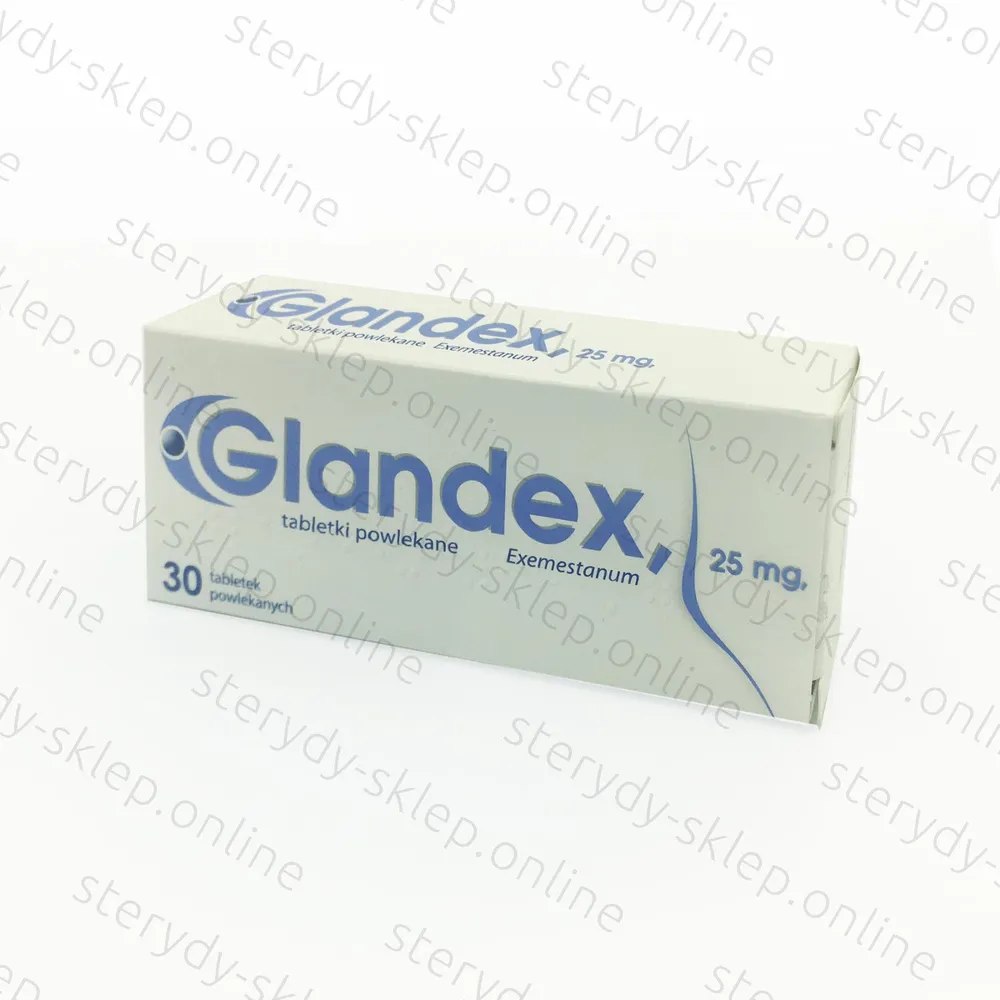
Table of Contents
Package leaflet: Information for the patient
GLANDEX, 25 mg, coated tablets
Exemestanum
Please read this leaflet carefully before using the medicine, as it contains
important information for the patient.
- Keep this leaflet, so that you can read it again if necessary.
- If you have any questions, please consult your doctor or pharmacist.
- This medicine has been prescribed for a specific individual. Do not pass it on to others. The medicine may harm another person, even if their symptoms are the same.
- If you experience any adverse effects, including any not listed in this leaflet, inform your doctor or pharmacist. See section 4.
Table of contents of the leaflet
- What Glandex is and what it is used for
- Important information before taking Glandex
- How to take Glandex
- Possible side effects
- How to store Glandex
- Contents of the pack and other information
1. What Glandex is and what it is used for
Glandex is a medicine containing an active substance belonging to a group known as aromatase inhibitors.
This substance inhibits the action of the aromatase enzyme, which is essential for the production of female sex hormones—estrogens—particularly in postmenopausal women. Reducing estrogen levels in the body is a method of treating so-called hormone-dependent breast cancer.
Glandex is indicated for the treatment of early hormone-dependent breast cancer in postmenopausal women, after 2–3 years of initial treatment with tamoxifen. The medicine is also used to treat advanced breast cancer in postmenopausal women in whom the disease has progressed despite treatment with other hormonal agents.
2. Important information before using Glandex
When not to use Glandex:
if the patient is allergic to exemestane or any of the other ingredients of this
medicine (listed in section 6);
in premenopausal women, i.e. women who are still menstruating;
in women planning to become pregnant or who are pregnant;
in breastfeeding women.
Warnings and precautions
Before starting treatment with Glandex, discuss this with your doctor or pharmacist.
Your doctor will order a blood test to assess hormonal activity in order to confirm whether you are in a natural or treatment-induced postmenopausal state;
1/5
Inform your doctor about any symptoms suggesting possible liver or kidney problems;
Inform your doctor about any events or conditions that may be relevant to the assessment of bone health and risk of so-called osteoporosis. This type of medicine significantly reduces the activity of female sex hormones; therefore, in patients receiving this medicine, a decrease in bone mechanical strength may be expected. Bone status should be monitored both before and during treatment (by performing so-called densitometric tests);
Before starting treatment, your doctor may recommend measuring vitamin D levels, as significant deficiency is commonly observed in women with early breast cancer. If deficiency is confirmed, your doctor will recommend vitamin D supplementation.
Glandex with other medicines
Inform your doctor about all medicines you are currently taking or have recently taken, as well as any medicines you plan to take.
Glandex must not be used concomitantly with medicines containing estrogens, such as those used in hormone replacement therapy (HRT).
Caution is required when using Glandex together with:
- certain antibiotics (rifampicin);
- certain antiepileptic medicines used to treat epilepsy (carbamazepine, phenytoin);
- medicines and other products containing St John's wort (Hypericum perforatum).
Pregnancy, breastfeeding and fertility
If the patient is pregnant or breastfeeding, suspects she may be pregnant, or is planning to have a baby, she should consult her doctor or pharmacist before using this medicine.
Do not use Glandex during pregnancy.
Do not use Glandex during breastfeeding due to lack of sufficient data on the passage of exemestane into human milk.
Appropriate contraception should be considered together with the doctor in women who may become pregnant (including women in the perimenopausal period and women who have recently stopped menstruating, until menstruation has permanently ceased).
Driving and operating machinery
It has been reported that administration of Glandex may occasionally cause weakness, drowsiness, dizziness, and reduced physical performance manifested by fatigue and exhaustion (so-called asthenia), which may impair the ability to drive vehicles or operate machinery.
3. How to take Glandex
This medicine should always be taken as directed by the physician. In case of doubt, consult your doctor.
Your doctor will inform you how to take Glandex and how long the treatment should last.
Adults and elderly women (over 65 years of age)
The recommended dose is one coated tablet (i.e. 25 mg) once daily.
Glandex coated tablets should be taken after a meal, at the same time each day.
Your doctor will inform you about the duration of treatment.
2/5
If hospitalization becomes necessary during treatment with Glandex, inform hospital staff that you are taking this medicine.
In women with early breast cancer, Glandex should be administered for a period of 2 to 3 years, as an extension of prior tamoxifen therapy, so that the total duration of treatment amounts to 5 years. If tumor recurrence occurs, treatment with Glandex may be discontinued earlier.
In women with advanced breast cancer, treatment with Glandex should be continued until clear disease progression is observed.
Use in children and adolescents
Glandex is not recommended for use in children and adolescents.
Use in patients with renal or hepatic impairment
Glandex should be used with caution in patients with impaired kidney or liver function.
No dose adjustment is required in patients with renal or hepatic impairment.
Use in elderly patients (over 65 years of age)
No dose adjustment is required in elderly patients.
Taking more Glandex than recommended
Do not take more medicine than prescribed by your doctor.
In case of overdose, contact your doctor immediately and show him the medicine packaging or patient information leaflet. Depending on the symptoms present, the doctor will initiate appropriate treatment.
Missed dose of Glandex
Do not take a double dose to make up for a missed dose.
Take the missed dose as soon as possible. However, if it is almost time for the next scheduled dose, skip the missed dose and continue with your regular dosing schedule.
Stopping treatment with Glandex
The decision to discontinue treatment with exemestane should be made by the physician.
Do not stop treatment without consulting your doctor. Do not discontinue the medicine if you feel better, without first discussing it with your doctor.
If you have any further questions about the use of this medicine, consult your doctor or pharmacist.
4. Possible adverse effects
Like all medicines, this medicine can cause adverse effects, although not everyone will experience them.
Glandex is well tolerated, and adverse effects reported by patients related to the administration of Glandex have been mild or moderate. Most adverse effects are associated with the consequences of reduced estrogen levels (e.g. hot flushes).
Very common adverse effects (in more than 1 in 10 patients):
insomnia,
headache,
hot flushes,
nausea,
increased sweating,
joint pain and musculoskeletal pain (including joint pain, less frequently limb pain, osteoarthritis, back pain, arthritis, muscle pain and joint stiffness),
feeling of excessive fatigue.
Common adverse effects (in 1 to 10 out of 100 patients):
loss of appetite,
depression,
carpal tunnel syndrome (pricking sensation in almost the entire hand except the little finger),
paresthesia (unpleasant sensations usually described as tingling or numbness),
dizziness,
vomiting, diarrhoea, constipation, dyspepsia, abdominal pain,
hair loss, rash, urticaria, pruritus,
bone fractures, osteoporosis (reduced bone mineralization and density),
pain, swelling of hands and feet.
Uncommon adverse effects (in 1 to 10 out of 1,000 patients):
leukopenia (reduced number of white blood cells),
hypersensitivity,
somnolence,
hepatitis, cholestatic hepatitis (hepatitis caused by bile stasis), increased liver enzyme activity, increased blood bilirubin and alkaline phosphatase levels,
acute generalized exanthematous pustulosis,
weakness.
Rare adverse effects (in 1 to 10 out of 10,000 patients):
thrombocytopenia (reduced number of platelets).
Adverse effects with unknown frequency (frequency cannot be estimated from available data):
lymphopenia (reduced number of lymphocytes in blood).
Reporting of adverse effects
If any adverse effects occur, including any adverse effects not listed in this leaflet, inform your doctor or pharmacist. Adverse effects can be reported directly to the Department of Monitoring of Adverse Drug Reactions of the Office for Registration of Medicinal Products, Medical Devices and Biocidal Products:
Aleje Jerozolimskie 181C, 02-222 Warsaw,
tel.: +48 22 49 21 301, fax: +48 22 49 21 309,
e-mail: [email protected]
Adverse effects can also be reported to the marketing authorization holder.
Reporting adverse effects helps to provide more information on the safety of the medicine.
5. How to store Glandex
No special precautions for storage are required.
Keep the medicine out of the sight and reach of children.
Do not use this medicine after the expiry date stated on the packaging. The expiry date refers to the last day of the stated month.
4/5
Medicines must not be disposed of via the sewage system or household waste. Ask your pharmacist how to dispose of medicines no longer in use. This will help protect the environment.
6. Contents of the pack and other information
What Glandex contains
- The active substance is exemestane. One coated tablet contains 25 mg of exemestane.
- The other ingredients are: mannitol, copovidone (K=28), crospovidone, microcrystalline cellulose silicon dioxide (microcrystalline cellulose, colloidal anhydrous silica), sodium carboxymethyl starch (type A), magnesium stearate, and the coating (hypromellose, macrogol 400, titanium dioxide - E 171).
What Glandex looks like and contents of the pack
Glandex is a white or almost white, round, biconvex coated tablet,
marked on one side with the number 25 and smooth on the reverse.
One pack contains 30 coated tablets (3 blisters of 10 tablets each) in a cardboard box.
Marketing Authorisation Holder and Manufacturer
"PRZEDSIĘBIORSTWO PRODUKCJI FARMACEUTYCZNEJ HASCO-LEK" S.A.
51-131 Wrocław, ul. Żmigrodzka 242 E
Information on the medicinal product
tel.: + 48 (22) 742 00 22
e-mail: [email protected]
This medicinal product is authorised in the European Economic Area countries under the following names:
Poland – Glandex
5/5