Ginkofar
Poland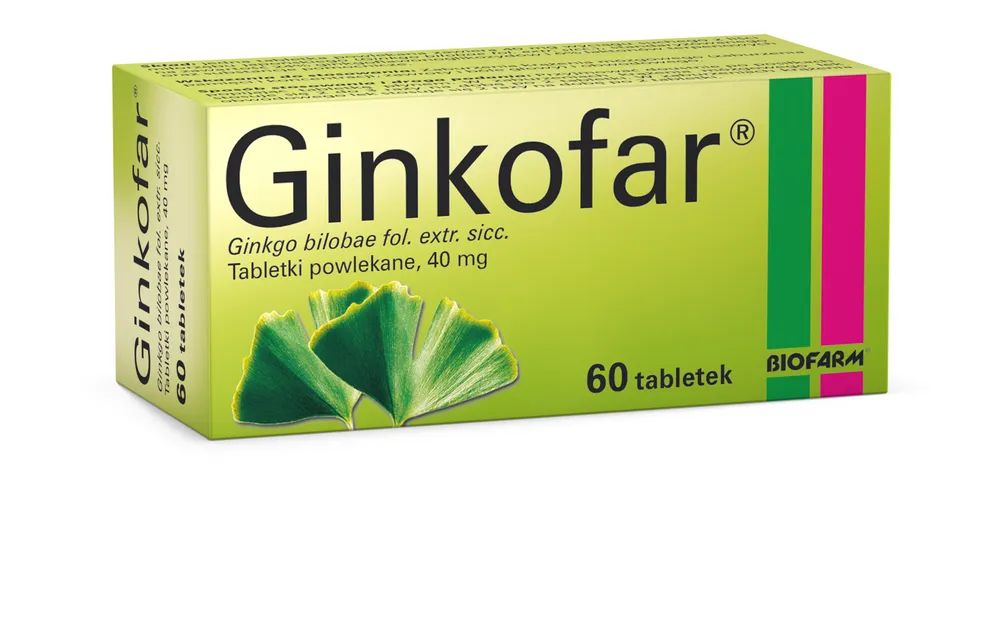
Table of Contents
Package leaflet: Information for the user
Ginkofar
40 mg, coated tablets
Ginkgo bilobae folium extractum siccum
Please read the entire leaflet carefully before using this medicine, because it contains
important information for the patient.
This medicine should always be used exactly as described in this patient leaflet or as directed by a
physician or pharmacist.
- Keep this leaflet, as you may need to read it again.
- If you need advice or further information, please consult your pharmacist.
- If you experience any adverse reactions, including any possible adverse reactions not listed in this leaflet, inform your doctor or pharmacist. See section 4.
- If there is no improvement after 3 months of treatment, or if the patient feels worse, consult a doctor.
Table of contents
- What Ginkofar is and what it is used for
- Important information before taking Ginkofar
- How to use Ginkofar
- Possible side effects
- How to store Ginkofar
- Contents of the pack and other information
1. What Ginkofar is and what it is used for
Ginkofar contains a dry extract of Ginkgo biloba leaves, which improves blood flow in the
brain, dilates blood vessels, and prevents platelet aggregation. The active components of the extract
are flavonoid glycosides, ginkgolides, and bilobalide.
Indications
Ginkofar is indicated:
- to improve cognitive function in elderly patients (age-related memory and mental performance decline),
- to improve quality of life in mild dementia. This medicine is intended for adults.
If there is no improvement after 90 days of treatment, or if the patient feels worse,
consult a doctor.
2. Important information before taking Ginkofar
When not to use Ginkofar
- if the patient is allergic to Ginkgo biloba leaf extract or to any of the other ingredients of this medicine (listed in section 6),
- if the patient is pregnant (see section "Pregnancy and breastfeeding").
Warnings and precautions
Before starting treatment with Ginkofar, consult a doctor or pharmacist if the patient has an increased tendency to bleed (bleeding diathesis).
Patients taking anticoagulant or antiplatelet drugs (so-called blood-thinning agents)
should consult their doctor before using this medicine.
Before undergoing any surgical or dental procedure, inform the doctor or dentist that you are taking Ginkofar.
It is recommended to discontinue Ginkofar at least 3–4 days before any planned surgical or dental procedure, such as tooth extraction.
Exercise caution in patients with epilepsy, as seizures cannot be ruled out during treatment with Ginkofar.
If symptoms do not improve or worsen during treatment, consult a doctor or pharmacist.
Children and adolescents
Ginkofar is not intended for use in children and adolescents.
Ginkofar with other medicines
Tell your doctor or pharmacist about all medicines you are currently taking, have recently taken, or plan to take.
In particular, inform your doctor or pharmacist if you are regularly taking any of the following medicines:
- anticoagulants (phenprocoumon, warfarin)
- antiplatelet agents (clopidogrel, acetylsalicylic acid, and other non-steroidal anti-inflammatory drugs)
Concomitant use of these medicines with Ginkofar may increase the risk of bleeding.
Also inform your doctor or pharmacist if you are taking any of the following medicines:
- efavirenz (used in the treatment of HIV infection),
- nifedipine (used to treat high blood pressure),
- talinolol (used to treat heart conditions and high blood pressure),
- dabigatran (used to prevent blood clots).
Taking Ginkofar with food and drink
Ginkofar should be taken orally, after meals, with a drink.
Pregnancy, breastfeeding, and fertility
If the patient is pregnant or breastfeeding, suspects she may be pregnant, or is planning to have a child, she should consult a doctor or pharmacist before using this medicine.
Pregnancy
Ginkofar is contraindicated during pregnancy due to insufficient data and the risk of increased bleeding tendency.
Breastfeeding
Due to insufficient data, Ginkofar is not recommended during breastfeeding.
Driving and operating machinery
There is no information available regarding the effect of this medicine on the ability to drive or operate machinery.
Ginkofar contains lactose.
If the patient has previously been diagnosed with an intolerance to certain sugars, consult a doctor before taking this medicine.
3. How to use Ginkofar
This medicine should always be used exactly as described in this patient leaflet or as directed by a
physician. If in doubt, consult a doctor or pharmacist.
The recommended dose for adults is:
2 tablets three times daily.
Daily dose: 6 tablets
Duration of treatment
Treatment should last at least 8 weeks.
If symptoms worsen or there is no improvement after 3 months of treatment, consult a doctor.
After 3 months, consult a doctor to determine whether treatment should be continued.
Use in children and adolescents
Ginkofar must not be used in children and adolescents.
Taking more Ginkofar than recommended
If you take more than the recommended dose, contact a doctor or pharmacist immediately.
Missed dose
Take the missed dose as soon as possible, then continue with the regular dosing schedule.
Do not take a double dose to make up for a missed dose.
Stopping Ginkofar
If you have any further questions about the use of this medicine, consult your doctor or pharmacist.
4. Possible side effects
Like all medicines, this medicine can cause side effects, although not everybody will experience them.
The following side effects may occur during treatment with Ginkofar:
Very common (affects more than 1 in 10 people):
- headache.
Common (affects 1 to 10 in 100 people):
- dizziness,
- gastrointestinal disorders (diarrhea, abdominal pain, nausea, vomiting).
Frequency not known (cannot be estimated from available data):
- bleeding from various organs (eyes, nose, gastrointestinal tract, cerebral vessels). The risk of bleeding increases when this medicine is taken concomitantly with blood-thinning agents (anticoagulants and antiplatelet drugs, see section 2).
- allergic reactions (anaphylactic shock),
- allergic skin reactions (erythema, swelling, itching, rash).
Reporting of side effects
If you experience any adverse reactions, including any not listed in this leaflet, inform your doctor or pharmacist. Side effects can be reported directly to the Department of Monitoring Adverse Drug Reactions, Office for Registration of Medicinal Products, Medical Devices and Biocidal Products
Al. Jerozolimskie 181C
02-222 Warsaw
Phone: +48 22 49 21 301
Fax: +48 22 49 21 309
Website: https://smz.ezdrowie.gov.pl
Side effects can also be reported to the marketing authorization holder.
Reporting side effects helps provide more information on the safety of this medicine.
5. How to store Ginkofar
Keep the medicine out of sight and reach of children.
Store below 25°C.
Do not use this medicine after the expiry date stated on the carton and blister. The expiry date refers to the last day of the stated month.
Medicines must not be disposed of via wastewater or household waste. Ask your pharmacist how to dispose of medicines no longer required. These measures help protect the environment.
6. Contents of the packaging and other information
What Ginkofar contains
- The active substance is: Ginkgo bilobae folium extractum siccum (35-67:1), extractant – acetone 60% (v/v)
- dry extract of Ginkgo biloba leaves (Ginkgo biloba L., folium) 40 mg, including:
- native extract: 90-100%, composition:
- 22-27% ginkgoflavonolignans,
- 5-7% terpene lactones (including 2.8-3.4% ginkgolides A, B and C and 2.6-3.2% bilobalide),
- no more than 5 ppm ginkgolic acids;
- excipient: liquid glucose 0-10%.
- Other ingredients: tablet core: microcrystalline cellulose, monohydrate lactose, crospovidone type A, magnesium stearate, povidone K30, colloidal anhydrous silica; tablet coating: polyvinyl alcohol, titanium dioxide (E171), macrogol 4000, yellow iron oxide (E172), talc.
What Ginkofar looks like and contents of the packaging
Ginkofar is in the form of film-coated tablets, round, biconvex, smooth, beige-yellow in colour, without chipping, with acceptable local discolourations.
Film-coated tablets are packed in blisters made of PVC/PVDC-Aluminium, placed in a cardboard box.
Packaging contains 20, 60 or 90 film-coated tablets.
Not all pack sizes may be marketed.
Marketing Authorisation Holder and Manufacturer
Biofarm Sp. z o.o.
ul. Wałbrzyska 13
60-198 Poznań
For further information, please contact the local representative of the Marketing Authorisation Holder:
Poland
Biofarm Sp. z o.o.
ul. Wałbrzyska 13
60-198 Poznań
Tel. +48 61 66 51 500