Gebetil
Poland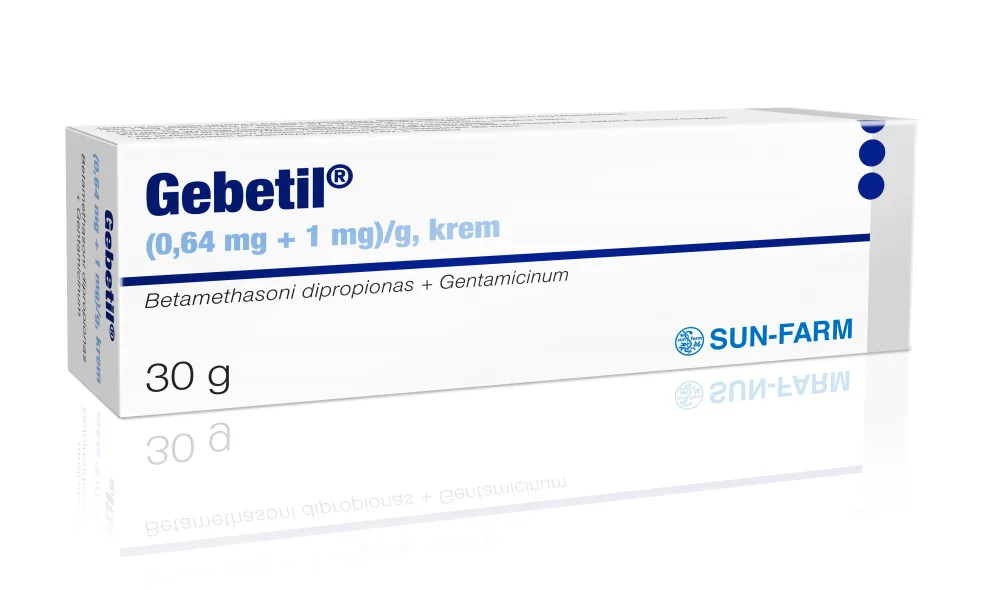
Table of Contents
Package leaflet: Information for the user
Gebetil, (0.64 mg + 1 mg)/g, cream
Betamethasone dipropionate + Gentamicin
Please read all of this leaflet carefully before using this medicine, because it contains
important information for the patient.
- Keep this leaflet so that you can read it again if necessary.
- If you have any doubts, please consult your doctor or pharmacist.
- This medicine has been prescribed for a specific individual. Do not pass it on to others. This medicine may harm other people, even if their symptoms are the same.
- If any adverse reactions occur in the patient, including any adverse reactions not listed in this leaflet, inform your doctor or pharmacist. See section 4.
Table of contents
- What Gebetil is and what it is used for
- Important information before using Gebetil
- How to use Gebetil
- Possible side effects
- How to store Gebetil
- Contents of the pack and other information
1. What Gebetil is and what it is used for
Gebetil is a combination medicine intended for external use. Gebetil contains two active substances:
- betamethasone (as betamethasone dipropionate) – a synthetically produced corticosteroid (glucocorticosteroid)
- gentamicin (as gentamicin sulfate) – an antibiotic from the aminoglycoside group.
Gebetil is used in local skin diseases affecting a small surface area when:
- treatment with a potent glucocorticosteroid is required, and
- there is a concurrent bacterial infection (superinfection), and
- the bacteria involved are susceptible to the active substance gentamicin.
In general, the active substance betamethasone has an anti-inflammatory effect and thus may relieve itching, redness, swelling, and pain.
The active substance gentamicin acts against bacterial infections.
Gebetil cream is particularly intended for use on oily skin or in the treatment of weeping skin conditions.
2. Important information before using Gebetil
When not to use Gebetil
- if the patient is allergic to betamethasone or gentamicin, other drugs from the group of glucocorticosteroids or aminoglycoside antibiotics, methyl parahydroxybenzoate, propyl parahydroxybenzoate, or any of the other ingredients of this medicine (listed in section 6),
- in viral infections, including post-vaccination reactions and chickenpox,
- in skin lesions caused by tuberculosis or syphilis,
- in viral skin infections (e.g. herpes simplex, shingles),
- in perioral rash (skin rash around the mouth),
- in rosacea (facial redness) and rosacea-like dermatitis,
- in perioral dermatitis (inflammation of the skin around the mouth),
- if the patient has a fungal skin infection,
- in eye diseases,
- if the patient is also taking oral aminoglycoside antibiotics, due to the risk of toxic antibiotic concentrations in the blood,
- if the patient has severe kidney function disorders,
- during the first three months of pregnancy,
- in newborns and infants under 1 year of age.
Warnings and precautions
Before starting treatment with Gebetil, discuss it with your doctor.
Do not use Gebetil in the ear canal, eyes, or on mucous membranes. In case of accidental contact with the eyes, rinse thoroughly with plenty of water and consult an ophthalmologist if necessary.
Exercise particular caution when applying Gebetil to the face.
Do not use Gebetil under occlusive dressings that do not allow air passage (e.g. under bandages, diapers).
Adverse effects reported with systemic absorption of glucocorticosteroids may also occur with topical glucocorticosteroids, especially in infants and children.
The risk of local skin infections may be increased with local use of glucocorticosteroids.
The systemic effect of glucocorticosteroids after topical application generally increases with their potency, duration of treatment, size of treated body surface area, and when applied to skin folds.
Due to the possible absorption of active substances into the body, prolonged treatment and (or) application over large skin areas should be avoided. Consult your doctor if you are unsure whether you have extensive skin disease.
If blurred vision or other visual disturbances occur, contact your doctor.
The use of Gebetil should be carefully considered for each individual case. It should only be used when the response to antiseptics is slow, inadequate, or when antiseptics cannot be used.
Topical application of the active substance gentamicin contained in Gebetil for skin infections is associated with a risk of allergic reactions. This risk increases with the frequency of use and duration of treatment.
If the patient is allergic to other aminoglycoside antibiotics such as neomycin or kanamycin, an allergic reaction to the active substance gentamicin in Gebetil may also occur.
If the patient develops an allergy to gentamicin after topical use, gentamicin and other aminoglycoside antibiotics must not be used or administered in the future.
Prolonged use or application over large skin areas of antibiotics may sometimes lead to colonization by resistant pathogens, including fungi. In such cases, or if skin irritation, allergic reactions, or additional infections occur, treatment with Gebetil should be discontinued and appropriate therapy initiated.
When gentamicin is used topically, absorption of the active substance into the body may increase when treating large skin areas, particularly with prolonged use or in cases of skin damage. Special caution is advised in children, as they are at higher risk of adverse effects.
Exercise caution if the patient has a certain type of muscle weakness (myasthenia), Parkinson's disease, or other conditions involving muscle weakness. Aminoglycoside antibiotics may inhibit (block) nerve-muscle transmission.
Caution is also recommended when using other drugs that have neuromuscular blocking effects simultaneously.
Do not apply Gebetil to wounds or leg ulcers.
Due to excipients (other ingredients): white soft paraffin and liquid paraffin, use of Gebetil around the genital or anal area may more easily cause condoms to break, thereby reducing their effectiveness.
Gebetil and other medicines
Tell your doctor or pharmacist about all medicines you are currently using, have recently used, or plan to use, including those available without a prescription.
Do not apply Gebetil on the skin at the same time as other medicines, as they may interact with Gebetil.
Do not use Gebetil if the patient is being treated with other medicines containing the following active substances:
- amphotericin B used in severe fungal infections,
- heparin used to thin the blood,
- the following antibiotics:
- sulfadiazine,
- active substances from the beta-lactam antibiotic group (e.g. cephalosporins).
Pregnancy and breastfeeding
If the patient is pregnant, breastfeeding, suspects she may be pregnant, or plans to have a child, she should consult her doctor or pharmacist before using this medicine.
Women must not use Gebetil during the first three months of pregnancy. Immediately contact a doctor for advice on discontinuing or changing treatment.
After the first three months of pregnancy, the doctor will decide whether Gebetil should be used.
Breastfeeding
Gebetil should not be used during breastfeeding, as active substances may pass into breast milk.
The infant should be protected from contact with treated skin areas throughout treatment.
Driving and operating machinery
Gebetil has no effect or a negligible effect on the ability to drive vehicles and operate machinery.
Gebetil contains methyl parahydroxybenzoate (E 218), propyl parahydroxybenzoate (E 216), and cetostearyl alcohol
Methyl parahydroxybenzoate and propyl parahydroxybenzoate may cause allergic reactions (including delayed-type reactions). Cetostearyl alcohol may cause local skin reactions (e.g. contact dermatitis).
3. How to use Gebetil
This medicine should always be used as directed by a physician. If in doubt, consult a doctor or pharmacist.
Recommended dosage:
- Adults: Apply a thin layer of Gebetil once or twice daily to affected areas of the skin and gently rub in. The treated area of skin should not exceed 10% of the body surface. The duration of treatment with Gebetil should not exceed 7 to 10 days. Do not extend or restart treatment without consulting a doctor.
- Children: In general, particular caution is advised when using glucocorticosteroid-containing medicines in children, as absorption of the active substance through a child's skin may be higher than in adults. Apply a thin layer of Gebetil once daily to affected areas of the skin and gently rub in. Gebetil should be used in children only on small areas of skin. The duration of treatment with Gebetil should not exceed 7 days. Do not extend or restart treatment without consulting a doctor. Gebetil must not be used in newborns and infants during the first year of life.
For further treatment, consult a doctor. The doctor may recommend switching to a medicine containing only one active substance, depending on the course of the disease.
Do not use Gebetil under occlusive, air-impermeable dressings due to the risk of increased systemic absorption of the active substance betamethasone.
Gebetil cream is especially intended for use on oily skin or in the treatment of weeping skin conditions. Gebetil ointment is suitable for dry skin, as the ointment contains more fatty substances than the cream.
Use of a higher than recommended dose of Gebetil
If Gebetil has been accidentally ingested or used in excessive amounts or for too long, inform a doctor immediately, as this may lead to certain adverse effects (e.g. Cushing's syndrome, fungal colonization of wounds, or colonization by resistant pathogens), which require treatment.
Missed dose of Gebetil
Apply the missed dose as soon as possible and continue using Gebetil according to the doctor's instructions.
4. Possible adverse reactions
Like all medicines, this product may cause adverse reactions, although not everybody will experience them.
Gebetil is generally very well tolerated.
The following adverse reactions have been reported:
Frequency unknown (cannot be estimated from available data):
Endocrine disorders (frequency unknown):
Suppression of the hypothalamic-pituitary-adrenal axis (reduced cortisol production by the body) and Cushing's syndrome in children (moon face, growth retardation, increased body hair).
Skin and subcutaneous tissue disorders (frequency unknown):
Burning, itching (pruritus), skin irritation, dry skin, folliculitis, hypertrichosis, steroid acne (acneiform rash), skin pigmentation changes, rosacea-like symptoms, perioral dermatitis, allergic contact dermatitis, skin maceration (skin swelling), skin atrophy (thinning of the skin), striae, bullae (blisters), erythema, hypersensitivity, skin discoloration.
Musculoskeletal and connective tissue disorders (frequency unknown):
Growth retardation in children.
Vascular disorders (frequency unknown):
Increased intracranial pressure in children (bulging fontanelle, headache, optic disc edema).
Metabolism and nutrition disorders (frequency unknown):
Reduced weight gain in children.
Eye disorders (frequency unknown):
Blurred vision.
With prolonged use (more than 4 weeks) and/or application over large areas (approximately 10% or more of body surface area), especially under occlusive dressings, the following adverse reactions may occur: skin edema or thinning, telangiectasia, striae, acneiform rash (steroid acne), bullae (blisters), folliculitis, hypertrichosis, skin pigmentation changes, and perioral dermatitis.
Transient irritation (erythema, itching) caused by gentamicin usually does not require discontinuation of treatment.
If severe irritation, sensitization, or secondary infection occurs, treatment should be discontinued and a physician should be consulted.
Local application of gentamicin may impair wound healing.
Additionally, ototoxic, nephrotoxic, and vestibular toxic effects [hearing disturbances, labyrinthine disorders (affecting balance), and kidney dysfunction] may occasionally occur even after topical application of gentamicin, particularly with repeated use on extensive wounds. Treatment with gentamicin has caused transient irritation (erythema and itching).
Additional adverse reactions in children and adolescents
Due to lower endogenous cortisol production, decreased blood cortisol levels may occur. Increased intracranial pressure manifests as a bulging fontanelle, headache, and bilateral papilledema.
Children are particularly susceptible to adverse reactions during treatment with glucocorticosteroids.
Methyl parahydroxybenzoate and propyl parahydroxybenzoate may cause allergic reactions (delayed-type reactions possible).
Reporting of adverse reactions
If any adverse reactions occur, including any not listed in this leaflet, inform your doctor or pharmacist. Adverse reactions can be reported directly to the Department of Monitoring Adverse Drug Reactions of the Office for Registration of Medicinal Products, Medical Devices and Biocidal Products:
Al. Jerozolimskie 181C
02-222 Warsaw
Phone: +48 22 49 21 301
Fax: +48 22 49 21 309
Website: https://smz.ezdrowie.gov.pl
Adverse reactions may also be reported to the marketing authorization holder.
Reporting adverse reactions helps to provide more information on the safety of the medicine.
5. How to store Gebetil
This medicine should be stored in a place out of sight and reach of children.
Do not use this medicine after the expiry date stated on the tube and the cardboard
pack. The expiry date refers to the last day of the stated month.
Shelf-life after first opening
The shelf-life of Gebetil after first opening of the tube is 6 months.
This medicine does not require any special storage conditions. Short-term
storage in a refrigerator does not affect the medicine. Do not store in the refrigerator for longer than 8
weeks.
Medicines must not be disposed of via wastewater or household waste. Ask
your pharmacist how to dispose of medicines no longer required. Such measures will help
protect the environment.
6. Contents of the pack and other information
What Gebetil contains
The active substances in the medicine are betamethasone and gentamicin.
One gram of cream contains 0.64 mg of betamethasone dipropionate (equivalent to 0.5 mg of betamethasone) and 1 mg of gentamicin (as 1.67 mg of gentamicin sulphate).
Other ingredients are:
white vaseline (containing all-rac-α-tocopherol), liquid paraffin, cetostearyl alcohol, cetostearyl macrogol ether 20, methyl parahydroxybenzoate, propyl parahydroxybenzoate, disodium dihydrogen phosphate dihydrate, phosphoric acid, sodium hydroxide, purified water.
What Gebetil looks like and contents of the pack
Gebetil is a white cream supplied in a 30 g aluminium tube in a cardboard box.
Marketing Authorisation Holder and Manufacturer
Marketing Authorisation Holder
SUN-FARM Sp. z o.o.
ul. Dolna 21
05-092 Łomianki
tel. +48 22 350 66 69
Manufacturer
mibe GmbH Arzneimittel
Münchener Straße 15
06796 Brehna
Germany
SUN-FARM Sp. z o.o.
ul. Dolna 21
05-092 Łomianki