Gardimax medica spray
Poland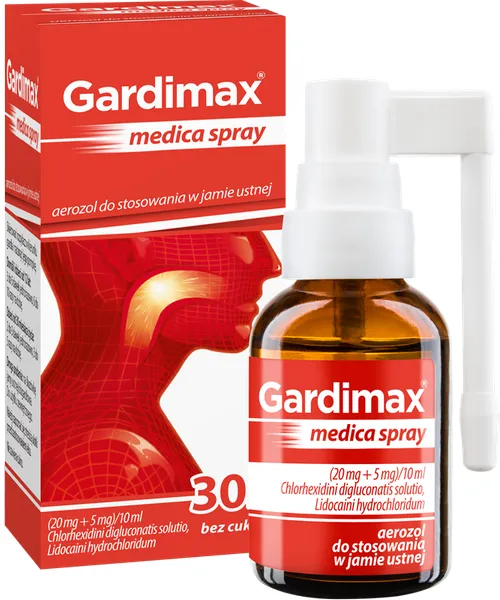
Table of Contents
- Package leaflet: Information for the patient
- 1. WHAT IS GARDIMAX MEDICA SPRAY AND WHAT IS IT USED FOR
- 2. IMPORTANT INFORMATION BEFORE USING GARDIMAX MEDICA SPRAY
- 3. HOW TO USE GARDIMAX MEDICA SPRAY
- 4. POSSIBLE ADVERSE REACTIONS
- 5. HOW TO STORE GARDIMAX MEDICA SPRAY
- 6. CONTENTS OF THE PACKAGE AND OTHER INFORMATION
Package leaflet: Information for the patient
GARDIMAX MEDICA SPRAY, (20 mg + 5 mg)/10 ml, oral spray
Chlorhexidini digluconatis solutio + Lidocaini hydrochloridum
Please read the entire leaflet carefully before using this medicine, as it contains important information for the patient.
This medicine should always be used exactly as described in this patient leaflet or as directed by a physician or pharmacist.
- Keep this leaflet, as you may need to read it again.
- If you need advice or further information, please consult your pharmacist.
- If you experience any adverse reactions, including any not listed in this leaflet, inform your doctor or pharmacist. See section 4.
- If there is no improvement after 3–4 days, or if you feel worse, contact your doctor.
Table of contents:
- What Gardimax Medica Spray is and what it is used for
- Important information before using Gardimax Medica Spray
- How to use Gardimax Medica Spray
- Possible side effects
- How to store Gardimax Medica Spray
- Contents of the pack and other information
1. WHAT IS GARDIMAX MEDICA SPRAY AND WHAT IS IT USED FOR
A medicine for symptomatic use to relieve pain associated with inflammation or irritation in inflammatory conditions of the mouth and throat.
If there is no improvement after 3–4 days, or if you feel worse, consult your doctor.
2. IMPORTANT INFORMATION BEFORE USING GARDIMAX MEDICA SPRAY
Do not use Gardimax Medica Spray:
- if you are allergic to chlorhexidine digluconate or lidocaine hydrochloride, or to any of the other ingredients of this medicine (listed in section 6);
- if you have hypersensitivity to other local anesthetics of the amide type;
- in children under 2.5 years of age (30 months).
Consult your doctor if any of the above contraindications apply to you, or have applied in the past.
Warnings and precautions
Before starting treatment with Gardimax Medica Spray, discuss it with your doctor or pharmacist.
- Do not use Gardimax Medica Spray for prolonged periods. Do not administer one dose immediately after another.
- Limit the use of this medicine to cases where relief of existing pain and irritation is absolutely necessary.
- Avoid contact with eyes and ears. If the spray gets into the eyes, rinse immediately with a large amount of water.
- If an excessive dose is taken (more than 1 bottle per day), there is a risk of excessive loss of sensitivity in the area of the vocal cords, leading to reduced control of the swallowing reflex and an increased risk of choking.
- Avoid using the medicine in individuals who are particularly prone to allergies.
- Due to the presence of menthol, exercise caution when using in children if symptoms preceding seizures occur.
Gardimax Medica Spray contains alcohol. Please also read the section titled “Gardimax Medica Spray contains alcohol (ethanol) and menthol”.
Children and adolescents
Do not use in children under 30 months of age.
Gardimax Medica Spray and other medicines
Inform your doctor or pharmacist about all medicines you are currently taking, have recently taken, or plan to take.
- Do not use this medicine simultaneously with drugs used for mild forms of Alzheimer’s disease (cholinesterase inhibitors).
- Do not use this medicine simultaneously with other antiseptic medicines.
Lidocaine hydrochloride may increase methemoglobin levels in patients receiving other drugs affecting its formation, e.g., sulfonamides. Cimetidine, beta-blockers, norepinephrine, and inhalational anesthetics inhibit lidocaine metabolism, leading to increased serum drug concentration.
Barbiturates, rifampicin, and phenytoin accelerate lidocaine metabolism.
Lidocaine enhances the effect of neuromuscular blocking agents.
Pregnancy and breastfeeding
If you are pregnant or breastfeeding, suspect you may be pregnant, or are planning to have a child, consult your doctor or pharmacist before using this medicine.
This medicine should not be used during pregnancy unless, in the opinion of the doctor, it is absolutely necessary.
The doctor will decide whether you should discontinue breastfeeding or continue using Gardimax Medica Spray, taking into account the benefits of breastfeeding for the child and the benefits of treatment for the mother.
Driving and operating machinery
No effects of Gardimax Medica Spray on the ability to drive motor vehicles or operate machinery have been observed.
Gardimax Medica Spray contains alcohol (ethanol) and menthol
- Gardimax Medica Spray contains alcohol (42.5% v/v ethanol), i.e., up to 168 mg in 5 doses, equivalent to 0.85 ml of beer or 0.35 ml of wine per dose. This is harmful for individuals with alcohol dependence. This should also be considered in pregnant and breastfeeding women, children, and patients in high-risk groups, such as those with liver disease or epilepsy.
- Gardimax Medica Spray contains menthol: exercise caution when using in children with a history of seizures.
Gardimax Medica Spray does not contain sugar and may be used by diabetics.
3. HOW TO USE GARDIMAX MEDICA SPRAY
This medicine should always be used exactly as described in this patient leaflet or as directed by a physician or pharmacist. If in doubt, consult a physician or pharmacist.
This medicine is intended for short-term symptomatic use only: 3 to 4 days. If there is no improvement after this period, or if new symptoms and/or general symptoms such as fever occur during treatment, consult a physician.
Route of administration
For oral mucosa, oropharyngeal
Recommended dose
Adults and adolescents aged 12 years and older: 3 to 5 sprays per single dose, 6 to 10 times daily.
Children above 2.5 years of age (30 months): 2 to 3 sprays per single dose, 3 to 5 times daily.
Instructions for use of Gardimax medica spray with dosing pump and foldable dosing nozzle
Direct the dosing nozzle toward the throat and press the pump.
It is recommended to clean the dosing nozzle daily as follows:
- Turn the bottle upside down and press the dosing pump until the liquid remaining in the dosing nozzle is expelled (to prevent solution from spraying out of the bottle).
- Remove the dosing nozzle from the dosing pump and place it in a container with hot water for several minutes.
- Remove the dosing nozzle from the water and allow it to dry completely.
- Reattach the dry dosing nozzle to the dosing pump, twisting it downward until it locks the dosing pump in place.
Overdose of Gardimax medica spray
In case of an overdose of Gardimax medica spray, contact a physician or pharmacist immediately.
Symptoms of overdose: anxiety, tinnitus, nystagmus, respiratory failure, hypotension, bradycardia, cardiac arrest, cardiac arrhythmia, difficulty swallowing, yawning, nervousness, muscle tremors, seizures, depression.
Missed dose of Gardimax medica spray
Do not use a double dose to make up for a missed dose.
Discontinuation of Gardimax medica spray
No special recommendations.
If you have any further questions about the use of this medicine, consult your physician or pharmacist.
4. POSSIBLE ADVERSE REACTIONS
Like all medicines, this medicine can cause adverse reactions, although not everyone experiences them.
The following adverse reactions may occur:
- In rare cases (less frequently than in 1 out of 1,000 patients): allergic reactions affecting the skin and mucous membranes (rash, inflammation of the oral mucosa, desquamation of the oral mucosa, salivary gland swelling), severe allergic reactions (anaphylactic reactions);
- Frequency not known (frequency cannot be estimated from available data): taste disturbances, sensation of burning in the tongue. With prolonged use, brownish discolorations of the tongue and teeth may occur (these discolorations can be removed).
Reporting of adverse reactions
If any adverse reactions occur, including those not listed in this leaflet, inform a doctor or pharmacist. Adverse reactions can be reported directly to the Department of Monitoring Adverse Drug Reactions of the Office for Registration of Medicinal Products, Medical Devices and Biocidal Products:
Al. Jerozolimskie 181C
02-222 Warsaw
Phone: +48 22 49 21 301
Fax: +48 22 49 21 309
Website: https://smz.ezdrowie.gov.pl
Reporting adverse reactions helps to provide more information on the safety of using this medicine.
Adverse reactions can also be reported to the marketing authorization holder.
5. HOW TO STORE GARDIMAX MEDICA SPRAY
Keep this medicine out of the sight and reach of children.
No special storage precautions are required.
The shelf life of the medicine after first opening the container: 3 months.
Do not use this medicine after the expiry date stated on the packaging after:
Expiry date (EXP) or on the label after: EXP.
Medicines must not be disposed of via wastewater or household waste. Ask your pharmacist how to dispose of medicines you no longer use. This will help protect the environment.
6. CONTENTS OF THE PACKAGE AND OTHER INFORMATION
What Gardimax medica spray contains
The active substances are: digluconate chlorhexidine solution 20 mg/10 ml, lidocaine hydrochloride 5 mg/10 ml.
One dose contains 0.180 mg of digluconate chlorhexidine solution and 0.045 mg of lidocaine hydrochloride.
Other ingredients: ethanol 96%, glycerol, levomenthol, cineol, sodium saccharin, citric acid monohydrate, purified water.
What Gardimax medica spray looks like and contents of the pack
A bottle containing 30 ml of solution made of amber glass with a dosing pump made of PP/stainless steel/polyacetal resin, equipped with a folding dosing nozzle made of PE.
Marketing Authorisation Holder
TACTICA Pharmaceuticals Sp. z o.o.
Królowej Jadwigi Street 148a/1a
30-212 Kraków
Poland
Tel.: +48 889 388 538
{Logo of the Marketing Authorisation Holder}
Manufacturer
Laboratoria QUALIPHAR N.V./S.A.
Rijksweg 9
B-2880 Bornem
Belgium