Gamma anti-hbs 200
Poland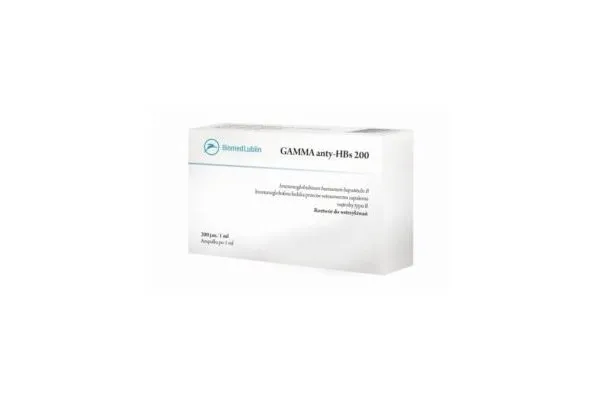
Table of Contents
Package leaflet: Information for the patient
GAMMA anty-HBs 200, 200 IU/ml
Solution for injection
Human immunoglobulin for hepatitis B
Please read all of this leaflet carefully before using this medicine, because it contains
important information for the patient.
- Keep this leaflet, as you may need to read it again.
- If you have any questions, please consult your doctor, pharmacist, or nurse.
- This medicine has been prescribed for a specific individual. Do not share it with others. This medicine may harm other people, even if their symptoms are the same.
- If the patient experiences any adverse reactions, including any not listed in this leaflet, inform the doctor. See section 4.
Leaflet contents
- What GAMMA anty-HBs 200 is and what it is used for
- Important information before using GAMMA anty-HBs 200
- How to use GAMMA anty-HBs 200
- Possible side effects
- How to store GAMMA anty-HBs 200
- Contents of the pack and other information
1. What GAMMA anty-HBs 200 is and what it is used for
GAMMA anty-HBs is a solution for intramuscular injection containing 200 IU of anti-HBs antibodies in an aqueous solution.
This medicine is used prophylactically to protect the body against infection with hepatitis B virus (HBV). Administered intramuscularly, anti-HBs immunoglobulins bind the HBs antigen in case of infection and prevent the development of hepatitis B (HBV infection). Passive immunity lasts for approximately 3 to 4 weeks.
The medicine is intended for:
- newborns whose mothers are HBs antigen carriers,
- children weighing up to 50 kg who are particularly at risk of nosocomial HBV infection.
2. Information before using GAMMA anty-HBs 200
When not to use GAMMA anty-HBs 200:
- if the patient is allergic to human immunoglobulin or to any of the other components of this medicine (listed in section 6).
Warnings and precautions
Before starting treatment with GAMMA anty-HBs 200, discuss this with your doctor.
GAMMA anty-HBs 200 must not be administered intravenously.
Ensure that the medicine GAMMA anty-HBs 200 is not injected directly into a blood vessel due to the risk of shock.
If the recipient is a carrier of HBsAg, administration of this medicine provides no benefit.
Hypersensitivity
Specific hypersensitivity reactions are rare.
GAMMA anty-HBs 200 contains a small amount of IgA. Patients with IgA deficiency may develop anti-IgA antibodies, which could lead to anaphylactic reactions when blood products containing IgA are administered. Therefore, the doctor must weigh the benefits of treatment with GAMMA anty-HBs 200 against the potential risk of hypersensitivity reactions.
In rare cases, administration of hepatitis B immunoglobulin may cause a drop in blood pressure with anaphylactic reaction, even in patients who previously tolerated immunoglobulin treatment well.
If an allergic or anaphylactic-type reaction is suspected, administration of the product must be stopped immediately. In case of shock, standard procedures for shock therapy should be applied.
Effect on laboratory test results
After injection of immunoglobulin, there may be a transient increase in the levels of various passively transferred antibodies in the patient's blood, leading to false-positive results in serological tests.
Passive transfer of antibodies against erythrocyte antigens, e.g. A, B, D, may interfere with certain serological tests for red blood cell antibodies, such as the antiglobulin (Coombs') test.
Infectious agents
Standard measures to prevent infections associated with medicinal products derived from human blood or plasma include: donor selection, screening of individual donations and plasma pools for specific markers of infection, and inclusion of effective viral inactivation/removal steps in the manufacturing process. Nevertheless, for medicinal products derived from human blood or plasma, the possibility of transmitting infectious agents cannot be completely excluded. This includes unknown or newly emerging viruses and other pathogens.
Measures taken are considered effective against enveloped viruses such as HIV, HBV, and HCV. However, they may have limited effectiveness against non-enveloped viruses such as HAV and/or parvovirus B19.
Clinical data indicate no transmission of hepatitis A virus or parvovirus B19 during immunoglobulin administration. It is also believed that the presence of antibodies plays an important role in the virological safety of the product.
For patient safety, it is recommended, whenever possible, to record the name and batch number of the medicine GAMMA anty-HBs 200 together with the patient's data each time the product is administered, in order to maintain traceability between the batch number and the patient.
GAMMA anty-HBs 200 and other medicines
Inform your doctor about all medicines currently or recently taken, as well as any medicines planned for future use. This medicine may reduce the effectiveness of vaccines containing live attenuated viruses, such as measles, mumps, and rubella. Vaccination with these vaccines should be performed at least 3 months after administration of immunoglobulin.
When undergoing laboratory tests, inform your doctor about immunoglobulin use, as this treatment may affect the results of serological tests.
Pregnancy, breastfeeding, and effects on fertility
Pregnancy
The safety of this medicinal product in pregnant women has not been evaluated in controlled clinical trials, and therefore caution should be exercised when using it in pregnant or breastfeeding women. Immunoglobulins have been shown to cross the placenta, increasingly so during the third trimester. Clinical observations from immunoglobulin administration indicate no harmful effects on pregnancy, the fetus, or the newborn.
Breastfeeding
Immunoglobulins are excreted in breast milk and may contribute to protecting the newborn against pathogens penetrating mucous membranes.
Fertility
Clinical experience with immunoglobulin use suggests that no harmful effect on fertility is expected.
Driving and operating machinery
This medicine has no influence on the ability to drive or operate machinery.
3. How to use GAMMA anty-HBs 200
This medicine should always be used as directed by a physician. The medicine must be administered
intramuscularly by a doctor or nurse. Before administration, the medicine should be brought to
room temperature or body temperature. The doctor or nurse should check whether the solution in the ampoule
is clear or slightly opalescent. The solution must not be used if it is cloudy or contains sediment.
GAMMA anty-HBs 200 is administered intramuscularly:
- to newborns whose mothers had hepatitis B virus infection during pregnancy or are
HBs antigen carriers, 200 IU should be given no later than within 12 hours after birth, - to newborns who have not been vaccinated against hepatitis B virus; after 1 month from the first dose (200 IU), a second dose of 200 IU is administered,
- to children weighing up to 50 kg according to the following scheme:
- to newborns, infants, and children weighing up to 10 kg: 200 IU (contents of 1 ampoule),
- to children weighing from 10 kg to 20 kg: 400 IU (contents of 2 ampoules),
- to children weighing from 20 kg to 30 kg: 600 IU (contents of 3 ampoules),
- to children weighing from 30 kg to 50 kg: 800 IU (contents of 4 ampoules). In cases of prolonged hospitalization, the dose should be repeated every 3–4 weeks. In these situations, hepatitis B vaccination is highly recommended. The first dose of vaccine may be administered on the same day as human immunoglobulin against hepatitis B virus, but at different injection sites.
If a dose greater than 400 IU (contents of more than 2 ampoules) is required, it should be
administered intramuscularly at different body sites, in divided doses.
If simultaneous administration of vaccine and immunoglobulin is necessary, the immunoglobulin
and vaccine should be administered at two separate body sites.
In patients who do not develop an immunological response after vaccination (no detectable
hepatitis B antibodies at measurable levels) and in whom continuous disease prevention is required,
administration of 500 IU in adults and 8 IU/kg in children every 2 months may be considered; a minimum protective antibody titer is considered to be 10 IU/mL.
If there are contraindications to intramuscular administration (coagulation disorders), the medicine
may be administered subcutaneously, provided that no intravenous product is available. However, it should be noted that clinical data on the efficacy of subcutaneous
administration of GAMMA anty-HBs 200 are not available.
Any unused medicine or waste material must be disposed of in accordance with
local regulations.
4. Possible adverse reactions
Like all medicines, this medicine can cause adverse reactions, although not everyone experiences them.
The following adverse reactions have been reported rarely (affecting 1 to 10 patients per 10,000
treated):
headache, low blood pressure, nausea, vomiting, skin reactions, erythema, itching, joint pain,
fever, malaise, chills; at the injection site: swelling, pain, redness, induration, sensation of warmth,
itching, rash.
The following adverse reactions have been reported very rarely (affecting fewer than 1 patient per 10,000
treated):
hypersensitivity, anaphylactic shock.
The frequency of the following adverse reaction is unknown (cannot be estimated from the available data):
tachycardia.
Reporting of adverse reactions
If any adverse reactions occur, including any adverse reactions not listed in this leaflet, inform your doctor, pharmacist, or nurse. Adverse reactions can be reported directly to the Department of Monitoring Adverse Drug Reactions at the Office for Registration of Medicinal Products, Medical Devices and Biocidal Products:
Al. Jerozolimskie 181C, 02-222 Warsaw, phone: +48 22 49-21-301, fax: +48 22 49-21-309, website: https://smz2.ezdrowie.gov.pl.
Adverse reactions can also be reported to the marketing authorization holder.
Reporting adverse reactions helps provide more information on the safety of the medicine.
For safety information regarding infectious agents, see section 2.
5. How to store GAMMA anty-HBs 200
Keep this medicine out of the sight and reach of children.
Do not use this medicine after the expiry date stated on the packaging.
The expiry date refers to the last day of the stated month.
Store in a refrigerator (2ºC - 8ºC).
Protect from light.
Medicines must not be disposed of via wastewater or household waste. Ask your pharmacist how to dispose of medicines no longer required. Such measures help protect the environment.
Batch number (LOT)
Expiry date (EXP)
6. Contents of the package and other information
What GAMMA anty-HBs 200 contains
- The active substance is human immunoglobulin against hepatitis B virus. Each 1 ml of solution contains not less than 100 mg of human protein, including not less than 85% immunoglobulin G (IgG), with an anti-HBs antigen antibody content of 200 IU.
- The other components are: glycine, sodium chloride, water for injections.
What GAMMA anty-HBs 200 looks like and contents of the pack
GAMMA anty-HBs 200 is a clear or slightly opalescent solution.
Pack contents: 1 vial containing 1 ml.
Marketing authorisation holder and manufacturer
Synthaverse S.A.
ul. Uniwersytecka 10, 20-029 Lublin
tel 81 533 82 21
fax 81 533 80 60
e-mail [email protected]