Galpent
Poland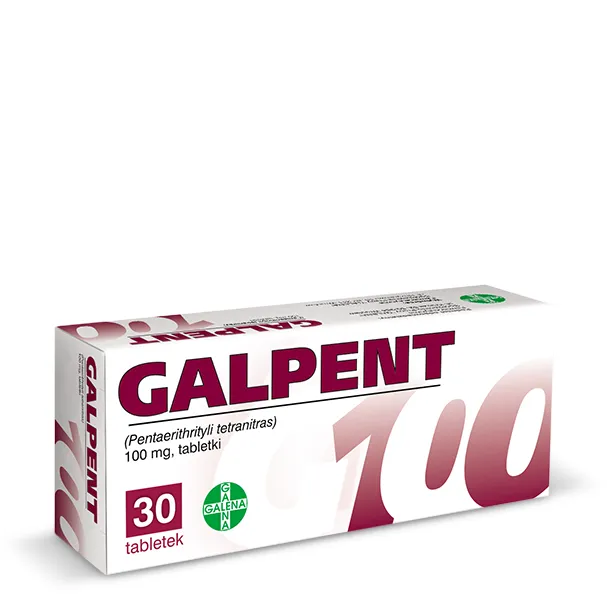
Table of Contents
Package leaflet: Information for the patient
GALPENT
100 mg, tablets
Pentaerythrityl tetranitrate
Please read all of this leaflet carefully before taking this medicine, because it contains
important information for the patient.
- Keep this leaflet so that you can read it again if necessary.
- If you have any questions, please consult your doctor or pharmacist.
- This medicine has been prescribed for a specific individual. Do not give it to others. This medicine may harm another person, even if their symptoms are the same.
- If you experience any adverse reactions, including any adverse reactions not listed in this leaflet, inform your doctor. See section 4.
Table of contents
- What Galpent is and what it is used for
- Important information before taking Galpent
- How to take Galpent
- Possible side effects
- How to store Galpent
- Contents of the pack and other information
1. What Galpent is and what it is used for
Galpent contains pentaerythritol tetranitrate, an organic nitrate used in the treatment of stable
ischaemic heart disease.
2. Important information before using Galpent
When not to take Galpent
- if the patient is allergic to pentaerythritol tetranitrate or other nitrates or any of the other components of this medicine (listed in section 6),
- if the patient has:
- shock, hypotension – including that associated with hypovolemia,
- myocardial infarction with low filling pressure – especially of the right ventricle,
- hypertrophic obstructive cardiomyopathy,
- mitral valve stenosis, aortic valve stenosis,
- cardiac tamponade,
- constrictive pericarditis,
- cor pulmonale,
- increased intracranial pressure, including stroke and head trauma,
- severe anemia,
- narrow-angle glaucoma.
Galpent must not be used in pregnant or breastfeeding women.
Galpent must not be used in children.
Sildenafil (a medicine used to treat erectile dysfunction and pulmonary arterial hypertension) is absolutely contraindicated in patients taking pentaerythritol tetranitrate and other nitrates due to the occurrence of adverse effects, including severe reduction in arterial pressure, which may be life-threatening.
Warnings and precautions
Before starting treatment with Galpent, discuss this with your doctor.
When Galpent is used in combination with other vasodilators, beta-blockers, diuretics, calcium antagonists, ACE inhibitors, AT1 receptor antagonists, other antihypertensive medicines, neuroleptics, and tricyclic antidepressants, it may cause undesirable, sudden reduction in arterial pressure.
In combination therapy, the doctor may start treatment with Galpent at low doses and then gradually increase them.
The medicine should be used with caution in patients with hypothyroidism.
Caution is required when gradually increasing the dose in elderly patients and in patients with advanced liver or kidney insufficiency – due to reduced elimination of active metabolites of the medicine and the possibility of adverse effects, especially sudden reduction in blood pressure.
Children and adolescents
There is lack of data on the safety of using this medicine in children.
Galpent with other medicines
Tell your doctor about all medicines currently taken or recently taken, as well as any medicines the patient plans to use.
Concomitant administration of pentaerythritol tetranitrate with:
- diphenhydramine (an antiallergic medicine) – increases (approximately 6-fold) the concentration of the active metabolite of pentaerythritol tetranitrate – pentaerythritol mononitrate,
- dihydroergotamine (a vasoconstrictor, mainly of cerebral vessels, used in migraine treatment) – increases its plasma concentration, causing elevated arterial pressure. Nonsteroidal anti-inflammatory drugs may reduce the effectiveness of pentaerythritol tetranitrate and other nitrates. Concomitant use of sildenafil and other phosphodiesterase-5 inhibitors is absolutely contraindicated during treatment with pentaerythritol tetranitrate and other nitrates (including sublingual nitroglycerin) due to potentiation of the effects of organic nitrates and other NO donors, leading to severe hypotension (myocardial infarction, stroke, sudden death), especially in patients after myocardial infarction, stroke, or with cardiac arrhythmias.
Galpent with food, drink, and alcohol
Since absorption of the medicine and its active metabolites is reduced in the presence of food in the intestines, it is recommended to take the medicine at least half an hour before a meal or one hour after a meal.
Alcohol intensifies the nitrate-induced reduction in arterial pressure.
Pregnancy and breastfeeding
If the patient is pregnant or breastfeeding, suspects she may be pregnant, or plans to become pregnant, she should consult her doctor before using this medicine.
This medicine must not be used in pregnant or breastfeeding women.
Driving and operating machinery
Due to the possibility of experiencing (most often at the beginning of therapy) headache, dizziness, hypotension, and syncope, particular caution should be exercised, and the patient's reaction after administration of a single dose should be assessed. If any of the above symptoms occur, the patient should not drive or operate machinery. Medical supervision is also recommended.
Galpent contains lactose and sucrose
If the patient has previously been diagnosed with intolerance to certain sugars, the patient should consult a doctor before taking this medicine.
3. How to use Galpent
This medicine should always be used as directed by the physician. In case of doubt, consult your doctor.
Recommended dose
The recommended dose for adults is 100 mg once daily, in the morning or evening.
In some patients, increasing the dose to 100 mg twice daily may be appropriate.
Use of Galpent in patients with renal and/or hepatic impairment
In patients with advanced liver and/or kidney dysfunction, it is recommended to use the lowest effective dose, increasing it under medical supervision.
Use of Galpent in elderly patients
In elderly patients, it is recommended to use the lowest effective dose, increasing it under medical supervision.
Method of administration
Oral administration.
It is recommended to take the medicine at least half an hour before a meal or one hour after a meal.
Use of a higher than recommended dose of Galpent
If an overdose is taken, seek immediate medical advice.
There is no data on cases of overdose. Symptoms of overdose are similar to those observed after nitroglycerin overdose. The most common symptoms include severe headache, dizziness, nausea and vomiting, and a marked decrease in arterial blood pressure, especially when standing up or in the upright position (orthostatic hypotension), weakness, and in more severe cases—particularly after alcohol consumption—fainting and loss of consciousness with tachycardia (increased heart rate) or bradycardia (slowed heart rate).
The severity of clinical symptoms of overdose depends on the dose of Galpent administered, concomitant use of other medications, and the patient's condition: heart failure, acute coronary syndromes, especially myocardial infarction with reduced blood pressure perfusing the left ventricle.
Management in case of overdose
Treatment of mild overdose is symptomatic. Hypotension can usually be controlled by placing the patient in a supine position with legs elevated above the level of the chest. If there is no rapid improvement, the physician may administer intravenous infusion fluids. Oxygen administration is recommended. In cases of bradycardia, 1 mg of intravenous atropine is usually administered.
Severe cases of nitrate overdose require treatment in an intensive care unit with continuous monitoring of the patient's condition.
Missed dose of Galpent
Do not take a double dose to make up for a missed dose.
Discontinuation of Galpent
Avoid abrupt discontinuation of the medicine (except in cases of very rare hypersensitivity).
If discontinuation is necessary, the physician will gradually reduce the dose.
In case of any further doubts regarding the use of this medicine, consult your doctor.
4. Possible adverse reactions
Like any medicine, this medicine can cause adverse reactions, although not everyone will experience them.
Adverse reactions of pentaerythritol tetranitrate are characteristic of the entire group of organic nitrates.
The frequency of occurrence of the adverse reactions listed below is defined as follows:
- very common (occur in more than 1 in 10 people),
- common (occur in up to 1 in 10 people),
- uncommon (occur in up to 1 in 100 people),
- rare (occur in up to 1 in 1,000 people),
- very rare (occur in fewer than 1 in 10,000 people),
- unknown (frequency cannot be estimated from the available data).
Very common:
- headache (usually mild in intensity, observed during the first few to several days of treatment, occurred in 4.9% - 25% of treated patients).
Common:
- dizziness (occurred in 0.8% - 7% of treated patients),
- orthostatic hypotension (sudden drop in arterial blood pressure upon changing from lying to standing position, occurred in 0.8% - 2.3% of treated patients),
- decreased arterial blood pressure (mainly observed in patients with arterial hypertension). There is a possibility of increased intracranial and intraocular pressure.
- weakness (occurred in 0.8% - 2.3% of treated patients).
Uncommon:
- nausea, vomiting, abdominal pain,
- reflex tachycardia (rapid heart rate),
- transient facial flushing,
- hypersensitivity reaction to nitrates.
Rare:
- skin allergic reactions,
- in particularly sensitive individuals, under the influence of alcohol, as well as when administered concomitantly with vasodilating drugs, episodes of arterial hypotension with fainting or collapse and reflex bradycardia may occur, mainly after nitroglycerin.
Very rare:
- rosacea and erythrodermia (diffuse redness and usually extensive desquamation).
Methemoglobinemia has been observed exclusively after intravenous administration of nitrates.
After administration of therapeutic doses of nitroglycerin given sublingually or intravenously, sudden drop in arterial blood pressure, fainting with loss of consciousness, and bradycardia which may lead to cardiac arrest have been observed in the initial phase of treatment. This reaction has not been observed after administration of pentaerythritol tetranitrate.
Reporting of adverse reactions
If any adverse reactions occur, including any adverse reactions not listed in this leaflet, inform your doctor or pharmacist. Adverse reactions can be reported directly to the Department of Monitoring of Adverse Drug Reactions, Office for Registration of Medicinal Products, Medical Devices and Biocidal Products
Al. Jerozolimskie 181C
02-222 Warsaw
Phone: +48 22 49 21 301
Fax: +48 22 49 21 309
Website: https://smz.ezdrowie.gov.pl
Adverse reactions can also be reported to the marketing authorization holder.
Reporting adverse reactions allows the collection of additional information on the safety of the medicine's use.
5. How to store Galpent
Store below 30°C.
Keep the medicine out of the sight and reach of children.
Do not use this medicine after the expiry date stated on the packaging. The expiry date refers to the last day of the stated month.
Medicines must not be disposed of via wastewater or household waste. Ask your pharmacist how to dispose of medicines no longer in use. This will help protect the environment.
6. Contents of the package and other information
What Galpent contains
- The active substance is pentaerythritol tetranitrate. Each tablet contains 100 mg of pentaerythritol tetranitrate.
- The other ingredients (excipients) are: monohydrate lactose, potato starch, sucrose, gelatin, magnesium stearate, talc.
What Galpent looks like and contents of the pack
Galpent is available as tablets. The tablet is white, round, and slightly convex on both sides.
Available pack:
30 tablets – 3 blisters of 10 tablets each
The packaging consists of aluminum foil and PVC foil blisters in a cardboard box.
Marketing Authorisation Holder and Manufacturer
Farmaceutyczna Spółdzielnia Pracy „GALENA”
ul. Dożynkowa 10
52-311 Wrocław
Tel.: + 48 71 710 62 01