Fulvestrant accord
PolandTable of Contents
- Package leaflet: Information for the patient
- 1. What Fulvestrant Accord is and what it is used for
- 2. Important information before using Fulwestrant Accord
- 3. How to use Fulwestrant Accord
- 4. Possible adverse reactions
- 5. How to store Fulwestrant Accord
- 6. Contents of the pack and other information
- Information intended exclusively for medical professionals:
Package leaflet: Information for the patient
Fulvestrant Accord, 250 mg/5 ml, solution for injection in pre-filled syringe
Fulvestrantum
Please read all of this leaflet carefully before using this medicine because it contains
important information for you.
- Keep this leaflet as you may need to read it again.
- If you have any further questions, please ask your doctor or pharmacist.
- This medicine has been prescribed for you personally. Do not pass it on to others. It may harm someone else, even if their symptoms are the same as yours.
- If you experience any side effects, including any not listed in this leaflet, tell your doctor or pharmacist. See section 4.
Contents of the leaflet
- What Fulvestrant Accord is and what it is used for
- What you need to know before you use Fulvestrant Accord
- How to use Fulvestrant Accord
- Possible side effects
- How to store Fulvestrant Accord
- Contents of the pack and other information
1. What Fulvestrant Accord is and what it is used for
Fulvestrant Accord contains the active substance fulvestrant, which belongs to a group of medicines called oestrogen receptor antagonists. Oestrogens, female sex hormones, can sometimes influence the development of breast cancer.
Fulvestrant Accord is used:
- as a single agent, for the treatment of postmenopausal women with a certain type of breast cancer called oestrogen receptor-positive breast cancer that is locally advanced or has spread to other parts of the body (metastatic), or
- in combination with palbociclib for the treatment of women with a certain type of breast cancer called hormone receptor-positive, human epidermal growth factor receptor 2 (HER2) negative advanced breast cancer that is locally advanced or has spread to other parts of the body (metastatic). Women who have not yet reached menopause will also receive a medicine called a luteinising hormone-releasing hormone (LHRH) agonist.
When Fulvestrant Accord is given in combination with palbociclib, it is important to also read the leaflet provided with the palbociclib medicine. If you have any questions about palbociclib, please consult your treating doctor.
2. Important information before using Fulwestrant Accord
When not to use Fulwestrant Accord:
- if the patient is allergic to fulvestrant or any of the other ingredients of this medicine (listed in section 6);
- if the patient is pregnant or breastfeeding;
- if the patient has severe impairment of liver function.
Warnings and precautions
Tell your doctor, pharmacist, or nurse before using Fulwestrant Accord if you have ever had any of the following health problems:
- kidney or liver function disorders;
- low platelet count (involved in blood clotting) or bleeding disorders;
- history of thrombotic disease;
- osteoporosis (reduced bone density);
- alcohol-related disease.
Children and adolescents
Fulwestrant Accord is not intended for use in children and adolescents under 18 years of age.
Fulwestrant Accord and other medicines
Tell your doctor or pharmacist about all medicines you are currently taking, have recently taken, or plan to take. In particular, inform your doctor if you are taking anticoagulant medicines (medicines that prevent blood clots).
Pregnancy and breastfeeding
Fulwestrant Accord must not be used during pregnancy. If the patient is capable of becoming pregnant, effective contraception should be used during treatment with Fulwestrant Accord and for 2 years after the last dose. Breastfeeding must not be undertaken while being treated with Fulwestrant Accord.
Driving and operating machinery
Fulwestrant Accord is not expected to affect the ability to drive or operate machinery. However, if treatment causes fatigue, the patient should refrain from such activities.
Fulwestrant Accord contains 10% v/v ethanol (alcohol), i.e. up to 500 mg per dose, equivalent to 10 ml of beer or 4 ml of wine per dose. This is harmful for patients with alcohol-related disease.
This should be taken into account in high-risk patients, such as those with liver function disorders or epilepsy.
Fulwestrant Accord contains 500 mg of benzyl alcohol per injection, equivalent to 100 mg/ml.
Benzyl alcohol may cause allergic reactions. Consult your doctor if you have impaired liver or kidney function, as large amounts of benzyl alcohol may accumulate in the body and cause adverse effects (known as metabolic acidosis).
Fulwestrant Accord contains 750 mg of benzyl benzoate per injection, equivalent to 150 mg/ml.
3. How to use Fulwestrant Accord
This medicine should always be used as directed by a doctor or pharmacist. If in doubt,
consult a doctor or pharmacist.
The recommended dose of fulvestrant is 500 mg (two injections of 250 mg each), administered once a
month, with an additional 500 mg dose given 2 weeks after the first dose.
Fulwestrant Accord is administered by a doctor or nurse as a slow intramuscular injection, one in each buttock.
If there are any further doubts regarding the use of this medicine, consult a doctor, pharmacist, or nurse.
4. Possible adverse reactions
Like all medicines, this medicine can cause adverse reactions, although not everyone will experience them.
Immediate medical attention may be required if any of the following adverse reactions occur:
- allergic reactions (hypersensitivity), including swelling of the face, lips, tongue and (or) throat, which may be symptoms of anaphylactic reactions
- thromboembolism (increased risk of blood clots)*
- hepatitis
- liver failure
Inform your doctor, pharmacist or nurse if you experience any of the following adverse reactions:
Very common adverse reactions (may affect more than 1 in 10 people)
- reaction at the injection site, e.g. pain and (or) inflammation;
- abnormal liver enzyme activity (detected in blood tests)*
- nausea
- weakness, fatigue*
- joint pain and musculoskeletal pain
- hot flushes
- skin rash
- allergic reactions (hypersensitivity), including swelling of the face, lips, tongue and (or) throat
All other adverse reactions
Common adverse reactions (may affect up to 1 in 10 people)
- headache
- vomiting, diarrhoea or loss of appetite*
- urinary tract infections
- back pain*
- increased bilirubin concentration (a bile pigment produced in the liver)
- thromboembolism (increased risk of blood clots)*
- decreased platelet count (thrombocytopenia)
- vaginal bleeding
- lower back pain radiating to one leg (sciatica)
- sudden weakness, numbness, tingling or loss of movement in the leg, especially on one side of the body, sudden difficulty walking or maintaining balance (peripheral neuropathy)
Uncommon adverse reactions (may affect up to 1 in 100 people):
- thick, whitish vaginal discharge and vaginal candidiasis (infection)
- anaphylactic reactions
- bruising and bleeding at the injection site
- increased activity of the liver enzyme gamma-GT (detected in blood test)
- hepatitis
- liver failure
- numbness, tingling and pain
* adverse reactions in which the exact role of fulvestrant has not been established due to the underlying disease
Reporting of adverse reactions
If any adverse reactions occur, including any adverse reactions not listed in this leaflet, inform your doctor or pharmacist. Adverse reactions can be reported directly to the Department of Monitoring Adverse Drug Reactions of the Office for Registration of Medicinal Products, Medical Devices and Biocidal Products
Al. Jerozolimskie 181C
02-222 Warsaw
tel.: + 48 22 49 21 301
fax: + 48 22 49 21 309
website: https://smz.ezdrowie.gov.pl
Adverse reactions can also be reported to the marketing authorization holder.
Reporting adverse reactions helps provide more information on the safety of this medicine.
5. How to store Fulwestrant Accord
Keep the medicine out of the sight and reach of children.
Do not use this medicine after the expiry date stated on the cardboard box or
on the prefilled syringe label (EXP). The expiry date refers to the last day of the stated month.
Store and transport under refrigerated conditions (2°C - 8°C).
Storage of the medicine at temperatures outside the range of 2°C - 8°C should be minimized. Avoid
storage at temperatures above 30°C and do not exceed a period of 28 days with an average
storage temperature below 25°C (but above the 2°C - 8°C range). If the temperature range is
exceeded, the recommended storage conditions should be immediately reinstated
[store and transport under refrigerated conditions (2°C - 8°C)]. Exposure to inappropriate
storage temperatures may have a cumulative effect on the quality of the medicine, and the 28-day period
must not be exceeded during the 2-year shelf life of Fulwestrant Accord (see section 6.3).
Exposure to temperatures below 2°C does not damage the medicine, provided it is not stored
below -20°C.
Keep prefilled syringes in the original packaging to protect from light.
Medical personnel are responsible for the proper storage, method of use, and disposal of the packaging
after the Fulwestrant Accord medicine has been used.
This medicine may pose a risk to the aquatic environment. Medicines must not be disposed of
via wastewater or household waste. Ask your pharmacist how to dispose of medicines no longer
in use. This will help protect the environment.
6. Contents of the pack and other information
What Fulwestrant Accord contains
The active substance is fulvestrant.
Each pre-filled syringe contains 250 mg of fulvestrant in 5 ml of solution (50 mg/ml).
The other ingredients are: ethanol 96%, benzyl alcohol, benzyl benzoate and purified castor oil.
What Fulwestrant Accord looks like and contents of the pack
Fulwestrant Accord is a clear, colourless to yellow, viscous solution.
The pre-filled syringe is made of colourless type I glass, closed with a plunger and plunger lock, with a tamper-evident seal, containing 250 mg of fulvestrant in 5 ml of solution.
The pack also includes a needle with a safety system (BD SafetyGlide), intended to be attached to the syringe barrel.
The Fulwestrant Accord pack contains two pre-filled syringes for single use.
Marketing Authorisation Holder
Accord Healthcare Polska Sp. z o.o.
ul. Taśmowa 7
02-677 Warsaw
Poland
Manufacturer / Importer
Accord Healthcare Polska Sp. z o.o.
ul. Lutomierska 50
95-200 Pabianice
Poland
Pharmadox Healthcare Ltd.
KW20A Kordin Industrial Park
Paola, PLA 3000
Malta
This medicinal product is authorised in the Member States of the European Economic Area under the following names:
| Member State Name | Medicinal Product Name |
| Austria | Fulvestrant Accord 250 mg Injection solution in a pre-filled syringe |
| Belgium | Fulvestrant Accord 250 mg solution for injection in a pre-filled syringe |
| Bulgaria | Fulvestrant Accord 250 mg/5 ml injection solution in a pre-filled syringe |
| Croatia | Fulvestrant Accord 250 mg solution for injection in a pre-filled syringe |
| Czech Republic | Fulvestrant Accord |
| Cyprus | Fulvestrant Accord 250 mg Solution for injection in pre-filled syringe |
| Denmark | Fulvestrant Accord 250 mg |
| Estonia | Fulvestrant Accord |
| Finland | Fulvestrant Accord |
| France | FULVESTRANT ACCORD 250 mg Solution for injection in a pre-filled syringe |
| Greece | Fulvestrant Accord |
| Spain | Strantas 250 mg solution for injection in a pre-filled syringe EFG |
| Netherlands | Fulvestrant Accord 250 mg solution for injection in pre-filled syringe |
| Ireland | Fulvestrant 250 mg Solution for injection in prefilled syringe |
| Iceland | Fulvestrant Accord 250 mg injection solution, solution in pre-filled syringe |
| Latvia | Fulvestrant Accord |
| Germany | Fulvestrant Accord 250 mg Injection solution in a pre-filled syringe |
| Norway | Fulvestrant Accord |
| Poland | Fulvestrant Accord |
| Portugal | Fulvestrant Accord |
| Romania | Fulvestrant Accord 250 mg Solution for injection in pre-filled syringe |
| Slovakia | Fulvestrant Accord 250 mg injection solution filled in a syringe |
| Slovenia | Fulvestrant 250 mg Solution for injection in a filled injection syringe |
| Sweden | Fulvestrant Accord |
| Hungary | Fulvestrant Accord 250 mg solution for injection in a pre-filled syringe |
| United Kingdom | Fulvestrant 250 mg Solution for injection in prefilled syringe |
| Italy | Fulvestrant Accord |
Information intended exclusively for medical professionals:
Fulwestrant Accord 500 mg (2 x 250 mg/5 ml solution for injection) should be administered using
two pre-filled syringes (see section 3).
Administration instructions
Warning – Do not autoclave the needle with the safety shielding system prior to use.
Avoid hand contact with the needle during administration and disposal.
The syringes are supplied with a BD SafetyGlide safety needle.
Applies to both syringes:
Remove the glass cartridge from the container and Rys.1
check whether it is damaged.
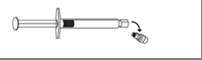
Turn the plastic tamper-evident protection on the
Luer syringe until it disconnects, allowing it to be
removed (see Fig. 1).
Open the outer packaging of the safety needle (BD Rys. 2
SafetyGlide).
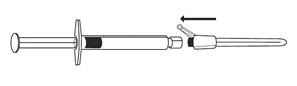
Attach the safety needle to the Luer tip (see Fig. 2).
Screw the needle securely onto the Luer tip to ensure firm attachment.
Remove the needle cap without damaging the sharp tip.
Bring the filled syringe close to the administration site.
Prior to administration of parenteral solutions, visually inspect them for the presence of
particulate matter and discoloration.
Expel excess air from the syringe.
Administer the drug intramuscularly, slowly (1–2 Rys. 3
minutes/injection), into the gluteal muscle
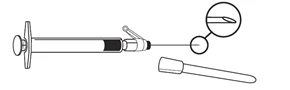
(site on the buttock). For the administrator’s
convenience, the needle cut is located on the
same side of the needle as the safety shield lever
(see Fig. 3).
Immediately after drug administration, activate Rys. 4
the needle safety shield by pushing its lever
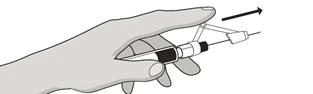
forward (see Fig. 4).
Note: Act to ensure safety for yourself and others. Listen for the
click and visually confirm that the needle tip is completely covered.
Disposal of waste
The pre-filled syringe is intended exclusively for single use.
This medicinal product may pose a risk to the aquatic environment. Any unused product or waste
should be disposed of in accordance with local regulations.