Fsme-immun 0.25 ml junior
Poland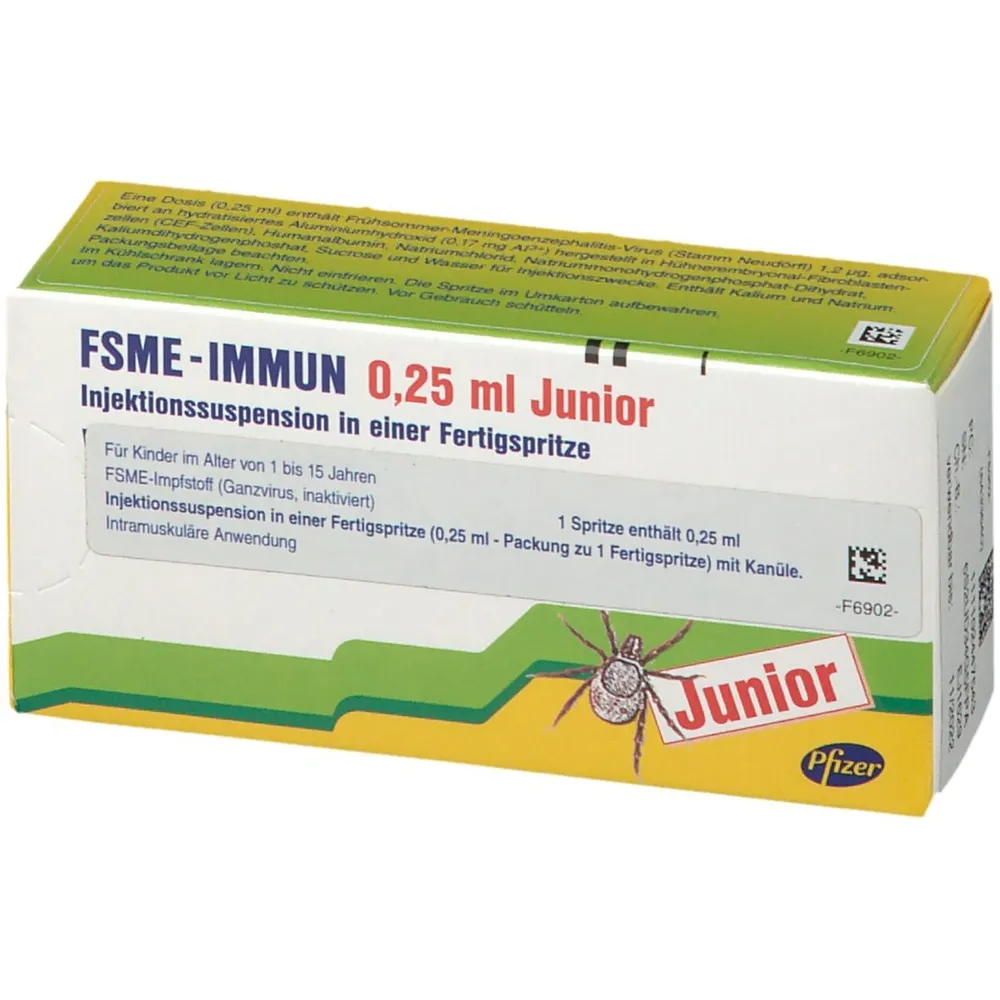
Table of Contents
- 1. What FSME-IMMUN 0.25 ml Junior is and what it is used for
- 2. Important information before using FSME-IMMUN 0.25 ml Junior
- 3. How to use FSME-IMMUN 0.25 ml Junior
- 4. Possible adverse reactions
- 5. How to store FSME-IMMUN 0.25 ml Junior
- 6. Contents of the pack and other information
- Information intended exclusively for medical professionals
FSME-IMMUN 0.25 ml Junior
Suspension for injection in prefilled syringe
Tick-borne encephalitis vaccine (whole virus, inactivated)
Please read this leaflet carefully before using the vaccine, as it contains important information for the patient.
- Keep this leaflet for future reference.
- If you have any questions, consult your doctor, pharmacist, or nurse.
- This vaccine has been prescribed for a specific individual. Do not pass it on to others.
- If any adverse reactions occur in the patient, including any not listed in this leaflet, inform your doctor, pharmacist, or nurse. See section 4.
Leaflet contents
1 What FSME-IMMUN 0.25 ml Junior is and what it is used for
2 Important information before using FSME-IMMUN 0.25 ml Junior
3 How to use FSME-IMMUN 0.25 ml Junior
4 Possible side effects
5 How to store FSME-IMMUN 0.25 ml Junior
6 Contents of the pack and other information
1. What FSME-IMMUN 0.25 ml Junior is and what it is used for
FSME-IMMUN 0.25 ml Junior is a vaccine used to prevent disease caused by the tick-borne encephalitis virus. It is intended for vaccination of children aged over 1 year up to 15 years.
- The vaccine stimulates the body to produce its own protective mechanisms (antibodies) against the virus.
- It does not provide protection against infections caused by other viruses or bacteria (some of which are also transmitted by tick bites) that may cause similar symptoms.
The tick-borne encephalitis virus can cause very serious infections of the brain, spinal cord, or meninges (the membranes surrounding the brain and spinal cord). Often, the first symptoms are headache and high fever. In some individuals, severe forms of infection may lead to loss of consciousness, coma, and death.
The virus can be transmitted to humans through the bite of a tick. The risk of being bitten by a tick carrying the virus is very high in many parts of Europe, as well as Central and Eastern Asia. Individuals living in or travelling to these areas are at risk of contracting tick-borne encephalitis. Ticks are not always noticed on the skin, and their bites may go unnoticed.
- Like all vaccines, this vaccine may not protect all vaccinated individuals.
- A single dose of the vaccine is unlikely to provide protection against infection. Three doses of the vaccine should be administered (see section 3 for details) to achieve optimal protection.
- Protection does not last a lifetime. Booster doses must be given regularly (see section 3 for details).
- There are no data on post-exposure prophylaxis (vaccination after a tick bite).
2. Important information before using FSME-IMMUN 0.25 ml Junior
When not to use FSME-IMMUN 0.25 ml Junior
- if the patient is allergic to the active substance, any of the vaccine components (listed in section 6), formaldehyde or protamine sulfate (used during the manufacturing process), or to antibiotics such as neomycin and gentamicin. For example, if there has been a skin rash, facial and throat swelling, breathing difficulties, bluish discoloration of the tongue or lips, low blood pressure, or collapse.
- if the patient has ever had a severe allergic reaction after eating egg or chicken meat.
- if the patient has an acute illness with or without fever. In such cases, vaccination with FSME-IMMUN 0.25 ml Junior should be postponed. The doctor will decide on the appropriate time for vaccination once the patient feels better.
Warnings and precautions
Before vaccination, inform the doctor, pharmacist, or nurse if:
- the patient has blood clotting disorders or increased tendency to bruising
- the patient has an autoimmune disease (such as rheumatoid arthritis or multiple sclerosis)
- the patient has an impaired immune system (resulting in inability to properly fight infections)
- the patient has insufficient antibody production
- the patient is taking any anticancer medicines
- the patient is taking medicines called corticosteroids (which reduce inflammation)
- the patient has any brain disease
- the patient has neurological disorders or convulsions.
If the patient has any of the above conditions, administration of this vaccine
may be contraindicated. Alternatively, the doctor may decide to administer the vaccine. The doctor may recommend
a blood test to check whether the vaccine has been effective.
FSME-IMMUN 0.25 ml Junior and other medicines
Tell the doctor, pharmacist, or nurse about all medicines the patient is currently taking
or has recently taken, including those obtained without a prescription. The doctor will decide
whether FSME-IMMUN 0.25 ml Junior can be administered simultaneously with other vaccines.
If the patient has recently received another vaccine, the doctor will determine the appropriate
site and timing for administration of FSME-IMMUN 0.25 ml Junior.
FSME-IMMUN 0.25 ml Junior may not provide complete protection in patients undergoing
immunosuppressive therapy.
Inform the doctor about any previous infection or vaccination against yellow fever virus,
Japanese encephalitis virus, or dengue virus. Antibodies against these viruses, which may be
present in the patient's blood, may cross-react with the tick-borne encephalitis virus used in
antibody detection tests and may lead to false test results.
Pregnancy, breastfeeding and fertility
If the patient is pregnant or breastfeeding, suspects she may be pregnant, or is planning to become
pregnant, she should consult her doctor or pharmacist before using this vaccine.
The doctor should inform the patient about the potential risks and benefits associated with
vaccination. The effects of FSME-IMMUN 0.25 ml Junior during pregnancy and breastfeeding are
unknown. Nevertheless, FSME-IMMUN 0.25 ml Junior may be used if the risk of infection is high.
Driving and operating machinery
It is unlikely that the vaccine will affect the ability to drive or operate machinery (playing outside or riding a bicycle). However, visual disturbances or dizziness may occur.
FSME-IMMUN 0.25 ml Junior contains potassium and sodium
Potassium and sodium are present in amounts below 1 mmol per dose, meaning the medicine is considered "sodium- and potassium-free".
3. How to use FSME-IMMUN 0.25 ml Junior
This vaccine is usually administered into the deltoid muscle. In children under 18 months of age,
the vaccine should be given into the thigh muscle. The vaccine must not be injected into a blood
vessel. Subcutaneous administration is permitted only in exceptional cases (e.g. in patients with
blood coagulation disorders or those taking anticoagulant medicines, known as anticoagulants).
This vaccine should not be given to individuals aged 16 years and older. For this age group, a tick-borne encephalitis vaccine intended for adults is recommended.
Vaccination should be documented by the physician, including recording the batch number.
Primary vaccination
Primary vaccination consists of three doses of FSME-IMMUN 0.25 ml Junior.
- The timing of the first dose is determined by the physician.
- The second dose should be administered 1 to 3 months after the first dose. If rapid protection is required, the second dose may be given as early as two weeks after the first dose.
- The third dose should be administered 5 to 12 months after the second dose.
- Ticks become active in spring. Therefore, it is best to administer the first and second doses during winter. This allows sufficient protection to develop before the tick season begins.
- The third dose completes the primary vaccination series. It is best to complete the vaccination schedule by administering the third dose within the same tick season or, at the latest, before the start of the next tick season.
- This provides protection for up to three years.
- If the interval between the three doses is too long, the patient may not achieve full protection against infection.
| Primary vaccination | Dose | Standard vaccination schedule | Accelerated vaccination schedule |
| First dose | 0.25 ml | Selected date | Selected date |
| Second dose | 0.25 ml | 1 to 3 months after the first vaccine dose | 14 days after the first vaccine dose |
| Third dose | 0.25 ml | 5 to 12 months after the second vaccine dose | 5 to 12 months after the second vaccine dose |
Booster doses
The first booster dose should be administered 3 years after the third dose. Subsequent booster
doses should be given at 5-year intervals.
| Booster dose | Dose | Time |
|---|---|---|
| First booster dose | 0.25 ml | 3 years after the third vaccine dose |
| Subsequent booster doses | 0.25 ml | every 5 years |
Booster dose
If individual doses of the vaccine are administered with too long an interval between them, the vaccine
may not provide adequate protection against tick-borne encephalitis. However, administration of
one booster dose of FSME-IMMUN vaccine is sufficient to continue the vaccination schedule
if the patient has previously received at least two doses of the vaccine. There is no need to
restart the entire primary vaccination cycle. For additional information, consult a physician.
There are no data available regarding the use of booster doses in children under 6 years of age.
Children with weakened immune systems (including children receiving immunosuppressive
treatment)
The physician may consider measuring antibody levels in blood four weeks after the second dose,
and if no immune response is detected, may recommend administration of an additional dose. The same
applies to each subsequent dose.
Administration of a higher than recommended dose of FSME-IMMUN 0.25 ml Junior
Overdose is highly unlikely, as the vaccine is supplied in a pre-filled syringe containing a single dose and
is administered by a healthcare professional.
In case of any doubts regarding the use of the vaccine, consult a physician, nurse, or pharmacist.
4. Possible adverse reactions
Like any medicine, this vaccine may cause adverse reactions, although they do not occur in everyone. If any of the adverse reactions worsen or if any adverse reactions not listed in this leaflet occur, a doctor or pharmacist should be informed.
As with all vaccines, severe allergic reactions may occur. These are very rare, but appropriate medical equipment and care should always be available in case they occur. Symptoms of serious allergic reactions include:
- Swelling of the lips, mouth, or throat (which may make swallowing or breathing difficult)
- Rash and swelling of the hands, feet, and ankles
- Fainting due to low blood pressure
These symptoms usually occur very shortly after injection, often while still at the clinic or doctor's office. If any of these symptoms occur after leaving the place where the injection was administered, contact a doctor IMMEDIATELY.
High fever may occur in children. Among the youngest children (aged 1 to 2 years), fever occurs in about one in three children after the first dose. In children aged 3 to 15 years, fever occurs in less than one in ten children. Fever usually lasts only 1 to 2 days. The frequency of fever after the second, third, and subsequent doses is lower. Fever-reducing prophylaxis or treatment may be used if necessary.
The following adverse reactions have been reported:
Very common (may affect more than 1 in 10 people):
- Pain at the injection site
Common (may affect up to 1 in 10 people):
- Headache
- Swelling, hardening, and redness at the injection site
- Nausea or vomiting, decreased appetite
- Feeling tired or unwell
- Restlessness and sleep disturbances (in younger children)
- Muscle pain
- Fever (see above)
Uncommon (may affect up to 1 in 100 people):
- Swollen lymph nodes
- Abdominal pain
- Joint pain
- Chills
Rare (may affect up to 1 in 1,000 people):
- Itching at the injection site
- Abnormal and reduced sensation, such as tingling or numbness along several nerves
- Dizziness
- Diarrhea
- Indigestion
- Urticaria (hives)
Additional adverse reactions reported after marketing authorization with rare frequency:
- Allergic reactions
- Encephalitis, symptoms of meningeal irritation such as neck stiffness
- Neurological symptoms such as facial paralysis, paralysis, nerve inflammation
- A disease characterized by muscle weakness, sensory disturbances, and tingling in the hands, feet, and upper part of the body (Guillain-Barré syndrome)
- Vision disturbances/impaired vision, increased sensitivity to light, eye pain
- Ringing in the ears (tinnitus)
- Shortness of breath
- Skin reactions (rash and/or itching), redness of the skin, increased sweating
- Musculoskeletal stiffness and neck stiffness, pain in arms and legs
- Influenza-like symptoms, weakness, skin swelling, gait disturbances
- Seizures with or without fever
In a small comparative study assessing the immunological response after intramuscular and subcutaneous administration of FSME-IMMUN in healthy adults, subcutaneous administration was shown to result in a higher number of local reactions at the injection site (i.e., redness, swelling, itching, and pain), particularly in women.
Reporting of adverse reactions
If any adverse reactions occur, including any not listed in this leaflet, inform a doctor or pharmacist. Adverse reactions can be reported directly to the Department of Monitoring Adverse Drug Reactions of the Office for Registration of Medicinal Products, Medical Devices and Biocidal Products
Al. Jerozolimskie 181 C
02-222 Warsaw
Tel.: +48 22 49 21 301
Fax: +48 22 49 21 309
Website: https://smz.ezdrowie.gov.pl
Adverse reactions can also be reported to the marketing authorization holder.
Reporting adverse reactions helps to provide more information on the safety of the vaccine.
5. How to store FSME-IMMUN 0.25 ml Junior
- Store in a refrigerator (2°C - 8°C). Keep the syringe in the outer packaging to protect it from light. Do not freeze. If foreign solid particles are observed or if the packaging is damaged or leaking, this vaccine must not be used.
- Keep out of sight and reach of children.
- Do not use this vaccine after the expiry date stated on the packaging following: EXP. The expiry date refers to the last day of the stated month.
- Vaccines must not be disposed of via wastewater or household waste. Ask your pharmacist how to dispose of vaccines no longer required. This will help protect the environment.
6. Contents of the pack and other information
What FSME-IMMUN 0.25 ml Junior contains
The active substance of the vaccine is: tick-borne encephalitis virus (strain Neudörfl).
One dose of vaccine (0.25 ml) contains 1.2 micrograms of inactivated tick-borne encephalitis
virus (strain Neudörfl), produced in chick embryo cells.
Other ingredients are: human albumin, sodium chloride, disodium phosphate dihydrate, potassium
dihydrogen phosphate, sucrose, and water for injections.
Aluminium hydroxide (hydrated) contained in this vaccine is an adsorbent. Adsorbents are
substances included in certain vaccines to accelerate, enhance and (or) prolong the protective
effect of the vaccine.
What FSME-IMMUN 0.25 ml Junior looks like and contents of the pack
The FSME-IMMUN 0.25 ml Junior vaccine is supplied as a 0.25 ml (1 dose) suspension for
injection in a pre-filled syringe. The pack may not contain a needle or may contain 1 separate
needle per syringe. Needles are sterile and intended for single use only. Packs containing
1 or 10 pre-filled syringes are available. Not all pack sizes may be marketed. After shaking,
the suspension is white-grey in colour and has a milky appearance.
Each pre-filled syringe is packed in a blister. The hole in the blister seal is intentional and
allows for moisture equilibrium during recommended warming prior to administration of the
vaccine. Open the blister by removing the lid and remove the syringe. Do not press the syringe
out of the blister.
Marketing Authorisation Holder and Manufacturer
Marketing Authorisation Holder:
Pfizer Europe MA EEIG
Boulevard de la Plaine 17
1050 Bruxelles
Belgium
Manufacturer:
Pfizer Manufacturing Belgium NV
Rijksweg 12
2870 Puurs-Sint-Amands
Belgium
For further information about this medicinal product, contact the local representative of the
Marketing Authorisation Holder:
Pfizer Polska Sp. z o.o.
Tel: +48 22 335 61 00
This medicinal product is authorised for marketing in the European Economic Area and in the United Kingdom (Northern Ireland) under the following names:
Belgium, Germany, Luxembourg, FSME-IMMUN 0.25 ml Junior
Netherlands, Poland, Portugal
Bulgaria FSME-IMMUN 0.25 ml Junior
Czech Republic FSME-IMMUN
Denmark, Finland, Norway, Iceland, TicoVac Junior
Greece, Cyprus
Estonia TicoVac 0.25 ml
Croatia FSME-IMMUN 0,25 ml Junior, suspenzija za
injekciju u napunjenoj štrcaljki, cjepivo protiv
krpeljnog encefalitisa, inaktivirano
Hungary FSME-IMMUN Junior vakcina fecskendőben
Malta TicoVac Junior 0.25 ml Suspension for injection in
pre-filled syringe
Austria FSME-IMMUN 0.25 ml Junior
Injektionssuspension in einer Fertigspritze
France TicoVac Enfant 0.25 ml
Ireland, United Kingdom TicoVac Junior 0.25 ml
(Northern Ireland)
Sweden FSME-IMMUN Junior
Italy TicoVac 0.25 ml per uso pediatrico
Latvia, Lithuania TicoVac 0.25 ml
Romania FSME-IMMUN 0.25 ml Junior
suspensie injectabila in seringa preumpluta
Slovenia FSME-IMMUN 0,25 ml za otroke
Slovakia FSME-IMMUN 0,25 ml Junior Injekčná suspenzia
Other sources of information
Detailed information on this medicinal product is available on the website of the Office for Registration of Medicinal Products, Medical Devices and Biocidal Products:
https://www.gov.pl/web/urpl/
Information intended exclusively for medical professionals
The vaccine should reach room temperature before administration. Shake well to ensure the suspension is thoroughly mixed. After shaking, the FSME-IMMUN 0.25 ml Junior vaccine is a greyish-white, opalescent, homogeneous suspension. Visually inspect the vaccine for any foreign particulate matter and/or physical changes in appearance. If any changes are observed, the vaccine must be discarded.
Immediately after removing the syringe cap, attach the needle and remove the needle cover prior to administration. After attaching the needle, the vaccine must be administered immediately. In exceptional cases, when administering subcutaneously, an appropriate needle should be used.
Any unused product or waste material should be disposed of in accordance with local regulations.