Foscarnet sodium hexahydrate tillomed
Poland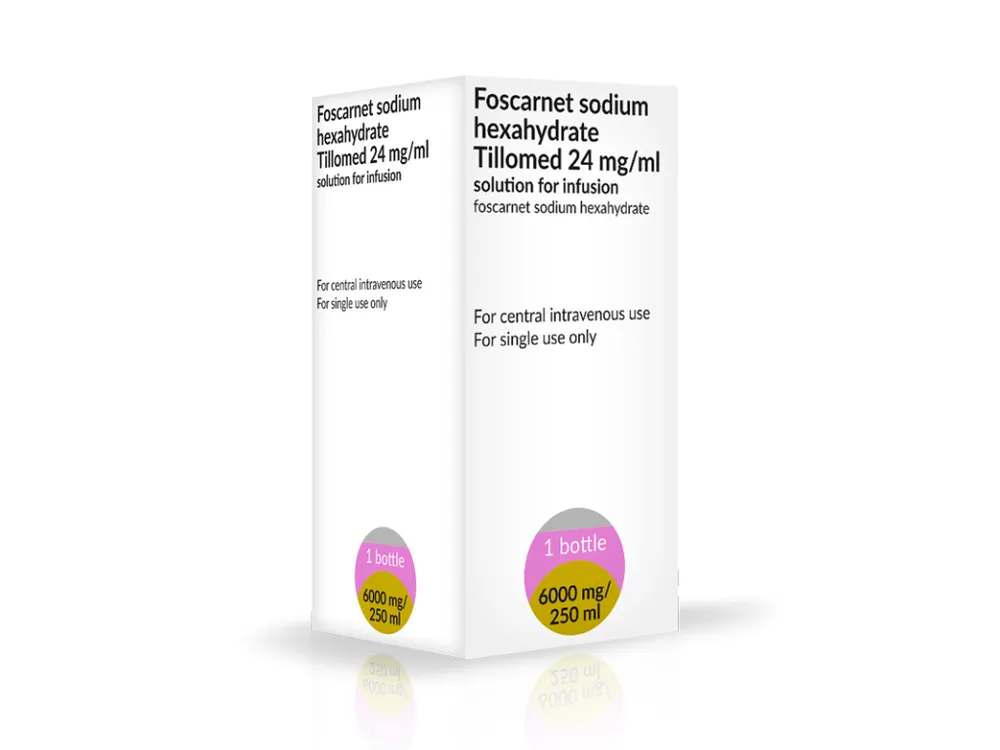
Table of Contents
- Package leaflet: Information for the user
- 1. What Foscarnet sodium hexahydrate Tillomed is and what it is used for
- 2. Important information before using Foscarnet sodium hexahydrate
- 3. How to use Foscarnet sodium hexahydrate Tillomed
- 4. Possible adverse effects
- 5. How to store Foscarnet sodium hexahydrate Tillomed
- 6. Contents of the pack and other information
- Information intended exclusively for medical professionals:
Package leaflet: Information for the user
Foscarnet sodium hexahydrate Tillomed, 24 mg/mL, infusion solution
Foscarnetum natricum hexahydricum
Please read this leaflet carefully before using this medicine, because
it contains important information for the patient.
- Keep this leaflet, so that you can read it again if necessary.
- If you have any questions, please consult your doctor, pharmacist, or nurse.
- If you experience any adverse reactions, including any not listed in this leaflet, inform your doctor or pharmacist. See section 4.
Leaflet contents
- What Foscarnet sodium hexahydrate Tillomed is and what it is used for
- Important information before using Foscarnet sodium hexahydrate Tillomed
- How to use Foscarnet sodium hexahydrate Tillomed
- Possible side effects
- How to store Foscarnet sodium hexahydrate Tillomed
- Contents of the pack and other information
1. What Foscarnet sodium hexahydrate Tillomed is and what it is used for
Foscarnet sodium hexahydrate Tillomed contains an active substance called foscarnet sodium hexahydrate. It belongs to a group of antiviral medicines. It works by preventing the replication of viruses.
Foscarnet sodium hexahydrate Tillomed is used to treat the following infections in patients with AIDS:
- Life-threatening or sight-threatening CMV retinitis, a viral eye infection caused by cytomegalovirus (CMV). This virus is known as cytomegalovirus (Eng. cytomegalovirus, CMV), and the infection is known as CMV retinitis. Foscarnet sodium hexahydrate Tillomed helps prevent the worsening of the infection, but cannot repair damage that has already occurred.
- Herpes simplex virus (HSV) infection. Foscarnet sodium hexahydrate Tillomed is given to individuals infected with HSV who have a weakened immune system. It is administered to patients who have not responded to acyclovir treatment.
2. Important information before using Foscarnet sodium hexahydrate
Tillomed
When not to use Foscarnet sodium hexahydrate Tillomed
- if the patient is allergic (hypersensitive) to foscarnet sodium hexahydrate or to any of the other ingredients of this medicine (listed in section 6).
If in doubt, consult a doctor or nurse before taking foscarnet.
Warnings and precautions
Before starting treatment with Foscarnet sodium hexahydrate Tillomed, discuss with a doctor or nurse if the patient has:
- Impaired kidney function.
- Heart disorders.
If the patient is unsure whether this applies, they should consult a doctor or nurse before using foscarnet.
Children and adolescents
The safety and efficacy of foscarnet sodium hexahydrate in children have not been established.
Foscarnet sodium hexahydrate Tillomed and other medicines
Tell the doctor or pharmacist about all medicines the patient is currently taking, has recently taken, or plans to take. This includes medicines obtained without a prescription and herbal medicines.
In particular, inform the doctor or nurse if the patient is taking any of the following medicines:
- Pentamidine (used to treat infections)
- Amphotericin B (used to treat fungal infections)
- Acyclovir (used to treat viral infections)
- Antibiotics known as aminoglycosides, such as gentamicin and streptomycin (used to treat infections)
- Cyclosporine A, methotrexate or tacrolimus (used to suppress immune system responses)
- Medicines known as protease inhibitors, such as ritonavir and saquinavir
- Laxatives
- Quinidine, amiodarone, sotalol or other medicines that may affect heart rate or rhythm
- Sedatives (neuroleptics).
Pregnancy, breastfeeding and fertility
If the patient is pregnant, breastfeeding, thinks she may be pregnant or is planning to have a baby, she should consult a doctor or pharmacist before using this medicine.
Use of the medicinal product Foscarnet sodium hexahydrate Tillomed is not recommended during pregnancy.
Attempts to become pregnant should not be made during treatment with Foscarnet sodium hexahydrate Tillomed; therefore, effective contraceptive methods should be used during treatment and for 6 months after its completion.
Men being treated with Foscarnet sodium hexahydrate Tillomed should not father a child during treatment or for 6 months after its completion.
Do not use Foscarnet sodium hexahydrate Tillomed during breastfeeding.
Driving and operating machinery
Foscarnet may affect the ability to drive or operate tools and machinery. Consult a doctor before engaging in such activities.
Tests before and during treatment with Foscarnet sodium hexahydrate Tillomed
The doctor may order blood and urine tests before starting and during treatment with Foscarnet sodium hexahydrate Tillomed. These tests are intended to monitor kidney function and blood mineral levels.
Foscarnet sodium hexahydrate Tillomed contains sodium
This medicine contains 1375 mg of sodium (the main component of table/food salt) in each 250 mL vial. This corresponds to 69% of the maximum recommended daily dietary sodium intake for adults.
Patients, especially those monitoring sodium intake in their diet, who are receiving 71 mL or more of this medicine per day over a prolonged period, should contact their doctor or pharmacist.
3. How to use Foscarnet sodium hexahydrate Tillomed
This medicine should always be used exactly as directed by the physician or pharmacist. If in
doubt, consult the physician or pharmacist.
- Foscarnet sodium hexahydrate Tillomed will be administered by a physician or nurse. It will be given as an intravenous infusion (drip). It may be administered via a central line in the chest if one is already in place.
- Each infusion will last at least 1 hour. Do not interfere with the infusion set during administration.
- The dose of foscarnet administered depends on kidney function. It also depends on the patient's body weight.
- Adequate hydration is important during the infusion. This helps prevent kidney problems. If fluids are needed, the physician or nurse will administer them at the same time as foscarnet.
Use of Foscarnet sodium hexahydrate Tillomed in CMV infection
If the patient is receiving Foscarnet sodium hexahydrate Tillomed for cytomegalovirus (CMV) retinitis, treatment will consist of two phases: induction therapy and maintenance therapy.
Induction therapy
- During induction therapy, the infusion will be given every 8 hours. This therapy usually lasts 2 or 3 weeks.
- The usual dose during induction therapy is 60 mg of Foscarnet sodium hexahydrate Tillomed per kilogram of body weight (60 mg/kg) three times daily (every 8 hours), or 90 mg/kg twice daily (every 12 hours).
- The physician will inform the patient when it is possible to switch to maintenance therapy.
Maintenance therapy - During maintenance therapy, the infusion will be given once daily.
- The usual maintenance dose is 90 to 120 mg of Foscarnet sodium hexahydrate Tillomed per kilogram of body weight (90 to 120 mg/kg).
The physician will inform the patient whether a lower or higher dose of Foscarnet sodium
hexahydrate Tillomed is required, and how often it should be administered. This is done to ensure the patient receives the appropriate individualized dose.
Sometimes the physician may ask the patient to take ganciclovir as well. This is to ensure the treatment is appropriate for the patient.
Use of Foscarnet sodium hexahydrate Tillomed in herpes simplex virus infection
- If the patient is receiving Foscarnet sodium hexahydrate Tillomed for herpes simplex virus infection, there is only one treatment phase.
- The infusion will be given every 8 hours.
- Lesions (sores) may begin to heal after about 1 week. However, continued treatment with Foscarnet sodium hexahydrate Tillomed may be necessary for 2 to 3 weeks or until the sores have healed.
- The usual dose is 40 mg of Foscarnet sodium hexahydrate Tillomed per kilogram of body weight (40 mg/kg).
Personal hygiene
After urination, wash the genital area thoroughly. This helps prevent the development of sores.
If Foscarnet sodium hexahydrate Tillomed comes into contact with skin or eyes
If Foscarnet sodium hexahydrate Tillomed is accidentally administered to the skin or eyes, immediately rinse the skin or eyes with water.
Use in children and adolescents:
The safety and efficacy of Foscarnet sodium hexahydrate Tillomed have not been established in children and adolescents under 18 years of age.
Use of more than the recommended dose of Foscarnet sodium hexahydrate Tillomed
If the patient thinks they have received too high a dose of Foscarnet sodium hexahydrate
Tillomed, they should contact their physician immediately.
Missed dose of Foscarnet sodium hexahydrate Tillomed
If the patient thinks they have missed a dose, they should speak to their physician immediately.
If there are any further doubts about the use of this medicine, consult the physician or nurse.
4. Possible adverse effects
Like all medicines, this medicine can cause adverse effects, although not everyone will experience them.
Some adverse effects may be serious and require immediate medical attention:
- Severe allergic reactions, including low blood pressure, shock and skin swelling (angioedema). These are known as hypersensitivity reactions, anaphylactic or anaphylactoid reactions.
- Severe skin rashes. Such rashes may be associated with redness, swelling and blistering of the skin, mouth, throat, eyes and other internal areas, and may sometimes lead to death. These are known as erythema multiforme, Stevens-Johnson syndrome and toxic epidermal necrolysis. If any of the above occur, contact your doctor immediately or go to the nearest emergency department.
Other adverse effects include:
Very common: (may occur in more than 1 in 10 people)
- Loss of appetite
- Diarrhoea
- Nausea or vomiting
- Weakness or fatigue
- High temperature or chills
- Dizziness
- Headaches
- Tingling sensations
- Skin rash
- Changes in kidney function (shown in blood tests)
- Low number of white blood cells. Symptoms include infections and high temperature (fever)
- Changes in red blood cells (shown in blood tests). This may cause fatigue or paleness
- Imbalance of salts and minerals in the blood. Symptoms include weakness, muscle cramps, thirst, tingling or itching of the skin, and muscle twitching.
Common: (may occur in less than 1 in 10 people)
- Abdominal pain, constipation, indigestion or gastrointestinal bleeding
- Pancreatitis or changes in pancreatic function. Symptoms include severe abdominal pain and changes detectable in blood tests
- Feelings of anxiety, nervousness, depression, agitation, aggression or disorientation
- Coordination problems
- Seizures
- Reduced sensation in the skin
- Itchy skin
- General malaise
- Swelling of feet and legs
- Palpitations or changes in heart rhythm, e.g. torsade de pointes, or rapid heartbeat (tachycardia)
- High blood pressure
- Low blood pressure. This may cause dizziness
- Changes in heart monitoring tests (ECG) indicating how well the heart is working
- Muscle problems. These include changes detectable in blood tests, as well as painful, tender, weak or twitching muscles
- Tremor
- Nerve damage, which may cause changes in sensation or muscle weakness (neuropathy)
- Swelling, pain and redness along the vein or at the injection site
- Genital ulcers
- Changes in liver function (shown in blood tests)
- Low platelet count. This may lead to easier bruising
- Blood infection
- Kidney problems. These include kidney pain (may be felt in the lower back) and kidney failure. Changes may be detectable in blood or urine tests
- Urinating more frequently than usual. Rarely, excessive thirst or dehydration may also occur
- Chest pain.
Uncommon: (may occur in less than 1 in 100 people)
- Itchy rash (urticaria)
- Excess acid in the blood. This may cause increased breathing rate
- Decrease in all blood cells (pancytopenia).
Unknown frequency: cannot be estimated from available data
- Irregular heartbeat
- Oesophageal ulceration (in the tube through which food passes from the throat to the stomach). This may be painful
- Severe muscle problems related to breakdown of muscle tissue (rhabdomyolysis). Symptoms include abnormal urine colour and severe muscle weakness, tenderness or stiffness
- Blood in the urine.
Reporting of adverse effects
If any adverse effects occur, including any not listed in this leaflet, inform your doctor, pharmacist or nurse. Adverse effects can be reported directly to the Department of Monitoring Adverse Drug Reactions, Office for Registration of Medicinal Products, Medical Devices and Biocidal Products
Al. Jerozolimskie 181C
02-222 Warsaw
Tel.: + 48 22 49 21 301
Fax: + 48 22 49 21 309
Website: https://smz.ezdrowie.gov.pl
Adverse effects can also be reported to the marketing authorisation holder.
Reporting adverse effects helps to provide more information on the safety of the medicine.
5. How to store Foscarnet sodium hexahydrate Tillomed
- Keep the medicine out of the sight and reach of children.
- Do not use this medicine after the expiry date stated on the outer carton and bottle under EXP. The expiry date refers to the last day of the specified month.
- Do not store in the refrigerator and do not freeze.
- Foscarnet sodium hexahydrate Tillomed should not be stored at temperatures below 8°C, as precipitation may occur at lower temperatures. The precipitate persists even if the infusion solution has been frozen and subsequently thawed.
- The medicinal product Foscarnet sodium hexahydrate Tillomed can be re-prepared for use if it has been accidentally stored under refrigerated conditions or if the infusion solution has been exposed to sub-zero temperatures. In such cases, the bottle should be shaken vigorously several times and then stored at room temperature for 4 hours until the precipitate is completely dissolved.
After opening:
From a microbiological point of view, unless the method of opening excludes the risk
of microbial contamination, the product should be used immediately. If the product
is not used immediately, the responsibility for determining the duration and conditions of storage during use lies with the user.
After dilution:
Chemical and physical in-use stability has been demonstrated for 36 hours at 2–
8 ℃ and 20–25 ℃ , following dilution of the solution from 24 mg/mL to 12 mg/mL of foscarnet sodium hexahydrate in PVC bags. From a microbiological point of view,
the product should be used immediately. If not used immediately, the responsibility for the duration and storage conditions prior to use lies with the user and this period should generally not exceed 24 hours at 2℃ to 8 ℃ , unless the dilution was carried out under controlled and validated aseptic conditions.
- Do not use Foscarnet sodium hexahydrate Tillomed if any damage to the bottle, discoloration or other signs of deterioration are observed.
- Medicines should not be disposed of via wastewater or household waste. Ask your pharmacist how to dispose of medicines no longer required. Such practices help protect the environment.
6. Contents of the pack and other information
What Foscarnet sodium hexahydrate Tillomed contains
- The active substance is foscarnet sodium hexahydrate.
- One mL of solution contains 24 mg of foscarnet sodium hexahydrate. One 250 mL vial contains 6000 mg of foscarnet sodium hexahydrate.
- Other components are: hydrochloric acid diluted to adjust pH and water for injections.
What Foscarnet sodium hexahydrate Tillomed looks like and contents of the pack
Foscarnet sodium hexahydrate Tillomed is a clear, colourless infusion solution in glass vials.
Each pack contains 1 vial or 10 vials of 250 mL.
Not all pack sizes may be marketed.
Marketing Authorisation Holder
Tillomed Pharma GmbH
Mittelstrasse 5/5a
12529 Schönefeld
Germany
Tel.: +48 88 55 00 706
Manufacturer
MIAS Pharma Limited
Suite 2, Stafford House,
Strand Road Portmarnock,
Co. Dublin
Ireland
Siegfried Hameln GmbH
Langes Feld 13
31789 Hameln
Germany
SGS Pharma Magyarorszag Kft.
Derkovits Gyula Utca 53,
Budapest XIX, 1193,
Hungary
Tillomed Malta Limited,
Malta Life Sciences Park,
LS2.01.06 Industrial Estate,
San Gwann, SGN 3000, Malta
This medicinal product is authorised in the Member States of the European Economic Area under the following names:
The package leaflet should include only the details of the actual manufacturer.
Austria: Foscarnet Tillomed 24 mg / ml Infusionslösung
Denmark: Foscarnet “Tillomed”
Estonia: Foscarnet sodium Tillomed
Finland: Foscarnet Tillomed 24 mg/ml infuusioneste, liuos
France: Foscarnet Tillomed 24 mg/ml solution pour perfusion
Greece: Foscarnet Tillomed
Spain: Foscarnet Tillomed 24 mg/ml solución para perfusión EFG
Netherlands: Foscarnet Tillomed 24 mg / ml oplossing voor infusie
Ireland: Foscarnet sodium hexahydrate Tillomed 24 mg/ml solution for infusion
Lithuania: „Foscarnet Tillomed” 24 mg / ml infuzinis tirpalas
Latvia: Foscarnet sodium Tillomed
Germany: Foscarnet Tillomed 24 mg / ml Infusionslösung
Norway: Foskarnetnatriumheksahydrat Tillomed
Poland: Foscarnet sodium hexahydrate Tillomed
Portugal: Foscarnet Tillomed 24 mg / ml solução para perfusão
Czech Republic: Foscarnet Tillomed
Slovakia: Foscarnet Tillomed
Sweden: Foscarnet Tillomed 24 mg/ml infusionsvätska, lösning
Italy: Foscarnet Tillomed
Information intended exclusively for medical professionals:
Instructions for use and handling
In the case of intravenous infusion, the solution must be diluted from 24 mg/mL to 12 mg/mL of foscarnet sodium hexahydrate before use. Individually dosed amounts of the medicinal product Foscarnet sodium hexahydrate Tillomed should be aseptically transferred into plastic infusion bags (PVC bags) and diluted with equal parts of sodium chloride 9 mg/mL (0.9%) solution or glucose 50 mg/mL (5%) solution.
Storage and shelf life of the medicinal product and the diluted solution: see section 5.
Each vial of the medicinal product Foscarnet sodium hexahydrate Tillomed should be used for the treatment of only one patient during a single infusion.
Accidental contact of the skin or eyes with foscarnet sodium hexahydrate solution may cause local irritation and burning. In case of accidental contact, the affected area should be rinsed thoroughly with water.
Any unused portions of the medicinal product or waste material must be disposed of in accordance with local regulations.