Fluomizin
Poland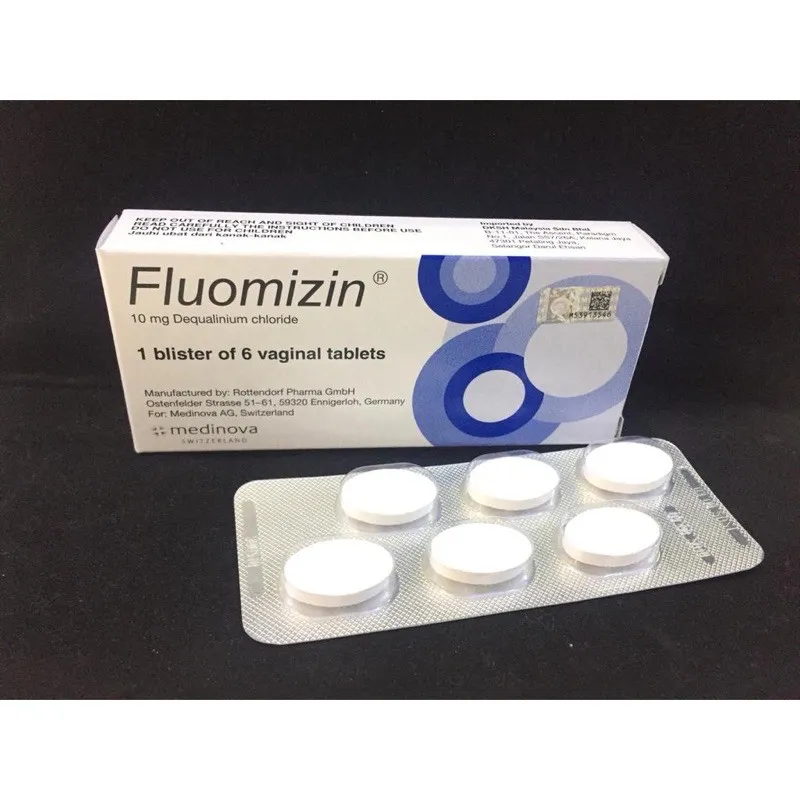
Table of Contents
Package leaflet: Information for the user
Fluomizin, 10 mg, vaginal tablets
Diquafos chloride
Please read the entire leaflet carefully before using this medicine, because it contains
important information for the patient.
Keep this leaflet, as you may need to read it again.
If you have any further questions, please consult your doctor or pharmacist.
This medicine has been prescribed for a specific individual. Do not pass it on to others. It may harm other people, even if their symptoms are the same.
If you experience any adverse reactions, including any not listed in this leaflet, inform your doctor or pharmacist. See section 4.
Table of contents
- What Fluomizin is and what it is used for
- What you need to know before using Fluomizin
- How to use Fluomizin
- Possible side effects
- How to store Fluomizin
- Contents of the pack and other information
1. What Fluomizin is and what it is used for
Diquafos chloride, the active substance in Fluomizin, belongs to a group of medicines known as antiseptics and disinfectants. Diquafos chloride acts against bacteria that may cause bacterial vaginitis.
Fluomizin is used in the treatment of bacterial vaginitis.
The medicine is administered intravaginally for local treatment of the infection.
2. Important information before using Fluomizin
When not to use Fluomizin:
- if the patient is allergic to dequalinium chloride or any of the other ingredients of this medicine (listed in section 6);
- if the patient has ulceration of the vaginal or cervical epithelium;
- if the patient has not yet had her first menstrual period.
Warnings and precautions
During treatment with Fluomizin, vaginal use of soaps, spermicides, or vaginal douching is not recommended.
As with all vaginal infections, sexual intercourse without protection is not recommended during treatment with Fluomizin.
Fluomizin does not reduce the effectiveness of latex condoms.
This medicine may reduce the effectiveness of non-latex condoms or vaginal diaphragms.
Therefore, alternative contraceptive methods should be used for at least 12 hours after administration of the medicine.
To minimize exposure of the newborn to dequalinium chloride, vaginal tablets should not be used within 12 hours before delivery. If this cannot be avoided, the physician should be informed.
Treatment with Fluomizin should be interrupted during heavy menstrual bleeding and resumed afterwards.
The patient should inform the physician if symptoms persist at the end of treatment or if symptoms recur after treatment has ended.
Children and adolescents
There is insufficient data on the use of Fluomizin in children and adolescents under 18 years of age.
Women aged over 55 years and elderly women
There is insufficient data on the use of Fluomizin in women over 55 years of age.
Fluomizin with other medicines
Tell your doctor or pharmacist if the patient is currently taking, has recently taken, or might take any other medicines, including those obtained without a prescription.
Pregnancy and breastfeeding
If the patient is pregnant, breastfeeding, suspects she may be pregnant, or is planning to have a baby, she should consult her doctor before using this medicine.
Based on previous experience and due to the local action of Fluomizin, harmful effects on pregnancy, the fetus, or the newborn are not expected. Fluomizin should be used during pregnancy and breastfeeding only if there are medical indications.
Before taking any medicine, consult a doctor or pharmacist.
Driving and using machines
It is unlikely that Fluomizin affects the ability to drive or operate machinery. No studies have been conducted in this regard.
3. How to use Fluomizin
This medicine should always be used as directed by the physician. In case of doubt, consult
your doctor or pharmacist.
The recommended dose is 1 vaginal tablet per day for 6 days.
Instructions for use
- Use daily in the evening before going to bed.
- Wash your hands before removing the tablet from the blister.
- Lie down in a semi-reclining position with knees slightly bent. Insert one tablet deeply into the vagina.
- During menstruation, in the case of heavy bleeding, treatment should be interrupted and resumed after bleeding stops.
- Do not stop treatment prematurely, even if symptoms have improved (e.g. itching, discharge, odor). Treatment shorter than 6 days may lead to recurrence of symptoms.
- Fluomizin contains excipients that do not completely dissolve, so tablet residues may occasionally remain on underwear. This does not affect the efficacy of Fluomizin. The tablets do not cause staining of underwear; however, for comfort, women may use sanitary pads or panty liners.
- In rare cases of significant vaginal dryness, the tablet may not dissolve and could be expelled intact from the vagina. As a result, treatment may not be optimal. To avoid this, it is recommended to moisten the tablet with a drop of water before insertion into a very dry vagina.
If the patient feels that Fluomizin is too strong or too weak, she should inform
her doctor or pharmacist.
Use of a higher than recommended dose of Fluomizin
Using a higher daily dose or extending the recommended duration of treatment may increase
the risk of vaginal ulceration.
In case of accidental overdose of vaginal tablets, inform your doctor.
Missed dose of Fluomizin
Do not use a double dose to make up for a missed dose.
Stopping Fluomizin treatment prematurely
Treatment shorter than 6 days may cause symptoms to recur. Therefore, do not stop treatment early, even if the patient no longer experiences symptoms (e.g. itching, discharge, odor).
If you have any further questions about the use of this medicine, consult your
doctor or pharmacist.
4. Possible adverse reactions
Like all medicines, this medicine can cause adverse reactions, although not everyone will experience them.
Most of them are mild and short-lived.
Sometimes symptoms of vaginal inflammation (such as itching, burning and discharge) may worsen at the beginning of treatment before improvement occurs. Treatment should be continued, but if symptoms do not subside, medical advice should be sought as soon as possible.
Common (may occur in up to 1 in 10 women)
Vaginal discharge; vaginal itching or burning sensation in the vaginal area.
Vaginal candidiasis.
Uncommon (may occur in up to 1 in 100 women)
Vaginal bleeding; vaginal pain.
Vaginitis and vulvitis.
Bacterial vaginosis.
Fungal skin infection.
Headache.
Nausea.
Frequency not known (frequency cannot be determined from available data)
Vaginal mucosal ulceration, if the vaginal mucosa was already damaged prior to treatment.
Bleeding from genital tract.
Redness of the vagina, vaginal dryness.
Cystitis.
Allergic reactions with symptoms such as rash, swelling and itching.
Fever.
Reporting of adverse reactions
If any adverse reactions occur, including any adverse reactions not listed in this leaflet, inform your doctor or pharmacist. Adverse reactions can be reported directly to the Department for Monitoring Adverse Drug Reactions at the Office for Registration of Medicinal Products, Medical Devices and Biocidal Products, Al. Jerozolimskie 181C, 02-222 Warsaw, phone: +48 22 4921301, fax: +48 22 4921309, e-mail: [email protected].
Reporting adverse reactions helps to provide more information on the safety of the medicine.
Adverse reactions may also be reported to the marketing authorization holder.
5. How to store Fluomizin
Keep this medicine out of sight and reach of children.
Do not use this medicine after the expiry date stated on the cardboard box and blister pack.
The expiry date refers to the last day of the stated month.
The batch number is shown on the cardboard box and blister pack.
No special storage conditions are required for this medicine.
Medicines must not be disposed of via wastewater or household waste. Ask your pharmacist how to dispose of medicines no longer in use. This will help protect the environment.
6. Contents of the pack and other information
What Fluomizin contains
- The active substance is dequalinium chloride.
- Each vaginal tablet contains 10 mg of dequalinium chloride.
- The other ingredients are: monohydrate lactose, microcrystalline cellulose and magnesium stearate.
What Fluomizin looks like and contents of the pack
Fluomizin vaginal tablets are white or almost white, oval-shaped and biconvex, with approximate dimensions of
length: 19 mm, width: 12 mm and thickness: 6.3 mm.
The cardboard box contains a blister with 6 vaginal tablets.
Marketing Authorisation Holder
GEDEON RICHTER POLSKA Sp. z o.o.
ul. Ks. J. Poniatowskiego 5
05-825 Grodzisk Mazowiecki
Poland
Manufacturer
Haupt Pharma Amareg GmbH
Donaustaufer Strasse 378
93055 Regensburg
Germany
For further information about the medicinal product and its names in other European Economic Area countries, please contact:
GEDEON RICHTER POLSKA Sp. z o.o.
Medical Department
ul. Ks. J. Poniatowskiego 5
05-825 Grodzisk Mazowiecki
Tel. +48 (22)755 96 48
[email protected]
fax: +48 (22) 755 96 24