Flumazenil kabi 0.1 mg/ml solution for injection
Poland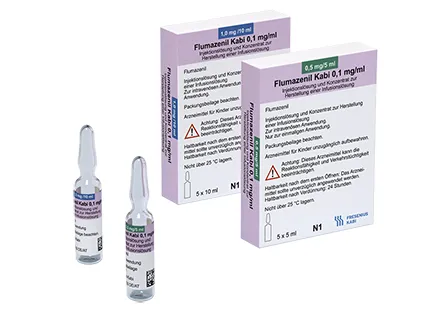
Table of Contents
- Package leaflet: Information for the user
- 1. What Flumazenil Kabi is and what it is used for
- 2. Important information before using Flumazenil Kabi
- 3. How to use Flumazenil Kabi
- 4. Possible side effects
- 5. How to store Flumazenil Kabi
- 6. Contents of the pack and other information
- Information intended exclusively for medical professionals:
Package leaflet: Information for the user
Flumazenil Kabi 0.1 mg/ml
injection solution,
concentrate for solution for infusion
Flumazenilum
Please read all of this leaflet carefully before using this medicine, as it contains
important information for the patient.
- Keep this leaflet, as you may need to read it again.
- If you have any further questions, ask your doctor, pharmacist or nurse.
- If you experience any side effects, including any not listed in this leaflet, tell your doctor, pharmacist or nurse. See section 4.
Contents of the leaflet
- What Flumazenil Kabi is and what it is used for
- What you need to know before using Flumazenil Kabi
- How to use Flumazenil Kabi
- Possible side effects
- How to store Flumazenil Kabi
- Contents of the pack and other information
1. What Flumazenil Kabi is and what it is used for
Flumazenil Kabi is an antidote used to completely or partially reverse the central sedative (calming) effects of benzodiazepines (a specific group of medicines with calming, sleep-inducing, muscle-relaxing and anti-anxiety properties).
Therefore, Flumazenil Kabi is used to awaken patients after certain diagnostic procedures or in intensive care, when sedative agents have been administered.
Flumazenil is also used in the diagnosis and treatment of benzodiazepine poisoning or overdose.
Flumazenil Kabi is also used in children (over 1 year of age) to reverse sedation induced by benzodiazepine administration during medical procedures.
2. Important information before using Flumazenil Kabi
When not to use Flumazenil Kabi
- If the patient is allergic to flumazenil or any of the other ingredients of this medicine (listed in section 6).
- In cases where benzodiazepines have been administered for a potentially life-threatening condition (e.g. control of intracranial pressure or severe epileptic seizure).
- In cases of mixed poisoning involving benzodiazepines and certain types of antidepressant drugs (so-called tricyclic and tetracyclic antidepressants, such as imipramine, clomipramine, mirtazepine or mianserin). The toxicity of these drugs may be masked by the protective effect of benzodiazepines. If signs of significant overdose with antidepressants occur, Flumazenil Kabi must not be used to reverse the effects of benzodiazepines.
Warnings and precautions
Before using this medicine, discuss it with your doctor or nurse.
- In case of lack of awakening after administration of Flumazenil Kabi, other causes should be considered, as Flumazenil Kabi specifically reverses the effects of benzodiazepines.
- When using Flumazenil Kabi at the end of surgery to awaken the patient, it should not be administered until the effects of muscle relaxants have worn off.
- Since the duration of action of flumazenil is usually shorter than that of benzodiazepines, sedation may recur. The patient must be closely monitored, possibly in an intensive care unit, until the effects of flumazenil have completely subsided.
- In patients treated with high doses of benzodiazepines and/or undergoing long-term (chronic) benzodiazepine therapy in the weeks preceding flumazenil administration, rapid injection of large doses of flumazenil (greater than 1 mg) should be avoided, as this may lead to withdrawal symptoms (see section 4. Possible side effects).
- In patients receiving long-term treatment with high-dose benzodiazepines, the benefits of using Flumazenil Kabi should be carefully weighed against the risk of withdrawal symptoms.
- Children who have previously received midazolam for sedation should be closely monitored in intensive care units for at least 2 hours after administration of Flumazenil Kabi, because sedative effects or breathing difficulties may recur. When other benzodiazepines are used for sedation, the duration of monitoring should be adjusted according to the expected duration of action of the respective drug.
- In patients with epilepsy who have been treated with benzodiazepines for a long time, flumazenil administration is not recommended, as it may provoke seizures.
- Seizures or other toxic adverse effects may be more pronounced in cases of mixed poisoning (e.g. benzodiazepines combined with tricyclic antidepressants).
- In patients with severe head injury (and/or unstable intracranial pressure), caution is required, as Flumazenil Kabi may lead to increased intracranial pressure.
- Flumazenil Kabi is not recommended for the treatment of benzodiazepine dependence or for managing withdrawal symptoms after discontinuation of benzodiazepines.
- In patients with a history of panic attacks, Flumazenil Kabi may trigger new episodes.
- In patients with alcohol or drug dependence, the risk of developing tolerance to benzodiazepines and becoming dependent on them may be increased.
- In patients with impaired liver function, elimination of the drug may be delayed.
Children
- Flumazenil Kabi is used in children exclusively to reverse sedation. There is insufficient data on other indications. This also applies to children under 1 year of age.
Other medicines and Flumazenil Kabi
Inform your doctor about all medicines currently used, recently used, or planned to be used.
When Flumazenil Kabi is used in cases of accidental overdose, it should be borne in mind that as the effects of benzodiazepines wear off, the toxic effects of other concurrently administered psychotropic drugs (particularly tricyclic antidepressants such as imipramine) may become more pronounced.
No interaction between flumazenil and other central nervous system depressants has been observed.
Flumazenil Kabi and alcohol
No interaction between flumazenil and ethanol has been observed.
Pregnancy, breastfeeding and fertility
If the patient is pregnant or breastfeeding, suspects she may be pregnant, or is planning to have a child, she should consult her doctor or pharmacist before using this medicine.
Due to insufficient experience, Flumazenil Kabi should be used during pregnancy only when the benefit to the patient outweighs the potential risk to the unborn child. There are no contraindications to administering Flumazenil Kabi during pregnancy in emergency situations.
There is no data on passage of flumazenil into human milk. Therefore, breastfeeding should be discontinued for 24 hours after administration of Flumazenil Kabi.
Driving and operating machinery
After receiving Flumazenil Kabi to reverse the sedative effects of benzodiazepines, patients must not drive vehicles, operate machinery, or engage in any other activities requiring physical or mental effort for at least 24 hours, as the sedative effects of benzodiazepines may recur.
Flumazenil Kabi contains sodium
This medicine contains less than 1 mmol of sodium (23 mg) per 5 ml vial, meaning the medicine is considered "sodium-free".
This medicine contains 37 mg of sodium (main component of table salt) in each 10 ml vial.
This corresponds to 1.9% of the maximum recommended daily dietary intake of sodium for adults.
3. How to use Flumazenil Kabi
Flumazenil Kabi is administered by intravenous injection (into a vein) or diluted for intravenous infusion (over a longer period of time).
Flumazenil is administered by an anaesthesiologist or an experienced physician. Flumazenil may be used simultaneously with other resuscitation procedures.
This medicine is for single use only. Any unused solution should be discarded.
The solution should be inspected visually before use. It may only be used if it is clear, colourless, and free from particles or contamination.
The following dosage is recommended:
| Adult patients | |
| Anesthesia | Intensive care |
| Dosage regimen: | |
| Initial dose: 0.2 mg administered intravenously over 15 seconds. | Initial dose: 0.3 mg administered intravenously over 15 seconds. |
| Subsequent 0.1 mg doses may be injected and repeated every 60 seconds; if the appropriate level of consciousness is not achieved within 60 seconds, a maximum total dose of 1 mg may be administered. | Subsequent 0.1 mg doses may be injected and repeated every 60 seconds; if the appropriate level of consciousness is not achieved within 60 seconds, a maximum total dose of 2 mg may be administered. |
| The usual dose ranges from 0.3 mg to 0.6 mg, but may vary depending on individual patient characteristics and the benzodiazepines used. | If drowsiness recurs, a second bolus injection may be given. An intravenous infusion of 0.1 mg to 0.4 mg per hour may prove effective. The dose and infusion rate should be individually adjusted to achieve the desired level of consciousness. |
| An intravenous infusion may be additionally used up to a maximum dose of 2 mg administered as bolus injections. | |
Patients with renal or hepatic impairment
In patients with hepatic impairment, elimination of flumazenil may be delayed and therefore careful dose titration is recommended.
There is no need for dose adjustment in patients with renal impairment.
Children
Children above 1 year of age
Reversal of sedation
Dosage regimen:
An intravenous dose of 0.01 mg/kg body weight (up to 0.2 mg) administered over 15 seconds. If an adequate level of consciousness has not been restored within 45 seconds, a repeat dose of 0.01 mg/kg body weight (up to 0.2 mg) may be administered.
If necessary, repeat injections may be given every 60 seconds (up to a maximum of 4 times), with a maximum total dose of 0.05 mg/kg body weight or 1 mg, whichever is lower.
Children below 1 year of age
There is insufficient data on the use of Flumazenil Kabi in children below 1 year of age. Therefore, Flumazenil Kabi should be administered to children below 1 year of age only when the potential benefits outweigh the potential risks.
In case of any further doubts regarding the use of this medicinal product, consult a physician or pharmacist.
Information for healthcare professionals is provided in one of the sections below.
4. Possible side effects
Like all medicines, this medicine can cause side effects, although not everybody will experience them.
Very common (occur in more than 1 in 10 patients):
nausea.
Common (occur in up to 1 in 10 patients):
hypersensitivity reactions (allergic reactions), anxiety (after rapid injection, does not require treatment), emotional lability, difficulty falling asleep and staying asleep (insomnia), feeling of drowsiness (somnolence), dizziness, headache, agitation (after rapid injection, does not require treatment), involuntary muscle twitching or tremor, dry mouth, abnormally rapid and deep breathing (hyperventilation), speech disturbances, subjective skin sensations (e.g. cold, warmth, tingling, pressure, etc.) in the absence of stimulation (paresthesia), double vision, squinting (strabismus), increased lacrimation (production of tears), palpitations (after rapid injection, does not require treatment), skin redness, low blood pressure upon changing position from lying to standing, transient high blood pressure (after awakening), vomiting, hiccups, sweating, fatigue, pain at injection site.
Uncommon (occur in up to 1 in 100 patients):
fear (after rapid injection, does not require treatment), seizures (in patients with epilepsy or severe liver impairment, mainly after long-term benzodiazepine treatment or in cases of mixed poisoning – see section 2. Warnings and precautions), abnormal hearing, slow or rapid heartbeat, premature ventricular contraction (extra beat), breathing difficulties (dyspnea), cough, nasal congestion, chest pain, chills (after rapid injection, do not require treatment).
Frequency not known (cannot be estimated from available data):
withdrawal symptoms (see below), panic attacks (in patients with a history of such episodes), atypical crying, agitation, aggressive behaviour, severe allergic reactions (anaphylactic reactions).
In cases of long-term benzodiazepine treatment, flumazenil may cause withdrawal symptoms, such as tension, agitation, anxiety, emotional lability, hallucinations, involuntary muscle twitching or tremor, and seizures.
Generally, side effects in children do not differ significantly from those observed in adult patients. When Flumazenil Kabi has been used to reverse sedation in children, cases of excessive crying, agitation and aggressive reactions have been reported.
Reporting of side effects
If any side effects occur, including any not listed in this leaflet, inform your doctor, pharmacist or nurse. Side effects can be reported directly to the Department of Monitoring of Adverse Drug Reactions at the Office for Registration of Medicinal Products, Medical Devices and Biocidal Products
Al. Jerozolimskie 181C
02-222 Warsaw
Phone: +48 22 49 21 301
Fax: +48 22 49 21 309
Website: https://smz.ezdrowie.gov.pl
Side effects can also be reported to the marketing authorisation holder.
Reporting side effects helps provide more information on the safety of the medicine.
5. How to store Flumazenil Kabi
Keep the medicine out of the sight and reach of children.
Do not use this medicine after the expiry date stated on the label and the outer carton following: EXP. The expiry date refers to the last day of the stated month.
Do not store above 25°C.
This medicine is intended for single use only.
Storage period after first opening of the container: the medicine should be used immediately.
Storage period after dilution: 24 hours.
Chemical and physical stability after dilution has been demonstrated for 24 hours at 25°C.
From a microbiological point of view, the medicine should be used immediately. If the medicine is not used immediately, the user is responsible for the storage conditions and duration of use. This period should not normally exceed 24 hours at 2–8°C unless dilution was carried out under controlled and validated aseptic conditions.
Do not use this medicine if the solution is not clear and free from particulate matter.
Any unused solution should be disposed of according to local regulations.
Medicines should not be disposed of via wastewater or household waste. Ask your pharmacist how to dispose of medicines no longer required. This will help protect the environment.
6. Contents of the pack and other information
What Flumazenil Kabi contains
The active substance is flumazenil.
Each millilitre contains 0.1 mg of flumazenil.
Each 5 ml ampoule contains 0.5 mg of flumazenil.
Each 10 ml ampoule contains 1.0 mg of flumazenil.
Other ingredients are: glacial acetic acid, sodium chloride, disodium edetate, sodium hydroxide 1N solution, water for injections.
What Flumazenil Kabi looks like and contents of the pack
Flumazenil Kabi is a clear, colourless solution for injection and a concentrate for solution for infusion, in ampoules made of colourless glass.
Available pack sizes:
5 or 10 ampoules containing 5 ml of solution for injection, packed in a cardboard box.
5 or 10 ampoules containing 10 ml of solution for injection, packed in a cardboard box.
Not all pack sizes may be marketed.
Marketing Authorisation Holder and Manufacturer
Marketing Authorisation Holder
Fresenius Kabi Deutschland GmbH
D-61346 Bad Homburg v.d.H.
Germany
Manufacturer
Fresenius Kabi Austria GmbH
Hafnerstraße 36
A-8055 Graz
Austria
For further information, contact the representative of the Marketing Authorisation Holder:
Fresenius Kabi Polska Sp. z o.o.
Al. Jerozolimskie 134
02-305 Warsaw
Tel.: +48 22 345 67 89
This medicinal product is authorised in the European Economic Area countries under the following names:
| Austria | Flumazenil Kabi 0.1 mg/ml solution for injection and concentrate for solution for infusion |
| Denmark | Flumazenil Fresenius Kabi |
| Finland | Flumazenil Fresenius Kabi 0.1 mg/ml solution for injection |
| Spain | Flumazenil Fresenius Kabi 0.1 mg/ml solution for injection |
| Netherlands | Flumazenil Kabi 0.1 mg/ml solution for injection |
| Ireland | Flumazenil 0.1 mg/ml Solution for Injection |
| Germany | Flumazenil Kabi 0.1 mg/ml solution for injection and concentrate for solution for infusion |
| Norway | Flumazenil Fresenius Kabi 0.1 mg/ml solution for injection |
| Poland | Flumazenil Kabi 0.1 mg/ml solution for injection |
| Portugal | Flumazenil Fresenius Kabi 0.1 mg/ml solution for injection |
| Sweden | Flumazenil Fresenius Kabi 0.1 mg/ml solution for injection |
| Hungary | Flumazenil Kabi 0.1 mg/ml solution for injection |
| United Kingdom | Flumazenil 0.1 mg/ml Solution for Injection |
| Italy | Flumazenil Kabi 0.1 mg/ml, solution for injection |
Information intended exclusively for medical professionals:
Detailed storage conditions for the medicinal product are described in section 5. How to store Flumazenil Kabi.
If flumazenil is to be administered by infusion, it must be diluted first.
Flumazenil should only be diluted with the following solutions: sodium chloride 9 mg/ml (0.9%),
glucose 50 mg/ml (5%), or sodium chloride 4.5 mg/ml (0.45%) + glucose 25 mg/ml (2.5%).
Compatibility of flumazenil with other injection solutions has not been established.
The medicinal product must not be mixed with other medicinal products except those mentioned in this section.
Further information on dosing can be found in section 3 of this leaflet.