Fluimucil muko junior
Poland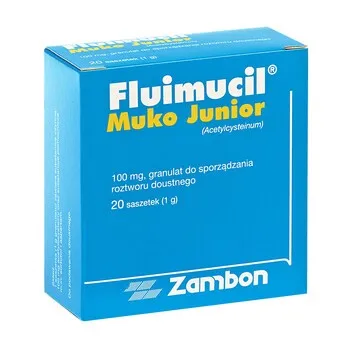
Table of Contents
- Package leaflet: Information for the user
- 1. What Fluimucil Muko Junior is and what it is used for
- 2. Important information before using Fluimucil Muko Junior
- 3. How to use Fluimucil Muko Junior
- 4. Possible adverse reactions
- 5. How to store Fluimucil Muko Junior
- 6. Contents of the packaging and other information
Package leaflet: Information for the user
Fluimucil Muko Junior
100 mg, oral solution granules
Acetylcysteinum
Please read all of this leaflet carefully before taking this medicine, because it contains
important information for the patient.
This medicine should always be used exactly as described in this patient leaflet or as directed by
the doctor or pharmacist.
- Keep this leaflet so that you can read it again if necessary.
- If you need advice or further information, please consult your pharmacist.
- If the patient experiences any adverse reactions, including any not listed in this leaflet, inform the doctor or pharmacist. See section 4.
- If there is no improvement after 5 days, or if the patient feels worse, contact a doctor.
Contents of the leaflet:
- What Fluimucil Muko Junior is and what it is used for
- Important information before taking Fluimucil Muko Junior
- How to take Fluimucil Muko Junior
- Possible side effects
- How to store Fluimucil Muko Junior
- Contents of the pack and other information
1. What Fluimucil Muko Junior is and what it is used for
Acetylcysteine, the active substance in Fluimucil Muko Junior, liquefies mucus and mucopurulent secretions by breaking the disulfide bonds in the polypeptides of respiratory mucus.
Fluimucil Muko Junior is used short-term as a mucolytic agent to thin respiratory secretions and facilitate expectoration in patients with symptoms of upper respiratory tract infection.
If there is no improvement after 5 days, or if the patient feels worse, consult a doctor.
2. Important information before using Fluimucil Muko Junior
When not to use Fluimucil Muko Junior
- if the patient is allergic to acetylcysteine or any of the other ingredients of this medicine (listed in section 6);
- in asthmatic conditions;
- if the patient has phenylketonuria;
- in children under 2 years of age, as the active substance acetylcysteine may cause airway obstruction in children under 2 years of age (see also section 3. How to take Fluimucil Muko Junior).
Warnings and precautions
Before starting treatment with Fluimucil Muko Junior, discuss this with your doctor or
pharmacist.
- Caution is advised when using Fluimucil Muko Junior if the patient has or has had a history of peptic ulcer disease of the stomach or duodenum, especially if they are also taking other medicines known to irritate the gastric mucosa.
- Treatment of patients with bronchial asthma should be carried out under strict medical supervision due to the risk of bronchospasm. If this symptom occurs, administration of the medicine must be stopped immediately.
- If large amounts of secretions are liquefied, especially in young children and very ill immobilized patients, suctioning should be ensured.
- Acetylcysteine should not be administered to patients with reduced ability to expectorate unless respiratory physiotherapy is provided during treatment.
- Caution is advised when Fluimucil Muko Junior is used long-term in patients with histamine intolerance, as symptoms such as headache, vasomotor rhinitis, and skin itching may occur.
Children and adolescents
Mucolytic agents may cause airway obstruction in children under 2 years of age.
Due to the physiological characteristics of the respiratory tract in this age group, the ability to expectorate may be limited; therefore, mucolytic agents should not be used in children under 2 years of age.
Due to the amount of active substance, Fluimucil Muko Junior should not be used in children under 3 years of age.
Fluimucil Muko Junior and other medicines
Tell your doctor or pharmacist if the patient is currently taking, has recently taken, or might take any other medicines.
Do not take Fluimucil Muko Junior together with antitussive (cough suppressant) medicines, as this may lead to mucus accumulation due to reduced cough reflex.
Activated charcoal may reduce the effectiveness of Fluimucil Muko Junior.
If concomitant use of other medicines, including antibiotics, is necessary, a 2-hour interval between administration of these medicines and Fluimucil Muko Junior is recommended. This does not apply to loracarbef (a medicine used for infections).
Concomitant use of Fluimucil Muko Junior and nitroglycerin (a medicine used for ischemic heart disease) may cause severe arterial hypotension. Headache may also occur. If the patient is taking nitroglycerin, they should consult their doctor before taking Fluimucil Muko Junior.
Concomitant use of Fluimucil Muko Junior and carbamazepine (a medicine used to treat epilepsy) may reduce the blood concentration of carbamazepine and decrease its effectiveness.
Fluimucil Muko Junior may affect the results of certain laboratory tests (colorimetric determination of salicylates and urine ketone testing).
Mixing other medicines with the Fluimucil Muko Junior solution is not recommended.
Pregnancy, breastfeeding, and fertility
If the patient is pregnant or breastfeeding, suspects she may be pregnant, or is planning to have a child, she should consult her doctor or pharmacist before using this medicine.
Pregnancy
Use of Fluimucil Muko Junior during pregnancy is not recommended. Fluimucil Muko Junior may be administered during pregnancy only if absolutely necessary and under strict medical supervision.
Breastfeeding
It is not known whether Fluimucil Muko Junior passes into human milk. Risk to the breastfed infant cannot be excluded. Fluimucil Muko Junior should not be used if the patient is breastfeeding.
Fertility
There are no data on the effect of Fluimucil Muko Junior on fertility in humans. Animal studies do not indicate harmful effects of acetylcysteine on human fertility when used at recommended doses.
Driving and operating machinery
The effect of the medicine on the ability to drive and operate machinery is unknown.
Fluimucil Muko Junior contains:
- 25 mg of aspartame in each sachet (1 g of granules). Aspartame is a source of phenylalanine. It may be harmful to patients with phenylketonuria. This is a rare genetic disorder in which phenylalanine accumulates in the body due to impaired excretion.
- Sucrose (β-carotene component). If the patient has previously been diagnosed with intolerance to certain sugars, they should consult their doctor before taking this medicine.
- Less than 1 mmol (23 mg) of sodium per sachet (β-carotene component), meaning the medicine is considered “sodium-free”.
- Glucose and lactose (orange flavour components). If the patient has previously been diagnosed with intolerance to certain sugars, they should consult their doctor before taking this medicine.
- 762.7 mg of sorbitol in each sachet (1 g of granules). Sorbitol is a source of fructose. If the patient (or their child) has previously been diagnosed with intolerance to certain sugars or hereditary fructose intolerance—a rare genetic disorder in which the body does not break down fructose—the patient should consult their doctor before taking the medicine or giving it to their child.
3. How to use Fluimucil Muko Junior
This medicine should always be used exactly as described in this patient information leaflet or as directed by a doctor or pharmacist.
If in doubt, consult a doctor or pharmacist.
Do not use Fluimucil Muko Junior for longer than 5 days without consulting a doctor.
Recommended dose
Children aged 3 to 6 years
1 sachet of Fluimucil Muko Junior (1 x 100 mg) 2 to 3 times daily.
Children aged 7 to 14 years
2 sachets of Fluimucil Muko Junior (2 x 100 mg) twice daily, or 1 sachet of Fluimucil Muko Junior (1 x 100 mg) 4 times daily.
Adults and children over 14 years of age
2 sachets of Fluimucil Muko Junior (2 x 100 mg) 2 to 3 times daily.
Method of administration:
Dissolve the contents of one sachet in half a glass of lukewarm water, stirring with a spoon if necessary.
The resulting solution is ready to drink. The solution should be taken immediately after preparation.
During treatment, increased fluid intake is recommended.
Note:
The last dose of Fluimucil Muko Junior should be taken no later than 4 hours before bedtime.
If you feel that the effect of Fluimucil Muko Junior is too strong or too weak, consult your doctor.
Taking more Fluimucil Muko Junior than recommended
If you take more Fluimucil Muko Junior than recommended, gastrointestinal symptoms such as nausea, vomiting, and diarrhoea may occur.
There is no known specific antidote for acetylcysteine. Symptomatic treatment should be administered.
If you take more than the recommended dose, seek medical advice immediately from a doctor or pharmacist.
Missed dose of Fluimucil Muko Junior
Do not take a double dose to make up for a missed dose.
If you have any further doubts concerning the use of this medicine, consult your doctor or pharmacist.
4. Possible adverse reactions
Like all medicines, this medicine can cause adverse reactions, although not everybody gets them.
In clinical studies, gastrointestinal disorders were most frequently reported,
while hypersensitivity reactions occurred less frequently.
Adverse reactions that may occur during treatment with Fluimucil Muko Junior:
Not common (less frequent than in 1 out of 100 patients):
- hypersensitivity,
- headache,
- tinnitus,
- tachycardia (increased heart rate),
- vomiting, diarrhoea, stomatitis, abdominal pain, nausea,
- urticaria, rash, angioedema (swelling of the skin and mucous membranes, most commonly affecting the face, throat, larynx, genital organs, intestines), pruritus,
- fever,
- hypotension (low blood pressure).
Rare (less frequent than in 1 out of 1,000 patients):
- bronchospasm, dyspnoea,
- dyspepsia.
Very rare (less frequent than in 1 out of 10,000 patients):
- severe allergic reactions (anaphylactic shock, anaphylactic reaction, pseudoanaphylactic reaction),
- haemorrhage.
Frequency not known (frequency cannot be estimated from the available data):
- facial swelling.
Very rarely, severe skin reactions (Stevens-Johnson syndrome, Lyell's syndrome) and mucosal lesions have been reported following administration of Fluimucil Muko Junior.
In most cases, at least one other medicinal product likely contributed to the development of skin and mucosal lesions.
If adverse reactions occur, treatment should be discontinued and medical advice should be sought.
Reporting of adverse reactions
If any adverse reactions occur, including any possible adverse reactions not listed in this leaflet, inform your doctor or pharmacist. Adverse reactions can be reported directly to:
Department of Monitoring of Adverse Drug Reactions, Office for Registration of Medicinal Products, Medical Devices and Biocidal Products
Al. Jerozolimskie 181C, 02-222 Warsaw, phone: +48 22 49 21 301, fax: +48 22 49 21 309,
e-mail: [email protected]
Adverse reactions can also be reported to the marketing authorisation holder.
Reporting adverse reactions helps to provide more information on the safety of the medicine.
5. How to store Fluimucil Muko Junior
Keep the medicine out of sight and reach of children.
Do not use this medicine after the expiry date stated on the packaging.
The expiry date refers to the last day of the stated month.
Store Fluimucil Muko Junior below 30°C.
Note:
The possible presence of a sulfur-like odor is typical for the active substance contained in the medicine.
Medicines must not be disposed of via wastewater or household waste. Ask your pharmacist how to dispose of medicines no longer in use. This will help protect the environment.
6. Contents of the packaging and other information
What Fluimucil Muko Junior contains
- The active substance is acetylcysteine. One sachet (1 g of granules) contains 100 mg of acetylcysteine.
- Other ingredients are: aspartame, β-carotene (contains sucrose and less than 1 mmol (23 mg) of sodium), orange flavour (contains glucose and lactose), sorbitol.
What Fluimucil Muko Junior looks like and contents of the pack
Fluimucil Muko Junior is a yellow granule with an orange odour and a possible odour of sulphur, typical for the active substance contained in the medicine.
Pack sizes available:
20 sachets of 1 g granules, in a cardboard box.
Marketing Authorisation Holder and Manufacturer
Marketing Authorisation Holder:
ZAMBON S.p.A.
Via Lillo del Duca, 10
20091 Bresso (MI), Italy
Manufacturer:
ZAMBON S.p.A.
Via Della Chimica, 9
36100 Vicenza, Italy
Representative of the Marketing Authorisation Holder:
Komtur Polska Sp. z o.o.
Plac Farmacji 1, 02-699 Warsaw
tel. (22) 566 26 00
e-mail: [email protected]
The package leaflet in an accessible format for blind or partially sighted persons is available at the office of the representative of the Marketing Authorisation Holder.