Fluanxol depot
Poland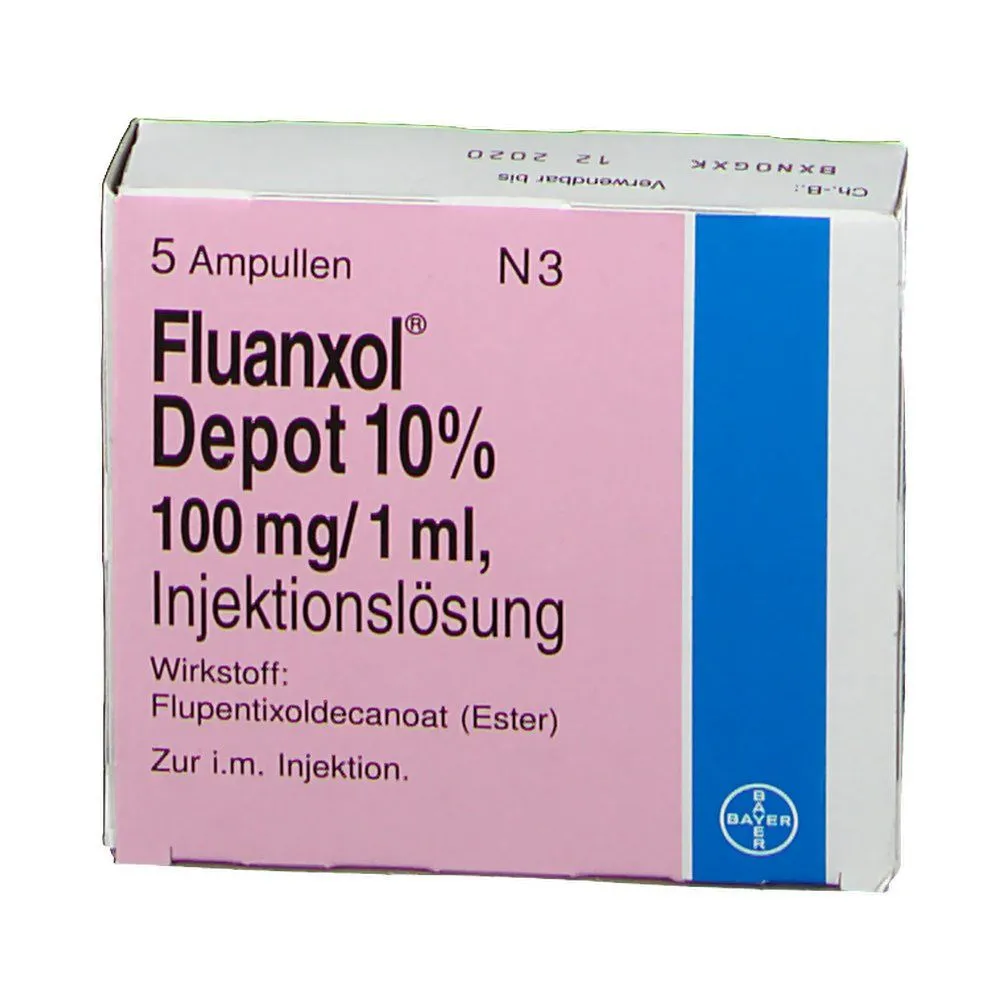
Table of Contents
Package leaflet: Information for the user
Fluanxol Depot, 20 mg/ml, solution for injection
Flupentixol decanoate
Please read all of this leaflet carefully before using this medicine, because it contains
important information for you.
- Keep this leaflet. You may need to read it again.
- If you have any further questions, ask your doctor or pharmacist.
- This medicine has been prescribed for a specific individual. Do not pass it on to others. It may harm someone else, even if their symptoms are the same.
- If you experience any side effects, including any not listed in this leaflet, tell your doctor or pharmacist. See section 4.
Contents of the leaflet:
- What Fluanxol Depot is and what it is used for
- What you need to know before you use Fluanxol Depot
- How to use Fluanxol Depot
- Possible side effects
- How to store Fluanxol Depot
- Contents of the pack and other information
1. What Fluanxol Depot is and what it is used for
Fluanxol Depot contains the active substance flupentixol decanoate. Fluanxol Depot belongs to a group of medicines called antipsychotics (also known as neuroleptics).
These medicines act on nerve pathways in certain areas of the brain and help correct certain imbalances in brain chemistry that cause disease symptoms.
Fluanxol Depot is used in the treatment of schizophrenia and other related psychoses.
2. Important information before using Fluanxol Depot
When not to use Fluanxol Depot
- if the patient is allergic (hypersensitive) to flupentixol or any of the other ingredients of this medicine (listed in section 6). If allergy is suspected, consult a doctor;
- if the patient has reduced level of consciousness regardless of the cause (e.g. alcohol, barbiturates or opiates intoxication), circulatory collapse, or coma.
Warnings and precautions
Before starting treatment with Fluanxol Depot, discuss with a doctor or pharmacist:
- if the patient has impaired liver function;
- if the patient has had seizures in the past;
- if the patient has diabetes (adjustment of antidiabetic treatment may be required);
- if the patient has organic brain syndrome (a condition that may develop due to alcohol or organic solvents intoxication);
- if the patient has risk factors predisposing to stroke (e.g. smoking, hypertension);
- if the patient has hypokalaemia or hypomagnesaemia (low potassium or magnesium levels in blood) or genetic predisposition to such abnormalities;
- if the patient has had cardiovascular disorders;
- if the patient is taking other antipsychotic medicines;
- if the patient is more agitated or shows increased activity, as the medicine may worsen these symptoms;
- if the patient or someone in their family has had venous thrombosis, because use of medicines like this may be associated with blood clots.
Fluanxol Depot and other medicines
Tell your doctor or pharmacist about all medicines the patient is currently taking, has recently taken, or plans to take.
Inform the treating doctor about use of the following medicines:
- tricyclic antidepressants;
- guanethidine and similar medicines (lowering blood pressure);
- barbiturates (medicines causing drowsiness);
- medicines used in epilepsy treatment;
- levodopa and similar medicines (used in Parkinson's disease treatment);
- metoclopramide (a medicine used for gastrointestinal disorders);
- piperazine (an antiparasitic medicine effective against pinworms and roundworms);
- medicines affecting water and electrolyte balance (causing low potassium or magnesium levels in blood);
- medicines known to increase blood levels of Fluanxol Depot.
The following medicines should not be taken at the same time as Fluanxol Depot:
- medicines affecting heart rhythm (quinidine, amiodarone, sotalol, dofetilide, erythromycin, terfenadine, astemizole, gatifloxacin, moxifloxacin, cisapride, lithium);
- other antipsychotic medicines;
- medicines used in cancer treatment.
Fluanxol Depot with food, drink and alcohol
Fluanxol Depot may enhance the sedative effect of alcohol, causing drowsiness. Drinking alcoholic beverages during treatment with Fluanxol Depot is not recommended.
Pregnancy, breastfeeding and effects on fertility
If the patient is pregnant or breastfeeding, suspects she might be pregnant, or is planning to have a baby, she should consult her doctor or pharmacist before using this medicine.
Pregnancy
Women who are pregnant or suspect they may be pregnant should inform their doctor.
Fluanxol Depot should not be used during pregnancy unless clearly necessary.
In newborns whose mothers took Fluanxol during the third trimester (last three months of pregnancy), the following symptoms may occur: tremors, muscle stiffness and/or weakness, drowsiness, agitation, breathing difficulties, feeding problems. If such symptoms occur in the newborn, contact a doctor.
Breastfeeding
Women who are breastfeeding should consult their doctor. Fluanxol Depot should not be used by breastfeeding women, as small amounts of the medicine may be excreted in breast milk.
Fertility
Animal studies indicate that flupentixol may affect fertility. The patient should consult a doctor for advice.
Driving and operating machinery
There is a risk of drowsiness and dizziness after administration of Fluanxol Depot. In such cases, patients should not drive, operate machinery or use tools until these symptoms subside.
3. How to use Fluanxol Depot
This medicine should always be used exactly as directed by your doctor or pharmacist. If you are unsure,
you should consult your doctor or pharmacist.
A small volume of Fluanxol Depot is drawn into a syringe and then injected into the gluteal muscle.
The doctor determines the dose and frequency of injections. The medicine, administered into the buttock, is in a depot formulation with slow release, meaning that a constant amount of the drug is released into the bloodstream throughout the interval between injections.
Recommended dose:
Adults
Fluanxol Depot 20 mg/ml
The usual dose is 1–2 ml, administered at intervals of 1 to 4 weeks.
A volume exceeding 2 ml is usually administered in two separate injections at different sites.
In patients previously treated with Fluanxol tablets who are being switched to Fluanxol Depot, the doctor may recommend continuing tablet treatment for several days after the first injection.
When switching from oral flupentixol to maintenance treatment with flupentixol decanoate, follow the recommendations below:
x mg of Fluanxol tablets (i.e. orally administered flupentixol) per day corresponds to 4x mg of Fluanxol Depot (i.e. flupentixol) administered every two weeks
(for example, 1 mg of Fluanxol tablets taken orally per day corresponds to 4 mg of Fluanxol Depot every two weeks).
x mg of Fluanxol tablets (i.e. orally administered flupentixol) per day corresponds to 8x mg of Fluanxol Depot (i.e. flupentixol decanoate) every four weeks
(for example, 1 mg of Fluanxol tablets, i.e. flupentixol dihydrochloride, taken orally per day corresponds to 8 mg of Fluanxol Depot, i.e. flupentixol decanoate, every four weeks).
For one week after the first injection, oral flupentixol should be continued, but in gradually reduced doses.
Patients previously treated with other depot (long-acting) medications should receive doses calculated according to the following conversion:
40 mg of flupentixol decanoate corresponds to 25 mg of flufenazine decanoate or 200 mg of zuclopenthixol decanoate or 50 mg of haloperidol decanoate.
Periodically, your doctor may decide to adjust the dose or change the injection intervals.
Elderly patients (over 65 years of age)
Elderly patients are usually given doses at the lower end of the recommended dose range.
Special patient groups:
Patients with liver disease are generally given doses at the lower end of the recommended dose range.
Use in children
Fluanxol Depot is not recommended for use in children.
If you feel that the effect of Fluanxol Depot is too strong or too weak, you should consult your doctor.
Duration of treatment
Treatment should be continued at regular intervals, even if your condition improves. The illness may persist for a long time, and if treatment is stopped too early, symptoms may return.
The duration of treatment is determined by the doctor.
Overdose of Fluanxol Depot
Fluanxol Depot will be administered by a doctor or nurse. In rare cases of overdose, symptoms of overdose may occur.
Symptoms of overdose may include:
- drowsiness;
- loss of consciousness;
- movement disorders or muscle rigidity;
- seizures;
- low blood pressure, weak pulse, rapid heartbeat, pallor, restlessness;
- elevated or decreased body temperature;
- changes in heart rate, including irregularity or slowing, particularly when Fluanxol Depot has been administered in excessively high doses in combination with medicines known to affect the heart.
The doctor or nurse will initiate symptomatic and supportive treatment.
4. Possible adverse effects
Like all medicines, Fluanxol Depot may cause adverse effects, although not everyone will experience them.
If any of the symptoms described below occur, contact your doctor or go to hospital immediately:
Uncommon adverse effects (may occur in 1 to 10 out of 1,000 patients):
- involuntary rhythmic movements of the lips and tongue; this may be a sign of a condition called tardive dyskinesia.
Very rare adverse effects (may occur in fewer than 1 out of 10,000 patients):
- high fever, unusual muscle stiffness and disturbances of consciousness, particularly accompanied by sweating and rapid heartbeat; these may be symptoms of a rare condition known as neuroleptic malignant syndrome, which has been reported with the use of various antipsychotic drugs;
- yellowing of the skin and whites of the eyes (jaundice), which may indicate liver damage;
- blood clots in the veins, especially in the legs (symptoms include swelling, pain and redness of the skin in the legs), which may travel through blood vessels to the lungs, causing chest pain and breathing difficulties.
The adverse effects listed below are most pronounced at the beginning of treatment, and most of them diminish with continued therapy:
Very common adverse effects (may occur in more than 1 out of 10 patients):
- drowsiness, inability to sit or stand still for a prolonged period (akathisia), excessive motor activity (hyperkinesia), slowed or impaired movements (hypokinesia);
- dry mouth.
Common adverse effects (may occur in 1 to 10 out of 100 patients):
- palpitations, sensation of rapid, strong or irregular heartbeat (palpitations);
- tremor, twisting or repetitive movements, or unusual body posture due to sustained muscle contractions (dystonia), dizziness, headache;
- blurred vision of objects close to the eyes (accommodation disorders), visual disturbances;
- difficulty breathing or painful breathing (dyspnea);
- increased salivation (sialorrhea), constipation, vomiting, digestive problems or discomfort in the upper abdomen (dyspepsia), diarrhoea;
- urinary problems, urinary retention;
- excessive sweating, itching (pruritus);
- muscle pain;
- increased appetite, weight gain;
- fatigue, feeling of weakness (asthenia);
- insomnia, depression, nervousness, agitation, reduced sexual drive (decreased libido);
Uncommon adverse effects (may occur in 1 to 10 out of 1,000 patients):
- irregular movements (dyskinesia), parkinsonism, speech fluency disorders, seizures;
- oculogyric crisis (involuntary upward deviation of the eyes);
- abdominal pain, nausea, bloating with flatulence;
- rash, skin reactions related to light sensitivity (photosensitivity), eczema or skin inflammation;
- muscle stiffness;
- decreased appetite;
- low blood pressure (hypotension), hot flushes;
- redness or pain at the injection site of Fluanxol Depot;
- abnormal liver function tests;
- sexual disorders (delayed ejaculation, erectile dysfunction);
- confusion.
Rare adverse effects (may occur in 1 to 10 out of 10,000 patients):
- low platelet count (thrombocytopenia), low white blood cell count (neutropenia, leukopenia), toxic bone marrow damage (agranulocytosis);
- increased prolactin levels in the blood (hyperprolactinemia);
- increased blood glucose (hyperglycaemia), impaired glucose tolerance;
- hypersensitivity (allergic reaction), acute systemic and severe allergic reaction (anaphylactic reaction);
- breast development in males (gynaecomastia), excessive milk production (galactorrhoea), absence of menstruation;
- slow heart rate and changes in ECG (QT interval prolongation);
- irregular heartbeat (ventricular arrhythmias, torsade de pointes);
- irregular heartbeat (arrhythmia) leading to sudden death.
In elderly patients with dementia treated with antipsychotic drugs, a slightly higher number of deaths has been observed compared to patients not receiving antipsychotic medications.
Reporting of adverse effects
If any adverse effects occur, including any not listed in this leaflet, inform your doctor or pharmacist. Adverse effects can be reported directly to the Department of Monitoring Adverse Drug Reactions of the Office for Registration of Medicinal Products, Medical Devices and Biocidal Products:
Al. Jerozolimskie 181C
PL-02 222 Warsaw
Tel.: + 48 22 49 21 301
Fax: + 48 22 49 21 309
e-mail: [email protected].
Adverse effects can also be reported to the marketing authorization holder.
Reporting adverse effects helps to provide more information on the safety of the medicine.
5. How to store Fluanxol Depot
Keep the medicine out of the sight and reach of children.
Do not use this medicine after the expiry date stated on the label. The expiry date refers to the last day of the stated month.
There are no special storage temperature requirements for this medicinal product.
Store ampoules in their outer packaging to protect from light.
Medicines must not be disposed of via wastewater or household waste. Ask your pharmacist how to dispose of medicines no longer required. Such measures will help protect the environment.
6. Contents of the pack and other information
What Fluanxol Depot contains
The active substance is cis (Z)-flupenthixol decanoate.
Each millilitre (ml) of Fluanxol Depot contains 20 mg of cis (Z)-flupenthixol decanoate.
The other ingredient is a rare plant oil (medium-chain triglycerides).
What Fluanxol Depot looks like and contents of the pack
Fluanxol Depot is available as an injectable solution at a strength of 20 mg/ml.
Fluanxol Depot is a clear, light yellow liquid.
Fluanxol Depot is supplied in colourless glass ampoules containing 1 ml (20 mg) or 2 ml (40 mg) of solution.
Ampoules are packed in cardboard boxes containing either 1 ampoule of 1 ml, 10 ampoules of 1 ml, 1 ampoule of 2 ml, or 10 ampoules of 2 ml.
Not all pack sizes may be marketed.
Marketing Authorisation Holder and Manufacturer
H. Lundbeck A/S
Ottiliavej 9,
DK-2500 Valby
Denmark
For further information, please contact the Marketing Authorisation Holder's representative.
Swixx Biopharma Sp. z o.o.
Prosta 51
00-838 Warsaw, Poland
Tel. +48 22 4600 720