Flixonase
Poland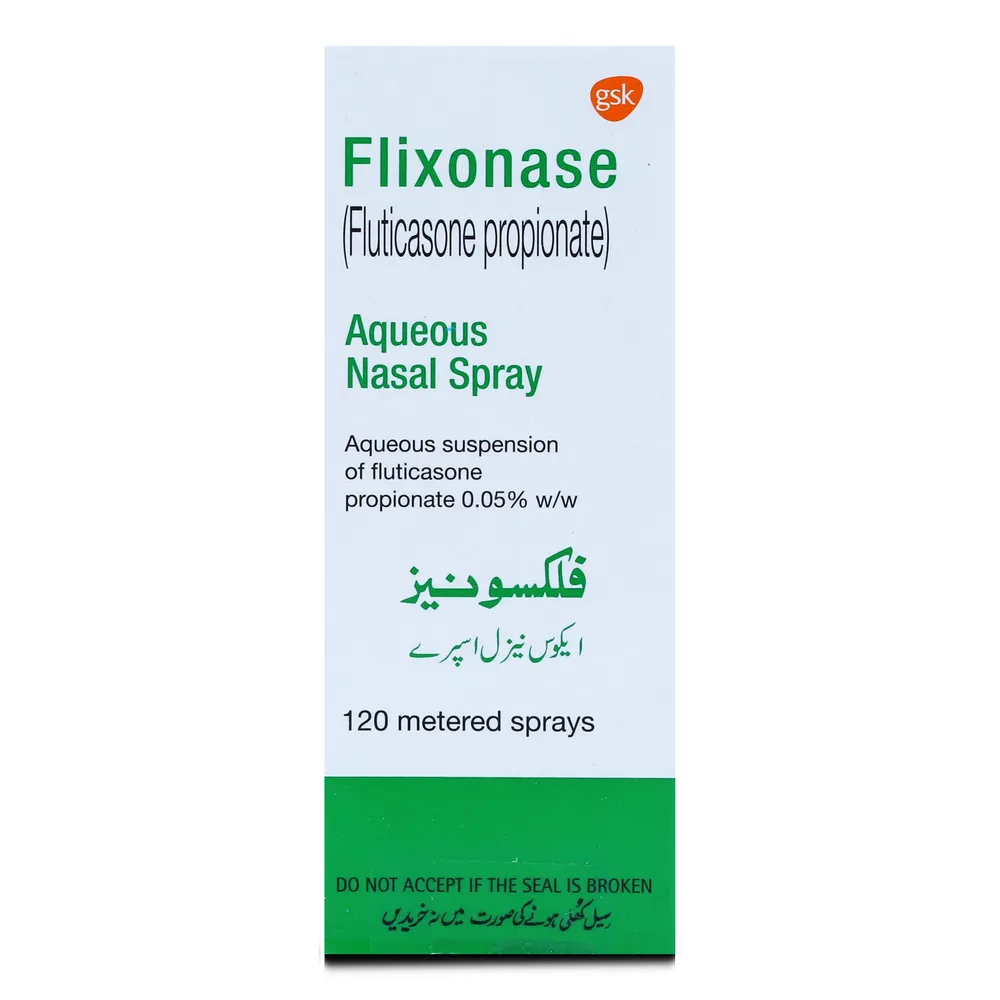
Table of Contents
- Patient Information Leaflet
- 1. What Flixonase nasal spray is and what it is used for
- 2. Important information before using Flixonase nasal spray
- 3. How to use Flixonase nasal spray
- 4. Possible side effects
- 5. How to store Flixonase nasal aerosol
- 6. Contents of the packaging and other information
- Package leaflet: information for the patient
- 1. What Flixonase nasal spray is and what it is used for
- 2. Important information before using Flixonase nasal spray
- 3. How to use Flixonase nasal spray
- 4. Possible side effects
- 5. How to store Flixonase nasal spray
- 6. Contents of the packaging and other information
Patient Information Leaflet
Flixonase, 50 g/dose, nasal spray, suspension
(Fluticasone propionate)
Please read all of this leaflet carefully before you start using this medicine, because it contains
important information for you.
- Keep this leaflet. You may need to read it again.
- If you have any further questions, ask your doctor or pharmacist.
- This medicine has been prescribed for you personally. Do not pass it on to others. It may harm someone else even if their symptoms are the same as yours.
- If you get any side effects, including any not listed in this leaflet, tell your doctor or pharmacist. See section 4.
Leaflet contents:
- What Flixonase nasal spray is and what it is used for
- What you need to know before you use Flixonase nasal spray
- How to use Flixonase nasal spray
- Possible side effects
- How to store Flixonase nasal spray
- Contents of the pack and other information
1. What Flixonase nasal spray is and what it is used for
The active substance in Flixonase nasal spray is fluticasone propionate.
It belongs to a group of medicines called steroids or corticosteroids.
Steroids work by reducing inflammation:
- reducing swelling and irritation in the nose,
- reducing itching, sneezing, blocked or runny nose.
Flixonase nasal spray, suspension is used to prevent and treat:
- seasonal allergic rhinitis (including hay fever),
- perennial allergic rhinitis.
Flixonase nasal spray, suspension may also be used to treat symptoms of nasal polyps (growths of the mucous membrane inside the nose).
2. Important information before using Flixonase nasal spray
When not to use Flixonase nasal spray
- if the patient is allergic to fluticasone propionate or any of the other ingredients of this medicine (listed in section 6).
Warnings and precautions
Before starting to use Flixonase nasal spray, discuss with your doctor or
pharmacist if the patient:
- has an upper respiratory tract infection,
- has adrenal insufficiency,
- is taking ritonavir (see also section "Flixonase nasal spray and other medicines").
➔ The patient should consult their doctor to determine whether any of the above conditions apply.
With long-term use of Flixonase nasal spray, the active substance – fluticasone propionate – may suppress the natural production of steroid hormones by the adrenal glands. If adrenal insufficiency is diagnosed, the doctor may consider additional systemic corticosteroid therapy during periods of stress or prior to planned surgery.
Due to the potential for impaired adrenal function, patients who are switching from oral steroid therapy to intranasal fluticasone propionate should remain under close medical supervision, and adrenal function should be monitored.
If the patient experiences blurred vision or other visual disturbances, which may be due to cataract or glaucoma, they should contact their doctor.
During long-term treatment with intranasal corticosteroids, the doctor will recommend regular growth monitoring in children.
Flixonase nasal spray and other medicines
Tell your doctor about all medicines the patient is currently taking or has recently taken, as well as any medicines the patient plans to take, including those available without a prescription.
It is especially important to inform the doctor if the patient is currently taking or has recently taken any of the following medicines:
- corticosteroids in tablets or injections
- ritonavir or medicines containing cobicistat, used in the treatment of HIV
- ketoconazole or itraconazole, used in the treatment of fungal infections.
The doctor will assess whether Flixonase can be used with these medicines. Some medicines may increase the effect of Flixonase, and the doctor may wish to closely monitor the patient taking such medicines (including certain HIV medicines: ritonavir, cobicistat).
➔ The doctor will decide whether the patient can use Flixonase nasal spray together with these medicines.
Pregnancy and breastfeeding
If the patient is pregnant, breastfeeding, suspects she may be pregnant, or is planning to become pregnant, she should consult her doctor before using this medicine. The doctor will consider the benefits and risks to both the patient and the unborn or nursing child associated with using Flixonase nasal spray during pregnancy.
Flixonase nasal spray may be used in pregnant women only if, in the opinion of the doctor, the benefit to the mother outweighs the potential risk to the fetus.
It is not known whether the active substance of Flixonase passes into breast milk. If the patient is breastfeeding, she must contact her doctor before using Flixonase.
Driving and operating machinery
No effect of the medicine on the ability to drive or operate machinery has been observed.
This medicine contains benzalkonium chloride
This medicine contains 0.02 mg of benzalkonium chloride per dose. Benzalkonium chloride may cause irritation or swelling inside the nose, especially if used for a prolonged period. Benzalkonium chloride may also cause wheezing or breathing difficulties (bronchospasm), particularly in patients with asthma.
3. How to use Flixonase nasal spray
This medicine should always be used as directed by your doctor. Do not exceed the recommended dose. If in doubt, consult your doctor.
Flixonase nasal spray is for nasal use only.
Avoid contact with the eyes.
Regular use is essential for the medicine to be effective. Full therapeutic effect in the treatment of allergic rhinitis is achieved after 3–4 days of regular use. Full therapeutic effect in the treatment of nasal polyps occurs after several weeks of regular use.
Continue using Flixonase for as long as your doctor recommends. Consult your doctor before stopping treatment with Flixonase.
Prevention and treatment of seasonal allergic rhinitis and perennial rhinitis
Dosage for adults and children over 12 years of age
Two sprays into each nostril once daily, preferably in the morning.
In some cases, two sprays into each nostril twice daily may be recommended. Do not use more than four sprays into each nostril per day.
Your doctor will determine the lowest effective dose that controls symptoms.
Dosage for elderly patients
The same dosage as for adults should be used.
Dosage for children aged 4 to 11 years
One spray into each nostril once daily, preferably in the morning.
In some cases, one spray into each nostril twice daily may be recommended. Do not use more than two sprays into each nostril per day.
Your doctor will determine the lowest effective dose that controls symptoms.
Symptomatic treatment of nasal polyps
Dosage for adults
Initially, two sprays into each nostril twice daily (morning and evening) for 1 to 2 months, until symptoms are under control. Do not exceed four sprays into each nostril per day.
Then, reduce to two sprays into each nostril once daily for three months.
Dosage for elderly patients
Same dosage as for adults.
Dosage for children and adolescents
Flixonase should not be used in children and adolescents for the treatment of nasal polyps.
Instructions for using Flixonase nasal spray
Before use
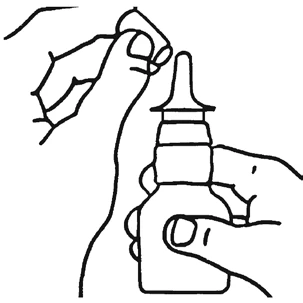
- Gently shake the bottle and remove the protective cap.
- Hold the bottle as shown in the picture.
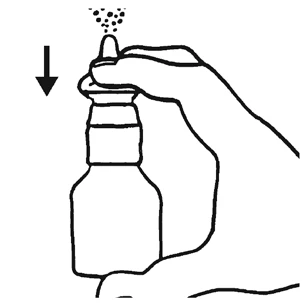
- If Flixonase is being used for the first time or after a break of about one week, test the spray pump. Pointing away from yourself, press the nozzle several times until a fine mist appears.
Using the medicine
- Gently blow your nose.
- Close one nostril with your finger, as shown in the picture, and insert the nozzle into the other nostril.
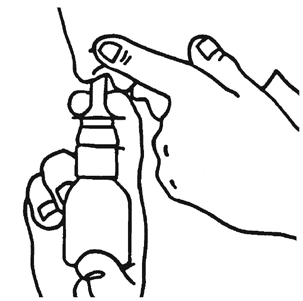
Tilt your head slightly forward and hold the spray upright.
- Breathe in gently through your nose and, WHILE INHALING, press the nozzle ONCE with your fingers to release the medicine.
- Breathe out through your mouth.
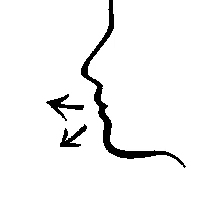
Repeat steps 6 and 7 to administer the second dose.
- Then switch the bottle to the other hand and repeat the procedure to administer the medicine into the other nostril.
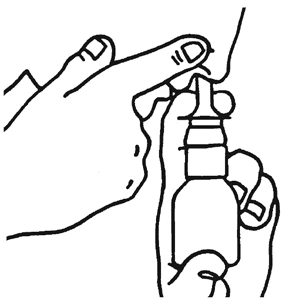
After use
- Wipe the nozzle with a clean tissue or cloth and replace the protective cap.
Cleaning
- Carefully remove the spray nozzle. Wash it with warm water.
- Shake off excess water and allow it to dry. Do not dry at high temperatures.
- Carefully reattach the nozzle to the medicine bottle and replace the protective cap.
- If the nozzle becomes blocked, remove it and soak in warm water for several minutes, then rinse under cold water. Dry thoroughly and reattach to the bottle. Do not unblock the nozzle with a pin or other sharp object.
If more than the recommended dose of Flixonase nasal spray has been used
If more Flixonase nasal spray has been used than recommended, contact your doctor or pharmacist for advice.
It is important to use the medicine exactly as prescribed. Do not use more than the prescribed dose. Using less or more than the recommended dose may worsen symptoms.
Long-term use of higher than recommended doses of Flixonase nasal spray may lead to adrenal insufficiency.
If a dose of Flixonase nasal spray is missed
It is very important to use the prescribed dose daily to ensure maximum effectiveness of treatment.
If a dose is missed, take it as soon as possible, then continue treatment as directed.
Do not use a double dose to make up for a missed dose.
Stopping treatment with Flixonase nasal spray
Continue using Flixonase for as long as your doctor recommends. Consult your doctor before stopping treatment with Flixonase.
If you have any further questions about the use of this medicine, consult your doctor or pharmacist.
4. Possible side effects
Like all medicines, this medicine can cause side effects, although not everybody will get them.
Below are the side effects observed in patients using
Flixonase nasal spray.
Allergic reactions: seek medical help immediately
Allergic reactions to Flixonase nasal spray are very rare (may occur
in less than 1 in 10,000 patients using the medicine). In a small number of patients, allergic
reactions may develop into a serious condition, even life-threatening, if not treated.
Symptoms include:
- skin rash (urticaria) or redness,
- swelling of the face or tongue, which may cause difficulty in swallowing or breathing,
- sudden onset of breathing difficulties or sudden worsening of wheezing (bronchospasm),
- sudden feeling of weakness or dizziness (possibly leading to falling or loss of consciousness). ➔ If any of these symptoms occur, stop using the medicine immediately and contact your doctor without delay, who will advise on appropriate treatment.
Very common side effects ( may occur in more than 1 in 10 patients ):
- nosebleeds.
Common side effects ( may occur in 1 to 10 in 100 patients ):
- headache, unpleasant taste sensation, unpleasant smell sensation;
- dryness and irritation of the nasal and throat mucosa.
Very rare side effects ( may occur in less than 1 in 10,000 patients ):
- allergic reactions;
- increased intraocular pressure causing vision problems (glaucoma), lens clouding (cataract);
- nasal septum damage.
➔ Inform your doctor as soon as possible if any of these
symptoms occur.
Side effects with unknown frequency ( frequency cannot be estimated
from available data ):
- blurred vision;
- nasal mucosal ulceration.
During the use of Flixonase nasal spray, especially at high doses over a long
period, systemic symptoms may occur due to suppression of natural
steroid hormone production by the adrenal glands.
Reporting of side effects
If any side effects occur, including any not listed
in this leaflet, inform your doctor or pharmacist. Side effects can be reported
directly to the Department for Monitoring Adverse Drug Reactions of the Office for Registration of Medicinal Products, Medical Devices and Biocidal Products:
Al. Jerozolimskie 181C
02-222 Warsaw
Tel: + 48 22 49 21 301
Fax: + 48 22 49 21 309
Website: https://smz.ezdrowie.gov.pl
Side effects can also be reported to the marketing authorisation holder or
its representative.
Reporting side effects helps to provide more information on the safety of the medicine.
5. How to store Flixonase nasal aerosol
Keep the medicine out of the sight and reach of children.
Store below 30 °C.
Do not use this medicine after the expiry date stated on the packaging after EXP.
The expiry date refers to the last day of the stated month.
The batch number of the medicine is shown on the packaging after: Lot.
Medicines must not be disposed of via wastewater or household waste. Ask your pharmacist how to dispose of medicines you no longer use. This will help protect the environment.
6. Contents of the packaging and other information
What Flixonase nasal spray contains
- The active substance is fluticasone propionate. One dose of Flixonase nasal spray contains 50 µg (micrograms) of micronized fluticasone propionate.
- Other ingredients: anhydrous dextrose, microcrystalline cellulose and carboxymethylcellulose, phenylethyl alcohol, benzalkonium chloride (50% solution), polysorbate 80, diluted hydrochloric acid to pH 6.3–6.5, purified water.
What Flixonase looks like and contents of the pack
A 20 ml polypropylene bottle with a dosing device combined with a VP3 type spray pump
(containing components made of, among others, polypropylene, low-density polyethylene and ethylene vinyl acetate) and a protective cap, containing 120 doses, in a cardboard box.
Marketing Authorisation Holder: Manufacturer:
GlaxoSmithKline Trading Services Limited Glaxo Wellcome S.A.
12 Riverwalk Avenida de Extremadura 3
Citywest Business Campus 09400 Aranda de Duero
Dublin 24 Burgos
D24 YK11 Spain
Ireland
For further information, please contact the representative of the marketing authorisation holder:
GSK Services Sp. z o.o.
ul. Rzymowskiego 53
02-697 Warsaw
tel. (22) 576-90-00
GSK Logo
Package leaflet: information for the patient
Flixonase, 50 µg/dose, nasal spray, suspension
(Fluticasoni propionas)
Please read carefully all the information in this leaflet before using the medicine, as it contains
important information for the patient.
- Keep this leaflet, as you may need to read it again.
- If you have any further questions, please consult your doctor or pharmacist.
- This medicine has been prescribed for a specific person. Do not pass it on to others. The medicine may harm another person, even if their symptoms are the same.
- If you experience any adverse effects, including any not listed in this leaflet, tell your doctor or pharmacist. See section 4.
Contents of the leaflet:
- What Flixonase nasal spray is and what it is used for
- Important information before using Flixonase nasal spray
- How to use Flixonase nasal spray
- Possible side effects
- How to store Flixonase nasal spray
- Contents of the packaging and other information
1. What Flixonase nasal spray is and what it is used for
The active substance in Flixonase nasal spray is fluticasone propionate.
It belongs to a group of medicines called steroids or corticosteroids.
Steroids work by reducing inflammation:
- reducing swelling and irritation in the nose,
- reducing itching, sneezing, blocked or runny nose (rhinitis).
Flixonase nasal spray, suspension is used for the prevention and treatment of:
- seasonal allergic rhinitis (including hay fever),
- perennial allergic rhinitis.
Flixonase nasal spray, suspension may also be used for symptomatic treatment of nasal polyps (growths on the mucous membrane inside the nose).
2. Important information before using Flixonase nasal spray
When not to use Flixonase nasal spray
- if you are allergic to fluticasone propionate or any of the other ingredients of this medicine (listed in section 6).
Warnings and precautions
Before starting Flixonase nasal spray, consult your doctor or pharmacist if you:
- have an upper respiratory tract infection,
- have adrenal insufficiency,
- are taking ritonavir (see also section “Flixonase nasal spray and other medicines”).
You should consult your doctor to determine whether any of the above conditions apply to you.
With long-term use of Flixonase nasal spray, the active substance – fluticasone propionate – may suppress the natural production of steroid hormones by the adrenal glands. If adrenal insufficiency is diagnosed, your doctor may consider additional systemic corticosteroid therapy during periods of stress or before planned surgery.
Due to the potential for impaired adrenal function, patients switching from oral steroid therapy to intranasal fluticasone propionate should remain under special medical supervision, and adrenal function should be monitored.
If you experience blurred vision or other visual disturbances, contact your doctor.
During long-term treatment with intranasal corticosteroids, your doctor may recommend regular monitoring of growth in children.
Flixonase nasal spray and other medicines
Tell your doctor about all medicines you are currently taking or have recently taken, including those obtained without a prescription, as well as any medicines you plan to take.
It is especially important to inform your doctor if you are currently taking or have recently taken any of the following medicines:
- corticosteroids in tablet or injectable form,
- ritonavir or medicines containing cobicistat, used in the treatment of HIV,
- ketoconazole or itraconazole, used in the treatment of fungal infections.
Your doctor will assess whether it is safe to use Flixonase with these medicines. Some medicines may enhance the effect of Flixonase, and your doctor may need to closely monitor your condition (including certain HIV medicines: ritonavir, cobicistat).
Your doctor will decide whether you can use Flixonase nasal spray with these medicines.
Pregnancy and breastfeeding
If you are pregnant, breastfeeding, think you may be pregnant, or are planning to have a baby, consult your doctor before using this medicine. Your doctor will weigh the benefits and risks of using Flixonase nasal spray during pregnancy.
Flixonase nasal spray may be used in pregnant women only if, in the opinion of the doctor, the benefit to the mother outweighs the potential risk to the fetus.
It is not known whether the active substance of Flixonase passes into breast milk. If you are breastfeeding, you must contact your doctor before using Flixonase.
Driving and using machines
No effect of the medicine on the ability to drive or operate machinery has been observed.
This medicine contains benzalkonium chloride
This medicine contains 0.02 mg of benzalkonium chloride per dose. Benzalkonium chloride may cause irritation or swelling inside the nose, especially with prolonged use.
Benzalkonium chloride may also cause wheezing or breathing difficulties (bronchospasm), particularly in patients with asthma.
3. How to use Flixonase nasal spray
Always use this medicine exactly as prescribed by your doctor. Do not exceed the recommended dose. If in doubt, consult your doctor.
Flixonase nasal spray is for intranasal use only.
Avoid contact of the medicine with the eyes.
Regular use is essential for the medicine to be effective. Full therapeutic effect in the treatment of allergic rhinitis occurs after 3–4 days of regular use. Full therapeutic effect in the treatment of nasal polyps occurs after several weeks of regular use.
Continue using Flixonase for as long as your doctor recommends. Consult your doctor before stopping treatment with Flixonase.
Prevention and treatment of seasonal allergic rhinitis and perennial rhinitis
Dosage for adults and children over 12 years of age
Two sprays into each nostril once daily, preferably in the morning.
In some cases, two sprays into each nostril twice daily may be recommended. Do not exceed four sprays into each nostril per day.
Your doctor will prescribe the lowest effective dose to control symptoms.
Dosage for elderly patients
The same dosage as for adults.
Dosage for children aged 4 to 11 years
One spray into each nostril once daily, preferably in the morning.
In some cases, one spray into each nostril twice daily may be recommended. Do not exceed two sprays into each nostril per day.
Your doctor will prescribe the lowest effective dose to control symptoms.
Symptomatic treatment of nasal polyps
Dosage for adults
Initially, two sprays into each nostril twice daily (morning and evening) for 1 to 2 months, until symptoms are controlled. Do not exceed four sprays into each nostril per day.
Then, two sprays into each nostril once daily for three months.
Dosage for elderly patients
Same as for adults.
Dosage for children and adolescents
Flixonase should not be used in children and adolescents for the treatment of nasal polyps.
Instructions for using Flixonase nasal spray
Before use
- Gently shake the medicine bottle and remove the protective cap.
- Hold the bottle as shown in the picture.
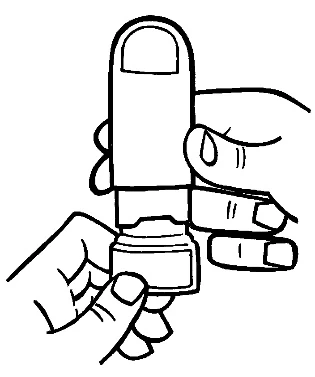
- If Flixonase is being used for the first time or after a break of about one week, check that the dispenser is working. Pointing away from yourself, press the dispenser several times until a fine mist appears.
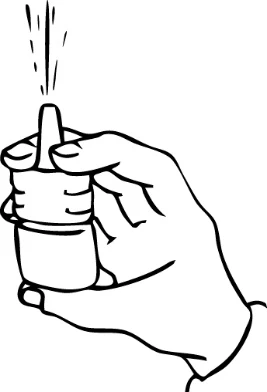
Using the medicine
- Gently blow your nose.
- Block one nostril with your thumb, as shown in the picture, and insert the dispenser into the other nostril.
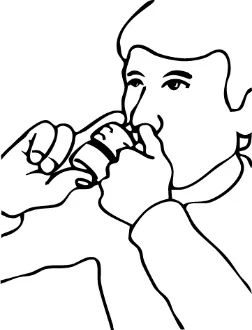
Tilt your head slightly forward and hold the dispenser vertically.
- Breathe in through your nose and, WHILE INHALING, press the dispenser once with your fingers to release the medicine.
- Breathe out through your mouth.
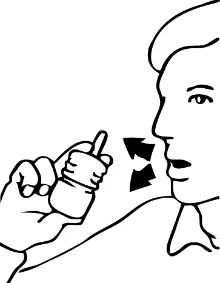
Repeat steps 6 and 7 to administer the second spray.
- Then switch the bottle to the other hand and repeat the steps to administer the medicine into the other nostril.
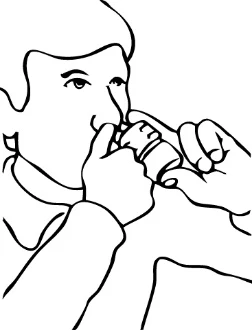
After use
- Wipe the dispenser with a clean tissue or cloth and replace the protective cap.
Cleaning
- Gently remove the dispenser. Wash it with warm water.
- Shake off excess water and leave to dry. Do not dry at high temperatures.
- Gently reattach the dispenser to the medicine bottle. Replace the protective cap.
- If the dispenser becomes blocked, remove it and soak it in warm water for several minutes, then rinse under cold water. Dry and reattach to the bottle. Do not clear the dispenser with a pin or other sharp object.
Overdose of Flixonase nasal spray
If you use more Flixonase nasal spray than recommended, contact your doctor or pharmacist for advice. It is important to take the medicine exactly as prescribed. Do not take more than the recommended dose. Taking lower or higher doses than recommended may worsen your symptoms.
Long-term use of higher than recommended doses of Flixonase nasal spray may lead to adrenal insufficiency.
Missed dose of Flixonase nasal spray
It is very important to take the recommended dose every day to ensure maximum treatment effectiveness.
If you miss a dose, take it as soon as possible, then continue treatment as prescribed.
Do not take a double dose to make up for a missed dose.
Stopping treatment with Flixonase nasal spray
Continue using Flixonase for as long as your doctor recommends. Consult your doctor before stopping treatment.
If you have any further questions about using this medicine, consult your doctor or pharmacist.
4. Possible side effects
Like all medicines, this medicine can cause side effects, although not everyone will experience them.
Below are side effects observed in patients using Flixonase nasal spray.
Allergic reactions: seek immediate medical help
Allergic reactions to Flixonase nasal spray are very rare (may occur in fewer than 1 in 10,000 patients). In a small number of patients, allergic reactions may develop into a serious, even life-threatening condition if not treated.
Symptoms include:
- skin rash (urticaria) or redness,
- swelling of the face or tongue, causing difficulty swallowing or breathing,
- sudden breathing difficulties or sudden worsening of wheezing (bronchospasm),
- sudden feeling of weakness or dizziness (possibly leading to collapse or loss of consciousness).
If any of these symptoms occur, stop using the medicine immediately and contact your doctor for appropriate treatment.
Very common side effects (may occur in more than 1 in 10 patients):
- nosebleeds.
Common side effects (may occur in 1 to 10 in 100 patients):
- headache, unpleasant taste sensation, unpleasant smell sensation;
- dryness and irritation of the nasal and throat mucosa.
Very rare side effects (may occur in fewer than 1 in 10,000 patients):
- allergic reactions;
- increased intraocular pressure causing vision problems (glaucoma), lens opacity (cataract);
- nasal septum damage.
Inform your doctor as soon as possible if any of these symptoms occur.
Side effects with unknown frequency (frequency cannot be determined from available data):
- blurred vision;
- nasal mucosal ulceration.
During long-term use of Flixonase nasal spray, especially at high doses, systemic effects due to suppression of natural steroid hormone production by the adrenal glands may occur.
Reporting of side effects
If you experience any side effects, including those not listed in this leaflet, inform your doctor or pharmacist. Side effects can be reported directly to the Department of Monitoring of Adverse Drug Reactions at the Office for Registration of Medicinal Products, Medical Devices and Biocidal Products:
Al. Jerozolimskie 181C
02-222 Warsaw
Tel: +48 22 49 21 301
Fax: +48 22 49 21 309
Website: https://smz.ezdrowie.gov.pl
Side effects can also be reported to the marketing authorisation holder or its representative.
Reporting side effects helps provide more information on the safety of the medicine.
5. How to store Flixonase nasal spray
Keep the medicine out of the sight and reach of children.
Store below 30°C.
Do not use this medicine after the expiry date stated on the packaging after EXP.
The expiry date refers to the last day of the stated month.
The batch number is indicated on the packaging after: Lot.
Do not dispose of medicines via the sewage system or household waste. Ask your pharmacist how to dispose of medicines no longer in use. This will help protect the environment.
6. Contents of the packaging and other information
What Flixonase nasal spray contains
- The active substance is fluticasone propionate. One dose of Flixonase nasal spray contains 50 µg (micrograms) of micronized fluticasone propionate.
- Other ingredients: anhydrous dextrose, microcrystalline cellulose and carboxymethylcellulose, phenylethyl alcohol, benzalkonium chloride (50% solution), polysorbate 80, diluted hydrochloric acid to pH 6.3–6.5, purified water.
What Flixonase looks like and contents of the pack
A 20 ml dark glass bottle with a dosing device combined with a VP3 type spray pump
(containing components made of, among others, polypropylene, low-density polyethylene and ethylene vinyl acetate) or SP270+ spray pump (containing components made of, among others, polypropylene, low-density polyethylene, polyethylene and ethylene vinyl acetate) and a protective cap, containing 120 doses, in a cardboard box.
Marketing Authorisation Holder: Manufacturer:
GlaxoSmithKline Trading Services Limited Glaxo Wellcome S.A.
12 Riverwalk Avenida de Extremadura 3
Citywest Business Campus 09400 Aranda de Duero
Dublin 24 Burgos
D24 YK11 Spain
Ireland
For further information, please contact the representative of the marketing authorisation holder:
GSK Services Sp. z o.o.
ul. Rzymowskiego 53
02-697 Warsaw
tel. (22) 576-90-00
GSK Logo