Flegatussin caps
Poland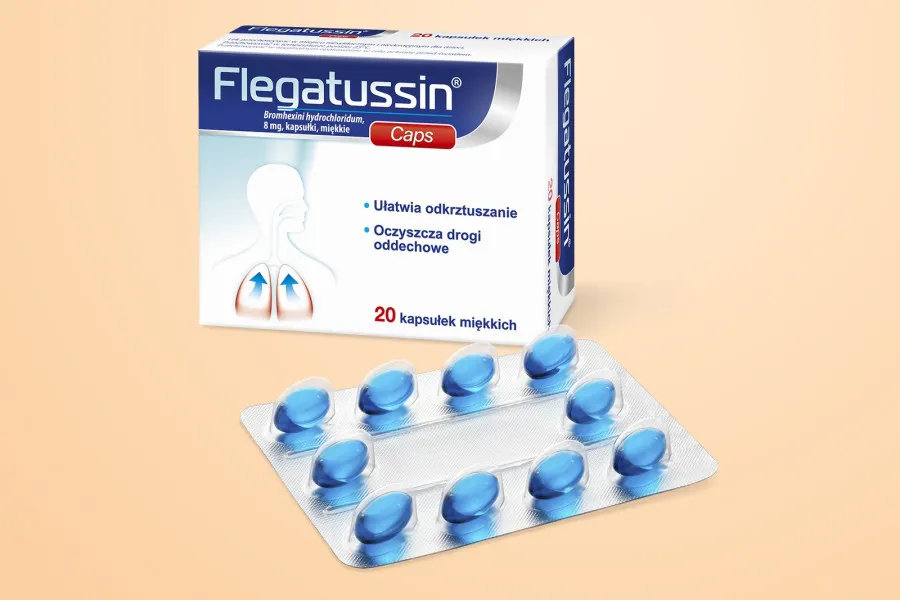
Table of Contents
Package leaflet: Information for the patient
Flegatussin Caps, 8 mg, soft capsules
Bromhexini hydrochloridum
Please read all of this leaflet carefully before taking this medicine, because it contains
important information for the patient.
This medicine should always be taken exactly as described in this patient leaflet or as directed by
the physician or pharmacist.
- Keep this leaflet, so that you can read it again if necessary.
- If you need advice or further information, please consult your pharmacist.
- If you experience any adverse reactions, including any possible adverse reactions not listed in this leaflet, inform your doctor or pharmacist. See section 4.
- If there is no improvement within 4–5 days, or if you feel worse, consult your doctor.
Table of contents
- What Flegatussin Caps is and what it is used for
- Important information before taking Flegatussin Caps
- How to take Flegatussin Caps
- Possible side effects
- How to store Flegatussin Caps
- Contents of the pack and other information
1. What Flegatussin Caps is and what it is used for
Flegatussin Caps contains bromhexine hydrochloride as the active substance, which liquefies
secretions from the respiratory tract and has an expectorant effect.
Flegatussin Caps facilitates expectoration and clearance of the bronchi.
Flegatussin Caps is indicated in acute and chronic respiratory tract diseases associated with
difficult expectoration of thick mucus.
2. Important information before taking Flegatussin Caps
When not to take Flegatussin Caps:
- if the patient is allergic to bromhexine hydrochloride or any of the other ingredients of this medicine (listed in section 6);
- in children under 12 years of age.
Warnings and precautions
Before starting treatment with Flegatussin Caps, consult a doctor or pharmacist if:
- the patient suffers from a disease called ciliary dyskinesia with impaired bronchial motility,
- the patient has liver or kidney function disorders,
- the patient has difficulty expectorating or suffers from asthma,
- the patient has peptic ulcer disease of the stomach or duodenum,
- the patient experiences shortness of breath, fever, or purulent sputum.
Severe skin reactions associated with the use of bromhexine have been reported. If a rash occurs (including lesions of mucous membranes, e.g. in the mouth, throat, nose, eyes, or genital organs), treatment with Flegatussin Caps must be discontinued immediately and the patient should contact a doctor without delay.
If the patient has inflammatory respiratory conditions accompanied by bacterial infection, Flegatussin Caps should be used concomitantly with antibiotics and bronchodilators as prescribed by the physician. Adequate hydration of the patient is important, especially in the presence of fever. Proper hydration enhances bronchial secretion liquefaction and facilitates expectoration.
Bronchial secretions should be expectorated thoroughly.
Children and adolescents
Do not use in children under 12 years of age.
Flegatussin Caps and other medicines
Inform your doctor or pharmacist about all medicines currently used, recently used, or planned to be used.
Use with caution together with atropine and other anticholinergic drugs, as they may cause dryness of mucous membranes.
Flegatussin Caps should not be administered simultaneously with antitussive medicines (e.g. containing codeine), as this may lead to dangerous accumulation of bronchial secretions due to suppressed cough reflex.
This medicine may enhance the irritating effect on the gastrointestinal mucosa caused by salicylates and other non-steroidal anti-inflammatory drugs.
Concomitant use of bromhexine and antibiotics (medicines used to treat infections: ampicillin, amoxicillin, cefuroxime, erythromycin, doxycycline, oxytetracycline) may lead to increased antibiotic concentration in the lungs.
Pregnancy and breastfeeding
If the patient is pregnant or breastfeeding, suspects she may be pregnant, or is planning to have a child, she should consult a doctor or pharmacist before using this medicine.
Pregnancy
Use of this medicine is not recommended, especially during the first trimester of pregnancy. During the remainder of pregnancy, the medicine may be used only if, in the opinion of the physician, the benefit to the mother outweighs the potential risk to the fetus.
Breastfeeding
Use of this medicine is not recommended during breastfeeding.
Driving and operating machinery
Exercise caution, as headache, dizziness, or drowsiness may occur.
Flegatussin Caps contains sorbitol (E 420)
The medicine contains 69.03 mg of sorbitol per capsule. Sorbitol is a source of fructose. If the patient (or their child) has previously been diagnosed with intolerance to certain sugars or hereditary fructose intolerance—a rare genetic disorder in which the patient's body cannot metabolize fructose—the patient should consult a doctor before taking the medicine or giving it to a child.
Flegatussin Caps contains patent blue V (E 131)
The medicine may cause allergic reactions.
Flegatussin Caps contains sodium
The medicine contains less than 1 mmol (23 mg) of sodium per capsule, i.e. the medicine is considered "sodium-free".
3. How to take Flegatussin Caps
This medicine should always be taken exactly as described in this patient leaflet or as directed by a doctor or pharmacist. If in doubt, consult a doctor or pharmacist.
Recommended dose
Adults and adolescents over 12 years of age: 1 capsule three times a day.
Method of administration
Oral administration.
The medicine should be taken at regular intervals, after meals.
It is recommended to increase fluid intake during treatment.
This medicine should not be taken immediately before bedtime.
If symptoms do not improve within 4–5 days, consult a doctor.
The medicine is usually used for 7 to 10 days.
Taking more Flegatussin Caps than recommended
Symptoms of bromhexine overdose have not been described so far. In case of overdose, symptomatic treatment may be necessary.
If you have taken more than the recommended dose, consult a doctor or pharmacist immediately.
If you forget to take Flegatussin Caps
Do not take a double dose to make up for a missed dose.
If you have any further doubts concerning the use of this medicine, consult your doctor or pharmacist.
4. Possible adverse reactions
Like all medicines, this medicine can cause adverse reactions, although not everyone will experience them.
If severe adverse reactions occur, such as: hypersensitivity reactions, anaphylactic reactions including anaphylactic shock, angioedema (rapid swelling of the skin, subcutaneous tissue, mucous membranes or submucosal tissues), or itching, severe skin-related adverse reactions (including erythema multiforme, Stevens-Johnson syndrome, toxic epidermal necrolysis, generalized pustular eruption), bronchospasm, or if other adverse reactions worsen, discontinue use of the medicine and contact your doctor or the nearest hospital's Emergency Department immediately.
Uncommon (occur in less than 1 in 100 patients):
nausea, abdominal pain (particularly epigastric pain), vomiting, diarrhoea, fever.
Rare (occur in less than 1 in 1,000 patients):
hypersensitivity reactions, rash, urticaria.
Frequency not known (frequency cannot be estimated from available data):
anaphylactic reactions, including anaphylactic shock, angioedema (rapid swelling of the skin, subcutaneous tissue, mucous membranes or submucosal tissues) and itching, severe skin-related adverse reactions (including erythema multiforme, Stevens-Johnson syndrome, toxic epidermal necrolysis, generalized pustular eruption), headache, dizziness, somnolence, decreased blood pressure, bronchospasm, dyspepsia, increased liver enzyme activity.
Reporting of adverse reactions
If any adverse effects occur, including any adverse effects not listed in this leaflet, inform your doctor, pharmacist or nurse. Adverse reactions can be reported directly to the Department of Monitoring Adverse Drug Reactions at the Office for Registration of Medicinal Products, Medical Devices and Biocidal Products
Al. Jerozolimskie 181C
02-222 Warsaw
Tel.: + 48 22 49 21 301
Fax: + 48 22 49 21 309
Website: https://smz.ezdrowie.gov.pl
Adverse reactions can also be reported to the marketing authorization holder.
Reporting adverse reactions helps to provide more information on the safety of the medicine.
5. How to store Flegatussin Caps
Keep this medicine out of the sight and reach of children.
Store below 25°C.
Keep in the original packaging to protect from light.
Do not use this medicine after the expiry date stated on the packaging after EXP.
The expiry date refers to the last day of the stated month.
Medicines must not be disposed of via wastewater or household waste. Ask your pharmacist how to dispose of medicines no longer required. This will help protect the environment.
6. Contents of the packaging and other information
What Flegatussin Caps contains
- The active substance is bromhexine hydrochloride. Each capsule contains 8 mg of bromhexine hydrochloride.
- The other ingredients are: capsule filling: macrogol 600, sodium hydroxide, ascorbic acid (E 300), purified water; capsule shell: gelatin, sorbitol liquid, partially dehydrated (E 420), patent blue V (E 131), purified water.
What Flegatussin Caps looks like and contents of the pack
Flegatussin Caps is a blue, oval soft capsule with a central seam, filled with oily liquid.
PVC/PVDC/Aluminium blisters in a cardboard box.
The pack contains 20 or 40 capsules.
Not all pack sizes may be marketed.
Marketing Authorisation Holder
POLPHARMA Pharmaceutical Works S.A.
Pelplińska 19 Street, 83-200 Starogard Gdański
tel. + 48 22 364 61 01
Manufacturer
POLPHARMA Pharmaceutical Works S.A.
Medana Branch in Sieradz
Władysława Łokietka 10 Street, 98-200 Sieradz