Flegamina classic
Poland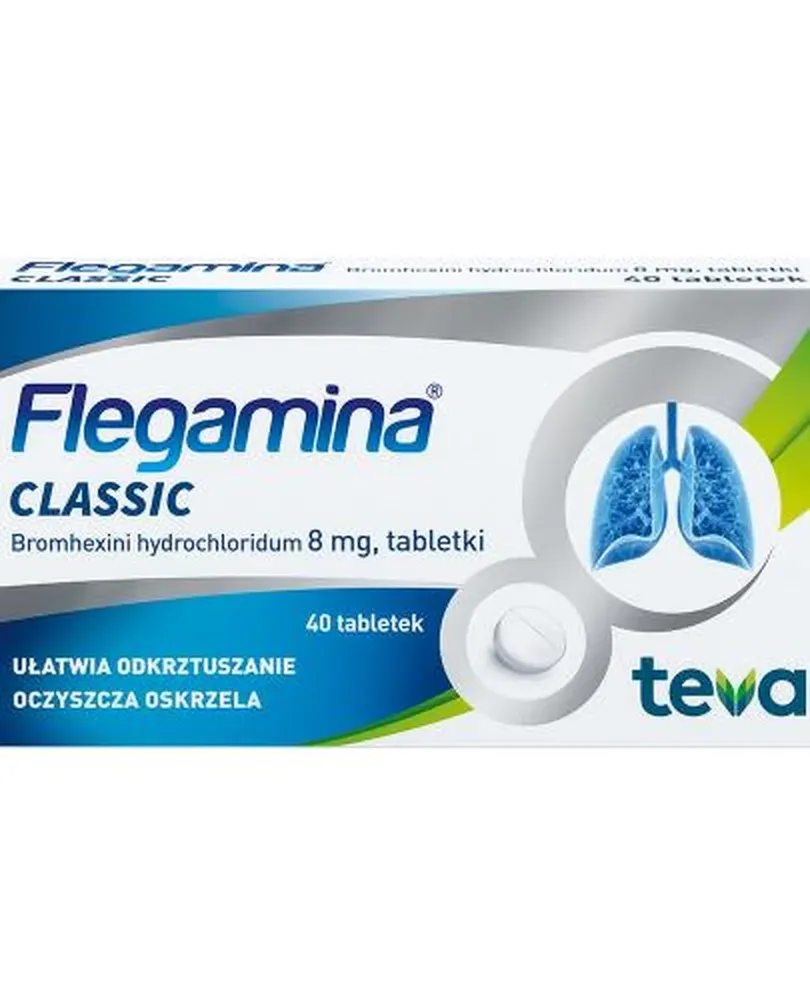
Table of Contents
Package leaflet: Information for the user
Flegamina Classic, 8 mg, tablets
Bromhexini hydrochloridum
Please read all of this leaflet carefully before taking this medicine, because it contains
important information for the patient.
This medicine should always be taken exactly as described in the patient leaflet or as directed by the
physician, pharmacist, or nurse.
- Keep this leaflet, so that you can read it again if necessary.
- If you need advice or further information, please consult your pharmacist.
- If you experience any adverse reactions, including any possible adverse reactions not listed in this leaflet, inform your doctor, pharmacist, or nurse. See section 4.
- If your symptoms do not improve or if you feel worse, contact your doctor.
Table of contents
- What Flegamina Classic is and what it is used for
- What you need to know before taking Flegamina Classic
- How to take Flegamina Classic
- Possible side effects
- How to store Flegamina Classic
- Contents of the pack and other information
1. What Flegamina Classic is and what it is used for
Flegamina Classic contains bromhexine hydrochloride as the active substance, which is an expectorant and mucolytic agent that liquefies respiratory secretions. The medicine facilitates expectoration and clearance of the bronchi.
Flegamina Classic is indicated for the treatment of acute and chronic respiratory tract diseases associated with impaired mucus expectoration and clearance.
2. Important information before using Flegamina Classic
When not to use Flegamina Classic
- if the patient is allergic to bromhexine hydrochloride or any of the other ingredients of this medicine (listed in section 6).
- in children aged 3 to 6 years who are unable to swallow tablets.
- in children under 2 years of age due to the bromhexine content.
Warnings and precautions
Before starting treatment with Flegamina Classic, consult a doctor:
- if the patient has inflammatory conditions of the respiratory tract associated with bacterial infection. Flegamina Classic tablets should be taken simultaneously with antibiotics and bronchodilators as prescribed by the doctor. During treatment, it is recommended to drink plenty of fluids, especially when fever is present. Adequate hydration enhances the liquefaction of bronchial secretions and facilitates expectoration.
- if the patient has a history of peptic ulcer disease of the stomach and duodenum, or active peptic ulcer disease of the stomach and duodenum, as the medicine may exacerbate symptoms.
- if the patient has severe liver function disorders.
- if the patient has severe kidney function disorders.
- if the patient has intolerance to certain sugars (see also "Flegamina Classic contains lactose").
Severe skin reactions associated with the use of bromhexine hydrochloride have been reported. If a rash occurs (including lesions on mucous membranes, e.g. mouth, throat, nose, eyes, genital organs), discontinue use of Flegamina Classic and contact a doctor immediately.
Children
Flegamina Classic tablets should not be used in children aged 3 to 6 years who are unable to swallow tablets. In these patients, bromhexine in the form of Flegamina Classic Junior strawberry-flavoured syrup is recommended.
Flegamina Classic tablets, due to the bromhexine content, should not be administered to children under 2 years of age.
Flegamina Classic and other medicines
Inform your doctor or pharmacist about all medicines the patient is currently taking or has recently taken, as well as any medicines the patient plans to take, including those available without a prescription.
Flegamina Classic tablets should not be used with:
- antitussive medicines, e.g. those containing codeine and its derivatives, as they may suppress the cough reflex and lead to accumulation of secretions in the respiratory tract.
Flegamina Classic tablets should be used with caution when used concomitantly with:
- atropine and other anticholinergic medicines, as they cause dryness of mucous membranes.
- salicylates and other non-steroidal anti-inflammatory drugs, as the medicine may enhance the irritating effect on the gastrointestinal mucosa.
- antibiotics such as oxytetracycline, erythromycin, ampicillin, doxycycline, cefuroxime, amoxicillin, as concomitant use of the medicine with these antibiotics increases their concentration in lung tissue.
Taking Flegamina Classic tablets with food and drink
The medicine should be taken after meals.
Pregnancy and breastfeeding
If the patient is pregnant or breastfeeding, suspects she may be pregnant, or is planning to become pregnant, she should consult a doctor or pharmacist before using this medicine.
Pregnancy
Flegamina Classic should not be used during the first three months of pregnancy.
During the remainder of pregnancy, the medicine should be used only if, in the opinion of the doctor, the benefit to the mother outweighs the potential risk to the fetus.
Breastfeeding
Use of the medicine is not recommended during breastfeeding.
Driving and operating machinery
Exercise caution, as dizziness, headache or drowsiness may occur.
Flegamina Classic contains lactose
If the patient has previously been diagnosed with intolerance to certain sugars, the patient should consult a doctor before taking this medicine.
Flegamina Classic contains sodium
The medicine contains less than 1 mmol (23 mg) of sodium per tablet, meaning the medicine is considered "sodium-free".
3. How to use Flegamina Classic
This medicine should always be taken exactly as described in the patient leaflet or as directed by a doctor or pharmacist. If in doubt, consult a doctor or pharmacist.
This is an oral medicine.
The recommended dose is:
Adults and children over 12 years of age: 1 tablet three times daily.
Children from 6 to 12 years of age: half a tablet three times daily.
Children from 3 to 6 years of age: half a tablet twice daily.
Flegamina Classic tablets are not recommended for children aged 3 to 6 years who are unable to swallow tablets; in these patients, use of Flegamina Classic Junior syrup with strawberry flavour is recommended.
The medicine should be taken at regular intervals, after meals.
Do not take the medicine immediately before bedtime.
The medicine is usually used for 7 to 10 days.
If symptoms worsen or do not improve, consult a doctor.
If you feel the effect of the medicine is too strong or too weak, consult a doctor.
Use of a higher than recommended dose of Flegamina Classic
Symptoms of bromhexine overdose have not been reported so far. In case of overdose, activated charcoal should be administered. If necessary, the doctor may recommend gastric lavage and symptomatic treatment.
If a higher than recommended dose has been taken, consult a doctor or pharmacist immediately.
Missed dose of Flegamina Classic
Take the missed dose as soon as possible. If it is almost time for the next dose, take the next dose at the scheduled time.
Do not take a double dose to make up for a missed dose.
If you have any further doubts about the use of this medicine, consult your doctor or pharmacist.
4. Possible adverse effects
Like all medicines, this medicine can cause adverse effects, although not everybody will experience them.
When using Flegamina Classic, the following may occur:
Not common (may affect up to 1 in 100 people):
- pain in the upper part of the abdomen, nausea, vomiting, diarrhoea
Rare (may affect up to 1 in 1,000 people):
- hypersensitivity reactions, rash, urticaria
Frequency unknown (frequency cannot be estimated from the available data):
- headache, dizziness, drowsiness,
- bronchospasm,
- dyspepsia,
- excessive sweating,
- increased liver enzyme activity,
- hypotension,
- anaphylactic reactions, including anaphylactic shock, angioedema (rapid swelling of the skin, subcutaneous tissue, mucous membranes or submucosal tissues), and itching;
- severe skin-related adverse reactions (including erythema multiforme, Stevens-Johnson syndrome, toxic epidermal necrolysis, and acute generalized exanthematous pustulosis).
Reporting of adverse effects
If any adverse effects occur, including any adverse effects not listed in this leaflet, inform your doctor or pharmacist.
Adverse effects can be reported directly to the Department of Monitoring Adverse Drug Reactions of the Office for Registration of Medicinal Products, Medical Devices and Biocidal Products, Al. Jerozolimskie 181C, 02-222 Warsaw, Tel.: +48 22 49 21 301, Fax: +48 22 49 21 309, website: https://smz.ezdrowie.gov.pl
Adverse effects can also be reported to the marketing authorization holder.
Reporting adverse effects helps to provide more information on the safety of the medicine.
5. How to store Flegamina Classic
Keep this medicine out of sight and reach of children.
Store below 25°C in a dry place.
Do not use this medicine after the expiry date stated on the label after "Expiry date:" or "EXP". The expiry date refers to the last day of the specified month.
Medicines must not be disposed of via wastewater or household waste. Ask your pharmacist how to dispose of medicines no longer required. These measures will help protect the environment. The batch number on the packaging follows the abbreviation "Lot".
6. Contents of the pack and other information
What Flegamina Classic contains
- The active substance is: bromhexine hydrochloride. One tablet contains 8 mg of bromhexine hydrochloride.
- Other ingredients are: monohydrate lactose, sodium carboxymethyl starch (see section 2, "Flegamina Classic contains sodium"), magnesium stearate.
What Flegamina Classic looks like and contents of the pack
Flegamina Classic tablets are round, biconvex with bevelled edges and a score line on one side.
The pack contains 20, 40 or 60 tablets.
Marketing Authorisation Holder
Teva Pharmaceuticals Polska Sp. z o.o.
Emilii Plater 53 Street, 00-113 Warsaw, tel.: (22) 345 93 00
Manufacturer
Teva Operations Poland Sp. z o.o., Mogilska 80 Street, 31-546 Kraków