Flavamed
Poland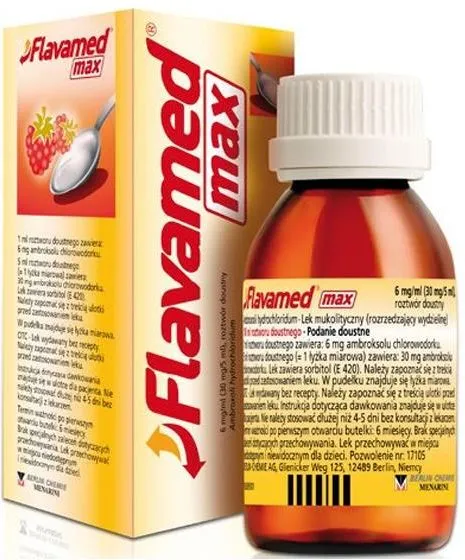
Table of Contents
Package leaflet: Information for the user
Warning! Keep this leaflet. Information on the immediate packaging in a foreign language.
Flavamed (Flavamed for children)
15 mg/5 ml, syrup
Ambroxoli hydrochloridum
Flavamed and Flavamed for children are different trade names for the same medicine.
Please read the entire leaflet carefully before using the medicine, as it contains
important information for the patient.
This medicine should always be used exactly as described in this patient information leaflet or as directed by the doctor or pharmacist.
- Keep this leaflet, so that you can read it again if necessary.
- If you need advice or further information, please consult your pharmacist.
- If the patient experiences any adverse reactions, including any possible adverse reactions not listed in this leaflet, inform the doctor, pharmacist, or nurse. See section 4.
- If there is no improvement within 4 to 5 days, or if the patient feels worse, contact the doctor.
Table of contents of the leaflet
- What Flavamed is and what it is used for
- Important information before taking Flavamed
- How to take Flavamed
- Possible side effects
- How to store Flavamed
- Contents of the pack and other information
1. What Flavamed is and what it is used for
Flavamed is a mucolytic agent used in acute and chronic lung and bronchial diseases associated with disturbances in mucus production and transport.
With the use of Flavamed, thick mucus becomes more fluid and easier to cough up.
Flavamed is indicated for children over 1 year of age, adolescents, and adults.
If there is no improvement within 4 to 5 days, or if the patient feels worse, contact the doctor.
2. Important information before using Flavamed
When not to use Flavamed
- if the patient is allergic to ambroxol hydrochloride or any of the other ingredients of this medicine (listed in section 6).
Warnings and precautions
Before starting to take Flavamed, discuss it with your doctor or pharmacist.
- if the patient has previously experienced very severe skin hypersensitivity reactions (Stevens-Johnson syndrome, Lyell's syndrome).
- Stevens-Johnson syndrome is a condition characterized by high fever and blistering rash on the skin and mucous membranes.
- life-threatening Lyell's syndrome is also known as toxic epidermal necrolysis. Symptoms of this syndrome include severe skin lesions with blistering, resembling burns. Page 1 of 5
Serious skin reactions associated with ambroxol use have been reported. If
a rash occurs (including lesions on mucous membranes, e.g., in the mouth, throat, nose, eyes,
genital organs), discontinue use of Flavamed immediately and contact your doctor
without delay.
- if the patient has renal function disorders or severe liver disease, Flavamed should be used only after consultation with a doctor. In severe renal impairment, accumulation of metabolites of the active substance of Flavamed may occur.
- if the patient has a rare bronchial disorder associated with increased mucus production (e.g., immotile cilia syndrome). In such cases, mucus cannot be cleared from the lungs. Flavamed should be used only under medical supervision in these patients.
- if the patient has previously had gastric or duodenal ulcer disease, consult a doctor on how to use Flavamed, as mucolytic agents may damage the gastric mucosa. Consult a doctor before using Flavamed.
Children
Flavamed may be used in children aged 1 to 2 years only under medical supervision.
For detailed information, see section 3.
Flavamed and other medicines
Inform your doctor or pharmacist about all medicines the patient is currently taking or has recently taken, as well as any medicines the patient plans to take.
Cough suppressants (antitussive medicines)
During treatment with Flavamed, do not use any medicines that suppress the cough reflex (so-called antitussives). The cough reflex is essential for expectorating liquefied mucus and thus removing it from the lungs.
Pregnancy, breastfeeding and fertility
If the patient is pregnant or breastfeeding, suspects she may be pregnant, or is planning to have a baby, she should consult her doctor or pharmacist before using this medicine.
Flavamed should be used during pregnancy and breastfeeding only if clearly recommended by a doctor! Use of Flavamed is not recommended, especially during the first trimester of pregnancy.
The active substance of Flavamed passes into breast milk.
Use of Flavamed is not recommended during breastfeeding.
Animal studies have not shown harmful effects of ambroxol on fertility.
There are insufficient data on the effect of ambroxol on human fertility.
Driving and operating machinery
There is no data available on the effect on the ability to drive or operate machinery.
No studies have been conducted on the effect of the medicine on the ability to drive or
operate machinery.
This medicine contains sorbitol and benzoic acid (E 210)
This medicine contains 1.75 g of sorbitol in 5 ml of syrup.
Sorbitol is a source of fructose. If the patient (adult or child) has previously been diagnosed with intolerance to certain sugars or hereditary fructose intolerance, a rare genetic disorder in which the patient's body cannot metabolize fructose, the patient should consult a doctor before taking the medicine or giving it to a child.
Sorbitol may cause gastrointestinal discomfort and may have a mild laxative effect.
This medicine contains 5.75 mg of benzoic acid in 5 ml of syrup.
Page 2 of 5
3. How to use Flavamed
This medicine should always be used exactly as described in the patient leaflet or as advised by your doctor or pharmacist. If in doubt, consult your doctor or pharmacist.
The following information applies if your doctor has not advised otherwise.
Always follow the instructions for use carefully, as the medicine Flavamed may not work properly if not used correctly!
Recommended dose:
Children aged 1 to 2 years:
Only under medical supervision!
½ measuring spoon, i.e. 2.5 ml of syrup twice daily (corresponding to 15 mg of ambroxol hydrochloride per day).
Children aged 2 to 5 years:
½ measuring spoon, i.e. 2.5 ml of syrup three times daily (corresponding to 22.5 mg of ambroxol hydrochloride per day).
Children aged 6 to 12 years:
1 measuring spoon, i.e. 5 ml of syrup 2 to 3 times daily (corresponding to 30 to 45 mg of ambroxol hydrochloride per day).
Adolescents aged 12 years and older, and adults:
2 measuring spoons, i.e. 5 ml of syrup each (i.e. 10 ml total) 2 to 3 times daily (corresponding to 60 to 90 mg of ambroxol hydrochloride per day) for the first 2 to 3 days of treatment, then reduce to 2 measuring spoons, i.e. 5 ml of syrup each (i.e. 10 ml total) twice daily (corresponding to 60 mg of ambroxol hydrochloride per day).
Note:
In adults, the dose may be increased to 4 measuring spoons, i.e. 5 ml of syrup each (i.e. 20 ml total) twice daily (corresponding to 120 mg of ambroxol hydrochloride per day).
Method of administration
For oral use. Flavamed should be taken after meals using the measuring spoon provided.
Do not take Flavamed immediately before going to sleep.
Duration of use
Flavamed should not be used for longer than 4–5 days without consulting a doctor.
If symptoms do not improve or worsen after 4–5 days, consult your doctor immediately!
If you feel that the effect of Flavamed is too strong or too weak, consult your doctor or pharmacist.
Overdose of Flavamed
Based on cases of accidental overdose and (or) reports of improper use, symptoms observed were consistent with the known adverse effects of Flavamed when used at recommended doses.
In case of overdose, contact your doctor immediately. Your doctor will initiate appropriate treatment depending on the symptoms of overdose.
Missed dose of Flavamed
If you miss a dose or take an insufficient dose, take the next prescribed dose at the usual time.
Page 3 of 5
Do not take a double dose to make up for a missed dose.
If you have any further questions about the use of this medicine, consult your doctor or pharmacist.
4. Possible adverse reactions
Like all medicines, this medicine can cause adverse reactions, although not everyone will experience them.
Adverse reactions
Common (may affect up to 1 in 10 patients):
- nausea
- taste disturbances
- sensation of numbness in the mouth and throat area (paraesthesia)
Uncommon (may affect up to 1 in 100 people):
- fever
- dryness of the oral mucosa
- diarrhoea
- gastrointestinal discomfort (dyspepsia)
- abdominal pain
- vomiting
- facial swelling
- respiratory disturbances
Rare (may affect up to 1 in 1,000 people):
- hypersensitivity reactions
- rash
- urticaria
Frequency not known (frequency cannot be estimated from the available data):
- anaphylactic reactions, including anaphylactic shock, angioedema (rapidly developing swelling of the skin, subcutaneous tissue, mucous membranes or submucosal tissues), and itching
- severe skin-related adverse reactions (including erythema multiforme, Stevens-Johnson syndrome, toxic epidermal necrolysis, and acute generalised exanthematous pustulosis; see section 2)
- dry throat
If any of the above adverse symptoms occur, discontinue use of
Flavamed and seek immediate medical advice.
Reporting adverse reactions
If any adverse reactions occur, including any adverse reactions not listed in this leaflet, inform your doctor, pharmacist or nurse. Adverse reactions can also be reported directly to the Department of Monitoring Adverse Drug Reactions at the Office for Registration of Medicinal Products, Medical Devices and Biocidal Products:
Al. Jerozolimskie 181C
02-222 Warsaw
Tel.: + 48 22 49 21 301
Fax: + 48 22 49 21 309 Website: https://smz.ezdrowie.gov.pl
Reporting adverse reactions helps to provide more information on the safety of this medicine.
5. How to store the medicine Flavamed
Page 4 of 5
Keep the medicine out of the sight and reach of children.
Do not use this medicine after the expiry date stated on the packaging. The expiry date refers to the last day of the stated month.
No special storage instructions apply.
Shelf life after first opening
Shelf life after first opening of the bottle: 6 months.
Medicines must not be disposed of via wastewater or household waste. Ask your pharmacist how to dispose of medicines no longer required. This will help protect the environment.
6. Contents of the package and other information
What Flavamed contains
- The active substance is ambroxol hydrochloride. 5 ml (one measuring spoon) contains 15 mg of ambroxol hydrochloride.
- Other ingredients are: liquid, non-crystallizing sorbitol, benzoic acid (E 210), glycerol 85%, hydroxyethylcellulose, raspberry flavour, purified water.
What Flavamed looks like and contents of the pack
Flavamed is a transparent, colourless to light brown solution with a raspberry odour.
Pack: brown glass bottle with a screw cap and a measuring spoon made of polypropylene marked with graduations: 1.25 ml, 2.5 ml and 5 ml, in a cardboard box.
For more detailed information, please contact the responsible party or parallel importer.
Marketing Authorisation Holder in Latvia, country of export:
Berlin-Chemie AG, Glienicker Weg 125, 12489 Berlin, Germany
Manufacturer:
Berlin-Chemie AG, Glienicker Weg 125, 12489 Berlin, Germany
Parallel importer:
Delfarma Sp. z o.o., ul. Św. Teresy od Dzieciątka Jezus 111, 91-222 Łódź
Repackaged in:
Delfarma Sp. z o.o., ul. Św. Teresy od Dzieciątka Jezus 111, 91-222 Łódź
Marketing Authorisation Number in Latvia, country of export: 13-0158
Parallel Import Authorisation Number: 188/24
Page 5 of 5