Flavamed max
Poland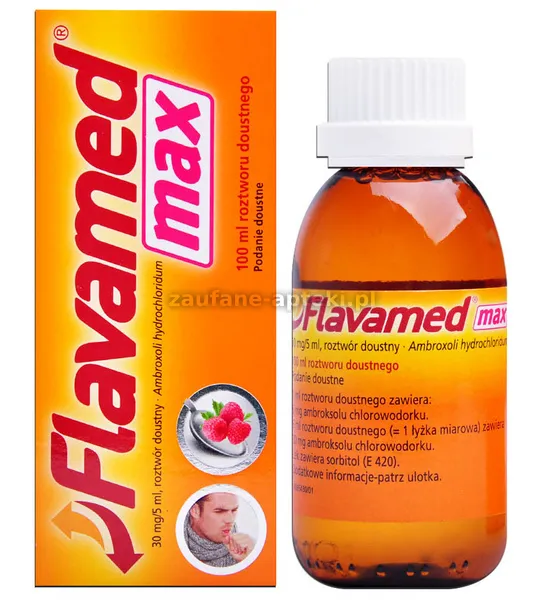
Table of Contents
Patient Information Leaflet
Flavamed max, 30 mg/5 ml, oral solution
ambroxoli hydrochloridum
Please read the entire leaflet carefully before taking this medicine, as it contains
important information for the patient.
This medicine should always be taken exactly as described in the patient leaflet or
as directed by a doctor or pharmacist.
- Keep this leaflet for future reference.
- If you need advice or further information, consult your pharmacist.
- If you experience any adverse reactions, including any possible side effects not listed in this leaflet, inform your doctor or pharmacist. See section 4.
- If there is no improvement after 4 to 5 days, or if you feel worse, consult your doctor.
Table of contents
- What Flavamed max is and what it is used for
- What you need to know before using Flavamed max
- How to take Flavamed max
- Possible side effects
- How to store Flavamed max
- Contents of the pack and other information
1. What Flavamed max is and what it is used for
Flavamed max contains the active substance ambroxol hydrochloride and belongs to the therapeutic group of cough and cold remedies, specifically mucolytics. Ambroxol hydrochloride is used in the treatment of productive cough associated with respiratory tract and bronchial diseases.
Flavamed max is indicated for use in children from 2 years of age, adolescents, and adults.
Flavamed max helps make thick mucus more fluid and easier to cough up.
If there is no improvement after 4 to 5 days, or if you feel worse, consult your doctor.
2. Information before using Flavamed max
When not to use Flavamed max
- if the patient is allergic to ambroxol hydrochloride or any of the other ingredients of this medicine (listed in section 6). Flavamed max must not be used in children under 2 years of age.
Warnings and precautions
Before starting treatment with Flavamed max, consult a doctor or pharmacist:
- if the patient has previously experienced severe skin hypersensitivity reactions (Stevens-Johnson syndrome, Lyell's syndrome).
- Stevens-Johnson syndrome is a disease characterized by high fever and a blistering rash on the skin and mucous membranes.
- life-threatening Lyell's syndrome is also known as toxic epidermal necrolysis. Symptoms of this syndrome include severe skin lesions with blistering, similar to those seen in burns.
Cases of serious skin reactions associated with ambroxol use have been reported. If a rash occurs (including lesions on mucous membranes, e.g. in the mouth, throat, nose, eyes, genital organs), treatment with Flavamed max must be discontinued immediately and medical advice must be sought.
- if the patient has renal impairment or severe liver disease. In such cases, special caution is required when using Flavamed max (i.e. extend the intervals between doses or use a lower dose – consult a doctor). In severe renal impairment, accumulation (build-up) of metabolites of the active substance in Flavamed max may occur.
- if the patient has a rare condition affecting the bronchial tubes, associated with increased mucus production (e.g. immotile cilia syndrome). In such cases, mucus cannot be cleared from the lungs. Flavamed max should be used only under medical supervision.
- if the patient has a history of peptic ulcer disease of the stomach and/or duodenum, medical advice should be sought regarding the use of Flavamed max, as mucolytic agents may damage the gastric mucosa. Consult a doctor before using Flavamed max.
Flavamed max and other medicines
Inform your doctor or pharmacist about any medicines currently taken or recently used, as well as any medicines planned for future use.
Cough suppressants (antitussive medicines)
While taking Flavamed max, do not use any medicines that suppress the cough reflex (so-called antitussives). The cough reflex is important because it enables expectoration of liquefied mucus and thus its removal from the lungs.
Pregnancy, breastfeeding and fertility
If the patient is pregnant or breastfeeding, suspects she may be pregnant, or is planning to become pregnant, she should consult a doctor or pharmacist before using this medicine.
Flavamed max should be used during pregnancy and breastfeeding only if clearly recommended by a doctor.
In particular, the use of Flavamed max is not recommended during the first trimester of pregnancy.
It has been observed that the active substance in Flavamed max passes into breast milk.
The use of Flavamed max is not recommended during breastfeeding.
Animal studies have not shown any harmful effects of ambroxol on fertility.
Driving and operating machinery
There is no evidence of an effect of the medicine on the ability to drive or operate machinery.
No studies have been conducted on the effect of the medicine on the ability to drive or operate machinery.
Flavamed max contains sorbitol and benzoic acid
The medicinal product contains 1.75 g of sorbitol in one 5 ml measuring spoonful of oral solution. Sorbitol is a source of fructose. If the patient (or his/her child) has previously been diagnosed with intolerance to certain sugars or hereditary fructose intolerance, a rare genetic disorder in which the body cannot metabolize fructose, the patient should consult a doctor before taking the medicine or giving it to a child.
Sorbitol may cause gastrointestinal discomfort and may have a mild laxative effect.
The medicine contains 5.75 mg of benzoic acid in one 5 ml measuring spoonful of oral solution.
3. How to use Flavamed max
This medicine should always be used exactly as described in this patient information leaflet or as directed by your doctor or pharmacist. If in doubt, consult your doctor or pharmacist.
The following information applies if your doctor has not advised otherwise. Always follow the instructions for using the medicine, as Flavamed max may not work properly if not used correctly!
Recommended dosage:
Children aged 2 to 5 years:
¼ measuring spoon, i.e. 1.25 ml of oral solution, 3 times daily (corresponding to 22.5 mg of ambroxol hydrochloride per day administered in three doses of 7.5 mg each).
Children aged 6 to 12 years:
½ measuring spoon, i.e. 2.5 ml of oral solution, 2 to 3 times daily (corresponding to 30–45 mg of ambroxol hydrochloride per day administered in two to three doses of 15 mg each).
Adolescents over 12 years of age and adults:
1 measuring spoon, i.e. 5 ml of oral solution, 3 times daily for the first 2 to 3 days (corresponding to 90 mg of ambroxol hydrochloride per day administered in three doses of 30 mg each),
then 1 measuring spoon, i.e. 5 ml of oral solution, 2 times daily (corresponding to 60 mg of ambroxol hydrochloride per day administered in two doses of 30 mg each).
Note:
If necessary, in adults the dose may be increased to 2 measuring spoons (each 5 ml) of oral solution twice daily to achieve a better effect (corresponding to 120 mg of ambroxol hydrochloride per day administered in two doses of 60 mg each).
Method of administration
For oral use. Flavamed max should preferably be taken after meals, using the measuring spoon provided.
Duration of treatment
Do not use Flavamed max for longer than 4 to 5 days without consulting a doctor.
If symptoms do not improve or worsen after 4 to 5 days, consult your doctor immediately!
If you feel that the effect of Flavamed max is too strong or too weak, consult your doctor or pharmacist.
Taking more Flavamed max than recommended
Based on cases of accidental overdose and (or) reports of improper use, symptoms observed were consistent with the known adverse effects of Flavamed max when used at recommended doses.
In case of overdose, contact your doctor, who will initiate appropriate treatment depending on the symptoms present.
Missed dose of Flavamed max
If you miss a dose or take too small a dose, take the next prescribed dose at the usual time.
Do not take a double dose to make up for a missed dose.
If you have any further doubts about using this medicine, consult your doctor or pharmacist.
4. Possible adverse reactions
Like all medicines, this medicine can cause adverse reactions, although not everyone will experience them.
Adverse reactions
Common (may affect up to 1 in 10 patients):
- Nausea
- Altered taste
- Numbness sensation in the mouth and throat (hypoesthesia)
Uncommon (may affect up to 1 in 100 patients):
- Vomiting
- Dryness of the oral mucosa
- Diarrhea
- Indigestion
- Abdominal pain
- Fever
Rare (may affect up to 1 in 1000 patients):
- Hypersensitivity reactions
- Rash, urticaria
Frequency not known (frequency cannot be estimated from the available data):
- Anaphylactic reactions, including anaphylactic shock, angioedema (rapid swelling of the skin, subcutaneous tissue, mucous membrane or submucosal tissue), and itching
- Severe skin adverse reactions (including erythema multiforme, Stevens-Johnson syndrome, toxic epidermal necrolysis and acute generalized exanthematous pustulosis)
- Dry throat
Reporting of adverse reactions
If any adverse reactions occur, including any adverse reactions not listed
in this leaflet, inform your doctor, pharmacist or nurse.
Adverse reactions can be reported directly to the Department of Monitoring Adverse Drug Reactions of the Office for Registration of Medicinal Products, Medical Devices and Biocidal Products
Al. Jerozolimskie 181C
02-222 Warsaw
Tel.: + 48 22 49 21 301
Fax: + 48 22 49 21 309
Website: https://smz.ezdrowie.gov.pl
Adverse reactions can also be reported to the marketing authorization holder.
Reporting adverse reactions helps provide more information on the safety of the medicine.
5. How to store Flavamed max
Keep the medicine out of sight and reach of children.
Do not use this medicine after the expiry date stated on the label of the bottle and the cardboard
pack following the abbreviation "EXP". The expiry date refers to the last day of the stated month.
No special storage conditions are required for this medicine.
Storage period after first opening of the bottle
Storage period after first opening of the bottle: 6 months.
Medicines must not be disposed of via wastewater or household waste. Ask your pharmacist how
to dispose of medicines no longer required. These measures will help protect the environment.
6. Contents of the package and other information
What Flavamed max contains
The active substance is ambroxol hydrochloride. 1 ml of oral solution contains 6 mg of ambroxol hydrochloride.
Each measuring spoonful, i.e. 5 ml of oral solution, contains 30 mg of ambroxol hydrochloride.
The other ingredients are: sorbitol liquid non-crystallizing (E 420) (Ph.Eur), benzoic acid (E 210), glycerol (85%) (E 422), hydroxyethylcellulose, raspberry flavour (containing valerian oil, ethyl acetate, ethyl butyrate, p-hydroxyphenylbutanone, alpha-ionone, beta-ionone, isoamyl acetate, isoamyl butyrate, rose oil and propylene glycol 1,2 (E 1520)), purified water.
What Flavamed max looks like and contents of the pack
A clear, colourless to pale yellow solution.
Flavamed max is available in an amber glass type III bottle containing 100 ml of oral solution, with a PP screw cap and a PP measuring spoon graduated at 1.25 ml, 2.5 ml and 5 ml.
Marketing Authorisation Holder and Manufacturer
Marketing Authorisation Holder
BERLIN-CHEMIE AG
Glienicker Weg 125
12489 Berlin
Germany
Manufacturer
Berlin-Chemie AG
Glienicker Weg 125
12489 Berlin
Germany
For further information about this medicinal product, please contact the local representative of the Marketing Authorisation Holder:
Berlin-Chemie/Menarini Polska Sp. z o.o.
Tel.: + 48 22 566 21 00
Fax: + 48 22 566 21 01
This medicinal product is authorised in the European Economic Area countries under the following names:
Bulgaria Flavamed forte
Estonia Flavamed forte
Finland Flavamed 6 mg/ml oral solution
Germany Flavamed Hustensaft 30 mg/5 ml Lösung zum Einnehmen
Latvia Flavamed 30 mg/5 ml šķīdums iekšķīgai lietošanai
Lithuania Flavamed 30 mg/5 ml geriamasis tirpalas
Poland Flavamed max
Slovakia Flavamed forte perorálny roztok
Slovenia Ambroksolijev klorid Berlin-Chemie 6 mg/ml peroralna raztopina